Dingdong Maicai's Liang Changlin: We Oppose Gimmicks and Tricks, We Do the Hard and Unsexy Things | Gaorong Ventures Share

Dingdong Maicai's Four Non-Consensus Beliefs: Retention Is King, Efficiency Is Life, Exponential Thinking, and the Seed Theory.
The fresh grocery sector is, without question, a mountain high enough to matter—but brutally hard to climb.
On the demand side, traditional supply channels led by wet markets can no longer satisfy new consumer cohorts; young people in first-tier cities today would rather trade money for convenience. On the supply side, the traditional fresh grocery supply chain still has too many inefficient links, and is undergoing profound transformation driven by technology and supply chain upgrades.
In 2018, Gaorong Ventures invested in Dingdong Maicai across three consecutive rounds, serving as the sole investor in the first two.
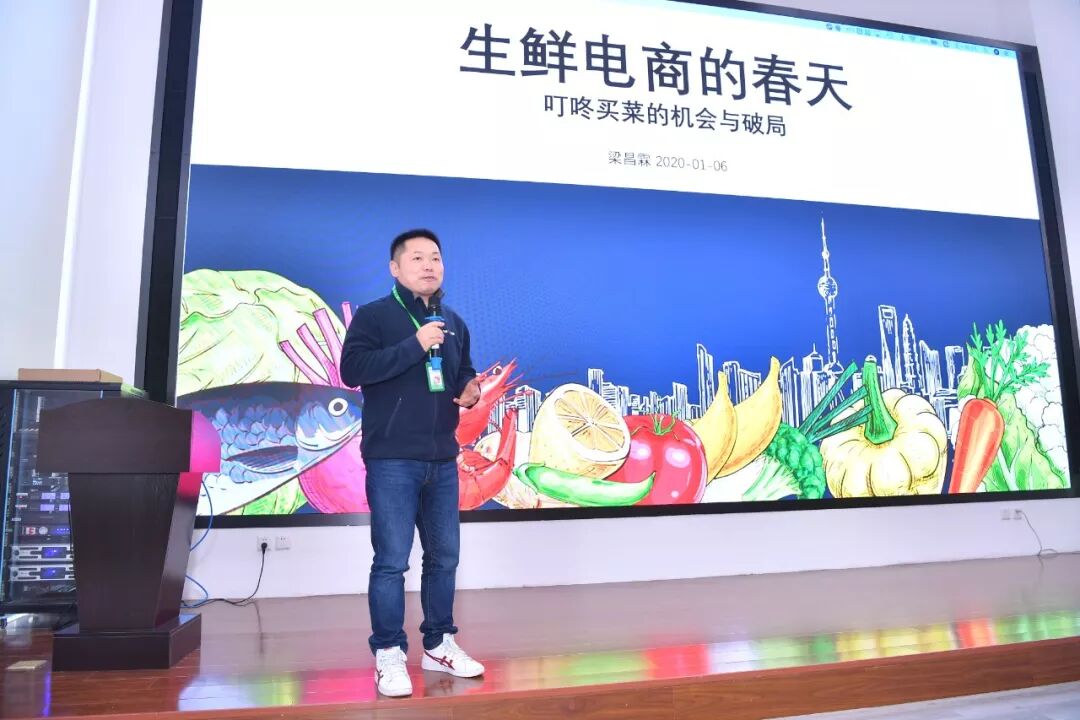
At the start of 2020, Liang Changlin, founder and CEO of Dingdong Maicai, shared the company's latest operating metrics at a media briefing: as of December 2019, monthly revenue had reached 700 million RMB. The company had established nearly 550 front warehouses across six cities—Shanghai, Hangzhou, Ningbo, Suzhou, Wuxi, and Shenzhen—with average daily orders exceeding 500,000.
What enabled such rapid growth? Liang identified four "non-consensus" principles: "retention is king, efficiency is life, exponential thinking, and seed theory."
Below, we present Liang Changlin's thinking. His non-consensus insights and tactics, his profound sense of mission to build social infrastructure, his corporate culture that rejects gimmicks and embraces "no highlights throughout," and his strategic resolve to do the hard, unglamorous work of turning uncertainty into certainty—we believe these are the precious endogenous forces that have allowed Dingdong Maicai to grow from seed into tree.
The following is an edited transcript of Liang Changlin's remarks:
The theme of today's sharing is "The Spring of Fresh E-commerce." Today is January 6th. After the winter solstice, the sun's direct rays move northward; days grow longer than nights, and it should get warmer. But the coldest days haven't arrived yet—it will still be freezing. So even though spring is already here, what we feel is still winter. Trends are the same: we often cannot perceive them directly; they require deep thinking and judgment.
Everyone sees Dingdong Maicai's rapid growth. What's behind it? We sum it up in three points:
First, do the right thing. We believe selling groceries must genuinely create value for users—that is the right thing. Doing the right thing matters far more than doing things right.
Second, starting point doesn't matter; direction and speed matter most. Entrepreneurship is like a marathon. Falling behind by 100 meters at the start is fine; you'll pass plenty of people as you run.
Third, Only One Thing. For over two and a half years, we have been the only fresh e-commerce company focused on just one thing: front warehouses. We believe this focus, this conviction in a single path, is critically important for entrepreneurship.
Dingdong Maicai's Original Aspiration
Let me first talk about why we started Dingdong Maicai.
I'm from a rural village in Anhui. My hometown was extremely poor when I was young. Later I went to military academy, joined the army after graduation, then transferred to civilian work, and had already succeeded in business once. Once my uncle came to visit me from back home, and I took him out to eat. He enjoyed the meal, but there were two dishes he never touched—white-cut chicken and chestnut-braised chicken. My uncle said he helped raise chickens back home, "and chickens are not for eating."
There was a period when a saying circulated in China—"everyone killing each other"—which is tragic to recall. "Food is the paramount necessity of the people," yet we couldn't guarantee that people ate healthily. Eating unhealthily, unsafely—that is the sadness and shame of our generation. So I thought, if given the chance, I must through our generation's efforts ensure that our children eat healthily and safely. This is Dingdong Maicai's original aspiration.

The Opportunity in Fresh E-commerce
The spring of fresh e-commerce today stems from the arrival of two opportunities.
Opportunity 1: Chinese Agriculture Is in a Period of Massive Transformation
Fresh e-commerce appears on the surface to be consumer internet; essentially it is industrial internet, backed by a massive but extremely backward agricultural industry.
What does the agricultural industry actually look like?
Using a fish as metaphor: the fish head is planting, breeding, and production; the fish tail is sales; the middle is the long, inefficient intermediate links, including centralized procurement, agents, distributors, and various levels of wholesalers.
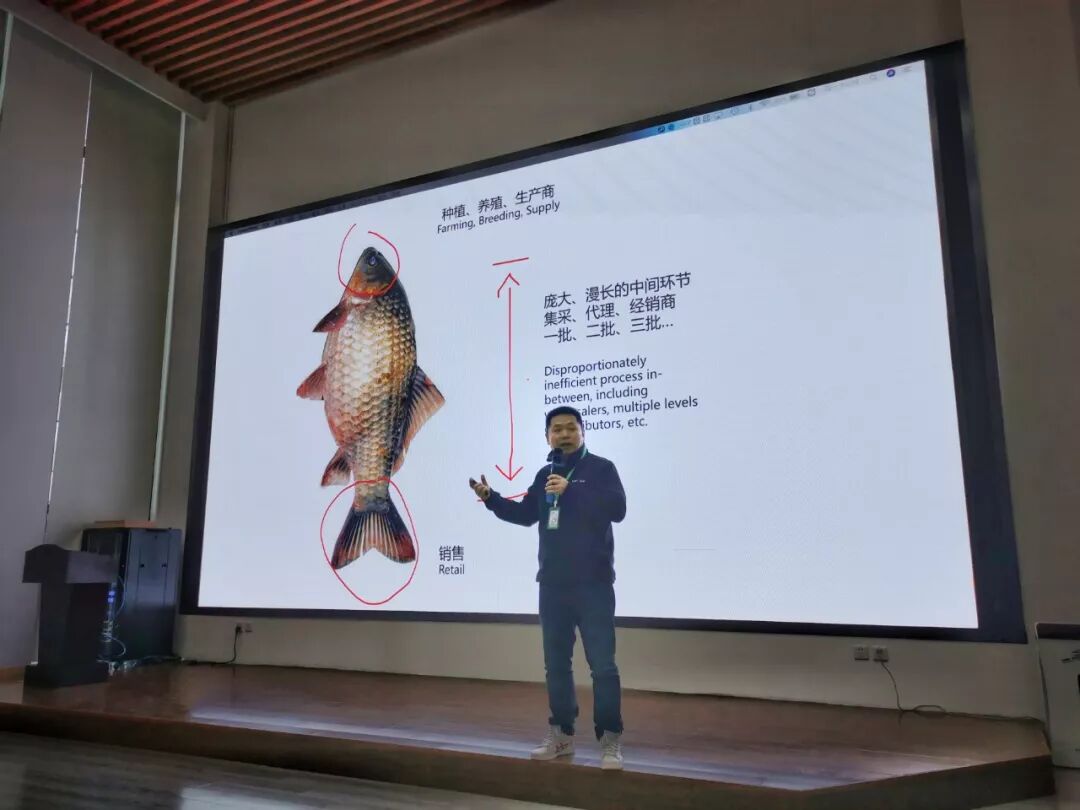
If a healthy industry forms a "smiling curve," China's traditional agriculture forms a "sad curve": both ends are small and fragmented, while the middle is bloated, cumbersome, and inefficient—a industry where bad money drives out good.
But today, Chinese agriculture is changing.
First, rural land consolidation is accelerating, and increasingly large, modern agricultural enterprises are emerging. Major well-known companies like Vanke, Lenovo, and Country Garden are all deeply cultivating agriculture. These enterprises have the capability to improve quality and technology.
Second, technology is driving retail-end upgrades. A batch of technology-driven new retail enterprises including Dingdong Maicai have grown up. As scale continuously expands, they gain stronger ability to push upstream for higher quality and service.
Third, intermediate links are being optimized; supply chains are becoming digitized, refined, and highly efficient. Previously people worried about not having fresh vegetables in winter; today vegetables from Yunnan can reach Shanghai in just 33 hours.
Any great enterprise must emerge during a transformative period of epochal change. The late 1980s saw real estate explode; the late 1990s, the internet; the late 2000s, mobile internet; and in the late 2010s and early 2020s, I believe agriculture is an exceptionally good opportunity.
Opportunity 2: The Dividend of Low Gross Margins
In China, "eating" encompasses two concepts: the "food" in "food, clothing, housing, and transportation," and the "eating" in "eating, drinking, playing, and entertainment." The former is material need—rigid demand, counter-cyclical; the latter is generally spiritual need, fast-changing, and more dependent on marketing techniques. Generally, the first "food" is a low-margin business; the second "eating" is a high-margin business.
Dingdong Maicai does the low-margin "food." Why is low margin also a dividend?
We believe low gross margin is itself a moat. Such business is more rigid in demand, more enduring, more counter-cyclical, and demands harder fundamental capabilities. As long as you do well the heavy, deep, difficult things in the supply chain, you can build barriers.
Everyone worries about what happens if giants do the same thing. In reality, if it's not difficult, startups have no opportunity. It's precisely because the thing is hard that there's opportunity to form a moat.
Of course, beyond these two opportunities, fresh e-commerce has others—such as changing demands among young people.

Dingdong Maicai's Cognition and Tactics
We deeply believe in one statement: any startup must win on non-consensus against everyone else. Having done Dingdong Maicai for over two years, we have different cognition about fresh e-commerce, and some of our own tactics.
1. Retention Is King
Everyone says traffic is king in internet, but selling groceries is different: more important than traffic is repurchase rate. People often ask, where does Dingdong Maicai's traffic come from? Actually, we basically rely on ground promotion. Users find it good, they repurchase, and word spreads.
Dingdong Maicai has a formula:

V is revenue scale; a+b+c+... is traffic; d is the growth factor dominated by repurchase rate; n is number of purchases.
Buying groceries is extremely high-frequency for users, so n is especially large.
Everyone knows the compound interest law: 1.01 to the 365th power versus 0.99 to the 365th power—how many times different? 1,453 times. Originally the traffic gap might be 100 times, but it cannot overcome a tiny gap in repurchase rate; after iteration, the resulting gap becomes enormous, enormous enough that traffic becomes negligible. This is where selling groceries differs from traditional e-commerce and internet.
Dingdong Maicai's repurchase rate approached 50% after 28 months. So though Dingdong Maicai started relatively late, with a traffic gap versus peers, and spent zero on advertising in its first two years, order volume could still lead.
How to guarantee high repurchase rate? Repurchase comes from users finding you reliable, trustworthy. Dingdong Maicai proposes "Three Certainties": certain quality, certain delivery time, certain assortment.
Previously e-commerce had three treasures: boost orders, boost basket size, run promotions; internally Dingdong Maicai calls this "don't boost orders, don't boost basket size, don't over-promote," because these affect our certainty. If today a promotion brings massive orders that we cannot service, worsening user experience—that is not what we want to do.
We often say internally—"no highlights throughout." We particularly don't care about techniques, and internally especially oppose those techniques. Very steady, very ordinary, doing certainty well every single day—this is Dingdong Maicai's characteristic.
2. Efficiency Is Life
Fresh grocery competitiveness can be abstracted as an iceberg model: above sea level is enterprise scale and revenue; the middle iceberg body is supply chain capability; the bottom is organizational capability, financial capability, data algorithm capability, agricultural technology capability. What you see is just the tip of the iceberg; what you don't see is your internal kung fu. And scale is determined by what's below sea level—it's a company's strength, and strength determines efficiency.
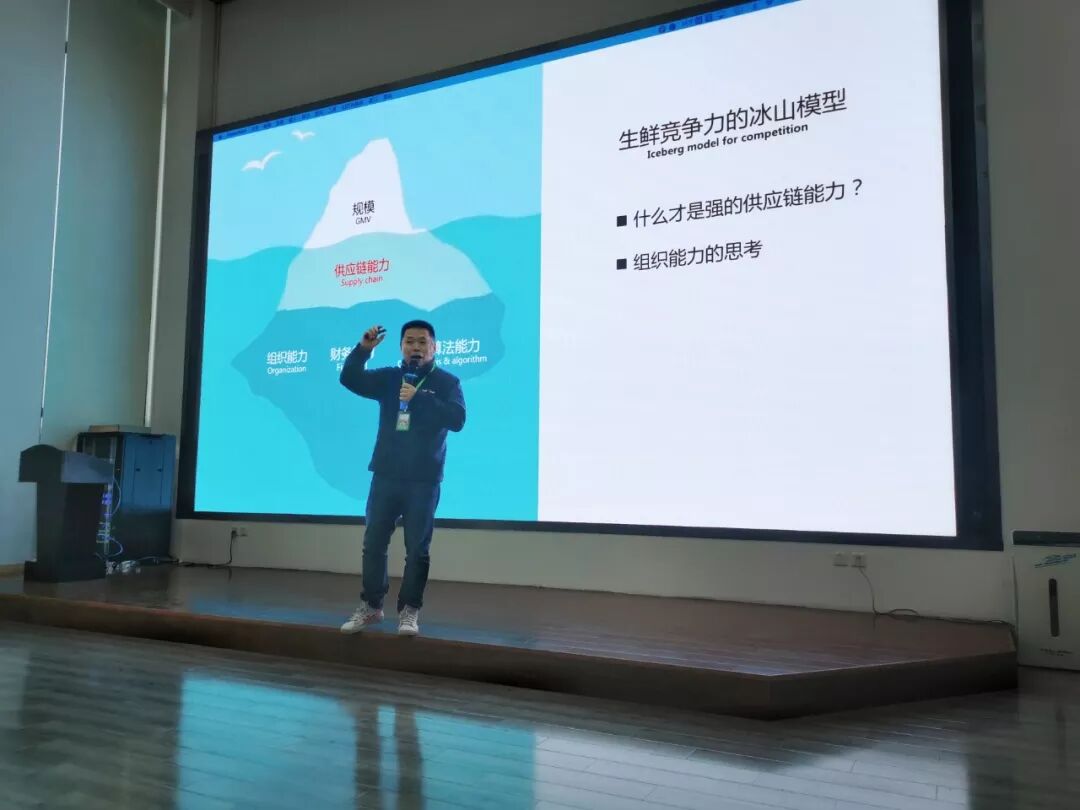
I always believe supply chain capability is key to guaranteeing our certainty.
We have a "bad review study class" where executives rotate on duty; during their week, they must read all user bad reviews daily and then drive resolution of key problems. One day I saw many bad reviews about scallions—many users said they wanted scallions but didn't receive them. At that time Dingdong Maicai's scallion base was in Yunnan; that day heavy fog closed the highway, and scallions arrived late to Shanghai. The next day we met and clarified: scallion bases cannot be only in Yunnan; when force majeure occurs, northern bases must also guarantee supply. Now Shanghai users all know a phrase: "Go Dingdong, get scallions."
So truly strong supply chain capability means turning all uncertainty into certainty. Previously people had a merchandising mindset: sell if you have it, forget it if you don't. But today we're solving a family meal scenario; you cannot be out of scallions.
I can share a recent operating metric: contrary to the popular perception that "fresh grocery gross margins are single digits," Dingdong Maicai's gross margin is 32%.
This 32% is the sum of three low-margin segments: 6% from source procurement; 8% from central warehouse processing, production, and transport; 18% from front warehouses.
This is actually redistribution of value. Previously fresh grocery had many intermediate links taking more profit; today we go to the source and deeply collaborate with origins, bypassing inefficient intermediate links in the industry, doing our own central warehouse sorting, processing, production, trunk transport, fully self-operated front warehouses and delivery. We call this approach "strategic depth."
We all know: revenue = order volume × basket size × gross margin. Every front warehouse, as time progresses, sees order volume, basket size, and gross margin all increasing—so revenue is super-linear. But as order volume grows, amortized utilities, warehouse fees, and management fees decrease; delivery staff efficiency improves; sorting efficiency improves; average cost per order declines—cost is sub-linear.
Charlie Munger said the best business is like an oil storage tank: oil stored is cubic, while surface area needing steel plate is square. Cubic grows faster than square—that's a good business model. That's Dingdong Maicai's single-warehouse logic.
In summary, we need to improve efficiency at every underlying link to achieve higher profit. Previously we said "scale brings responsibility"; today, we propose "efficiency is life."
3. Exponential Thinking
Some compare Dingdong Maicai to offline fresh grocery stores. These are completely different models, completely different logic, because they follow two different curves. Front warehouses follow an exponential curve; offline stores follow a logarithmic curve.
A mature front warehouse: 2,000 orders per day, average basket size around 60 RMB, annual revenue of over 43 million RMB. What is 43 million? In China, many five-star hotels have annual revenue of 40 million. But before reaching maturity, there is a difficult, prolonged爬坡期 [climbing period].
Running a business is like being a person: do you choose to live more comfortably each day, or choose to live harder? We particularly like doing things that fit exponential curves. And Dingdong Maicai's exponential curve stems from choosing to do hard things from the very beginning.
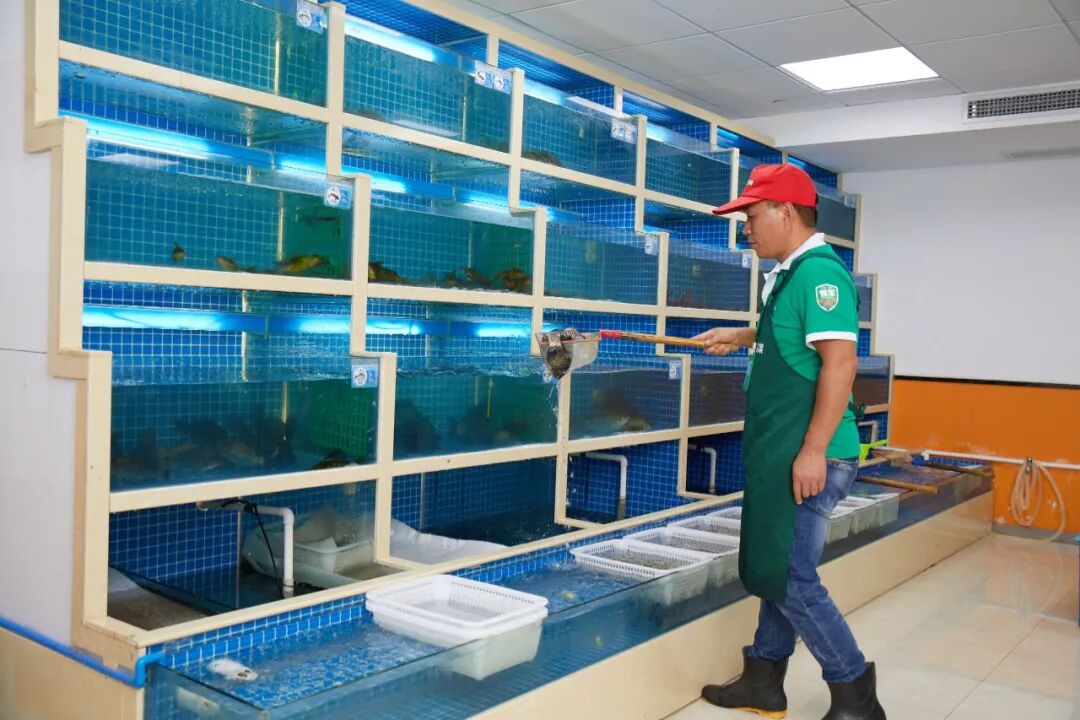
For example, when we first started selling groceries, an expert with 20 years of experience advised: don't sell fish and shrimp, survival rates are very low, losses are severe. But we refused to accept this and started doing fish and shrimp. Today users all know: in Shanghai, for live fish and live shrimp, you go to Dingdong Maicai. If you order white shrimp at 8 PM, not a single one arrives dead.
Promotion is the same. We know Dingdong Maicai's mission is delivering groceries to homes; others rely on advertising, we rely on ground promotion in residential compounds. Last October 1st, everyone was watching the military parade; Shanghai had a typhoon day. A friend said your Dingdong guys are incredible—knocking on doors doing promotion.
Others often say front warehouses must raise basket size very high to make money. We believe this thinking is wrong. Because basket size is determined by customer need; a family spending 50–60 RMB per day on meals is reasonable basket size. Raising it very high, with much food unused and rotting in the fridge after a few days—that's not what we want to do. Then how to make money? The core is still improving efficiency.
In 2019, after becoming number one in Shanghai, we began expanding to other cities. Once we achieve scale in a city, we must penetrate it thoroughly and generate more order volume.
Often, others do easy things; we choose to do hard things, dumb things. Hard things may be exponential growth things. Give us time, and we are friends of time.
4. Seed Theory
We are firm believers in seed theory. What is seed theory? I remember an elementary school Chinese text—"The Power of Seeds."
Below are two images: on the left is the Growth Heavenly King among the Four Heavenly Kings, currently the hottest deity in temples—everyone in internet worships him; the other image is the Guest-Greeting Pine of Huangshan.
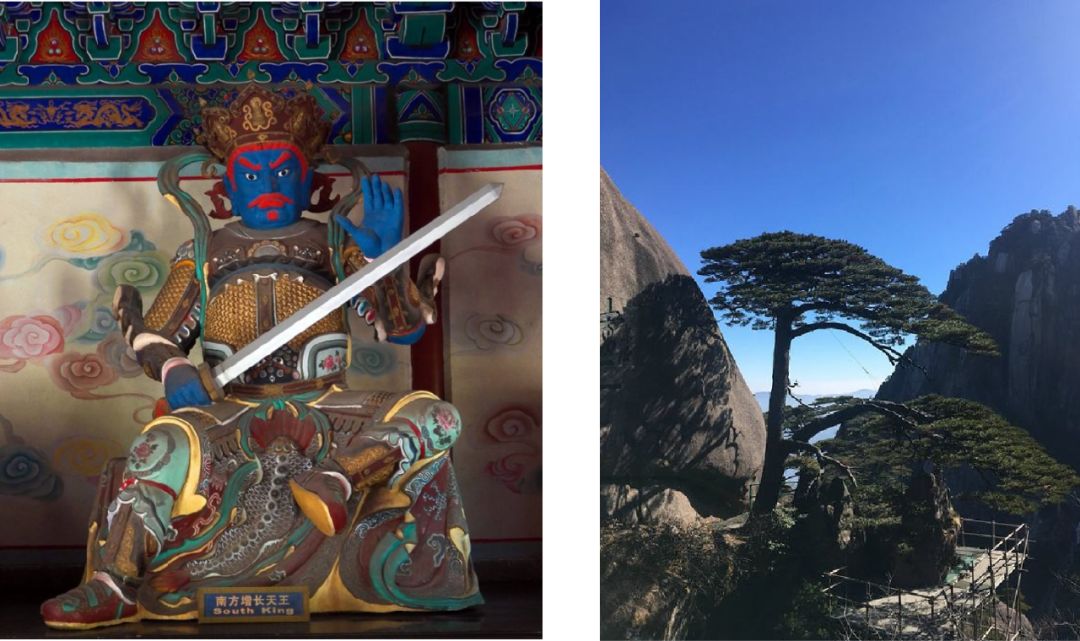
Many years ago a little bird carried a seed; the seed fell on a cliff precipice, and it grew. While growing, it didn't know whether it would face sunshine and rain or violent storms, but it grew tenaciously. In this world, what has greater power than the vajra is actually the inconspicuous power of seeds.
We've summarized five characteristics of seed power: small seed, big future; seed growth comes from endogenous force; seeds can withstand storms and blows; natural growth; one is everything.
Seed theory guides Dingdong Maicai's development.
First, we focus on endogenous force. In 2019 we brought in some executives from large companies; some said let me set up an org chart, hire some people. I said don't rush—first bring one or two people, accomplish things, then slowly expand outward. Many entrepreneurs say we want to play a big game of chess; we prefer more like running, expanding bit by bit outward.
Second, whether you are a flower or a tree is already determined when you are a seed. Flowers grow fast, bloom beautifully, have fragrance—everyone chases after them, but they wither annually; trees may initially grow even slower than grass, but they keep growing, eventually becoming towering trees. Often people see the charm of flowers but cannot see the future of trees. Internally when we judge many things, we also look at whether something is a flower or a tree—can it horizontally cover more regions, can it vertically grow year after year? If not, this is a flower, and we won't do it.
Because of seed thinking, starting from 2020, the word our company emphasizes is not growth but growth-as-in-growing. In goal-setting, this year we don't look at order volume targets, revenue targets, but "user repurchase rate." In 2020, average monthly orders per user above 6.5 times—this is our target. We believe if repurchase is done well, order volume and revenue are results that follow naturally.

Dingdong Maicai's Mission
In 2019, many fresh e-commerce models emerged, many formats—such as online-order in-store-pickup, new wet markets, etc. We call these "water-carrying models"; front warehouse format is the "tap water model"—turn the faucet, tap water arrives at home.
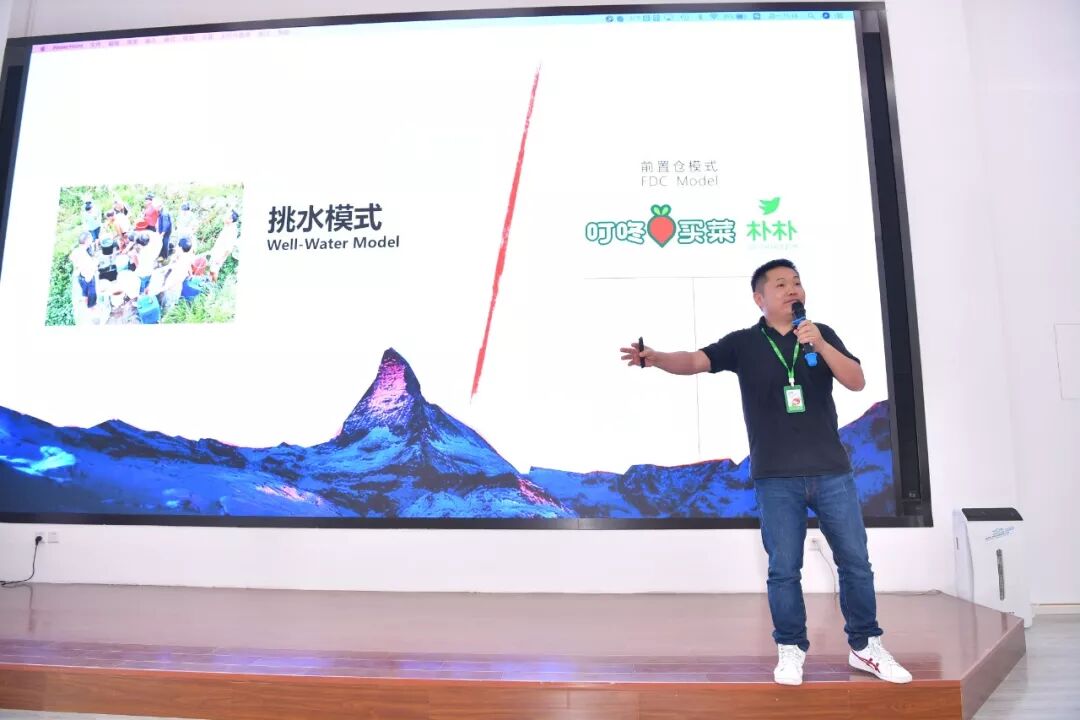
What advantages does the "tap water model" have? First, ultimate convenience—human nature inherently desires increasing convenience, not needing to spend time waiting. Second advantage: not dependent on site selection. Traditional retail is extremely dependent on offline location selection, but Dingdong Maicai's front warehouse model cracks this problem. Third advantage: can cover entire cities.
Last year, our understanding of the "tap water model" upgraded further. Last winter, I went with our VP of procurement and others to Yunnan and Guizhou for poverty alleviation. In Dali there is Wuliang Mountain; halfway up the mountain you occasionally see single farm households. Yet these households too had electricity, had modern tap water—I found this deeply moving. Tap water is universal benefit. Whether you are wealthy or ordinary, you can enjoy tap water. "Food" is the same—not demand for a specific group, but demand for all humanity.
So we thought, Dingdong Maicai's "tap water philosophy" must upgrade to 2.0—making wonderful ingredients as accessible as tap water, within reach, benefiting all.
Some ask: your business model is front warehouses; will there be changes in the future? Actually, "mission is the business model"—when we positioned tap water philosophy as our mission, our business model was already determined.
First, tap water is colorless, tasteless, not stimulating, not expensive, but it is the source of life. We similarly won't do expensive things, won't emphasize various gimmicks, won't emphasize marketing techniques—we do infrastructure. Second, tap water must satisfy more people's needs, must benefit all. We are not guarding some particular model; going forward anything is possible—achieving the goal and mission is what matters most.