Equipping Autonomous Driving, Robotics, and Virtual Entertainment with Brains... How Intelligent Agents Are Reshaping the Future | Ronghui

Five Tech Leaders Discuss: How AI Agents Cross from Virtual to Physical to Bring Greater Benefits to Humanity
On June 21, at the 2020 Beijing BAAI Conference — Qiyuan StarCraft AI Top Pro Player Challenge — Qiyuan World's self-developed intelligent agent "StarCraft Commander" defeated StarCraft I/II national champion Huang Huiming (TooDming) and three-time Gold Series champion Li Peinan (Time) with two 2:0 victories.
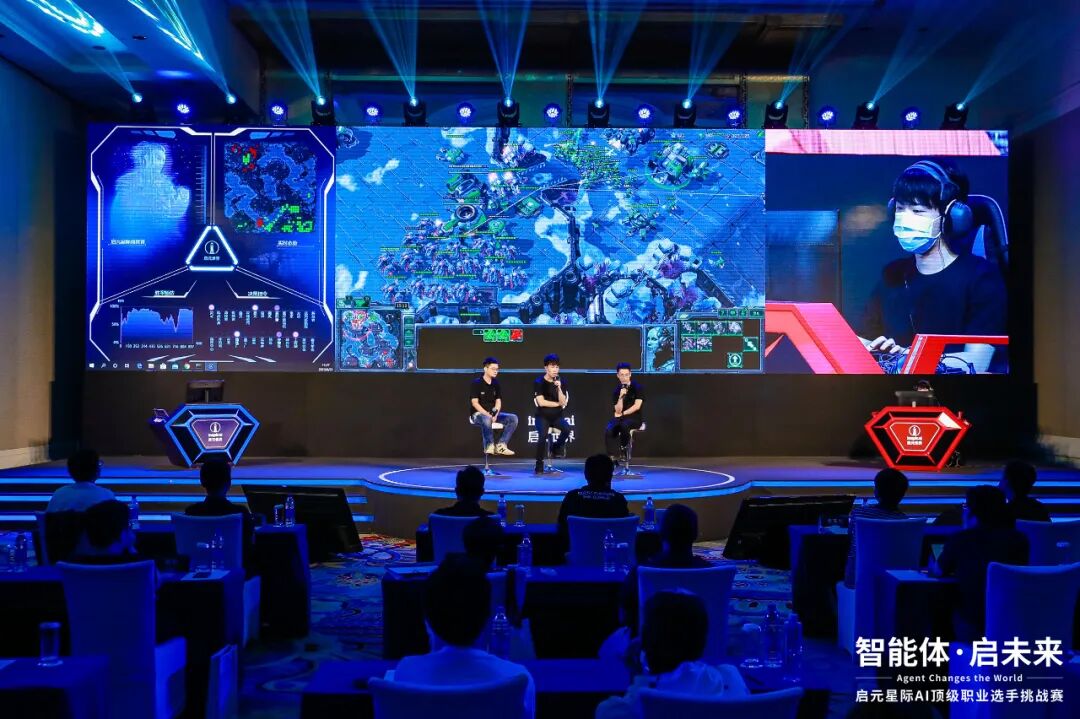
This marked the first time a Chinese StarCraft AI defeated top domestic professional players in a public match. It also gave people a full view of the powerful decision-making intelligence that intelligent agents can demonstrate on complex problems like long-term strategic planning, imperfect-information games, and ultra-large action spaces.
An intelligent agent is an entity with self-learning and autonomous decision-making capabilities, manifesting as either a digital human or a robot.
After "StarCraft Commander" reached the level of top human professional players, the industry grew more eager to see intelligent agents migrate from virtual to real, landing in practical applications across industries — moving from "Westworld" into every sector.
What commercial applications do intelligent agents already have? How will they change our lives in the next 5-10 years? At what speed will they evolve and continuously inspire us to explore unknown territories?
In the industry discussion following the tournament, Huang Tiejun, Director of Beijing Institute for General Artificial Intelligence and professor at Peking University; Yuan Quan, CEO of Qiyuan World; Yue Bin, founding partner of Gaorong Ventures; Zhang Wensong, Senior Vice President at DiDi; and Yan Qiang, Senior Vice President at Kuaishou, jointly explored the present and future of intelligent agents in real industries and virtual worlds.

Gaorong Ventures, as a special supporting partner, is sharing this technology-imaginative dialogue transcript. Below is an edited transcript:
The Boundless Frontier of Decision Intelligence and Real-World Applications
Intelligent Science Is a Boundless Frontier
Q: In its matches against top human professional players, Qiyuan's "StarCraft Commander" exceeded everyone's expectations, demonstrating world-class algorithm originality and engineering capability using only 1% of the computing power of top tech companies. How do you view the prospects for intelligent technology development?
Huang Tiejun: People in natural sciences often say that brain science is the last frontier of natural science, that the human brain is the most difficult unknown territory to crack.
Beyond that, intelligent science is a boundless frontier. Human intelligence is the product of hundreds of millions of years of evolution. Machine intelligence has only evolved for about a hundred years, but its evolutionary speed is very fast. We have no reason to believe machine intelligence won't surpass human intelligence, because human intelligence itself was trained through repeated exposure to natural environments.
Today, Qiyuan's "StarCraft Commander" has already developed strong intelligence through training in a complex environment like the StarCraft game. In increasingly complex training environments in the future, machine intelligence will certainly reach higher and higher levels. How complex? The universe itself is a complex physical environment. Will exploration of the universe be completed by slowly evolving humans, or by rapidly evolving machines? This is a major question worth considering.
In summary, we are already on the right path today. Using behaviorist methods to train a complex neural network will definitely produce increasingly strong intelligence. Today's match was won by "StarCraft Commander." In other application domains in the future, AI will similarly surpass humans. Reinforcement learning will play an increasingly strong role in open environments and will certainly play a role across broad domains — this is the inevitable result of AI development.
General AI Technology Will Develop Exponentially
Q: In what actual scenarios have intelligent agents already been applied? How will AI technology develop in the future?
Yuan Quan: Looking back four years, AlphaGo's victory over Ke Jie gave us tremendous shock. A new generation of intelligent agents with self-learning and autonomous decision-making capabilities officially stepped onto the historical stage. In our view, this may have been the inflection point for AI technology, and it also made us think about what matters most in the next era.
Three years ago, Qiyuan World began researching intelligent agents using StarCraft as its research environment. Today, the 24-year-old StarCraft game, together with young professional StarCraft players and the 3-year-old "StarCraft Commander," brought everyone an exciting match. We also hope to bring the intelligent agent born from StarCraft to every industry, every household, and every individual, becoming a new generation of intelligent living infrastructure.
Today, Qiyuan World's intelligent agents have already "transformed" across various industries, becoming traffic dispatchers, financial advisors, and service robots, diving into industrial endpoints to solve dynamic decision-making problems in complex environments involving games, optimization, and control. They can also become virtual players and virtual characters that learn and imitate human behavior, creating personalized, immersive entertainment experiences.
I believe that in the coming years, general AI technology represented by deep reinforcement learning will continue to grow exponentially.
Decision Intelligence Technology Crossing From Virtual to Reality, Unlocking More Business Scenarios
Q: Technological progress can unlock more business scenarios. What business scenarios will intelligent agent technology unlock?
Yue Bin: In 2014, we believed investment in new technology directions should go all-in on AI. At that time, we were mostly investing in machine vision companies. In 2016, AlphaGo's emergence completely opened our way of thinking — we saw a completely different world.
Today, decision intelligence technology has already achieved extensive applications in the virtual world, some happening without our noticing. For example, when we use search engines, the results have very likely already been ranked through decision intelligence. Decision intelligence technology has also been extensively applied in e-commerce — many product recommendations are based on our preferences. In Google's data centers, related technologies are used to regulate temperature and achieve energy-efficient operation.
Today, top Go players from China, South Korea, and other countries are all using Go AI for training. Many gamers also enjoy playing against AI in games, finding AI at suitable difficulty levels to improve their skills.
After decision intelligence technology has been widely applied in the virtual world, our greatest hope for the future is how it can cross from virtual to reality. For example, continuous application in dispatch platforms for mobility; a recent major breakthrough in the medical field is protein folding prediction; if it can be applied to autonomous driving, future mobility will undergo tremendous change.
As related technologies surpass humans in more decision-making scenarios in the future, I believe they will bring more benefits to humanity.
Decision Intelligence Technology Is Being Applied in Complex Prediction Scenarios in Mobility
Q: In intelligent transportation planning, what value can decision intelligence technology generate?
Zhang Wensong: Everyone has taken ride-hailing services. DiDi's dispatching is an intelligent decision-making process. In the past, the simplest algorithm was to dispatch the nearest car, but such an algorithm isn't optimal. For example, a car might be 2 kilometers from a passenger, but 1 millisecond later, another passenger suddenly appears only 100 meters from that car — clearly dispatching to the passenger 2 kilometers away isn't the optimal decision. So we must make predictions about the future; it's a complex decision-making process. Therefore, we use AI technology, big data, and cloud computing for decision-making, continuously improving passenger safety, experience, and efficiency.
Today, DiDi's decision intelligence technology is already being practiced in many prediction scenarios, such as spatiotemporal prediction of distance and pickup time, prediction of road conditions and route planning, supply-demand prediction, and so on.
Highly Human-like Intelligent Agents Will Profoundly Change the Digital Entertainment Industry
Q: In digital entertainment scenarios, what innovative experiences can intelligent agents bring to users in the future?
Yan Qiang: I saw version 1.0 of "StarCraft Commander." Today's match results showed me it has grown from a "child" to an "adult" — I was very surprised and moved.
At its core, Kuaishou works on understanding content and matching people with content. For the content and digital entertainment industries, there is much we can explore using intelligent technology. For example, virtual robots, virtual companions, and virtual players can bring people experiences they've never had before.
There's another particularly important direction. People are spending more and more time immersed in digital worlds. If humans can achieve self-growth through interaction with machines in digital world interactions, this would be a very great endeavor.
I very much look forward to "StarCraft Commander" becoming a graceful young man, becoming a booster that helps industries and the future digital world develop better.

How Intelligent Agents Will Change Our Lives in 5 Years
Q: How will intelligent agents change our lives in the next 5 years? Can you share a scene from your imagination?
Digital World Brain Intelligence Will Be Increasingly Replaced by Intelligent Agents
Huang Tiejun: In my view, what will inevitably happen in 5 years is this — the physical world will become increasingly digital, network connectivity will grow stronger, and the speed of information exchange will increase.
Behind this, decision intelligence in the digital world will certainly increase, to the point where the vast majority of scenarios will be taken over by intelligent agents. Because intelligent agents are faster and more efficient, while human thinking speed is relatively slow and costly. For example, having humans do traffic light scheduling or autonomous driving dispatch is less cost-effective than using intelligent agents. Digital world brain intelligence will increasingly be replaced by intelligent agents.
My advice to everyone is to be mentally prepared. We have already entered the fast lane, and AI's influence will only grow.
The One Piloting a Spaceship to Take Us to Mars in Our Lifetime Should Be AI
Yuan Quan: In the future, we should be able to better parse and understand intelligent agents. Today, intelligent agents are strong, but not necessarily fully parsed and understood by humans. Recently I was reading the Tao Te Ching: "The Tao that can be told is not the eternal Tao." AI is making us perceive it in its own way. Including when professional StarCraft players were battling "StarCraft Commander," they felt the AI had two brains — perhaps a cerebrum and cerebellum working together, responsible for macro strategy and micro operations respectively. At this stage, limited by our understanding of AI and technological development, this real interactive sensation cannot yet be fully explained in human-comprehensible ways.
And in the more distant future, I personally believe I can stand on Mars within my lifetime. I hope that when that time comes, the one piloting the spaceship to take us there will be AI. In the vastness of space, AI's piloting ability should be stronger and safer than humans'. Exploring and making decisions in very vast spaces and uncertain environments should be AI's capability and strength.
AI Could Become a Weapon for Humanity Against Major Health and Safety Events Like Pandemics
Yue Bin: In recent years we have made very long-term investments in the technology sector, including technologies we believe can play very important roles for humanity on time scales of at least 10 years or more. From this, we have also seen many new possibilities and scenarios.
In today's special period, the impact of COVID-19 has exceeded human capabilities, and solutions are difficult to find in a short time. So if you ask me about my expectations for AI-driven scenarios in the next 5 years, I am more hopeful about applications in healthcare and life sciences.
For example, in the ongoing CASP global competition, people are using AI technology to attempt protein structure prediction. I hope that within the next 5 years, AI can make tremendous progress in fields closely related to human life. When humanity faces major health and safety events affecting the entire species, we will have more weapons to overcome the difficulties we encounter. I believe 5 years is enough time for this opportunity.
Autonomous Driving Will Definitely Achieve Large-Scale Commercial Deployment
Zhang Wensong: If I had to choose one future scenario, my first choice would definitely be autonomous driving. In the next 5 to 10 years, autonomous driving will definitely achieve commercial deployment, and large-scale deployment at that.
With autonomous driving, the certainty of the transportation system will be higher, efficiency will be higher, and mobility will become safer. In 10 years, it's possible that all vehicles will become autonomous, with vehicles tightly connected like a small train or high-speed rail, even directly shifting to different land surfaces — transportation efficiency will be greatly improved. Traffic lights might no longer exist; people will negotiate who goes first through certain protocols.
So transportation in 10 years will be completely different from today. The transportation revolution has only just begun.
More Virtual Friends in the Digital World Will Accompany Our Growth
Yan Qiang: In the future world, everyone will have their own virtual idols and virtual friends — I believe this will happen very quickly.
For example, there are increasingly more virtual idols appearing in China, Japan, and South Korea today. These are essentially a form of intelligent agent, and in the future these intelligent agents will have more social attributes.
After the pandemic, people may find real-life friends growing more distant, and feelings of loneliness strengthening.
And machines, especially intelligent agents, can in many ways understand humans even better than people do. They will become indispensable parts of future life — possibly our friends, possibly our teachers, possibly even our opponents, accompanying us as we grow in the future world.
That is to say, in the digital world there can be many smarter virtual friends accompanying us. This is a relatively major change that will occur in entertainment and social domains.


Min Wanli Founds Cengzhuo Technology, Raises Over $20 Million in Series A Led by Gaorong Ventures