From Enterprise Services to Industrial Upgrading: One of the Most Important Directions for the Next Five Years | Ronghui

Using enterprise services as a foundation to identify breakthroughs in industrial upgrading will give rise to a large number of outstanding companies.

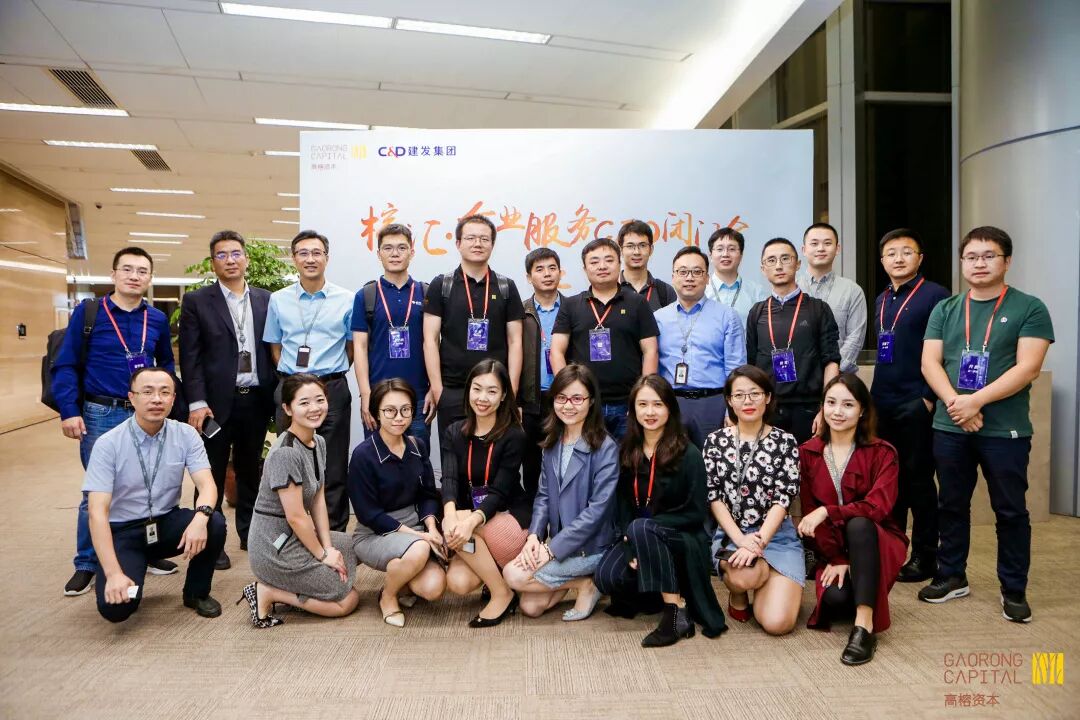
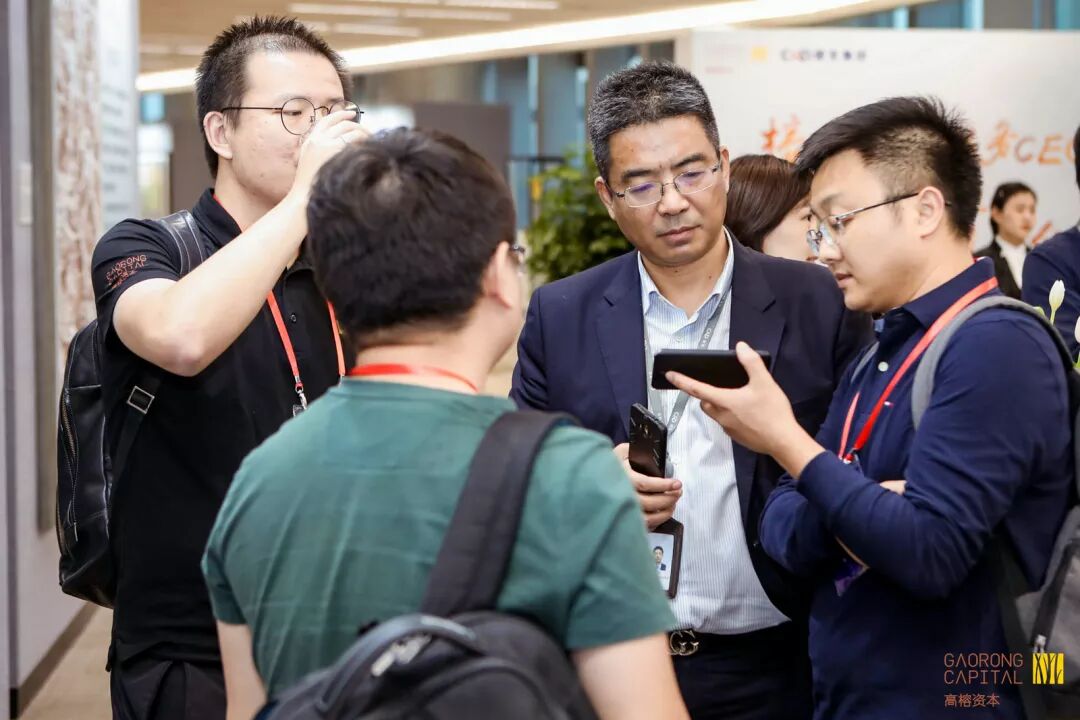
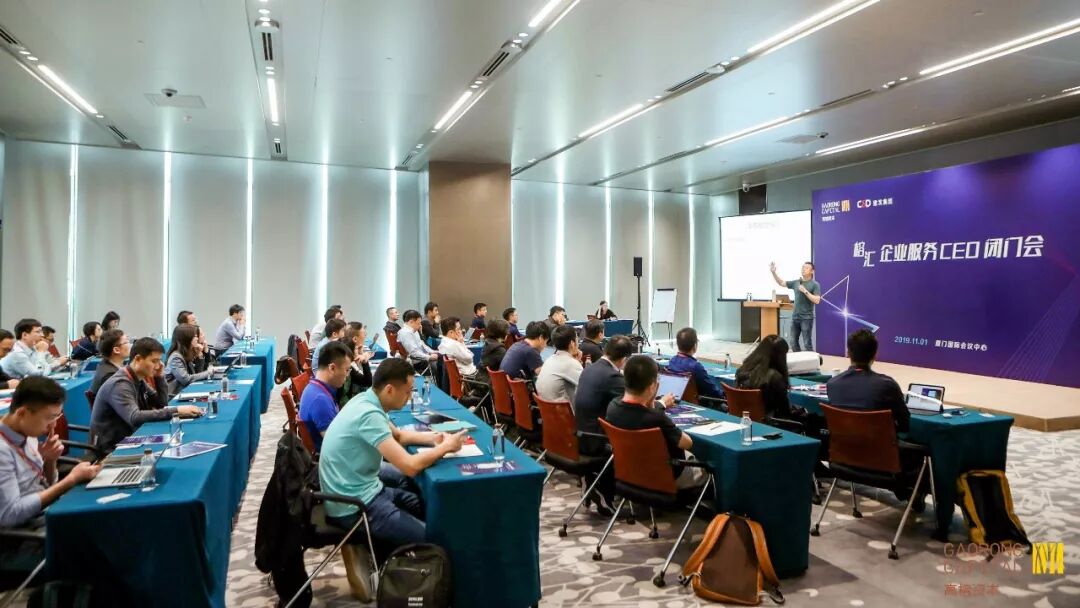
On November 1, Gaorong Ventures' innovation community "Ronghui" hosted an enterprise services CEO closed-door session at Xiamen C&D Group. Thirty CEOs from Gaorong's portfolio gathered to discuss emerging trends in enterprise services and industrial upgrading, engaging in deep dialogue around new business models, B2B sales, and product matrix strategy.
Yesterday, we shared Hillhouse operating partner and former Meituan COO Gan Jiawei's training session on B2B sales from the event ("Gan Jiawei: B2B Sales Must Return to First Principles, Don't Fall for 'Mystical Force Dependency' | Ronghui"). Today, we continue with more insights and conversations from the gathering.

Gao Xiang: From Enterprise Services to Industrial Upgrading
Gao Xiang, founding partner of Gaorong Ventures, noted that a key motivation for holding this enterprise services CEO closed-door session was observing significant shifts in the enterprise services market — shifts that are incubating enormous opportunities.
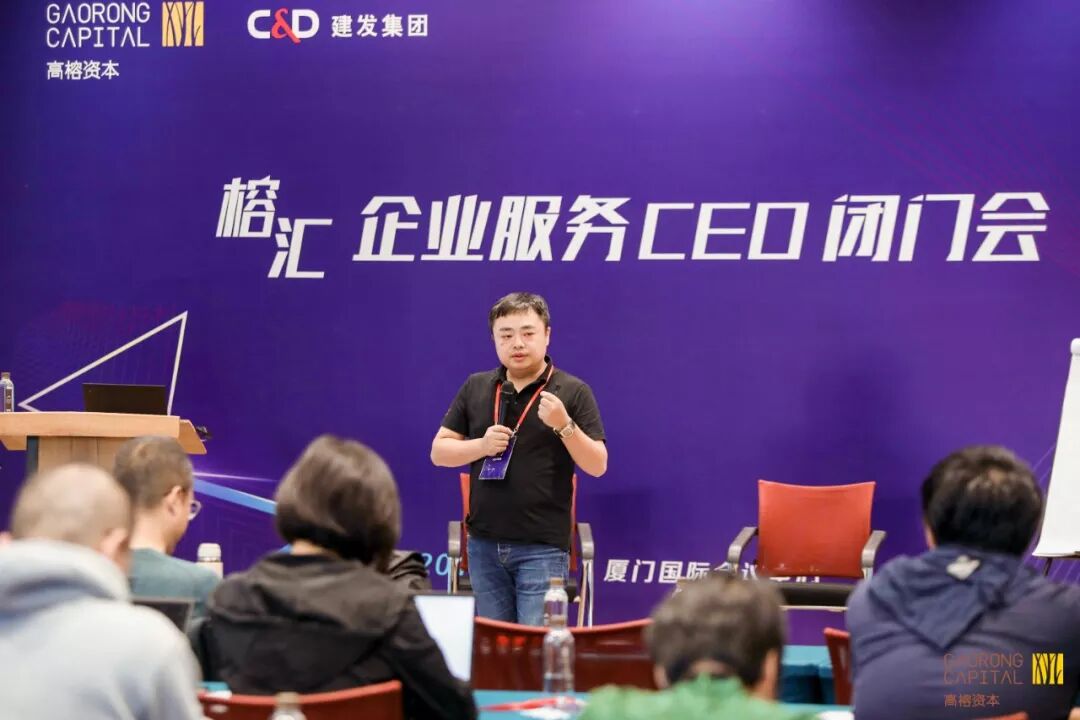
Gao Xiang, Founding Partner, Gaorong Ventures
In Gao's view, five changes in the enterprise services market merit attention.
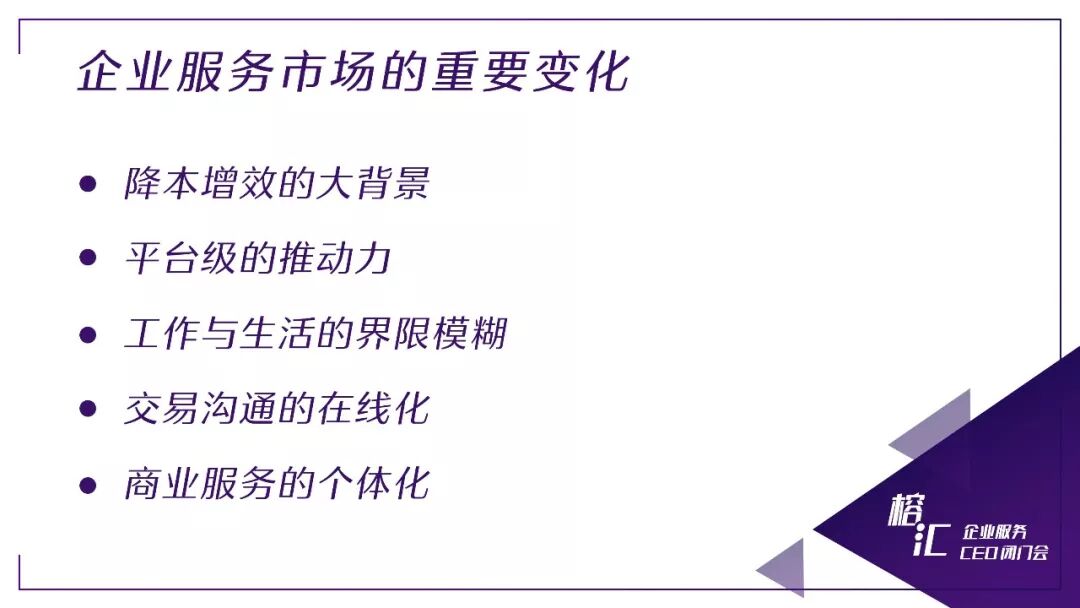
Change 1: The cost-cutting and efficiency drive. Facing internal and external pressures and challenges, businesses today are finding survival more difficult and are increasingly turning to enterprise-grade services to reduce costs and improve efficiency.
Change 2: Platform-level momentum. Platform-level forces have always been a critical driver reshaping internet industry development. Currently, cloud platforms are actively investing in infrastructure and integrating diverse services within their ecosystems, lowering the barrier for businesses to adopt enterprise services. With this platform-level push, the enterprise services market will welcome opportunities for rapid growth.
Change 3: The blurring boundary between work and life. Mobile internet has blurred the line between work and life for everyone, leading employees to use enterprise services with greater frequency.
Change 4: The digitization of transaction communication. Today, much transaction-related communication happens online, significantly increasing effective communication time and efficiency for deals, opening up entirely new opportunities.
Change 5: The individualization of commercial services. The individualization of commercial services is an important trend today. In social e-commerce, for instance, every individual has the opportunity to become a commercial service provider. These new individual commercial service providers need to use enterprise-grade services. In the US, for example, the prevalence of family doctors has given rise to companies that serve those family doctors.
Based on these changes, Gao believes enterprise services companies need to pay close attention to the following priorities.
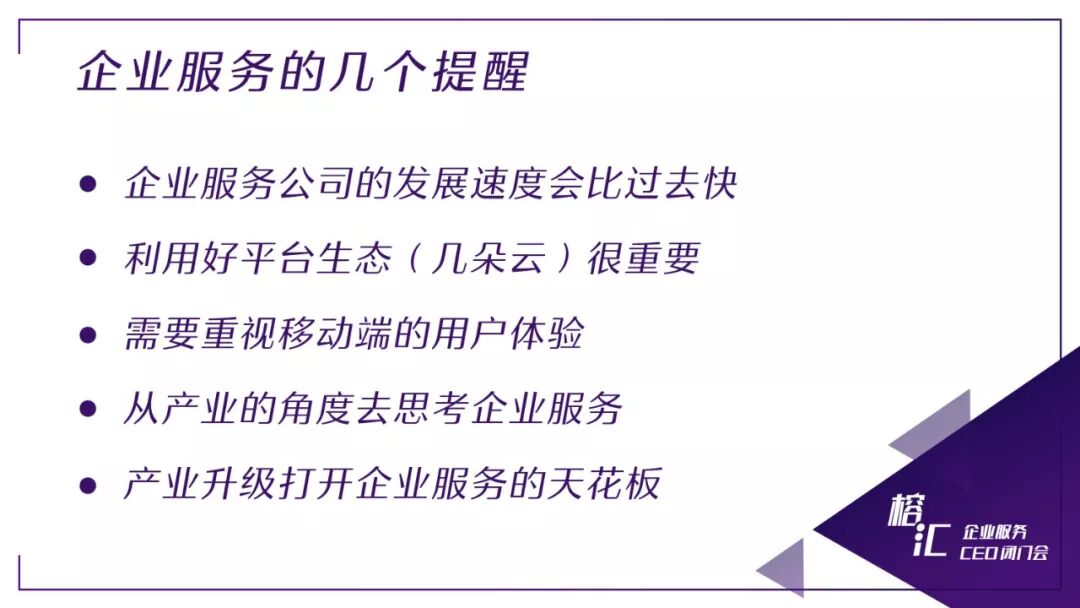
First, enterprise services companies will grow faster than in the past.
Second, leveraging platform ecosystems (the major clouds) is critical. Enterprise services companies should more proactively embrace ecosystem platforms like Alibaba Cloud and Tencent Cloud.
Third, mobile user experience demands attention. With blurred boundaries between work and life, products need to deliver excellent mobile experiences to have strong vitality. Enterprise services companies must therefore prioritize mobile user experience.
Fourth, think about enterprise services from an industry perspective. As enterprise services evolve, system integration, end-to-end informatization across supply chains, and the blurring of B2B and B2C boundaries will create new business models. In the past, many companies only provided software services, but today software services can serve as a wedge into industries. Companies should think more about enterprise services from an industry angle.
Fifth, industrial upgrading raises the ceiling for enterprise services. "Industrial internet" has attracted considerable industry attention recently. Gao prefers the term "industrial upgrading" to capture today's opportunity: just as "consumption upgrading" describes evolving consumer behavior, industries too are breaking through boundaries and upgrading. Enterprise services companies should ride this trend — first using enterprise services to open doors into industries, then identifying pain points in those industries to discover new models and growth paths.
Gao summarized: "From enterprise services to industrial upgrading — this is one of the most important directions for the next five years. Building on enterprise services as a foundation and finding breakthrough points for industrial upgrading will give rise to numerous outstanding companies. We're only just getting started."
Critical Issues in B2B: Business Model, Sales, Product
At the closed-door session, experts and Gaorong portfolio company CEOs also discussed key issues in B2B strategy around business models, sales, and product.
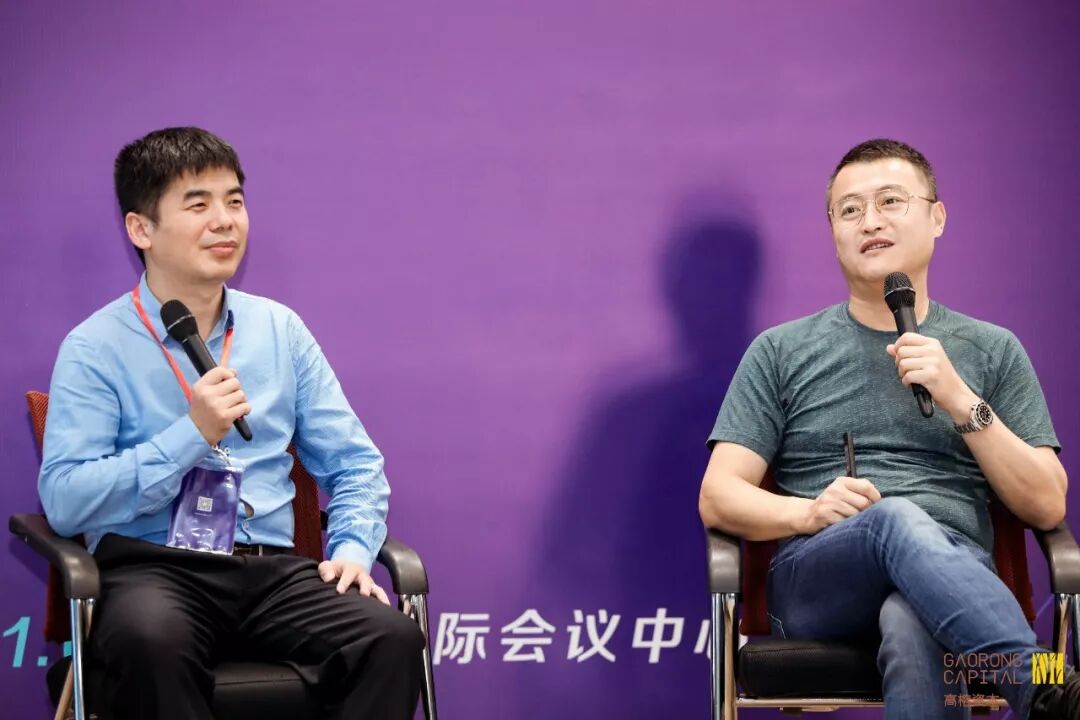
Left: Zhou Pengpeng, Founder and CEO of Vzan; Right: Gan Jiawei
In a case study breakdown, Gan Jiawei noted two characteristics of B2B businesses: multiple key decision-makers, and business that isn't the buyer's personal interest or direct benefit. B2C businesses can "plant seeds" in consumers' minds, but B2B doesn't work that way — you need salespeople to drive the process. Whether a B2B business model works depends on two things: first, whether it can genuinely deliver value to customers and meet long-term, rigid needs; second, whether it can deliver that customer value while consuming fewer resources than the social average or operating more efficiently than the social average — only then can a business survive and thrive sustainably.
Zheng Yong, founder and CEO of Geekplus, an intelligent warehouse robotics company, shared his B2B sales strategy for complex decisions and large accounts. Geekplus's system products and solutions cover various logistics application scenarios including goods storage, order picking, automated transport, and parcel sorting, serving numerous retail, logistics, and industrial manufacturing enterprises. Zheng explained that Geekplus focuses its sales strategy on key industries and global large accounts, with a future shift from "hunting" to "farming" — cultivating around key industries, continuously uncovering and nurturing new customer opportunities, and steadily improving customer satisfaction.

Zheng Yong, Founder and CEO, Geekplus
Aozhe Network is a cloud computing products and solutions provider centered on low-code development platforms. Through its three product lines — H3 BPM, Yunshu, and Chuancloud — it covers a relatively complete range of low-code scenarios including management middle platforms, business middle platforms, and scenario-specific mini-applications, with customer types spanning extra-large, large, and small-to-medium enterprises. Xu Pingjun, founder and CEO of Aozhe Network, shared the company's product matrix strategy. He emphasized that products shouldn't be differentiated for differentiation's sake — they must start from user needs and achieve precise positioning. Second, in developing multiple products, particular attention must be paid to full backend sharing.
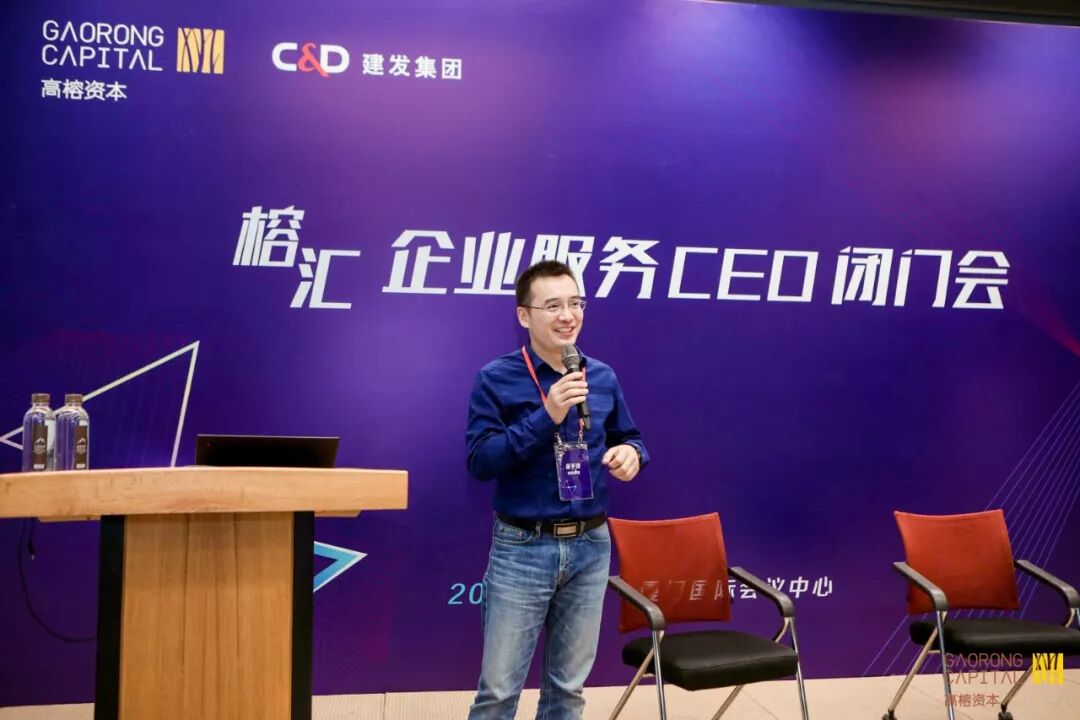
Xu Pingjun, Founder and CEO, Aozhe Network
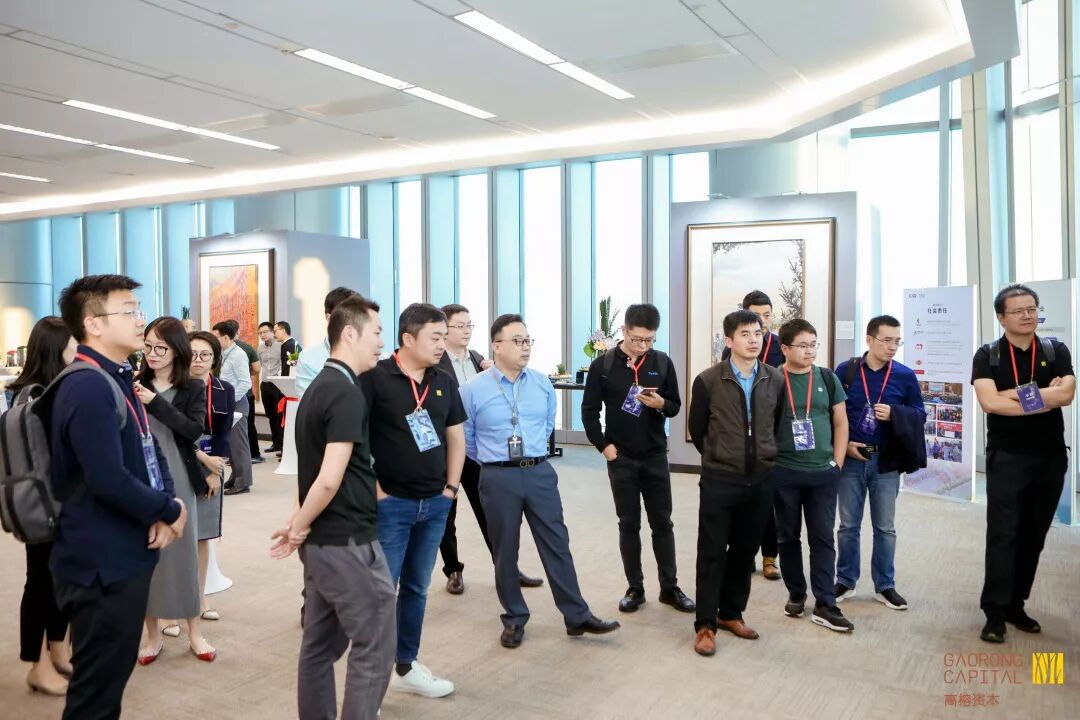
During the event, Gaorong portfolio company CEOs also visited C&D Group, where Cai Xiaofan, Investment Director of C&D Group and General Manager of C&D Emerging Investment, introduced the group's businesses. On-site, the CEOs connected with C&D's supply chain operations, real estate development, tourism and hotel business units for industrial resource matching and solution discussions.
More highlights from the event — swipe to view: