Gaorong Ventures' Xiang Gao: Finding Irreversible Trends to Withstand Market Volatility

The Logic Behind the "Irreversible" Trend
On March 29, 2019, Gaorong Ventures founding partner Xiang Gao was invited to speak at the Zero Boundary · New Economy 100 CEOs Summit, delivering a keynote titled "Identifying Irreversible Trends to Withstand Market Volatility."
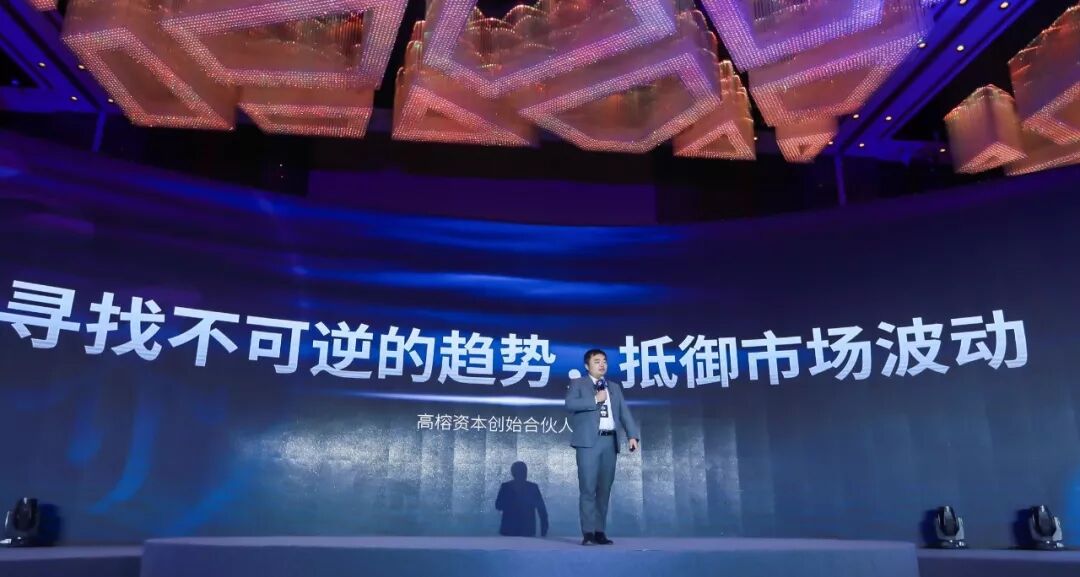
Xiang Gao, Founding Partner of Gaorong Ventures
Gao's key arguments:
- True "windfalls" are irreversible trends — they will arrive sooner or later, only the timing and form remain uncertain. An investor's job is to identify these irreversible trends, believe in them, understand them, and then invest in them.
- The logic behind irreversible trends lies in changes that are difficult to reverse: choices expanding from few to many, efficiency rising from low to high, time shrinking from long to short, and experience improving from bad to good. These shifts do not fluctuate with short-term market volatility.
- Artificial intelligence, e-commerce demand in third- through fifth-tier cities, and demographic shifts are among the irreversible trends already underway.
Below is an edited transcript of Gao's keynote:
First, let me take you through some of the "windfalls" we all know well — from portals, online games, and instant messaging to short video, livestreaming, and recommendation algorithms. The companies that rode these waves are household names. I often look at this list myself and think, of course these trends were bound to happen — how could they not? But in reality, when these trends first emerged, they faced tremendous skepticism. It was far from obvious that they would succeed.

Take game livestreaming. In 2014, when game livestreaming first appeared in China, Twitch in the U.S. was being hotly discussed in the media. As a gamer myself, I thought: games are meant to be played, right? Who would want to watch someone else play? At the time, I believed game livestreaming would be very difficult to build into a real business. But a few years later, esports became a major gaming category. When virtually everyone was playing Honor of Kings, esports became mainstream, and game livestreaming turned into a hard demand — the market exploded overnight.
Fortunately, we corrected our course in time and invested in HUYA Inc., so we didn't miss the game livestreaming opportunity. Most of the trends we've experienced ultimately materialized; they just arrived in different forms. So true windfalls are irreversible trends. They will come eventually — only the timing and form differ. What we need to do is believe in irreversible trends, understand them, and finally invest in them.
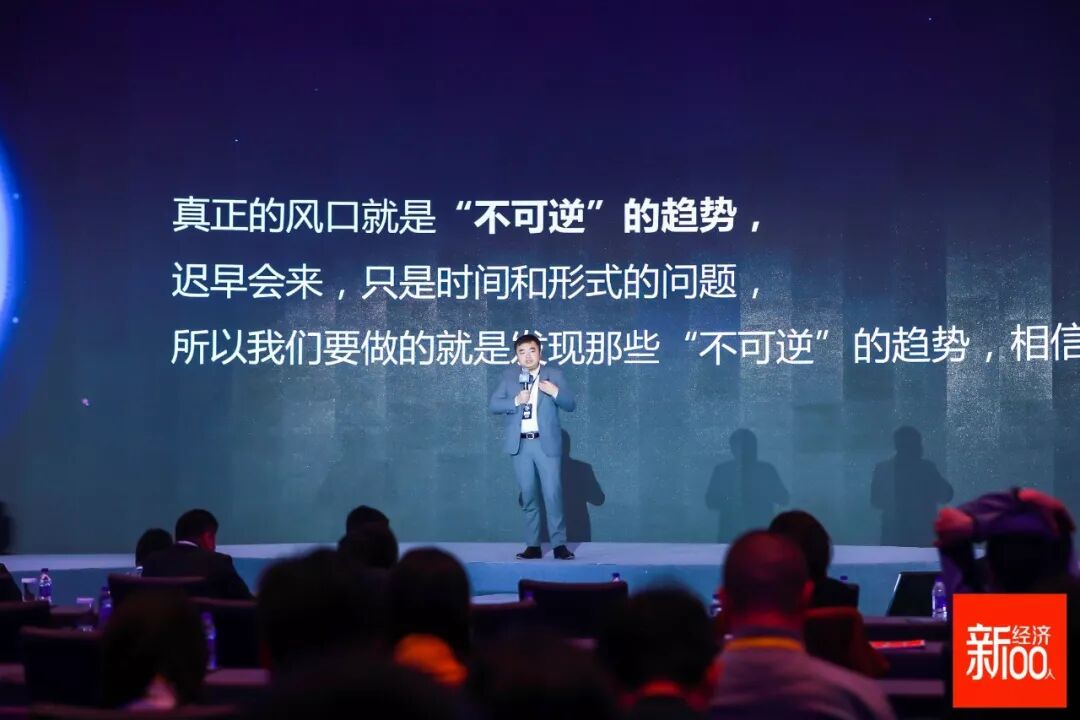
Xiang Gao, Founding Partner of Gaorong Ventures
To elaborate on "timing and form," let me give another example. In 2011, recommendation algorithms were a hot topic, and there was a lively debate around them. I wrote in my notebook at the time: after search, something more efficient might be recommendation. Around then, I tried investing in some recommendation algorithm-related companies.
But after a year or two, I found these recommendation companies weren't doing well and began to doubt whether recommendation would work. Recommendation requires massive amounts of data to refine algorithms, and those who had data wouldn't share it with recommendation companies, making truly efficient recommendation difficult. I also felt recommendation couldn't solve people's information efficiency problems — if I didn't even know what information I needed next, how could recommendation solve that? I grew skeptical. And yet today, Toutiao has built a massive company using recommendation algorithms.
So you'll notice that none of these past trends had smooth sailing. They all faced heavy skepticism early on, including mobile internet. Since I entered the industry in 2002, the entire sector had been talking about mobile internet, but it wasn't until the iPhone arrived in 2009 that the industry was truly activated.
Even after the iPhone's debut, many still questioned the market's size, whether company valuations were too high, and issues around legality and compliance. People also wondered whether carriers' role in the market would hinder industry development. So think back to the trends we're discussing today, or those that emerged in the past year or two — are they still being questioned? Are companies in these spaces facing fundraising difficulties? What will these companies look like in three to five years? Having invested for over 16 years, we've always been searching for irreversible trends.

What are irreversible trends? There's underlying logic. For example, users facing an expansion of choices from few to many — this is irreversible. In the past, traditional TV offered only 50–100 channels. When online video emerged, you faced a sea of programming. This process of choices multiplying is something you can't go back from. The same with e-commerce: when global merchandise is at your fingertips, it's hard to shop offline when you can find better value online.
Second, efficiency rising from low to high is also irreversible. Take search engines — before them, finding information was extremely difficult. Using a library took a long time. With search engines, you could find what you wanted instantly, with efficiency improving many times over. You can't go back to a world without search engines. The same applies to recommendation.
Third, time shrinking from long to short. Early on, using internet apps to hail a car still required long waits. Over time, waits grew shorter and your needs were met instantly.
Fourth, experience improving from bad to good. Smartphones, for instance. Or electric vehicles — I've been driving a Tesla for four or five years now, and after driving an EV, it's genuinely hard to go back to a gas-powered car. Experience improving from bad to good is irreversible.
There are also changes in cost and value that are difficult to reverse. They don't fluctuate with market movements. The only question is whether you can find a business model to support them, whether you can find sufficient capital. In fact, many successful models today already appeared around 1999, but lacked viable business models then because costs were too high. Today, with mobile internet's普及 and declining costs, many business models have shifted from impossible to possible. For a trend to fully form, you ultimately need to find a business model.
Returning to the present, what irreversible phenomena are already or currently unfolding?
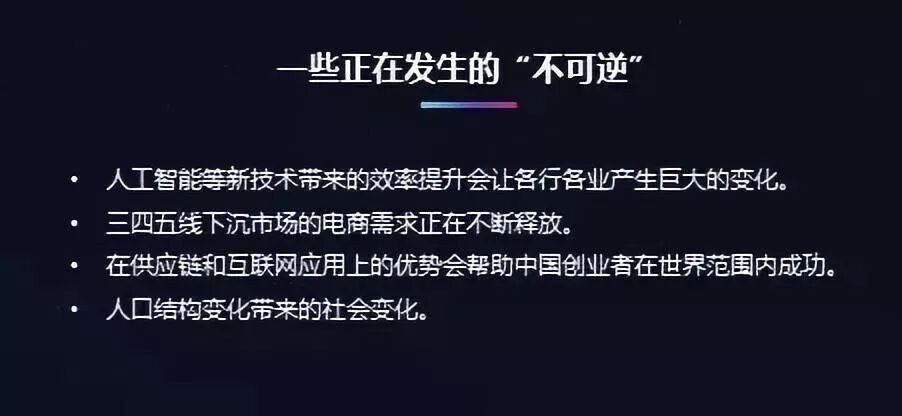
For instance, the changes brought by artificial intelligence. AI combined with any industry has the potential to dramatically improve that industry's efficiency, including social, information, and security sectors.
And the continuously unleashing demand in third-, fourth-, and fifth-tier markets. WeChat and Pinduoduo have allowed residents in these cities to enjoy the benefits of e-commerce — expanding their choices from few to many, and improving product value from low to high. These populations' e-commerce demand will explode rapidly in coming years.
China's advantages in supply chain and internet infrastructure will help Chinese entrepreneurs succeed globally. The irreversible trends we discuss apply equally to overseas consumers. When they can more conveniently access better Chinese products, they too won't want to return to their previous experience. This trend is already underway.
Finally, societal changes driven by demographic shifts. Starting in 2018, the number of people exiting the labor market began exceeding those entering it. For many years to come, we'll face a continuously declining working-age population — these are irreversible trends. Including the senior market that Zhigang discussed yesterday — this will certainly be a massive opportunity in the future.
That's what I wanted to share with you today. Investing may seem complex, but it's actually quite simple. If you can identify irreversible trends, believe in them, pay sustained attention to them, and develop deeper understanding of them, you'll find business opportunities aligned with these trends along the way — and you'll be able to do this well. If any of you here today spot irreversible trends that we haven't seen, we welcome you to connect with Gaorong Ventures. We'd be delighted to support you. Thank you.
END
Recommended Reading
Dialogue with the "Three Musketeers of Gaorong": Embracing Technology to Create a Better Life
Gaorong's Xiang Gao: How Can Mini Programs Create Industry-Shifting Opportunities?
Gaorong's Xiang Gao: The Evolution of Consumer Investment Strategy

- Gaorong Ventures manages USD and RMB funds totaling approximately RMB 15 billion, focused on early- and growth-stage investments in the TMT sector.
- Its limited partners include top-tier global institutional investors as well as Chinese corporate giants from finance, retail, advertising, and other industries.
- Additionally, dozens of successful entrepreneurs — founders of Tencent, Baidu, Taobao, Xiaomi, Meituan, Dianping, 360, 002027, Weibo, Sohu, JD.com, Vipshop, Tudou, Autohome, Ganji.com, and others — are LPs in Gaorong Ventures.
- The founding partners previously led investments in numerous outstanding companies, including Xiaomi, Razer, Baofeng Technology, G-bits, Tudou, Wondershare, ArcherMind, 91 Assistant, 3G.cn, Mogujie, Dota Legend, Yuanfudao, and others.
- Since Gaorong's founding, many of its portfolio companies have grown into national or global leaders in their respective industries, including: Pinduoduo (NASDAQ: PDD), HUYA Inc. (NYSE: HUYA), Huami (NYSE: HMI), Mogujou (NYSE: MOGU), Lifesense (300562.SZ), Meituan (03690.HK), Ping An Good Doctor (01833.HK), Zhongrongjin (acquired by Homa Appliances), DeePhi Tech (acquired by Xilinx), Qian Dai Bao (acquired by Meituan), BIGO LIVE (acquired by YY), Fanpu Jinke, Beibei.com, Poizon App, Leqi E-commerce, DotC, Shiheng, Nuro, YITU, Roborock, Tiangong Intelligence, Zhuiyi Technology, TigerBot, Geek+, Oasis Labs, Beitai Haoche, Quantgroup, Meili Jinrong, Shuidi HuZhu, Testin, Boss Zhipin, Doumi, Danke Apartments, Hellobike, Qian Damai, Perfect Diary, Ucommune, and others.
- Gaorong Ventures maintains investment teams in Beijing, Shanghai, Guangzhou, Shenzhen, and Hangzhou.
Scan the QR code to follow Gaorong Ventures

Thank you, good friends of Gaorong