Through the Darkest Hour to Today's IPO: Gaotu Techedu and Larry Chen's Five-Year Journey | Rongji

Only by finding a healthy business model and returning to the fundamentals of the industry can one witness the magic of the "snowball effect."

Today, Gaotu Techedu successfully listed on the New York Stock Exchange. We extend our warmest congratulations on this milestone!
Gaorong Ventures led Gaotu Techedu's Series A round in 2015. After completing that financing, the company did not raise additional funding in the primary market. Instead, it achieved profitability for the first time in Q3 2018 through its own cash generation capabilities, with revenue growing 307.1% year-over-year that same year. In the first three months of 2019, year-over-year growth reached 474%.
In China's online education sector, where heavy reliance on capital is the norm, Gaotu Techedu carved out a differentiated path of rapid growth and scalable profitability through high-quality teaching content and services, plus an innovative large-class live-streaming model.
What few outside the company knew was that Gaotu Techedu's journey was far from smooth. The founding team — a "dream team" combining education and technology DNA, led by former New Oriental executive president Larry Chen and including Huaiting Zhang, a founding member of Baidu's "Phoenix Nest" advertising system — had endured what they called their "darkest hour" over five years of building the business.
"All perfect movements in the world are the most effortless ones," Chen said, reflecting on the journey. But effortlessness, he noted, comes from returning to first principles. We hope this article offers deeper insight into this company that has "returned to the essence of education."
On a June 2017 morning, Larry Chen gathered his core team at Gaotu Techedu's Beijing office for a third-anniversary media briefing.
The event bore more resemblance to a session of criticism and self-criticism by Chen. In retrospect, it can be seen as Gaotu Techedu's "Zunyi Conference" — the moment it began climbing from the "valley of despair" toward the "slope of enlightenment."
"What mistakes did we make in building Gaotu Techedu? Where did we take wrong turns? I'm here today to examine that," Chen told the media, dissecting the company's erroneous decisions and clarifying its main battlefield: consumer-facing online education.
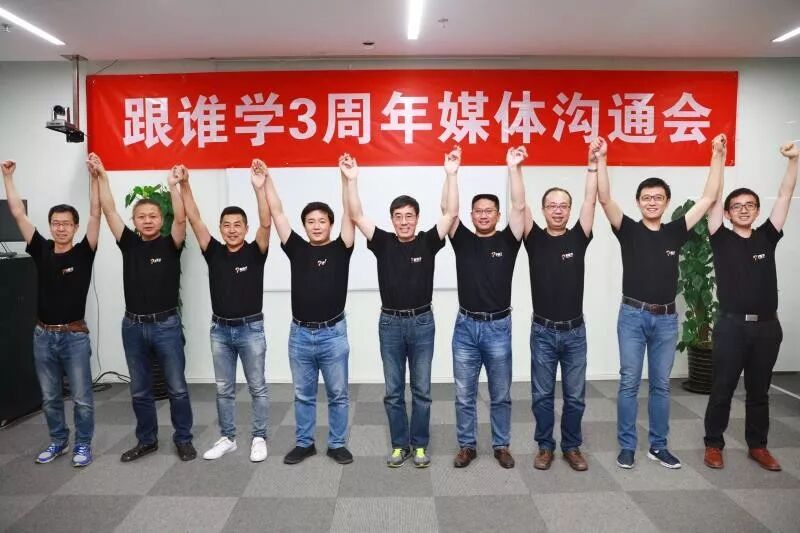
Gaotu Techedu's third-anniversary media briefing
Chen joined New Oriental in 1999. Over 14 years, he rose from teacher to school principal, then group vice president, and finally executive president — becoming "one of the people who understands education best in the industry."
In 2014, he founded Gaotu Techedu. Of the six-person founding team, half came from education, half from the internet.
From star-studded launch and aggressive expansion, through the darkest period and painful reckoning, to scalable profitability and successful IPO — Gaotu Techedu traced a "V" shape over five years, arriving at a new starting point.
Along the way, Chen — described as "extremely optimistic, responsible, and positive-energy" — underwent painful self-iteration and transformation. But judged by results, whether poaching a co-founder from Yiming Zhang, keeping the core team intact at the company's lowest point, or leading Gaotu Techedu to the NYSE five years after founding, Chen seemed to embody what Jeff Bezos and Allen Zhang have both said: "Kindness is more important than cleverness."
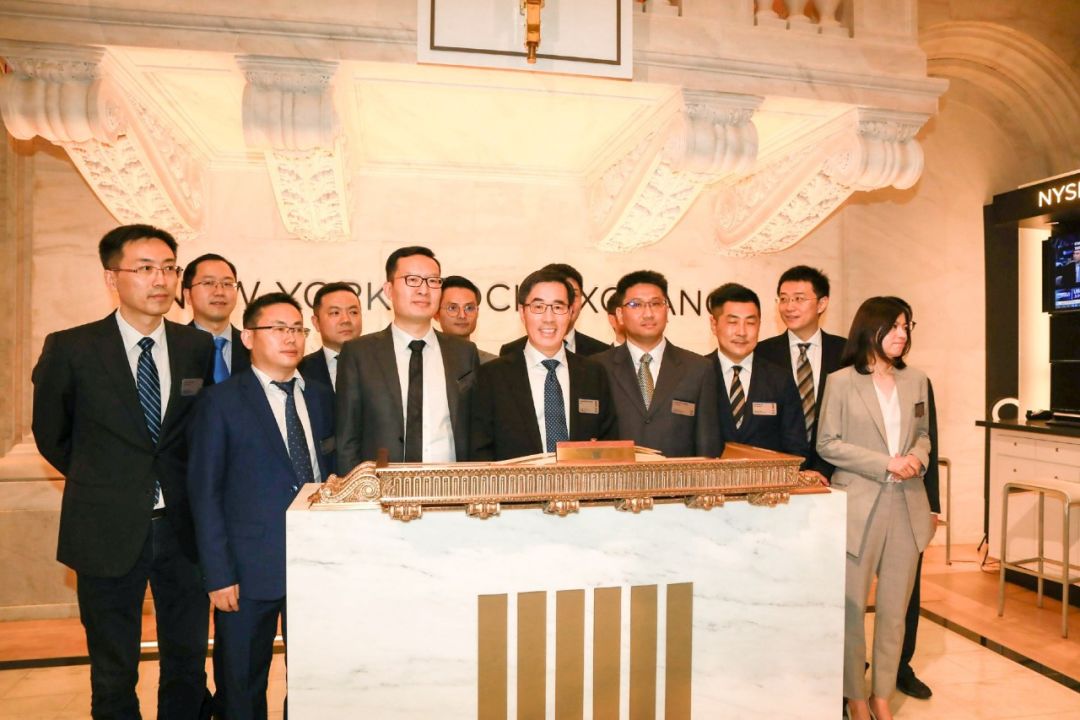
Gaotu Techedu's bell-ringing ceremony at the NYSE
Gaotu Techedu's comeback and IPO also serve as a fitting footnote to China's venture capital industry in recent years — only by finding a healthy business model and returning to industry fundamentals can one witness the magic of the "snowball effect."
A Night by the Charles River
The Charles River is Boston's mother river, with Harvard University, Boston University, MIT, and other renowned institutions along its banks. One winter evening in 2012, Chen walked along this river, and for the first time, the thought of starting a business took root.
Chen remembers it clearly. He was in a Harvard Business School executive program when a professor posed a question: "If you had $50 million, would you stop what you're doing now and do something completely different?" Eighty percent of the class of 80 raised their hands. He did not. That night, Chen was completely unable to sleep and went out for a run.
"I'm a kid from the countryside. I've really only had one job — New Oriental, for 14 years. I never even thought about leaving. If I left, all that money gone, all those friends gone. All I could think of was fear. That meant my courage was gone."
Chen had always been someone intensely focused on self-growth, consciously iterating his own cognition. He hoped to combine the refinement of his underlying mental models with ambition for his career, "to gain more happiness."
Ultimately, he killed his own indecision with one sentence: "If I don't leave, I might regret it." He then returned to China, spent a year on transition, and left New Oriental.
In June 2014, Gaotu Techedu was officially founded.

Born in O2O
2014 marked an important inflection point in China's internet market. Before this was the "first half of the internet" — "pure internet" encompassing portals, search engines, online games, e-commerce, and the like. After 2014 came the "second half," where the internet deeply integrated with industries like education, finance, and healthcare. Education, with its counter-cyclical properties, awaited a team capable of innovatively merging internet and education.
In its founding phase, Gaotu Techedu positioned itself as an "O2O platform for finding great teachers and learning services," hoping to build a full-category platform connecting institutions, teachers, and students.
O2O was then all the rage, with entrants flooding into e-commerce, retail, and lifestyle services. Education O2O was widely recognized as particularly difficult — deep water requiring exceptionally comprehensive team capabilities.
Gaotu Techedu happened to have a "dream team." From day one, Chen recruited Huaiting Zhang, Luo Bin, and others from the founding team of Baidu's "Phoenix Nest" system. In the view of Chang Chen, founding partner of Gaorong Ventures, this team "was the perfect combination of education and internet DNA."
"For an ordinary team, this wouldn't even be worth considering," said Xin Wang, executive director at Gaorong Ventures. "Education itself is a very heavy business — complex decision-making, high customer ticket prices, high quality demands, difficult matching."
The core pain point in China's offline education market had always been insufficient supply of quality educational resources. Chen said, "The thinking was quite simple at the time — use technology to advance education, so more students could access good educational resources."
In March 2015, based on recognition of the team and judgment of online education market trends, Gaorong Ventures led Gaotu Techedu's Series A round. Chang Chen said, "We firmly believed that through advanced technology and internet applications, people could gain better, more efficient educational services."
In this financing round, nearly $9 million also came from employee internal subscriptions. Chen recalled that when colleagues proposed buying company stock, "my instinct was to oppose it. For everyone to join a startup was already very brave; to then put their savings on the line would be too cruel." In the end, 136 employees participated, "believing and investing together."

Sprinting Under Pressure
The seemingly "highlight"-filled year of 2015 became what Chen called "the most anxious moment of my life."
"Facing so much uncertainty, the business model unproven, some people in the company putting in money from selling houses, from wedding funds — the responsibility and pressure behind that trust, honestly, made me extremely uneasy." He mentioned to media multiple times that he often couldn't sleep then, waking at 3 or 4 a.m. to stare blankly beside his bed.
Chen specifically rented a one-bedroom apartment near the office, "often getting home after midnight and returning around 7 a.m."
Under pressure, Chen and the team pressed forward on their established track. Xin Wang recalled, "The team was still very capable. Teacher Chen's organizational ability is very strong, the team gelled well, and metrics grew quickly." In month two, the team expanded to 100 people; month three, the core product launched; month four, 200 people. By end of March 2015, Gaotu Techedu had 70,000 registered teachers and student numbers in the millions.
Meanwhile, leveraging the team's technology DNA, Gaotu Techedu began expanding into B2B businesses. It successively incubated SaaS "Tianxiao System" for education and training institutions, video live-streaming service "Baijiayun," and education institution training business "Business School." By 2016, Gaotu Techedu had five business divisions.
"But once direction is wrong, the harder you work, the further off course you go." By end of 2016, the company's cash flow was tightening.
Recognizing the severity, Chen engaged in deep reflection and self-criticism. "Thinking back now, it's quite laughable — a 2-year-old startup doing five things, how could that possibly work?"
At that "Zunyi Conference," Chen also admitted frankly, "Returning to our original starting point, we found we were still a bit greedy. To be frank, we were doing a bit too much."
Chang Chen gave Chen two pieces of advice at the time. First, control cash flow — it's a company's lifeline, and the company should quickly optimize costs. Second, reflect on how to find a sustainable business model. Chang Chen said, "We worked with the company on research and concluded that the education O2O model faced considerable challenges. Because the essence of education is service, and quality control is paramount — the O2O platform model struggles to monitor the quality of educational services."

Killer Decision
The two men's thinking converged. Once clear, Chen rapidly turned the ship. He sent two unambiguous signals: first, the company would never run out of money — "I told everyone, if the company has no money, I'm willing to cover it"; second, Gaotu Techedu was never a B2B company — from day one of founding, it was a true B2C company, one that empowers B-side partners to serve students and parents.
Chen still remembers opposition from the team when he decided to cut B2B businesses. "Later I simply announced: everyone, we can only do one thing. Eventually everyone agreed. There was a deep trust — I had no selfish motives, and people felt they should still follow me."
After this killer decision, Chen shut down some B2B businesses and spun out others as independent companies. "We needed to return to what doesn't change. After much thought, we realized the eternal constants in education are — students and parents always need better teachers, better learning experiences, services, and outcomes, at lower cost. Find what doesn't change, and external changes don't matter."
Online education had been germinating since the 1990s, with product forms evolving through text-and-image, video, and live-streaming generations. From the second half of 2016, the industry began exploring how to achieve more personalized experiences and better outcomes online than offline. Live-streaming found its moment. In 2017, China's online education industry began achieving scalable monetization through "live-streaming."
Large-class live-streaming was the breakthrough business Gaotu Techedu had long been incubating.
In Chen's view, Gaotu Techedu's push into large-class live-streaming wasn't a pivot but more a focusing. "Actually, in month two of Gaotu Techedu's founding, we established a video live-streaming technology team. In 2015 we ran live-streaming interactive large classes with over 3,000 simultaneous participants. In 2016 we incubated the K12 large-class live-streaming brand Gaotu Classroom. In 2017, we chose to go all in."
This period of cutting, reflecting, and anchoring naturally caused ripples. "But Chen's actions and resolve behind the scenes became powerful glue for the team."
Beyond personally putting in funds, Chen personally subsidized some spun-out projects to help employees start their own businesses. He proactively approached investors: "If you need to exit, you can get your investment back plus a certain return." He also allocated more options to retain excellent team members, diluting only the founding team's options while not diluting investors' shares.
"Be kind in heart, swift with the knife — sometimes a devil, sometimes a bodhisattva. He achieved it," said Lv Weisheng, Gaotu Techedu vice president, describing Chen with a quote from Kazuo Inamori.
"Chen showed a very responsible demeanor and loyal attitude toward co-founders, employees, and investors," Chang Chen believed. Though the company had gone through developmental challenges and shed its founding "star halo," the confidence in the company actually grew stronger precisely because it had endured the "darkest hour."
At this point, Chang Chen also observed, "Chen truly entered an entrepreneurial state." Chen began diving deep into operations, declining external exposure and media interviews. Every penny spent was evaluated for reasonableness. He held weekly face-to-face communications with team members and new employees.
After some time, when Chang Chen visited Gaotu Techedu's office again, "without speaking, you could feel the company's upward momentum and employees' engaged state — the entire atmosphere was filled with energy."
Chang Chen thought to himself, "This is going to work."

Chang Chen (left), Larry Chen (right)

Wet Enough Snow, Long Enough Slope
According to Gaotu Techedu's prospectus, after focusing on B2C business in the second half of 2017, the unit economics of the large-class live-streaming model were validated, with revenue and profit growing substantially. Comparing 2018 to 2017, Gaotu Techedu revenue grew from 98 million yuan to 397 million yuan, up 307.1%. Q1 2019 versus Q1 2018, revenue grew from 47 million yuan to 269 million yuan, up 474%. The company achieved profitability for three consecutive quarters starting Q3 2018.
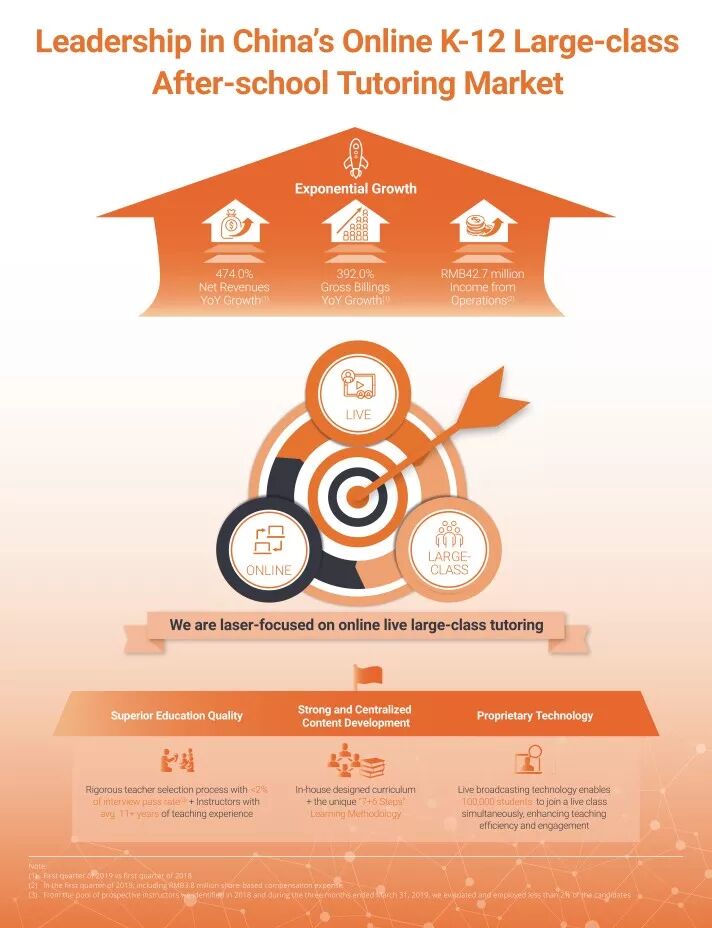
Gaotu Techedu is a leading K12 online education institution in China
Gaotu Techedu adopts a "star teacher instruction + dual-teacher tutoring" model, with K12 business accounting for 75.9% of revenue in the first fiscal quarter of 2019.
While K12 education has always been strongly demand-driven, the high cost of trial-and-error at this learning stage makes parents and students cautious. As the new generation of post-80s and post-90s parents upgrade their educational awareness and spending power, and as digital-native post-00s and post-10s generations grow naturally familiar with the internet, K12 parents and students' acceptance of online education has grown rapidly.
According to Frost & Sullivan data, China's online K12 education market grew rapidly from 1.4 billion yuan in 2013 to 30.2 billion yuan in 2018, a compound annual growth rate of 85.2%, and is expected to further expand to 367.2 billion yuan by 2023.
Chen also believes "K12 online education is a once-in-a-lifetime opportunity," with "a slope wide and long enough, so we just need to carefully find the starting point for the snowball, then roll it with care."
As for moats, Chen believes Gaotu Techedu's business essentially possesses the elements Warren Buffett described. First, intangible assets formed through serving students. Second, education is a heavy service industry, creating certain switching costs. Third, K12 education has natural network effects. Fourth, cost advantages.
Gaotu Techedu's technology DNA also became a core competitive strength. In July 2014, Gaotu Techedu established its video live-streaming technology team, and for five consecutive years maintained high-intensity R&D investment.
Chang Chen summarized that Gaotu Techedu achieved what it did because it completed two returns. First, returning to the essence of education — combining online and offline advantages, with star teachers online gathering quality educational resources and dual-teacher tutoring ensuring user experience, so educational quality is guaranteed. Second, returning to a healthy business model — the large-class model dramatically reduces customer acquisition and teacher costs, enabling scalable profitability as user scale expands. "Only with a healthy, sustainable business model can a company go far."


Chen has often mentioned that he is a "very lucky" person, repeatedly saying that "good fortune needs to be revered, good fortune must not be betrayed." As the prospectus states, after listing, Gaotu Techedu will continue improving educational service quality and student learning experience.
That emotionally turbulent night run in 2012 led Chen to decide to "do something different." Today, leading his company to list on the NYSE, "my mood is much calmer — the listing is just a new starting point."
Standing at this new starting point, "we'll just steadily serve every student and parent, rather than running a traffic business. What we see behind traffic is people, is trust, is 100% of a family."