Great Crises Breed Great Opportunities? Lessons from SARS and the Financial Crisis | Gaorong Ventures Share

Spring always comes, and the view next spring will surely be different from years past.
The COVID-19 outbreak remains at a critical juncture, with severe tests still ahead. At this very moment, countless individuals and organizations are fighting the virus with everything they've got.
This sudden crisis has left many businesses facing enormous difficulties — even existential threats. Churchill once said, "Never waste a crisis." A crisis is a major test, but also an opportunity for self-tempering and pursuing greater development.
What new opportunities often emerge from major crises? Is it possible for entrepreneurs to play "against the wind" under extreme challenge? We hope that by examining two major historical crises, we can offer founders some threads of thought and perspective.
Only by tackling the hardest challenges can you aim for the farthest horizons — no world champion has ever won without knowing how to play from behind. We sincerely wish all entrepreneurs a successful passage through this crisis, from adversity to victory, and toward greater opportunities for growth.

Nassim Nicholas Taleb wrote in The Black Swan that nearly everything in social life is produced by rare but consequential discontinuities and jumps.
Since the 21st century, two major black swan events have posed enormous challenges to China's economy and businesses — the 2003 SARS outbreak and the 2008 global financial crisis. Looking to history as our mirror, we find that major crises often incubate disruptive innovation opportunities.
Under normal development conditions, new business models are typically constrained by user habits and consumption inertia, incomplete infrastructure, and other factors that raise the barriers to customer acquisition and business expansion. The emergence of crises and the resulting new policies, combined with shifts in user behavior under extreme conditions, can break down these barriers and thus give rise to breakthrough opportunities.
Commercial innovation usually needs to clear two hurdles — trust and habit. In normal times, the "kinetic energy" required to clear them is to provide a user experience roughly "ten times better" (10X) than traditional solutions (as Peter Thiel proposed in Zero to One: for innovative companies to achieve rapid growth, their solution must be at least 10 times better than existing alternatives). The "opportunity" that crises bring entrepreneurs stems from the "potential energy" created by dangerous environments. In a severe winter, the effect of improved user experience becomes amplified, generating leveraged growth that can clear the trust and habit hurdles at accelerated speed.

Looking back at the business history of the 2003 SARS and 2008 financial crises, we find that a number of great companies decisively seized the "momentum" and key qualitative transformation elements within these crises, thereby navigating through them and advancing against the wind.
The 2003 SARS Crisis: E-Commerce, Online Payments, and Logistics Take Flight
In 2003, SARS ravaged China, becoming a public health crisis. Yet this crisis and the corresponding governance measures, to some extent, pressed the "accelerator" for China's internet adoption. During SARS, people reduced outings and collectively experienced the internet at home — especially online shopping — discovering unprecedented convenience and efficiency. This propelled e-commerce, online payments, and logistics into leapfrog development.

First, e-commerce took off.
During SARS, numerous business activities and import-export trade were forced to halt. The government urgently introduced measures to encourage e-commerce development. On May 6, 2003, the Ministry of Commerce issued an urgent notice requiring local authorities to "fully leverage the role of e-commerce and actively support enterprises in online promotion, online transactions, and related work."
In April 2003, when SARS was at its most severe and high-level control measures were implemented, Alibaba captured the rigid demand for online retail and launched Taobao in May 2003, providing personal online trading services for users. During SARS, daily new business opportunities on Alibaba's B2B platform grew threefold compared to 2002. In the same year, after JD.com's offline stores were hit by the SARS crisis, the company began fully pivoting to an online mall in 2004, successfully transforming into a dedicated e-commerce company.
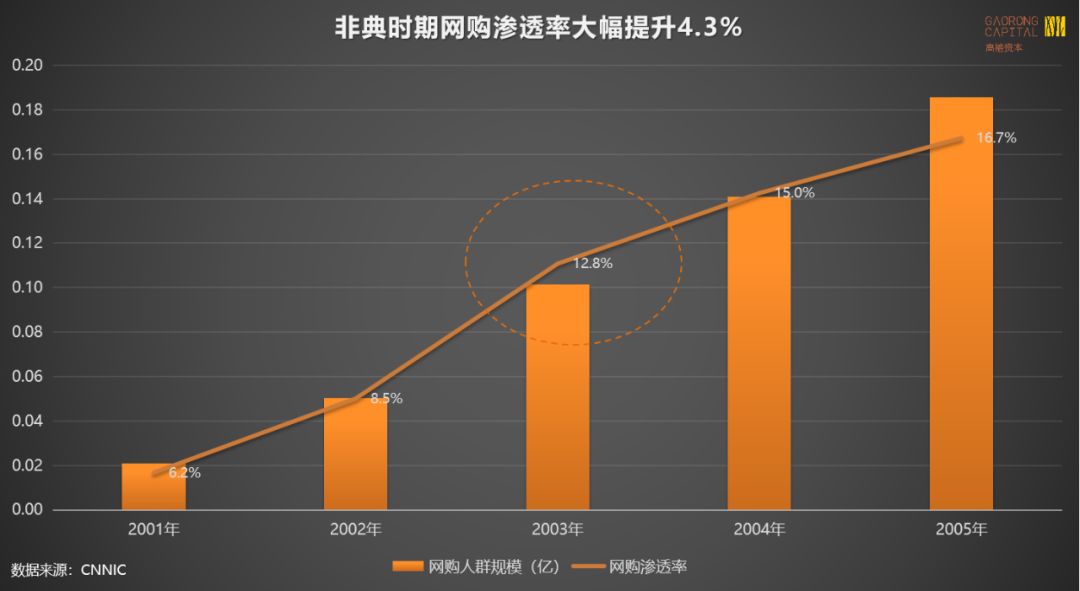
By the end of 2003, China's online shopping population had doubled from 2002, with online shopping penetration surging 4.3 percentage points to reach 12.8%.
Second, online payments emerged in response.
As e-commerce transaction volumes grew, online payments came into being. In October 2003, Alipay launched, opening the curtain on online payments, which gradually became the preferred method for online shopping.
Additionally, logistics companies seized a critical window and achieved counter-cyclical growth.
During the SARS outbreak, civil aviation passenger turnover dropped from 11.007 billion passenger-kilometers in January 2003 to 2.36 billion in May, a year-on-year decline of 78.1%. As air freight rates plummeted, SF Express seized the opportunity, signing an agreement with Yangtze River Express to charter five aircraft dedicated to express delivery, becoming the first private courier company in China to use all-cargo freighters. SF Express also signed agreements with multiple airlines to utilize dedicated belly cargo space on over 230 domestic routes for express delivery between cities nationwide. After 2003, SF Express maintained rapid annual volume growth.
According to statistics, national express delivery volume grew 22.8% year-on-year in 2003, an acceleration of 11.9 percentage points from 2002.
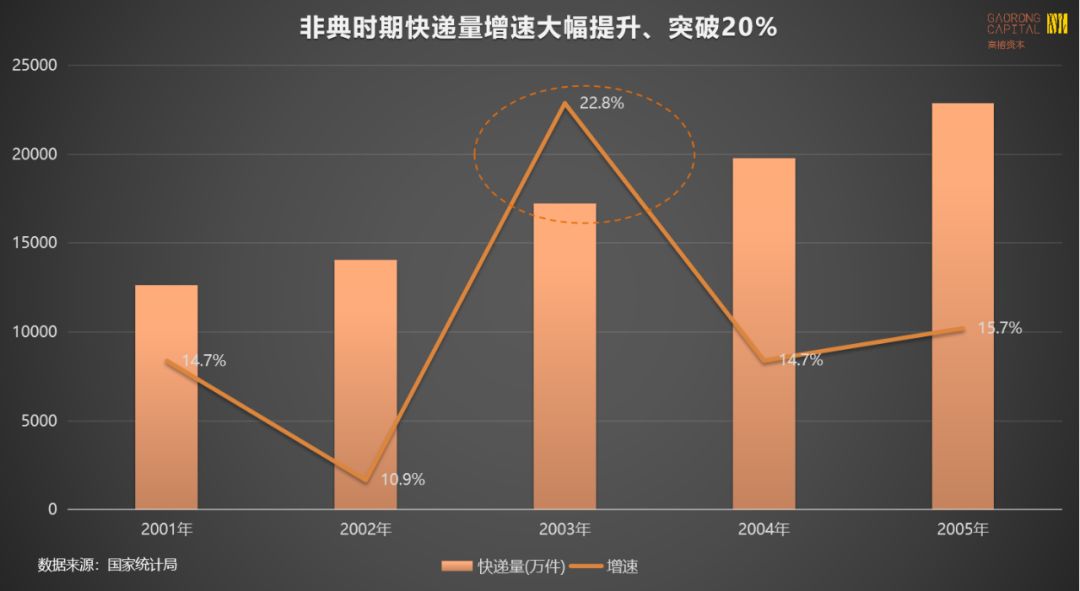
The special demands of this extraordinary period accelerated Chinese users' experience of the internet, giving e-commerce and electronic payment leapfrog development opportunities. These industries became new infrastructure and powerful engines for China's economic growth.
From the first SARS case in November 2002, to the spread in March 2003, high-level control measures in April, and the basic containment by June, SARS slowed Q2 2003 GDP growth by 1-2 percentage points. Yet the digital economy that germinated during SARS reached 31.3 trillion yuan by 2019, accounting for 34.8% of GDP.
Following "Black Swan," Taleb also proposed "antifragility" — things that benefit from shocks. Nature and the human immune system are classic antifragile systems: faced with unknown disasters and invasions, they not only recover from shocks but also mutate and evolve to become stronger.
The organizations and industries that broke through after SARS were "antifragile" winners that gained the right to survive and evolve, making the business world richer and more diverse.

After the 2008 Global Financial Crisis: Consumer Sector, Mobile Internet, and Sharing Economy Explode
The 2008 global financial crisis also brought unprecedented challenges to China. Starting in Q3 2008, Chinese exports plummeted, economic growth slowed, and employment pressure mounted.
Under the economic crisis, the Chinese government began in June 2008 to roll out a series of policy measures focused on expanding domestic demand, stimulating consumption, increasing investment, and improving people's livelihoods. By the first half of 2009, these gradually coalesced into a comprehensive plan to promote stable and relatively rapid economic development.
These crisis-response measures drove economic and industrial structural transformation. Combined with changes in user consumption habits during the crisis, they also catalyzed numerous innovation opportunities, mainly in the following areas:
First, the shift from export dependence to domestic demand expansion accelerated consumer sector development.
After the financial crisis, the state encouraged active expansion of domestic demand, particularly consumer demand, strengthening its pull on economic growth and cultivating consumption demand and spending power through multiple channels. This vast new consumer demand called for new supply. Meanwhile, the powerful supply chain accumulated through China's export trade development provided a mature foundation for consumer market growth.
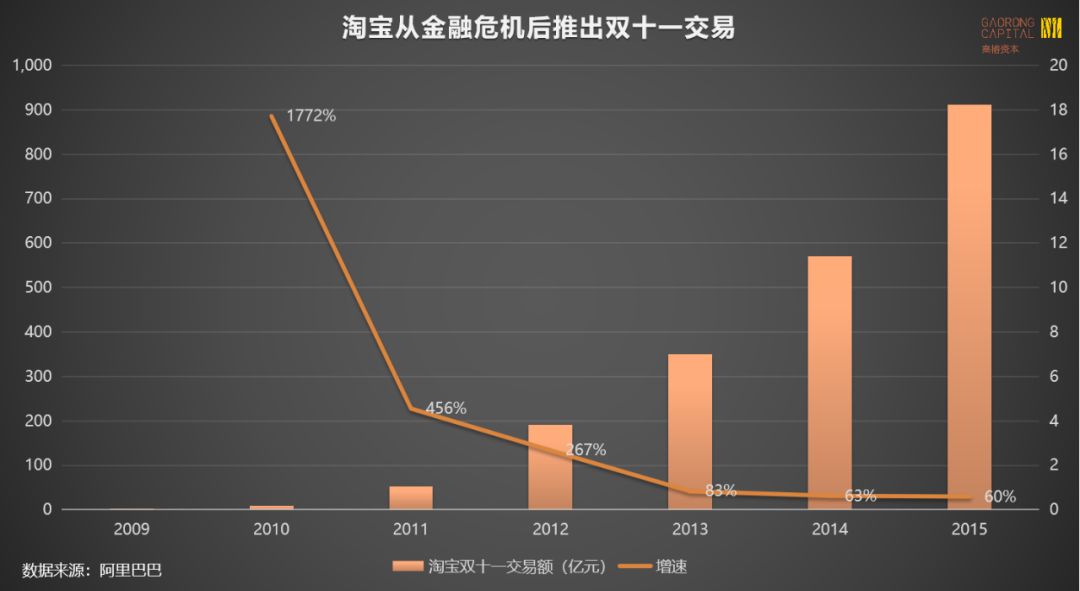
First, Chinese e-commerce received another round of accelerated development. In 2009, Taobao first launched its "Singles' Day" online promotion, with 27 brands generating 52 million yuan in sales. In 2010, Singles' Day sales reached 936 million yuan, attracting 21 million users, subsequently setting new transaction records. The shift in consumer behavior drove sustained and substantial growth in online consumption. In 2009, Chinese internet users' total online consumption exceeded 700 billion yuan, growing 23.1%.
A wave of local life service platforms also emerged after the financial crisis, including Ele.me founded in 2008 and Meituan in 2010. These companies captured users' consumption upgrade demands, using internet-based methods to provide lifestyle services centered on dining, entertainment, and leisure, while connecting China's vast small and medium merchants.
On another front, against the backdrop of massive infrastructure investment, the improvement of high-speed rail, 3G, and other infrastructure catalyzed the rapid explosion of mobile internet, comprehensively accelerating China's information industry.
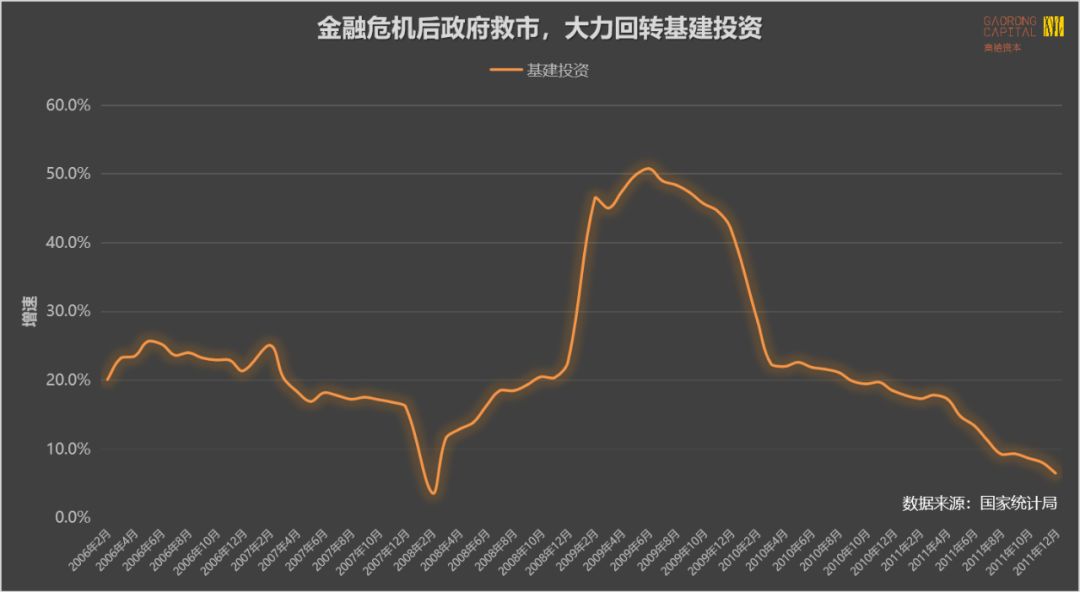
After the 2008 economic crisis, under the government's sustained 4 trillion yuan stimulus, China's infrastructure investment growth shot upward, reaching 42.2% for full-year 2009, with emphasis on highways, railways, telecommunications, power, affordable housing, and other public infrastructure. This included the construction and opening of China's high-speed rail network, which transformed the country's original clustered, hub-and-spoke urban agglomeration layout into linear city belts, greatly accelerating the flow of talent, logistics, and industry.
In this round of infrastructure building, 3G construction was particularly critical, largely giving birth to the germination and rapid explosion of China's mobile internet industry. In January 2009, the Ministry of Industry and Information Technology issued 3G licenses. Total 3G construction investment in 2009 reached 143.5 billion yuan, with 285,000 base stations built. By end-December 2009, China's mobile internet users reached 233 million, accounting for 60.8% of total internet users.
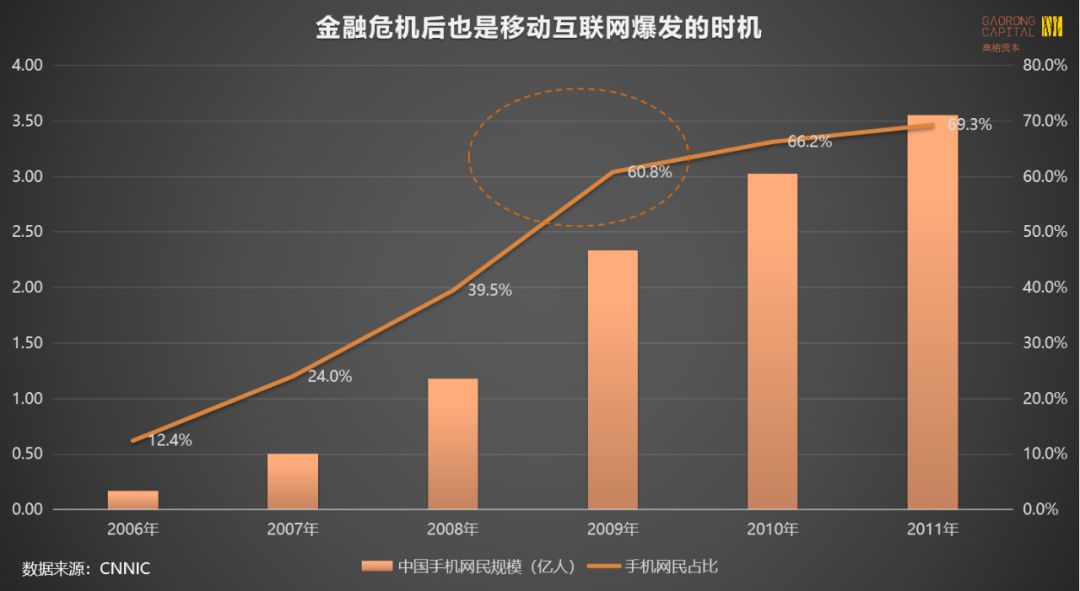
A cohort of mobile internet leaders emerged accordingly. For example, in the second half of 2009, Lei Jun began preparing to found Xiaomi; after 2010, WeChat, Meituan, and others were established successively.
Additionally, the sharing economy also originated from the financial crisis, returning assets more to their use value.
After the 2008 financial crisis, the sharing economy first sprouted in the United States. Between 2008 and 2009, sharing economy companies represented by Airbnb and Uber were founded successively. Their emergence catered to the broad backdrop of spending cuts and cost savings in the U.S. economy. People's consumption concepts shifted — no longer seeking ownership, but sharing and renting — providing demand-side foundations for the sharing economy. On the supply side, the sharing economy enabled the transaction and reuse of idle resources, opening a new era of separating resource ownership from usage rights.
China's sharing economy industry also rose accordingly, with companies like Ziroom and DiDi being founded successively. Vehicles, housing, and more returned to use value, and through refined long-term operations, created user value and saved social resources.

Innovation Opportunities Germinating and Catalyzed by COVID-19
Returning to the current crisis, the short-term economic shock is significant. Yet based on the maturity of China's traditional infrastructure plus new economy infrastructure, its huge and mature consumer market, improved labor quality, and technology-driven upgrades, we have ample reason to be optimistic about China's economic resilience in the long term.
We also believe that, like previous crises, "headwinds" are incubating entirely new opportunities and business possibilities.
Mass collective experience of online services nationwide — those that genuinely deliver value to users will see irreversible development.
This crisis has forced a national-level collective experience of online services, with particularly prominent examples including online healthcare, online education, and fresh grocery retail. Online services that truly create value for users will seize this opportunity to solidify and generalize user habits, gradually building infrastructure-level companies as ubiquitous as capillaries and running water.
For example, during this outbreak, Tencent, Alibaba, Ping An Good Doctor, and others have launched online consultation platforms to alleviate healthcare pressure, accelerating user cultivation and stickiness. This crisis has also become large-scale public health practical education, driving shifts in public health management concepts. In the medium to long term, information access, online services, digital health management, and health insurance in the health domain will all welcome new opportunities.
The outbreak's delay of school openings at all levels and postponement of offline training institutions has led online education companies like New Oriental Online and Gaotu Techedu to launch "classes suspended but learning continues" solutions, substantially improving students' and parents' acceptance of online education and accelerating consumer education.
During the Spring Festival, fresh grocery retailers like Dingdong Maicai and Pupu Supermarket became urban residents' "vegetable baskets." Dingdong Maicai's order volume on New Year's Eve grew over 300% month-on-month; during the seven-day Spring Festival period, it supplied 1,000 tons of vegetables and 439 tons of meat.
Nationwide enterprises and institutions providing online services are accelerating China's informatization and digitalization process.
In this outbreak's prevention and control, government-led digital governance and online services based on big data and AI have been further practiced and applied — for example, in tracking and locating people flowing out of epidemic areas, controlling spread, and public opinion monitoring. Public governance shows significant rigid demand for smarter, more efficient information systems.
Enterprises across sectors have also been "forced" to try providing online services. Going forward, AI customer service, live streaming, and other solutions may become standard equipment in business operations.
Industry-wide collective experience of remote work creates an inflection point for enterprise services to explode.
In early February, "remote work" became a trending term, as Chinese business history saw online collaborative work at the hundred-million-user scale for the first time, accelerating digital transformation that had previously progressed relatively slowly. Online office software represented by DingTalk, WeCom, Lark, and Zoom opened free trials, and beyond providing collaboration tools, delivered incremental value through products and technology for higher enterprise efficiency — becoming the cornerstone of user retention.
In recent years, we have consistently emphasized that the internet has entered its second half, with the internet integrating with various industries and penetrating work and life in all dimensions. Whether in consumer internet, industrial internet, or enterprise services, this penetration has been gradually unfolding.
The breadth and duration of this crisis are unprecedented, requiring us to join hands and overcome difficulties together. Meanwhile, viewing the crisis through a developmental lens reveals that it has also forced the online transformation of work and life, helping many industries gain new momentum and opportunities for development. Spring will always come, and next spring's scenery will certainly differ from years past. After this outbreak, China's internet second half may welcome accelerated development, enabling all industries to advance more efficiently.
Crises bring hardship, but also courage and boldness. Innovative enterprises that can discover opportunities in crisis, continuously adjust their boundaries, and focus on long-term value will emerge stronger. The more severe the crisis, the more resilient we must be — skilled at and willing to play "against the wind." Playing against the wind requires entrepreneurs to steady their footing, withstand pressure, and use the unreal to cultivate the real, standardizing every movement and forging a strong team. It also requires facing the crisis squarely, maintaining firm confidence, and on the foundation of believing in China's economic resilience, tightly seizing key qualitative transformation elements and development opportunities.

Past, present, and future — Gaorong Ventures is always willing to walk alongside entrepreneurs, finding the oasis of value innovation. "Remaining composed while clouds scud across the sky" — no wind or rain can suppress the endogenous power of healthy seeds growing into great trees; no hardship or obstacle can extinguish our original aspiration to create a better life.


Aiding Wuhan, Praying for Peace, We Are Together! | Gaorong News