Helping Sleep Apnea Patients Rest Easy: A Medtech Executive's Second Act, Pioneering a Novel Neurostimulation Therapy | Gaorong Future

A new generation of neurostimulation therapy for sleep apnea.

Obstructive sleep apnea (OSA) — sleep apnea for short — is a widespread yet woefully underappreciated condition. Simply put, it's a distinctive sleep disorder characterized by loud snoring, repeated gasping, and breathing interruptions during sleep. Beyond causing daytime drowsiness and low energy, it triggers or worsens other diseases, notably cardiovascular problems.
Treatment for sleep apnea represents a massive emerging market in the United States, valued at $11 billion annually. Established therapies include CPAP machines and hypoglossal nerve stimulation (HNS). HNS in particular has seen rapidly growing market share in recent years, making it one of the fastest-growing medical device segments in the US.
Yet significant unmet needs persist. Many people find sleeping with a ventilator intolerable, and HNS doesn't work for everyone — its efficacy drops notably for patients with high BMI.
"We all share a simple wish: a good night's sleep." In 2023, Quan Ni, a veteran of the medical device industry, set out to build Restora. "The company name reflects our vision — restoring restful sleep."
Restora is developing a next-generation neurostimulation device for sleep apnea treatment. Its dual-target approach stimulates both the hypoglossal nerve and the ansa cervicalis nerve, aiming for superior efficacy and broader indication coverage.
Restora closed its seed round in 2024. In early 2025, Gaorong Ventures participated as a major investor in the company's Series A round**.**
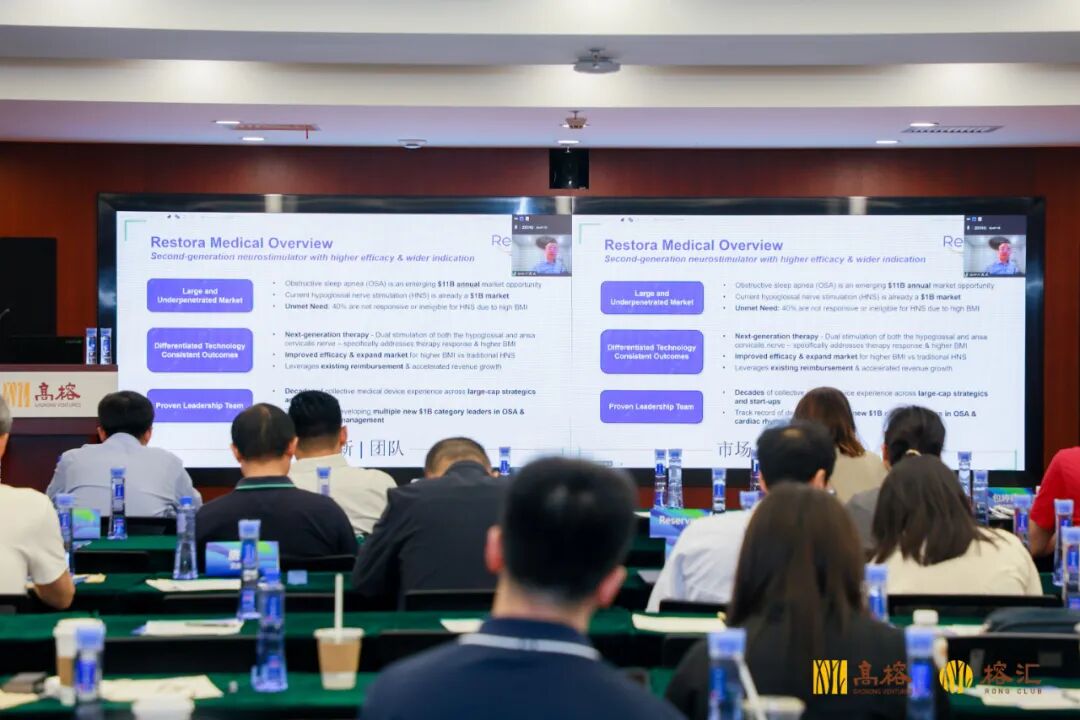
Recently, Restora founder and CEO Dr. Quan Ni joined us at Gaorong Ventures' 2025 Healthcare CEO Closed-Door Meeting and Healthcare Demo Day to discuss this pervasive yet often overlooked condition, and how Restora's deep expertise and differentiated therapy could help more people escape sleep's grip.

The following is Dr. Ni's remarks, edited for clarity:

Sleep apnea carries a substantial global disease burden.
By the numbers: roughly 1 billion people worldwide have sleep apnea, defined as an apnea-hypopnea index (AHI) above 5 — meaning more than 5 episodes per hour of stopped or severely reduced breathing.
An AHI above 15 qualifies as moderate-to-severe sleep apnea. Globally, 425 million adults fall into this category. China and the US represent the most concentrated markets: over 17 million patients in the US, and more than 100 million in China.
An AHI above 30 indicates severe sleep apnea — effectively, a breathing pause every two minutes.
Moderate-to-severe patients essentially endure fragmented sleep in a perpetual "doze-wake-doze-wake" cycle. Chronic oxygen deprivation forces the heart and lungs into overdrive while the brain suffers damage, directly causing or markedly worsening comorbidities.
Clinical data shows sleep apnea correlates strongly with cardiovascular risk.
A clinical trial tracking 1,500 patients from 2005 to 2015 found that over ten years, severe sleep apnea patients showed dramatically elevated cardiovascular event rates — fatal and non-fatal combined — versus controls: 2× higher stroke risk, 5× higher cardiovascular mortality, and 57% higher atrial fibrillation risk.
Research also links sleep apnea to neurocognitive impairment and Alzheimer's disease.
We associate sleep apnea with obesity, and rightly so — each 1 kg/m² BMI increase roughly triples risk. Conversely, sleep apnea itself causes leptin resistance and reduced metabolic rate, worsening obesity in a vicious cycle.

Despite its serious health impact, sleep apnea remains widely overlooked. Per the Chinese Sleep Research Society, diagnosis rates stand at 20% in the US and under 1% in China — vast numbers of patients go untreated.
The most commonly cited therapy is continuous positive airway pressure (CPAP), i.e., wearing a ventilator. Two million American adults use CPAP annually. Yet roughly 50% of sleep apnea patients cannot tolerate it.
Over the past decade, a clinically validated CPAP alternative has surged: hypoglossal nerve stimulation (HNS), suitable for approximately 500,000 US patients annually.
This therapy (branded as Inspire) was developed by my former employer, Inspire Medical Systems, and received FDA approval in 2014. Inspire Medical went public on the NYSE in 2018 and remains the sole player in this space. As a founding team member, I led product design and clinical work at Inspire from 2008 to 2021.
In essence, HNS uses an electrode fixed to the distal hypoglossal nerve to stimulate the genioglossus muscle, causing slight forward displacement of the tongue base to maintain an open airway.
HNS has become one of the fastest-growing medical device segments in the US. This fueled Inspire Medical's 44% compound annual growth rate over 11 years, with 2025 revenue projected near $1 billion and 2028 targets exceeding $1.5 billion. Today, virtually all US insurers cover the therapy.

Yet HNS has clear unmet needs, stemming from two gaps:
First, 35% of implanted patients show no meaningful AHI improvement post-treatment.
Second, current Inspire therapy targets patients with BMI below 32. At BMIs of 32–35, non-responder rates jump to 40%. This inconsistent efficacy limits physician referrals and increases follow-up burden.
We made a breakthrough discovery about why HNS fails for higher-BMI patients: while HNS addresses anterior-posterior collapse by pulling the tongue base forward, it cannot resolve lateral wall collapse. Lateral wall collapse afflicts roughly 42% of sleep apnea patients and correlates strongly with higher BMI.
This led us to identify a novel neurostimulation target — ansa cervicalis stimulation (ACS) — and propose a dual-target mechanism combining hypoglossal and ansa cervicalis nerve stimulation.
Trial data showed that hypoglossal nerve stimulation alone doubled upper airway cross-sectional area; ansa cervicalis stimulation alone achieved comparable results. Combined dual-target stimulation quadrupled airway area — a markedly more powerful effect.
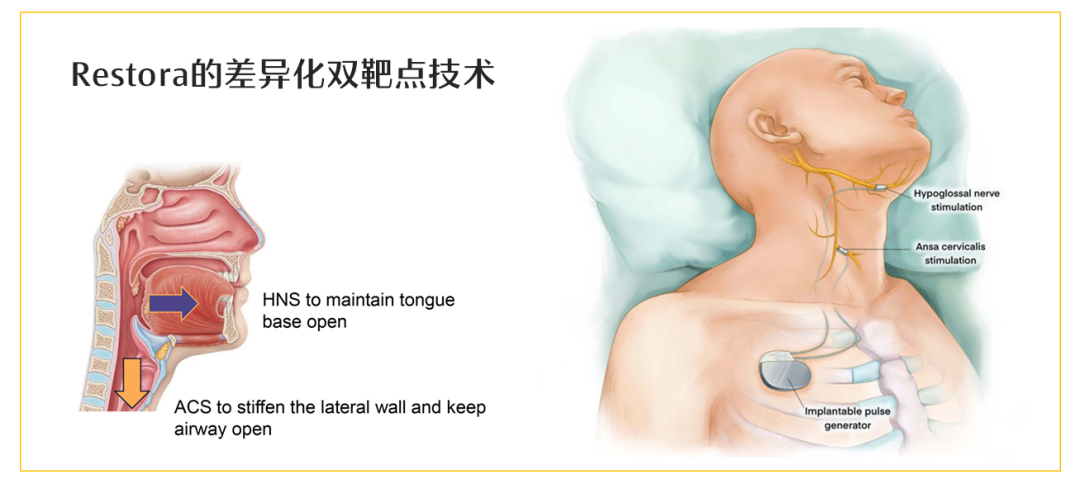
Our device will be implanted near the chest cavity via minimally invasive surgery, with two electrodes stimulating both neural targets simultaneously. The product logic parallels cardiac pacemakers: early markets were dominated by single-chamber devices, later supplanted by dual-chamber pacemakers that now command 90% market share.
We estimate Restora's novel therapy could address a $1.5 billion annual market versus conventional HNS. Our next-generation approach offers both higher efficacy rates and broader indication coverage — extending to patients with BMI up to 35 and effectively treating those with lateral wall collapse.

We've completed Restora's Phase I clinical trial, validating the technical concept and surgical approach. Sixteen patients undergoing acute neck surgery were enrolled, with preliminary confirmation of efficacy and safety.
Restora is now advancing Phase II trials focused on long-term feasibility studies.
We expect pivotal data by mid-next year — specifically, head-to-head comparison data between Restora's dual-target stimulation and hypoglossal nerve stimulation alone.
This rapid R&D and clinical progress stems from Restora's team of seasoned medical device veterans, whose core members previously developed multiple billion-dollar-leading products in obstructive sleep apnea (OSA) and cardiac rhythm management (CRM).
We look forward to accelerating clinical development and bringing this innovation to market — improving sleep quality and health outcomes for millions.