How AI Products Climb the Growth Ladder: Short-Term Activation, Mid-Term Habits, Long-Term Mindshare | Ronghui

How do you find PMF in the AI era?
Amid the new wave of AI technology, much is changing. Yet when it comes to the fundamentals of growth, first principles remain constant: user obsession, product excellence, value creation, and growth for good.
At the first module of the 2023 Growth Workshop co-hosted by Gaorong Ventures' Ronghui and Amazon Web Services, Liu Xinhua, Investment Partner at Gaorong Ventures, and Qi Junyuan, VP of Product at Lark, joined three CEOs — from ToDesk, SuperBrowser (Ziniao), and Yunzhongzi Technology — for a discussion on product-led growth (PLG) in the new era.
What new human-computer interaction paradigms will AI enable? How do you find product-market fit in the AI era? What are the immutable laws and new engines of growth for AI products?
A key consensus from the sharing and discussion: whether building AI Native, AI First, or AI Embedded products, the underlying principles that drive growth still apply when defining future product forms and exploring new commercial value.


AI is the light of growth for many entrepreneurs today, and a super opportunity now exploding. "But we also see considerable froth, especially in an era where financing and compute costs are increasingly expensive. Entrepreneurs need to plan and invest more cautiously," said Liu Xinhua, Investment Partner at Gaorong Ventures and former Chief Growth Officer at Kuaishou, urging founders not to neglect fundamental principles in the AI era.
Three Growth Laws for AI Products

AI Native products are fundamentally a supply-side revolution. To launch a growth offensive, you must return to the user value equation: the new experience your product delivers must create a 10X experience gap versus the old experience. Only then can you generate sufficient value pull — beyond effectively covering user switching costs and customer acquisition costs — to drive mass migration of users and customers within a market with clear demand. For AI Native products in the To B space, for instance, the battle is no longer about capabilities or cost efficiency between new and old software. The question is whether you have the opportunity to fully or partially replace humans. "If you can create this category of entirely new experience, users may switch."

When designing any product, you must think about the sources of power behind behavior change: 1) whether it can strongly satisfy user motivational needs, 2) whether it removes capability barriers for users, and 3) whether trigger mechanisms are designed to elicit desired behaviors. AI products need to satisfy motivations such as pleasure, security, sense of gain, recognition, or novel experiences. They must also lower usage barriers — including financial, temporal, physical, cognitive, social acceptance, and identity-matching obstacles — particularly leveraging mental accounting mechanisms to dissolve psychological barriers. And they need effective trigger mechanisms, with community and social media word-of-mouth playing crucial roles. For example, operating on Discord and Twitter has proven to be a highly effective approach for AI product distribution.

Product growth follows the pattern: "activation in the short term, habit in the medium term, mindshare in the long term." "From ChatGPT's launch to today, it's been less than a year. Overall, AI Native products have had a very short journey. Product retention and stickiness remain a long road ahead — they haven't yet reached the stage of ordinary users forming habits, let alone cultivating mindshare." According to statistics, even the best generative AI products today — including ChatGPT, Midjourney, Character.ai, and RunwayML — still lag significantly behind traditional blockbuster products like WhatsApp, Instagram, and TikTok in monthly retention rates and DAU/MAU ratios (a key metric for evaluating product stickiness).
For a product to have lasting vitality, one key is enabling users to establish a Habit Loop — designing repeated cycles of Cue (trigger), Routine (regular behavior), and Reward. Only through relatively high-frequency repeated cycles can users achieve the behavioral shift "from brain-burning to brainless." To build more stable mindshare requires even longer time horizons, with richer and more surprising rewards for users, attracting more of their energy, money, or resource investment. Only then can stable usage mindshare form, creating attention isolation from potential competitors.
Finding AI Market Fit: High-Value Scenarios and High Usability
In building products, finding PMF (Product Market Fit) is crucial. "We call PMF in the AI era AMF (AI Market Fit)." How do you find AMF?
Liu Xinhua believes that for To C AI products, on one hand you need to identify high-value scenarios — this includes both helping users complete tasks and delivering practical value, as well as providing emotional value, as with Character.ai. On the other hand, To C products need high usability and high creative inclusivity, even to the extent of tolerating LLM hallucinations to provide richer creative inspiration.
To B AI products similarly need to find high-value scenarios, such as work scenarios that previously relied heavily on professionals, involved complex processes, and carried high costs. Additionally, To B products also require high usability, but unlike To C products, To B products are averse to hallucinations. So they must significantly reduce hallucinations caused by large models, achieve relatively high accuracy, have high workflow integration, and ensure data isolation, tiering, and security compliance.
He emphasized that if an AI product targets non-high-value scenarios, user demand will ultimately be disproven, habits cannot be established, and true AMF will be difficult to achieve.
AI Products Should Especially Leverage AI for Growth Leverage
Liu Xinhua also shared growth engines that entrepreneurs can effectively utilize. The first is community-driven growth. "Users observing and learning in communities can effectively lower the capability barrier for on-boarding." For example, the AI coding tool Replit has built a developer community that encourages users to help each other; Midjourney is also a typical case of community-driven growth.
He particularly noted that "AI product companies today should especially learn to use AI technology to gain new traffic leverage." For instance, in programmatic SEO, AI can generate large volumes of static pages with unique content related to product value. These static pages match with massive long-tail keywords, then get crawled by search engines through Sitemaps, helping AI products rapidly acquire traffic. "Because AI-generated content is unique, it's valuable to search engines."

In the entrepreneur roundtable, Hu Jianqiang, Founder and CEO of ToDesk; Liu Zhihai, CEO of Zixun Technology; and Chen Junhong, Founder and CEO of Yunzhongzi Technology, also discussed what changes and what remains constant in product-led growth strategies in the new era, and the transformative opportunities AI technology brings to products.
Leading Technology Creates Experience Gaps
Hu Jianqiang, drawing on ToDesk's product growth journey, shared the path of creating experience gaps through technology leadership to achieve growth. "We saw the major trend of compute resource pooling and migration to the cloud. In the future, users will want to remotely access these resources anytime, anywhere. So we developed products like remote desktop, cloud desktop, and digital twin based on leading remote cloud rendering technology." In just over two years since founding, ToDesk's installations have surpassed 100 million, stemming from product advantages in high resolution, high frame rate, and low latency — creating unique experiences for users and achieving PLG.

For integrating AI into existing products or building AI Embedded products, Hu Jianqiang believes you need to find actual applicable scenarios, not do AI for AI's sake. He also mentioned another opportunity AI brings to startups: using AI to build your own company — treating the company itself as a product and system, and making it AI-native.
Customer Demand Above All: Cross-Border Enterprises Actively Embracing AI
From building the SuperBrowser SaaS product to developing AI assistants, Liu Zhihai has consistently emphasized customer demand above all. SuperBrowser primarily provides cross-border sellers with account security protection, multi-platform store management, and other services. "Initially we had only a 3-person team polishing the product prototype. But we found customers had strong刚需 [rigid demand] for the product features, with high switching costs and strong willingness to pay. So we made it our core product, even abandoning other products that already had some daily active users." By the end of 2022, SuperBrowser had accumulated over 360,000 paying merchants, with 3.11 million accounts managed on the platform.
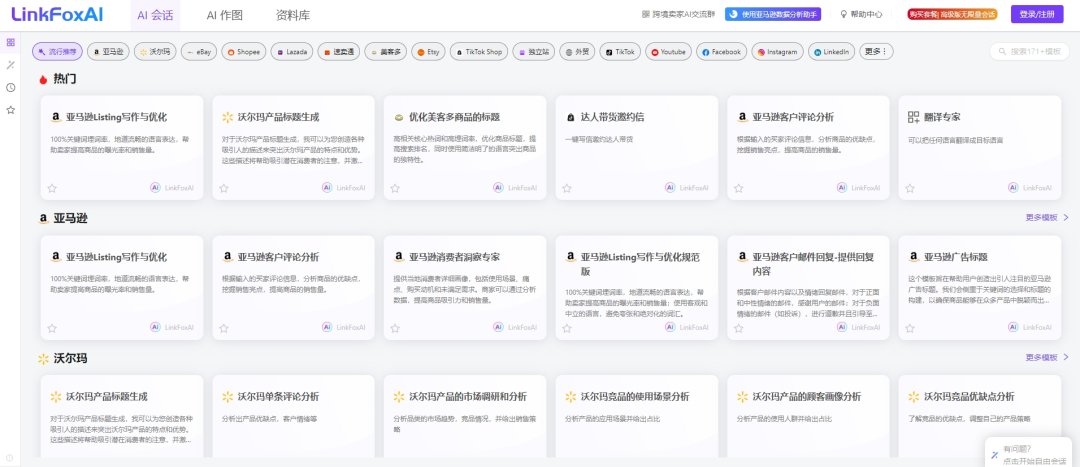
Recently, Zixun also launched the LinkFox AI assistant. "The reason is we found cross-border sellers generally hold an embracing attitude toward AI technology, looking forward to using AI to improve productivity. We always believe Chinese cross-border enterprises need AI more than domestic enterprises — to understand overseas culture, customer needs, and conduct product research. AI assistants can help our enterprise clients be more grounded when serving overseas users." Based on the actual needs of cross-border sellers, LinkFox provides accompanying AI services for sellers across full scenarios including listing optimization, market research, review analysis, and product selection.
AI Reconstructs Game Production and Consumption Models
Yunzhongzi Technology focuses on building AI social products. Chen Junhong believes, "Today is the moment to combine AI with social and gaming to build products." The reason: AI's involvement is dramatically changing the production and consumption models of gaming. On the production side, beyond improving productivity in the gaming industry, generative AI more importantly demystifies creativity — making what was once mysterious into something that can be engineered and even industrialized. This brings particularly significant opportunities. On the demand side, "Today and in the future we face gaming-native users, which will also reconstruct the consumption model."
For how startups can build innovative advantages based on AI going forward, Chen Junhong offered two methodological approaches. First, every new technological transformation redefines many boundaries; startups can attempt things that large companies dare not do. Second, value cross-disciplinary approaches — mobilize creativity, imagination, and technical knowledge to play "connect the dots" with cross-domain elements, and you may find new possibilities.
In his book Growth, Liu Xinhua proposed the eight-character growth mantra: understand the principle (明道), seize the momentum (取势), refine the method (优术), and know the people (识人). Despite the disruptive innovation brought by new generative AI technology, the laws of growth still apply today — AI products equally need to "understand the principle," grasping the underlying drivers of growth; "seize the momentum," capturing traffic potential and structural changes in growth (the best companies first compete on capturing beta, then alpha); "refine the method," establishing a complete indicator-based and model-based growth system tied to product growth, driving effective growth through growth experiments and data feedback; and "know the people," understanding the mechanisms of user behavior change, habit formation, and mindshare cultivation to build a moat for user growth.