How Do Next-Generation Brands Become Global Brands? Anker's "Guns and Roses" | Ronghui Practical Sharing

At the end of the day, it's about winning over consumers.
Today, Chinese brands going global are moving forward without pause, shifting from unchecked growth to meticulous cultivation. In an era of radical transparency and fierce competition, how do you ultimately win?
Anker, hailed as "the shining light of Chinese exports with billions in annual sales" and "the largest global consumer electronics brand by domestic revenue," answers: win with the consumer. Get consumers what they want faster, and deliver experiences that exceed expectations.
At Ronghui's "Globalization" growth series, Anker VP and Oceanwing CEO Zhuohui Wu drew on the changes and pain points facing globalizing brands today, using Anker's own brand globalization journey as a case study to analyze the fundamentals that export brands must cultivate over the long term.
Beyond showering consumers with roses and creating value for them, Wu also broke down the "firepower" behind Anker's rapid launch of category-leading brands in niche segments — an intelligent empowerment system built on real-time, dynamic consumer insights that helps upgrade efficiency across the entire value chain.
Wu joined Anker in 2017 and built the wireless audio category's global omnichannel expansion from scratch. He later took full responsibility for Anker's online operations, and in 2019 became General Manager of Anker's E-commerce Service Division, providing cross-border e-commerce platform services for global partners and empowering brands to go global. (Hereafter, "Anker" will be used as shorthand for "Anker.")

How the Globalization Landscape Has Changed: The Era of Unchecked Growth Is Over
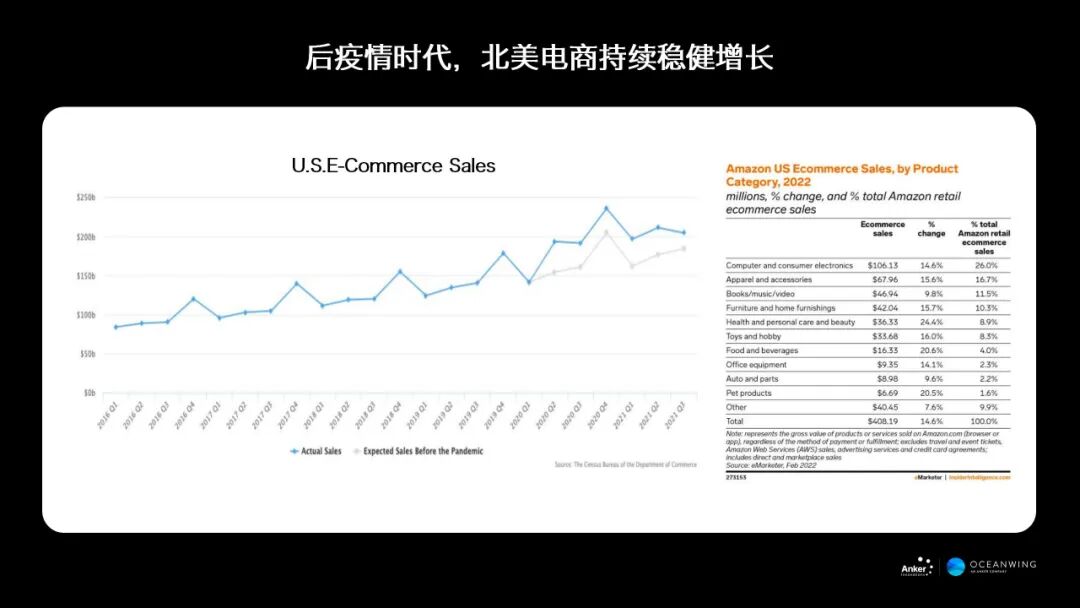
Since COVID-19, from 2020 to 2021, North American e-commerce saw high overall growth. Although growth trends moderated somewhat in the second half of 2021 as offline commerce reopened, the sector has continued to grow steadily. By category, sales growth on Amazon for consumer electronics, apparel and accessories, furniture and home goods, health and personal care, and food and beverage all reached double digits.
But we've found that over 90% of US-based e-commerce brands currently have annual revenue below $1 million, and only 0.5% exceed $25 million. Domestic US brands are more familiar with local markets and consumer needs, and can quickly launch differentiated small-to-medium brands; but constrained by factors like supply chain, their ability to rapidly develop and iterate new products is limited, capping scale at a certain stage.
Shifting to the China perspective, among the 2021 Top 50 Chinese Global Brands, the vast majority were large enterprises like Huawei, OPPO, vivo, Lenovo Capital and Incubator Group, and Xiaomi; truly globalized e-commerce-native brands that have gone out and stuck are few and far between, with SHEIN and Anker as representative examples. E-commerce-native brands' advantage lies in speed — leveraging faster supply chains and logistics to launch affordable goods more quickly, rapidly opening markets through channels; but they often lack understanding of local culture and consumer needs, as well as local marketing and customer service resources, preventing them from accumulating long-term brand value.
From a channel perspective, Amazon remains the preferred channel for export brands, maintaining nearly 40% of North American e-commerce channel share. But attention has also turned to rising Amazon traffic and fulfillment costs, driving brands to look toward independent sites.
If we extend the time horizon to ten years, the biggest change in going global is that speculative behavior pursuing unchecked growth and short-term windfalls has become history. There was a time when simply opening an Amazon account, creating product listings, and running automatic ads would generate orders, because there was channel红利 [red dividend/channel红利]. Today, as platforms like Amazon continuously upgrade — introducing more complex advertising systems, cracking down on违规 accounts, and so on — going global faces greater challenges. But from another angle, this also provides a more level playing field for global competition.
The "Pain" of Going Global: Also the Fundamentals That Must Be Cultivated Long-Term
Amid these changes, e-commerce-focused export brands today face several persistent pain points that also represent fundamentals requiring continuous attention and improvement.
Forever Manual Workshop Operations
When business scale is small, many export brands simply export reports from the Amazon backend and do data analysis by hand; but as business grows, this approach becomes unsustainable.
Some third-party SaaS tools have emerged on the market, while Anker has built its own systems. Our recommendation is to create a combined solution: use third-party SaaS for some functions, and proprietary systems for others to ensure your own data accumulation, improving overall efficiency.
Forever Miscalculated Inventory
In conversations with many export brands, we've found inventory is also a major pain point. Low sales forecast accuracy causes much profit to get trapped in inventory. Over the past few years, Anker has continuously optimized internal systems, using intelligent algorithms for multi-layer forecast validation, thereby optimizing the turnover chain, achieving sales-production coordination and supply-demand balance, and reducing inventory pressure.
Forever Constrained Amazon Inventory Limits
Since the pandemic, due to Amazon warehouse and fulfillment pressures, strict inventory limits have been imposed. If your IPI (Inventory Performance Index) score is insufficient, FBA capacity is directly cut.
Platform rules are uncontrollable for export enterprises. Our recommendation is to improve IPI scores on one hand — increasing sell-through and in-stock rates, reducing excess and stranded inventory — while also deploying some overseas warehouses as backup.
Forever Goods Floating at Sea
Last year many export brands also faced numerous logistics challenges, including ocean freight costs rising tenfold, logistics cycles stretching to three months, and uneven resource quality. Some enterprises would book containers but production wouldn't keep pace; consolidating containers with others would also affect turnover efficiency.
Our recommendation is to view the entire business holistically. Anker's full-chain, integrated system enables digital, visualized tracking of end-to-end processes including product design, procurement, production, marketing, inventory, and sales. When logistics fluctuates, timely measures can be taken for coordinated operations.
Forever Unsellable Returns
Returns are a pain point that e-commerce brands know deeply. The policy on mainstream Western e-commerce platforms is 30-day no-questions-asked returns. The average return rate on mainstream Western platforms was 10.6% in 2020, and reached 20.8% by 2022.
Anker's solution in recent years for high-priced items has been to打通 the inspection-refurbishment-resale process, achieving proper end-of-life product management. But we don't recommend this for low-priced items, as the process involves significant cost components.
Forever Worth-the-Price Risk Control
Five years ago when we talked about compliance, many peers perhaps didn't understand; but since platforms strengthened crackdowns on违规 behavior last year, more and more enterprises have realized compliance's importance. Western platform culture is trust-based — assuming sellers will operate compliantly; but once violations are discovered, they will be追溯 pursued continuously, and sellers will pay a painful price.
Anker has emphasized compliance from day one of opening shop. At the cultural values and company guidance level, we strictly draw red lines telling teams what can and cannot be done; for business compliance, there are systematic internal control systems with regular exams for business personnel; Anker also has professional teams in major countries globally, promptly following and interpreting changes in relevant laws and regulations, ensuring the company's long-term healthy operation.
The Anker Example: How to Build a Global Brand
Three Stages of Anker's Brand Globalization
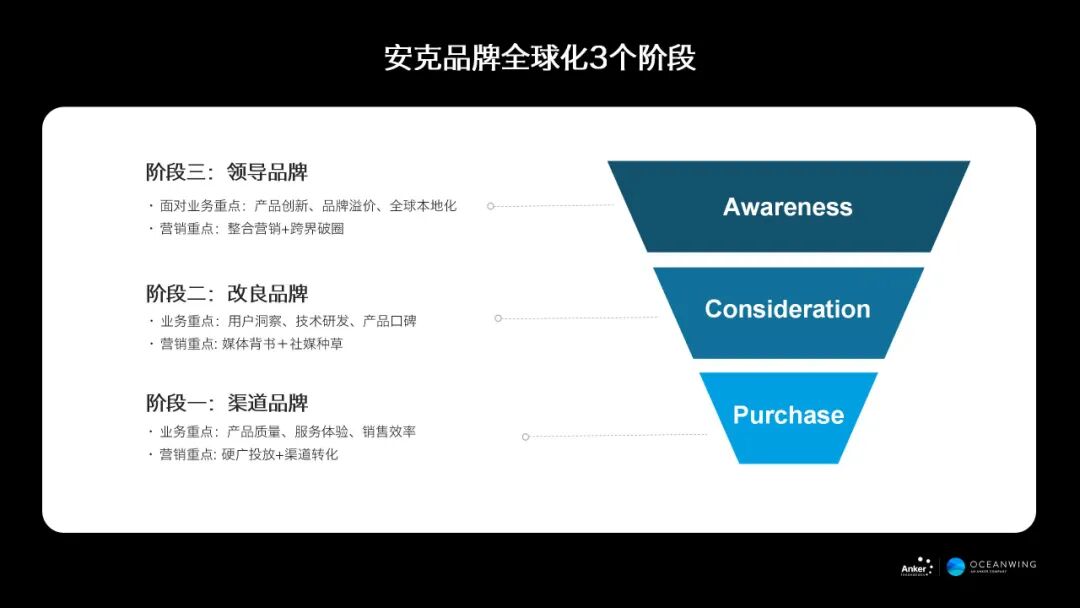
Anker's brand globalization has gone through three stages. Initially, similar to most Shenzhen export sellers, it was a channel brand. First look at data to discover pain points in a category, develop our own product, find better supply chain production, then run ads and maximize channel conversion.
The second stage was the改良 brand stage, strengthening user insights, building moats through technology R&D, continuously accumulating product口碑, and also doing more social media marketing and branding.
Today Anker's goal is to become a leading brand in target niche industries. We emphasize product innovation, improving brand premium, and also practice global localization, paired with integrated marketing and more cross-boundary breakthroughs.
Case: The Three Stages of Headphone Brand Soundcore
In 2017, we saw that Bluetooth headphones around $30 had the highest shipment volume on Amazon; we combined consumer pain points to launch products. Gradually we found that relying on low-price competition was unsustainable. In 2019 we launched改良 innovative TWS headphones, while strengthening marketing efforts, raising the average price to around $80. In 2022, starting from consumer needs, we defined a leading innovative TWS headphone product with an average price of $169. For integrated marketing, we also used Grammy-winning sound engineers as an entry point to strengthen brand mindshare.
Today, Anker is shaping Chinese consumer electronics brands in global markets, having successfully built the smart charging brand Anker, and subsequently launched smart hardware brands including Eufy, Soundcore, and Nebula. The ability to quickly build new brands owes much to the intelligent empowerment system behind it.
Consumer Insight-Centered Intelligent Empowerment System, Helping Anker Break Through
The so-called "intelligent empowerment system" is based on consumer insights, providing intelligent empowerment across all value chain links including operations, supply chain, product design, brand strategy, and channel marketing.
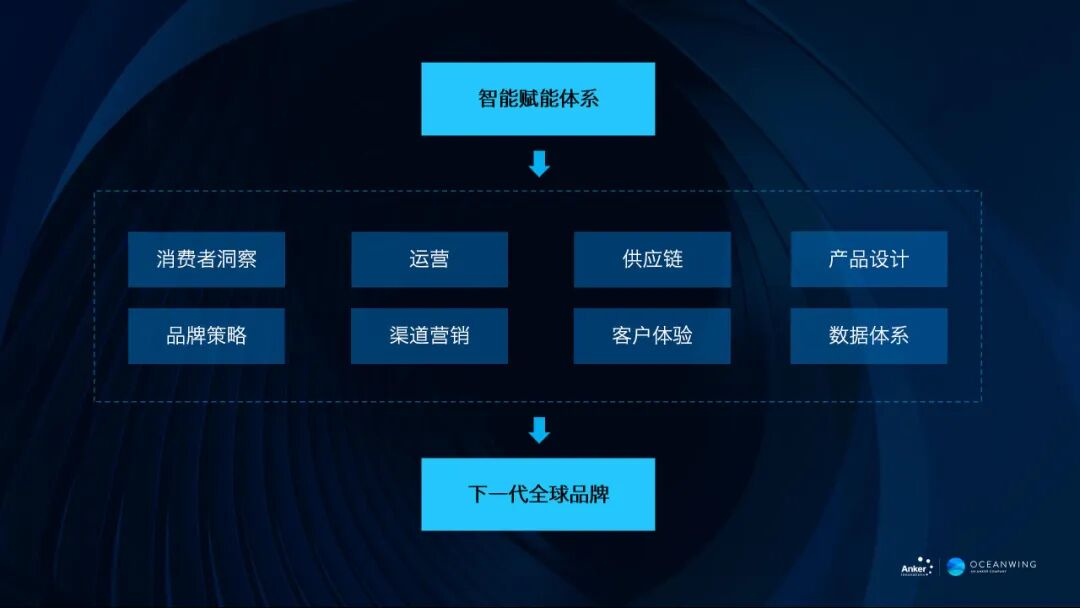
The core of the intelligent empowerment system follows first principles — something all brands agree on: the core of a brand is creating value for consumers, so this system is centered on massive consumer insights.
The intelligent empowerment system mainly comprises two parts: omnichannel VOC (Voice of Customer) and AI technology. Omnichannel VOC data includes Amazon reviews, user feedback, Q&A, social media dynamics, and hotline call feedback; the data then undergoes AI semantic analysis, semantic tagging and classification, user profiling through tags,还原 product usage scenarios, and洞察 user needs.
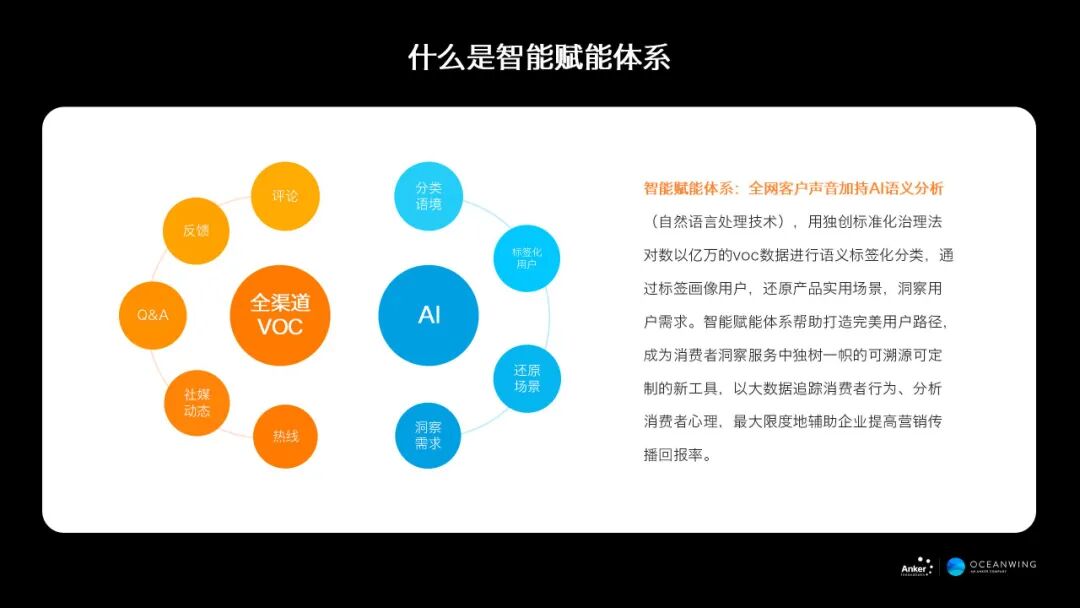
The biggest difference between this system and previous data systems is that data is no longer static, but real-time and dynamic. Today, relying solely on static historical data cannot achieve leadership.
Based on the intelligent empowerment system, Anker's brand-building strategy becomes clearer. First identify user needs, create differentiated innovative products, pair with coherent marketing, and finally return to users, focusing on user perception and feedback, then back to new products.
Specifically for brand breakthrough, Anker's differentiation lies in using big data and intelligent insights for overseas market analysis, product-market fit, competitive environment, and consumer needs analysis, to do product positioning; at the brand planning stage, we still start with the end in mind and return to consumers; when all big data is aligned, then advance integrated marketing communications.
Case: How Anker's Smart Security Products Achieved Breakthrough Innovation Based on Consumer Needs
When we entered the US smart security category, it was already a "wolves ahead, tigers behind" situation. Through consumer insights, we found several core consumer needs at that time. First, most products then were based on cloud storage technology, but as consumers grew more privacy-conscious, cloud storage carried certain risks; we chose to replace it with local storage solutions. Second, traditional devices had续航 shortcomings; based on Anker's technical accumulation in charging, we achieved 365-day standby, which users perceived very strongly. Third, addressing US consumers' installation pain points, we invented a magnetic screw patent, paired with anti-theft sensors. These were real consumer needs, while making products higher-definition was not a true need. For marketing, we also focused on consumer needs for core selling point refinement: "no monthly fees, no wiring needed," paired with full-scenario demonstration,全域种草, and private domain breakthrough, ultimately achieving focused force.
Intelligent Empowerment System: Powering the Next Generation of Global Brands
Today this intelligent empowerment system is also helping more export brands, empowering all links across the full chain.
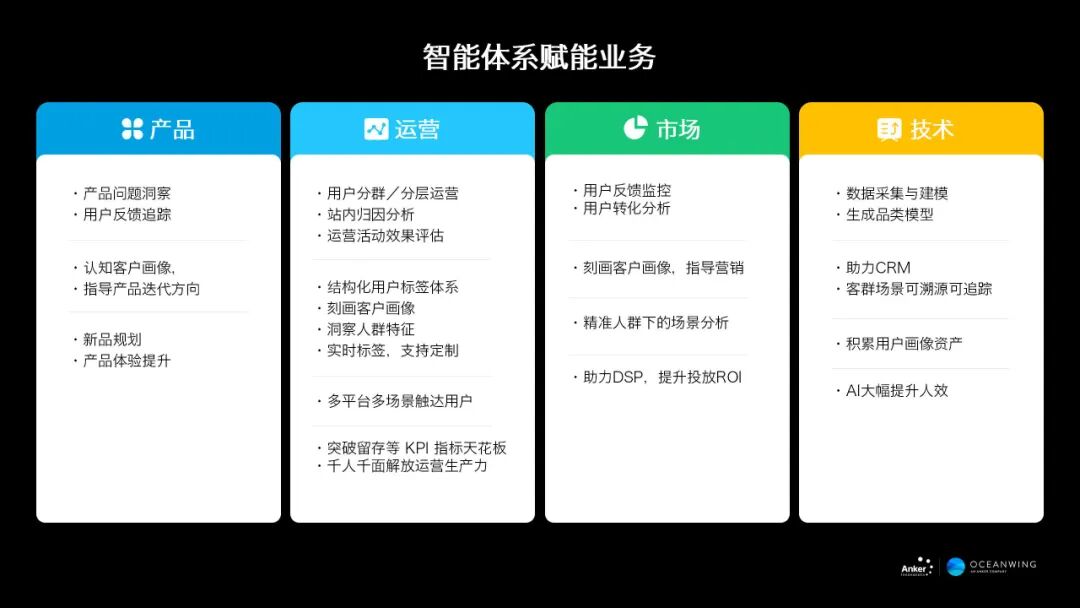
Product Dimension Helps with product problem insights, guides product iteration direction, improves product experience, and does new product planning. Operations Dimension Guides user segmentation/layered operations, structured user tag systems, achieving multi-platform multi-scenario user touchpoints, liberating operational productivity. Marketing Dimension Analyzes user conversion, guides marketing actions, improves投放 ROI. Technology Dimension Continuously accumulates data and user profile assets, also significantly improving human efficiency.
Looking at some specific link practices.
Product Planning
Based on scenario, performance, and material distribution of products at different price points, combined with core consumer concerns at different price segments, plan product roadmaps. Big data can't guarantee 100% commercial success, but it can at least improve the probability of commercial success.
Product Design
Analyze core concerns of different customer segments to inspire next-generation product positioning.
Product Iteration
Analyze customer churn timing, trace back to the product end;挖掘 churn reasons, accelerate product iteration. One thing Anker does successfully is fast with rhythm. In the past we also had some products that initially performed poorly; we would immediately analyze, find reasons, help the product end find iteration direction, and feedback to the supply chain end for rectification and upgrade at the first moment.
Marketing
Based on user基础 data, ethnic classification, and analysis of user behavior before, during, and after purchase, make marketing more precise and effective.
Advertising Creative
VOC also helps creative visualization, making target customers empathize. There's an interesting case: we helped a furniture brand with种草, promoting a floor lamp. Over 90% of listing images on the market showed sofa and floor lamp combinations, but in reality more consumers placed the lamp beside recliners; so we launched corresponding combination images, creating resonance with consumers and helping improve sales conversion rates.
Intelligent Upgrade of Advertising投放
For low-value links like data整理 and投放 action execution, implement automation; for high-value投放 decision links, through operations experts' "投放 rule extraction," continuously validate and improve, ultimately enhancing advertising effectiveness.
Export Channel Strategy: Advancing Toward Global Omnichannel
Amazon/Third-Party Platforms vs. Independent Sites?
Amazon and major platforms bring sales and traffic; independent sites help build brands, most importantly accumulating users. Our recommendation is: if a category inherently requires building a brand, then commit to running independent sites well from the start; if some categories' attributes are more suited to running sales volume, then leveraging platforms in early stages can rapidly expand business.
Online Channels vs. Offline Channels?
Online channels' advantage lies in speed and relatively lower costs; offline channels have high barriers, require giving channels higher profit margins, and demand higher team capabilities, with brands often lacking negotiation筹码 in early stages.
But we believe offline channels still need to be pursued. First, offline channels remain very strong in Europe and America, such as Walmart, Costco, BESTBUY, etc.; second, offline channels provide natural, direct brand exposure. We also hope Chinese export brands can build brand premiums, thereby gaining advantages in channel negotiations.
Global Omnichannel
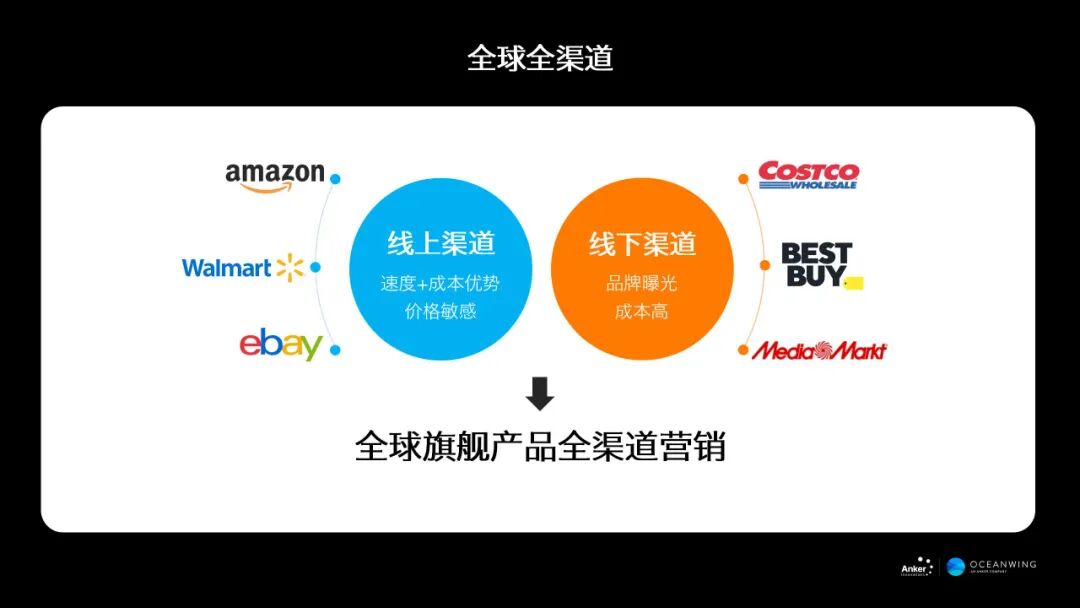
Of course, all export brands wanting to become world brands will certainly need global omnichannel marketing. Today Anker's global flagship products are planned for global omnichannel, easily exploding together at the same time point.
Finally, "long-term operating profit thrives on systems, withers on improper competition." Today export brands must continuously improve fundamentals in procurement-sales-inventory-returns, new product iteration, refined operations, and compliance, while using intelligent systems to improve operational efficiency at every link, and making the creation of omnichannel integrated consumption experiences a long-term strategy.