How to Manage and Motivate Organizations Well? Huawei's Former Head of Financing: Respect Human Nature, Distribute Money Right, and Live in Fear | Ronghui

Focus your force through a single point, and the returns will flow through that same point.

Organization is what turns strategy into reality and fuels enterprise growth. Huawei's organizational performance management and corporate culture have long been a source of fascination for founders.
There's no shortage of commentary on this topic. This article comes from a talk by Taiwen Wang, former head of Huawei's corporate finance department, at a Huawei Cloud & Gaorong Ventures private salon. Wang spent 24 years at Huawei, and over a five-year period helped the company secure nearly 300 billion RMB in global financing. He describes his two decades at Huawei as "running a marathon at sprint speed," constantly feeling the pressure from the front lines of the market.
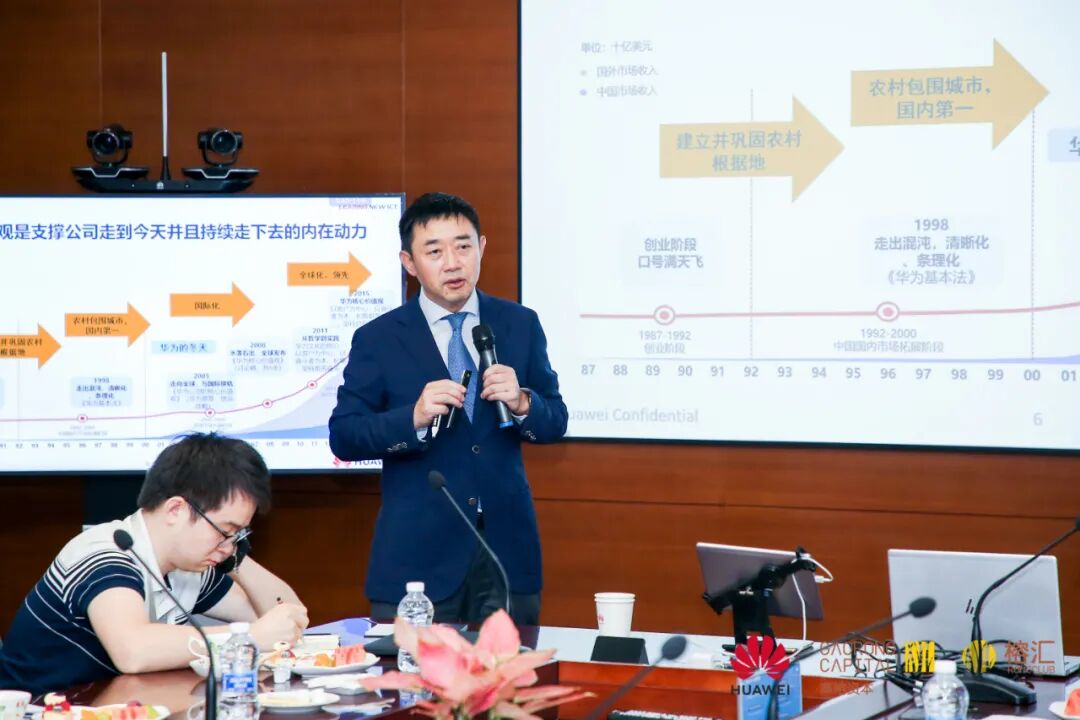
Drawing from his personal experience, Wang delivered a grounded, visceral talk from someone who was close to the battlefield. He tackled questions founders care about in plain, accessible terms:
- What is the essence of Huawei's corporate culture?
- How should we understand the meaning of Huawei's core values?
- How does Huawei use mechanism design and organizational transformation to keep the organization perpetually energized?
- How does Huawei get compensation right to motivate employees to work hard over the long term?
The following is an edited transcript of Taiwen Wang's remarks:
In 1995, I remember having only 1,000 RMB to my name. I spent 750 of it on a plane ticket to Shenzhen — the most important venture investment of my life.
I came to Huawei from the state-run Posts and Telecommunications Research Institute, and later became deputy director of the Guangzhou representative office and director of the Group Marketing Management Office.
In 2000, Huawei made a pivotal decision: we had to go out and find food. The company divided the world into eight regions, launching what we called our own 25,000-li Long March overseas. I was assigned to the Asia-Pacific region, first going to Malaysia to help set up the office.
Later, my boss asked me where I wanted to go. I said just one thing: "Send me wherever it's toughest." And somehow they actually sent me to the most grueling place — the Golden Triangle — where I became chief country representative for Southeast Asia. A few years later I returned to China and moved to the finance department, working on corporate financing. Over the next five-plus years, I secured various currency credit lines for Huawei globally that amounted to roughly 300 billion RMB, from financial institutions in Tokyo, Singapore, Hong Kong, Frankfurt, Paris, London, New York, Dubai, and elsewhere. I officially retired last year.
Huawei's Corporate Culture Starts by Acknowledging Human Nature
Looking back at my own path, you may have noticed that I kept asking to go to the front lines, to tough places. Why? Because that's the only way to "get promoted and get rich." Second, I was always searching for my own value. That's Huawei's organizational culture.
How did this culture form? When an employee enters a new organization, they're constantly "modeling" — figuring out what the boss likes and doesn't like. Employee behavior patterns are strongly tied to mechanisms and management systems. And mechanism design stems from what the core management team resolutely advocates and opposes — that's values. Values are constantly shaping decisions, because internally you believe you're making the right choice, knowing what's good and what's evil.
Core values are decisive in mechanism design. Mechanism design guides and shapes employee behavior. And that ultimately manifests as corporate culture.
Every enterprise has certain assumptions — even hidden ones — when designing its management system. What was Ren Zhengfei thinking when he founded Huawei? First, he knew he was a grassroots entrepreneur with no background to rely on, and that as a business, you have to make money to survive. Second, Huawei's industry follows only one law — the law of the jungle. When Huawei was born, it looked around at competitors like Alcatel, Lucent, Siemens, Nokia, Ericsson, NEC, and Fujitsu. So Ren said from day one, Huawei was actually fighting an international war. Third, once established, the company needed to attract employees. What would attract them? Why did I come to Huawei? Simple — at the research institute I made 500 RMB a month; at Huawei I could make 3,500.
And early Huawei was pretty chaotic. Every month on the 15th I'd go to the bank to check my passbook, and you'd find they'd added 100 RMB this month, 150 the next. Very crude, very simple — but we loved it. Precisely because there were no rules, it felt attractive, full of mystery.
So what did early Huawei rely on? First, a very clear understanding of human nature. People work hard to make money. Selfishness and the desire for comfort are the first things you have to acknowledge. Why do people strive? To improve living conditions for themselves and their families. Why strive today? So you don't have to strive tomorrow. When designing management systems, you have to think from the most universally applicable angle.
Making a High-Speed Train Run for 100 Years: Huawei's Core Values as a Power System
You've probably seen Huawei's core values: customer-centricity, dedication to those who contribute, long-term hard work, and continuous self-improvement. These four sentences actually have internal logic. They're an interest-driven mechanism — or rather, Huawei's power system.
First, Ren said a company must survive and make money. Where do you make money? Only from customers. So we must have "religious devotion" toward customers.
What is a dedicated contributor? Simply put, someone who makes money for the company. What is hard work? The official definition is creating value for customers. In Ren's words, you provide service or sell something to a customer, the customer takes money out of their pocket and gives it to you, and happily gives you a thumbs-up — that's creating value for customers.
And Huawei emphasizes dedication to those who contribute. It has never said "people-oriented" or "employee-oriented." Because everyone who enters Huawei, after orientation and reading Ren's articles, knows very clearly that Huawei is a private enterprise, and nobody knows how long Huawei can survive. Ren talks about this constantly — whether it's "Huawei's Winter" or "Will Huawei Be the Next to Fall?" What's he doing? He's saying we don't know how long Huawei will last, we don't know how long you'll last here, and whether you survive depends entirely on whether you create value for this enterprise.
Once our cohort accepted this language, we realized we had to keep running, constantly find our own value, to have a place to stand. Only after this ideological acceptance would the subsequent HR policies be embraced.
Ren said that for decades we fought while summarizing, trying to find the underlying logic of success. When these four sentences emerged, he said we could finally explain ourselves, forming a closed loop in management and business logic.
I've summarized it this way: These four sentences are actually a high-speed rail system. Customer-centricity answers where we come from and where we're going — starting from customer needs and going toward satisfying them. Dedication to those who contribute is the power and driving force. Long-term hard work addresses whether this power system can keep running over time. Continuous self-improvement is actually a correction system — the road forward may be winding, we may take detours or even go backward, but if the company has a spirit of self-criticism, it can adjust back to the right track.
Solve the whole system, and this train has a chance to run for 100 years. That's Huawei's most fundamental business logic.
Designing Management Systems and Mechanisms to Keep the Organization Perpetually Energized
In 1998, Huawei's Basic Law required participation from all employees. At the time I didn't really understand it. It was only when I looked back last year that I was, without exaggeration, stunned.
Article 1: "Huawei's pursuit is to become a world-class leader in the electronic information field." Second sentence: "In order to make Huawei a world-class equipment supplier, we will never enter the information service industry" — meaning even then, Ren had already forced himself onto a single path up Mount Hua with no retreat. He could only do this one thing, and only by doing it well could he survive. The third sentence: "Through market pressure transmission without dependency, internal mechanisms will forever remain activated." Reading this, I felt it deeply, because for over twenty years at Huawei, I truly never stopped feeling pressure transmitted from the market front lines.
And once Ren cut off all retreat for himself, what came next? Naturally, making sure everyone else had no retreat either — we're all in the same boat, living and dying together.
So what did Huawei later propose? "Single focus, shared benefit" — li as in force, and li as in profit. Thus Huawei's human resources has always pursued two values: making employees charge forward, and keeping the organization perpetually energized.
So when you find your organization lacks energy, your employees lack fighting spirit, you should first examine whether the management system has problems — not blame the employees.
To keep the organization energized, Huawei has also continuously pursued organizational transformation. Early Huawei was highly centralized. But as the business globalized, management problems became severe. Centralization brought inefficiency, bureaucracy, and declining customer satisfaction.
Economist Ronald Coase said a firm's expansion boundary is where its internal transaction costs equal its external transaction costs. Around 2007, Huawei's front lines were generally reporting that 70% of their time was spent on internal coordination — internal transaction costs had become too high.
So in 2009, Ren published an article in Huawei's internal magazine with the theme "put the command post where you can hear the gunfire." In 2010, among Huawei's top ten management priorities was making this a reality, turning it into a company-level initiative with a designated project team led by the head of the Finance Management Committee.
Huawei's solution was resource trading. Simply put, it created an internal market, putting all company resources on the shelf, clearly pricing each department's resources and capabilities for frontline project teams to purchase. For example, a Level 3 expert costs this much per day, a Level 5 expert that much.
Previously, headquarters held power and resources, and frontline teams had to do internal PR to get them. Now it was reversed — the company's budget followed strategy, and strategy-related budgets went directly into projects. Frontline had money but no capability; back end had capability but no money — it became a trading market. We used to constantly debate how many headcount this or that department had; after becoming a trading market, if market demand was strong, headcount naturally grew.
Behind this, Huawei also did massive transformation and infrastructure work, such as internal pricing and real-time IT support. We had to account every cup of water on a business trip into a project — only by doing this could frontline know exactly how much money they had to call in fire support.
Of course this cycle was very long, involving finance, business operations, human resources, IT systems, and more. Designated a priority in 2010, we're still implementing it today.
After designing this system, we also built in additional features. For example, we designed a human resource pool with a nice name: "Strategic Reserve." If Employee A wants to transfer, they just fill out an electronic flow to voluntarily enter the pool, their original department must release them unconditionally, and a new department immediately picks them up. Or if an employee needs knowledge储备 for a new position, they're first sent to Huawei University or the Strategic Reserve for training, then take certification exams, and upon passing, assume the post. Another scenario: if an original department doesn't want an employee, they're also sent to the Strategic Reserve. If their fundamentals are solid they might pass certification and start the next day; three months without placement means demotion and pay cut; six months without finding a new position, and unfortunately they have to leave. So the Strategic Reserve's opportunities are fair to everyone — whether you get out depends on your preparation and capability.
Through this Strategic Reserve mechanism design, we're actually enabling long-term hard work. As the boss says, keep your eyes on the customer and your backside to leadership. But without proper mechanism design, if you just make demands of employees, do you think they'd dare? We must design the mechanisms first, otherwise we sacrifice a generation of excellent young people.
Getting Compensation Right: Encourage People to Be Lei Feng, But Never Let Lei Feng Down
I believe Huawei's culture, at its core, is a "compensation culture." Ren said the thing he did most right was getting compensation right, and that getting compensation right solves 70% of management problems.
So how do you get it right? Many people think Huawei just pays a lot. That's not it — the key is getting it right. Essentially, encourage people to be Lei Feng, but never let Lei Feng down.
What must we do? You must properly evaluate employee value and distribute value accordingly. Only when the value cycle model is established will people desperately create value. This absolutely cannot be dumped on or delegated to HR. Professionals can provide tools and methods, but business unit leaders must personally do this themselves. And creating value for customers is the direction and measure of value evaluation.
So how do you get employees to work hard over the long term? Huawei has an incentive system emphasizing total rewards, controlling fixed costs while increasing variable ones, and breaking balance to create gaps. It's essentially "the fearful survive" — only those who feel constantly uneasy can survive at Huawei.
We often hear companies say they face the problem of activating veteran employees. Huawei has many methods.
First, our professional qualifications have expiration dates — only two years. No matter how senior you are, after two years you must re-certify, and you must provide evidence. Pass and you continue; fail and you step down.
Huawei also has末位淘汰, and it's layered and graded. This avoids always eliminating new employees. And managers face rigid 10%末位淘汰 — even if everyone hits their KPIs, 10% still go.
Huawei also resolutely opposes福利化, so there are no lifetime employees.
Another point: many veteran employees hold lots of stock. The longer they're at the company and the more stock accumulates, equity incentives become福利化. What to do? Initially the company set the ratio of stock to salary+bonus at 3:1, causing many veterans to lose their drive. Later Huawei changed it to 1:3, solving the problem.
There's also the retirement mechanism. If someone truly can't keep going, the company would rather pay to buy back their opportunity, making room for young, fighting, hungry talent.
So looking back at the whole mechanism, it's very much like a three-stage rocket launching a satellite. I describe my 20-plus years at Huawei as running a marathon at sprint speed. I hope this sharing of Huawei's organizational incentives and corporate culture can offer some inspiration to founders in rapid growth — so that as business scale expands, the organization continuously reduces entropy and stays vibrant.


Hangzhou NationalChip Technology Completes Hundreds of Millions RMB Series C Funding