How to Use Communication to Resupply Your Organization with "Emotional Ammunition" and Work Motivation | Ronghui Practical Sharing

How many founders simply can't communicate — or have never even learned how?

For founders, communication seems to be happening all the time. Bu Huahua, co-founder and CEO of Dedao App (得到App), recently shared her insights on communication and organizational management at Ronghui (榕汇), drawn from her entrepreneurial journey. She pointed out that "many founders think they've communicated, but they actually haven't." Many management problems in startups are really compensatory effects of insufficient communication.
And every "number one" (一号位) — the person at the top — can profoundly shape an organization through the design of communication spaces, frequency, and atmosphere. Creating a sense of meaning through communication is the responsibility of any excellent organization.
Bu Huahua also shared with founders how to build meaning through communication, the underlying principles of effectively motivating employees, communication methodologies for high-frequency scenarios like motivation and coaching, and practical experiences distilled from initiatives like "writing weekly reports to your next level down" and "open-sourcing work manuals."

The following is an edited transcript of Bu Huahua's sharing:
For the past two years, I've been researching the topic of communication. The reason is simple: Dedao got bigger. When we first started, we always thought we wanted to be a small but beautiful company. But after a little more than a year, we criticized ourselves for that. Everyone who claims they want to be small and beautiful simply hasn't had the opportunity to get big — all founders are "greedy." And when a company wants to solve more problems and provide more services to users, organizational expansion becomes a very hard trend to stop.
Starting last year, we faced an enormous challenge: more and more colleagues were greeting me at the company, and I didn't recognize them. That told me something was wrong with our management and internal communication. So for a while now, especially after the pandemic, we've spent a lot of time discussing the reconstruction of our internal organizational management and communication methods. We've overturned some practices that were naive, even ones we were once proud of. Today I want to share what I've summarized from several years of entrepreneurship — more accurately, lessons learned from failures.
Emotional Resources and Work Motivation: Creating Meaning Through Communication
The best line I've found about communication comes from George Bernard Shaw — "The single biggest problem in communication is the illusion that it has taken place." This is the problem of many founders: thinking you've communicated when you actually haven't. It happens everywhere.
I once visited a founder friend. During our meeting, his colleagues kept coming into his office to ask for instructions and report on things. Afterward, he said, "See how exhausted I am? I spend so much time communicating, but they just don't get it." I said, "Brother, I really want to remind you: you are not actually communicating with them. When they came in to talk to you, I only heard you talking. The employee got lectured by you for half an hour and then left. You didn't even ask them, 'Did I make myself clear?'"
I'll also share a story of "airing dirty laundry" — a soul-searching conversation I had with one of our programmers. Dedao has always held our tech team in high regard. We never cap their budget or headcount. One day last year, a god-tier programmer cornered me and said we needed to have a serious talk. He'd been at the company for four years. This was his first one-on-one conversation with me, and the first time he'd learned that the company values technology. I was devastated. I asked, how can I make the tech team feel my appreciation? He said I should come to the tech team more often to yell and express dissatisfaction. At that moment, I truly felt "a thousand arrows piercing my heart."
Then he mentioned two other grievances. First, the company never holds all-hands meetings — and he specifically meant the kind where leaders get on stage and lecture everyone. The reason was that he didn't understand the company's big-picture strategy. And we're a company whose strategy changes frequently. Every time there's a change, the tech team feels they have to go "move bricks again." Even a very senior programmer felt his work was just moving bricks. He said something very heavy at the time: "I feel my work has no meaning at all."
The second grievance was that the company never gives out perks. We used to think people didn't need that box of mooncakes at all, and we'd convert perks into cash instead. In reality, of our more than one hundred programmers, half are from rural families. Their parents have no idea what kind of work they actually do. Giving out mooncakes was a rare opportunity for their parents to know they worked at a big, proper organization.
The impact of this conversation on my soul was enormous. I wrote a long note overnight and sent it to the founding team. There was so much we could have done in terms of communication that we didn't do. We underestimated what others expected from a company or its founders. We thought we'd created jobs, given employees great development opportunities, and respected them. But in fact, in today's era, when someone joins a company, it's absolutely not just for a job.
Once, an anthropologist spent 20 minutes in my office and told me, "Your company isn't a company at all. It's a tribe — birth, aging, sickness, death, and social life all happen within the tribe." Our young employees, she said, are like people living in a primitive tribe — going out to hunt together, coming back to roast meat together. This anthropologist warned me that I needed a tribal elder's sense of responsibility. Being responsible only for their work is not enough.
Now we give out zongzi, mooncakes, and New Year gifts every year, and we've genuinely felt that it makes a difference. What is the essence of these things? In organizational behavior, there's a very important theory called "emotional resources." For anyone to fully commit to work, besides their abilities and physical energy, there's another crucial element: emotional resources. For many employees, organizations or jobs are like pumps — constantly extracting emotions while rarely replenishing them, until the employee is emotionally depleted. Then either you let them go, or they leave you. So if someone on the team has lost their drive, it's very likely they no longer have the emotional resources to secrete dopamine and can't engage in battle.
Why wasn't this problem so prominent in the past? In the past, the work unit wrapped around the individual in 360 degrees. People who worked at a unit often also lived in its residential compound. This connection formed sustained emotional support for a person. Today, to take a job, employees have already been largely disconnected from their original social environment.
Besides emotional resources, another headache for all founders is employees' "work motivation." I'm a post-70s generation. For my generation, work motivation wasn't a problem at all — if you didn't work hard, you simply couldn't survive in Beijing; but if you did, there was a chance to buy a home and start a family here. For younger employees today, such visible work rewards have become blurred, and work motivation has weakened accordingly.
The famous sociologist Richard Sennett wrote in an essay titled The Fall of Public Man a golden line: "Narcissism is the new Protestant ethic of our time." That is, today everyone is self-centered, and narcissism is the premise. So as founders and managers, whether facing people in society or internal employees, how to leverage this trend to do management and communication well becomes very important.
Professor Li Yuhui at Renmin University of China is an expert in organizational behavior. She said something: "The responsibility of an organization is to create a sense of meaning through communication." Today's organizations should not assume that employees will come to you with a sense of meaning and mission. John Mackey, CEO of Whole Foods, also said that if a company fails to create a meaningful workplace, it represents "the shame of management." You created a company and an organization — it should inherently give meaning to everyone.
So how do you create meaning? In the past, we'd spend a lot of money hiring consulting firms for management consulting. But in fact, many management problems we encounter are compensatory effects of insufficient communication. If managers at every level could fully communicate with superiors, subordinates, and partners, and create a sense of meaning in work, we wouldn't need to spend so much on so-called organizational transformation. In the end, you'll find that effective things boil down to two: first, the founder spends all their time on hiring, bringing in stronger people; second, once they're here, create a good communication atmosphere so strong people can talk to each other properly and want to work together.
Three Practical Experiences for Founders
Next, I'll share three small experiences from our practice to help with effective communication and giving meaning to teams. Many founder friends have tried them and the feedback has been very good.
1. Write Weekly Reports to Your Next Level Down
Today, probably 80% or more of companies have weekly reports as a requirement from superiors to subordinates. The more junior the employee, the more they have to write weekly reports. Frontline salespeople definitely have to write them. The vast majority of CEOs don't write weekly reports. Our company adopted a mechanism of writing weekly reports to the next level down. We built a template on Lark, and by 24:00 every Friday, starting from the founders, everyone writes their weekly report level by level down, with the default recipient being their next level down.
There are several key points. First, writing to your next level down carries an implicit message: if you don't have subordinates, you don't have to write. But in reality, people without subordinates are the most willing to write, so we successfully received weekly reports from almost everyone. Second, we made it explicit that the report's audience is the next level down. For me, the audience for my weekly report is all the business and function heads in the company. Third, we set a template for the weekly report with four items — last week's work, next week's work, reflections and insights, and视野和情报 (horizon and intelligence). Any of these can be left blank.
Then magical effects appeared. For me, I only need to look at the "horizon and intelligence" section in middle managers' weekly reports to know who has leadership potential. It's very simple: if this section is often left blank, it means this person's learning ability has hit a bottleneck, and they won't be able to lead a team either. So it became a magical measurement tool.
Another surprise was that our weekly reports are by default open to subordinates, with the option to open to the whole company. As long as one department head chooses to open to the whole company, everyone else in other departments will follow suit and open fully. Then employees can horizontally compare how all the directors are doing. So ever since we started writing weekly reports to the next level down, HR received a large number of internal transfer requests. Once such a mechanism gets going, it has an unexpected forcing effect. If a director doesn't perform well and doesn't "show proper respect" in reporting to subordinates, those subordinates will want to go somewhere else.
Earlier we said that "narcissism is the Protestant ethic of our time." Reporting upward with weekly reports violates this principle; writing for the level below aligns with it. For managers, it's also excellent training — training in how to systematically reflect on your own work, and a way to deepen mutual understanding through cross-departmental horizontal "memorial review."
2. Public livestreams of meetings and open-source work manuals
From day one, we've built a series of practices around "openness." In Dedao's earliest days, every Tuesday evening we would livestream our internal meetings to users. All our data — DAU, revenue, bugs, complaints — users could see it all. Later a small team began publishing meeting minutes to users weekly. You can't imagine how seriously users took it; that team spent enormous time each week processing user feedback on the minutes. We'd also announce new initiatives in these meetings, and constantly users would tell us: "What you're trying to do, I happen to have resources for, I can help." This created a wonderful tradition that broke down the wall between Dedao and its users.
But the biggest help this gave us was in motivating employees. Because we livestreamed meetings so often, virtually every skilled person at our company became known to users — and the emotional replenishment this provided employees was beyond what managers could imagine. An employee's ambition, their sense of responsibility to the boss — that might be performative. But responsibility to a user who genuinely loves your product? That's real.
We also open-sourced Dedao's work manual, called the Dedao Quality Control Manual, covering operational procedures for all work. We began writing and open-sourcing it in our first year of business; to date, 600,000 people have downloaded it. The results of open-sourcing have been remarkable. We've experienced genuine user participation — many users have been even stricter than our own quality control department in participating in Dedao's content production. For an educational content company, this is extraordinarily valuable.
Open-sourcing the work manual also let us connect inside and outside, laying the foundation for communication. For example, when Dedao for Youth first started, it needed to engage with many schools — and unexpectedly gained a lot of recognition. Teachers at schools had downloaded Dedao's work manual and used it as reference for writing their own teaching manuals.
3. The longest credits scroll in history
Dedao holds an annual New Year's Eve speech, and at the end there's an extraordinarily long credits sequence. The first year we did this, the company had only 50 people; we put everyone's name in the credits. Today we have 500 people, and we still insist on putting everyone in. When we sign contracts with TV stations, we require that the credits not be cut. The reason is simple: for our employees, this is the one chance each year to call their parents and say, "My company is going to be on TV, and you'll see my name at the end." I've also noticed that many employees will absolutely stay up until midnight watching the credits roll. This moved me tremendously.
All entrepreneurs: if you have the chance to replenish emotional resources for your employees, to create some sense of meaning — do it. And in the vast majority of cases, it doesn't cost money, but it helps organizational atmosphere enormously.
The underlying principles of team communication
The two things I spend the most time on at the company now: first, monthly training. To this day I insist on teaching every new employee's first session — about three hours each time. These three hours cover only one thing: mistakes we've made in our history and our reflections afterward. Employees absolutely love it.
The U.S. military has a method called AAR (After Action Review); Huawei also uses this in management. Simply holding retrospective meetings isn't enough. The scenarios and challenges we face change constantly over time; experience doesn't transfer directly. But reflection after action is useful — you must reflect on what you were thinking at the time, not just what you did. Only this way is it useful for employees to inherit the company's culture and values.
The other thing I spend a lot of time on: one-on-one conversations with everyone. The importance of one-on-ones is severely underestimated. Every month I tally the total hours of one-on-ones in my calendar — this is my only metric for myself. Many CEOs feel they have too much to say; often in a single meeting, the CEO talks longer than the sum of everyone else's reports combined. This impulse to talk is terrifying. One-on-ones give us the chance to listen to others. And listening is a skill that needs training — otherwise you don't know what to listen for, or how to categorize and process what you hear.
1. Start with structured listening: distinguishing emotion, fact, and expectation
In my new book The Communication Method, I summarize a technique called structured listening: separating out the emotion, facts, and expectations in what someone expresses. There's a problem that many new managers frequently encounter: an employee suddenly quits. In reality, before this seemingly impulsive act, the employee has sent you emotional signals countless times — and you never received them. It seems sudden to you; for the employee, it's the final eruption after enduring beyond limits.
What is emotion? If someone can tell you they're angry or disappointed, that's already remarkable — someone with very good communication training. People tend to package all emotion as fact. In fact, emotions have "road sign words." Whenever these words appear in someone's expression, no matter how rational and evidence-based they sound, ignore the content. These road sign words include: always, constantly, often, never... Once these words appear, you don't need to listen further — it's unhappiness. In fact, the objective cause of the unhappiness isn't important; solving the unhappiness isn't important. Recognizing the unhappiness is what matters.
In one-on-one conversations, we must be like card readers, accurately identifying the other person's emotion. Once identified, just one sentence: "I know you're very anxious / very worried / very angry right now..." If you can read the other person's emotion, the conversation is already more than half successful.
After reading emotion, there's a universal question that's especially useful for managers: "What do you need me to do for you?" We rarely asked this before, because we unconsciously assumed we knew what we could do for the other person. But if you make a habit of asking your team, you'll find their requests can be "bizarre." You're thinking about how much bonus to give them; the employee's request turns out to be whether mooncakes can be distributed. So in one-on-one conversations, whenever you have the chance to ask this question, you'll find employees can absolutely be sorted out — their emotions stabilize, they enter a discussion state with you, you become collaborators.
I used to often observe our graduates from top schools and found their work state was off in their first six months. I finally understood: they were treating work like an exam. Getting a task from their manager was like the teacher handing out the test paper — then they'd start a closed-book exam, working alone in silence until things collapsed in their hands, leaving them deeply frustrated. So we need to correct employees: work is not an exam, or at least not a closed-book exam. You can look things up, you can ask the teacher, everyone has an obligation to help you.
As a manager, regularly asking "What do you need me to do for you?" helps employees gradually develop the habit of seeing their superior as a collaborative partner — someone to factor in when solving problems. This greatly increases the likelihood that employees will solve problems proactively and reach consensus with you.
For the three dimensions of expression, there's a "three-step" communication method: respond to emotion, confirm facts, and clarify action.
When communicating with each other, the first step is always to ask yourself whether you've responded to the other person's emotion — whether you've been an unfeeling card reader, reading their emotion. Second, confirm facts: often once you strip away emotion, 80% of the conversation content isn't fact. At this point, you'll find problems become very easy to solve.
Communication dilemmas frequently occur in cross-departmental exchanges — department heads often glare at each other, digging up old grievances without mercy. At this point, you need to raise the question: let's look together at what's emotion and what's fact, then jointly clarify what the next actions are. You'll find the vast majority of things become simpler.
2. Understanding communication style types, using more effective communication methods to motivate
In organizational management, you can also use organizational behavior science and certain tools for "scientific fortune-telling" — for example, communication style type assessments. Simply put, communication styles can be divided into four types: Controlling (Tiger), Expressive (Peacock), Conscientious (Owl), and Steady (Koala). These four types aren't good or bad, only preferences, and all four types in a team can learn from and communicate with each other. But if you can't transcend your own type to understand differences, conflict comes easily.
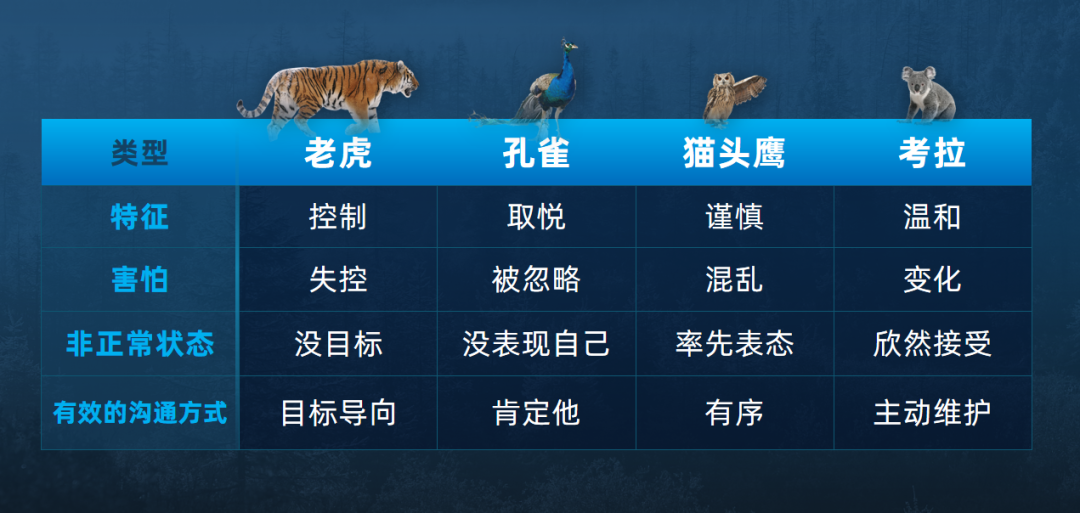
Tigers want everything within their control; once things slip from their grasp, they become extremely agitated. This type has very strong goal orientation. If you find a Tiger suddenly seems to have fuzzy goals, they're 100% considering leaving. Managers can think about what caused them to lose their sense of purpose, and how to help them rebuild it — that's the best motivation for them.
Peacocks' greatest strength is people-orientation; they're committed to making sure everyone gets along. The problem is weak goal orientation. Having this type on a team is very important; used well, Peacocks help create excellent team atmosphere, and some functions only they can fulfill. But Peacocks fear being ignored; effective communication means affirming them.
Owls are characterized by caution; they pursue order. So Owls are especially good at processes, with detective-like sensitivity to detail. When an Owl is the first to state a position in a scenario, that's their abnormal state — they're very likely not telling the truth. When recruiting senior talent, the match between a candidate's communication style and the position is very important; for example, CTOs and CFOs tend toward Owl types. But you must also consider team fit. When our company was looking for a CFO, because our business team was relatively dominant, we needed to find a Tiger-type CFO — someone unafraid of conflict.
Koalas are characterized by gentleness, very high cooperativeness, and fear of change. Koalas are excellent assistants, well-suited to supportive work. I don't recommend putting them in decision-making positions, because decision-making consumes too much for them — they need to withstand far more pressure than others to complete it.
What's the value of this communication style framework? First, it's a very mature assessment tool that can help you understand candidates better in interviews. Second, we need to recognize that people of different communication styles will inevitably create friction. For managers, you must first remove biases of liking and disliking, and use more effective communication methods to motivate the other person — rather than using our instinctive ways.
3. The frequency of communication is crucial
In 2008, MIT professor Alex Pentland conducted one of the most important experiments in organizational behavior and management psychology. He found an ideal sample: the call centers of a major American telecom company. Since every employee's job was identical, Pentland had each person wear sensors that recorded everything they said and how they allocated their time, then correlated this data with performance. Management theory had many hypotheses about high performance — perhaps team leaders were more charismatic, more assertive, more motivating — but none of these held up. What actually drove performance was how teams took their breaks. Because call center work is so intense, employees get periodic breaks. Some teams chose to rest all together; others rotated in shifts.
The results showed that teams who took breaks together performed significantly better. The content of communication didn't matter; frequency did. Taking breaks together did two things: it synchronized communication frequency across the entire team, and it created more informal communication during rest periods — moments when people build trust, exchange experiences, and pass along knowledge that never gets codified. This is incredibly valuable.
This case gave me a major insight: for managers, the design of communication contexts, frequency, and atmosphere can profoundly shape an organization.
I've visited companies where you can basically predict their trajectory from the office layout. There's an entire discipline called spatial sociology — changing space to change relationships between people. In reality, communication isn't about how you talk; it's about context design. For founders, how you set up the office, where you place the core executives' offices — these tangibly affect team communication dynamics. Steve Jobs designed Pixar's headquarters so that the main office floor made it deliberately inconvenient to reach the bathrooms. Everyone was forced to cross paths. For creative teams, creating opportunities for informal exchange is incredibly stimulating for generating ideas.
We recently did an internal exercise where we mapped organizational charts with two colors of lines representing communication frequency with others — one color for formal communication, one for informal. The results showed that the people you spend the most time communicating with are invariably your weakest performers; your most capable people, the ones you have the most rapport with, you communicate with far too little, especially informally. This inverted communication pattern is extremely common.
The same applies to clients. Your most difficult clients consume the most energy, while your best clients get the least attention — a misallocation of communication resources that needs fixing. There's an unwritten rule in consulting: every dissatisfied client is a client you didn't spend enough time talking to. So when communicating with clients, we can break down project processes and think about how to maintain the highest possible frequency of both formal and informal conversations to build better alignment.
4. Three Foundational Principles of Communication
Every founder can establish three foundational principles of communication in their company. First, openness: whether you can master an open communication style that expands mutual understanding. Second, constructiveness: whether everyone can use constructive language rather than easily negating others. Third, goal-orientation: whether you can continually return to problem-solving as the objective.
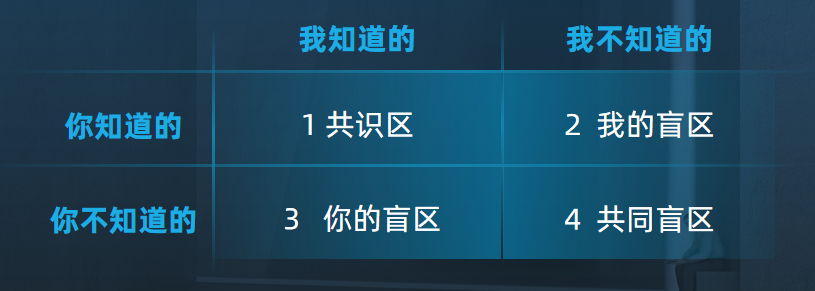
How to improve openness? First, work hard to eliminate blind spots and expand the zone of shared understanding. We know the Johari Window, which divides communication into the open area, your blind spot, my blind spot, and the shared blind spot. At work, we have far too many blind spots that we never see.
For example, Dedao's offline learning centers in various cities have class managers, and we have a policy that class managers cannot dine with students. The original intention was simple — to reduce burden on class managers. But a year later when we held a meeting to ask their opinions, the top concern was not understanding why they couldn't eat with students, feeling the company didn't trust them. This shows how important eliminating blind spots is — you can't emphasize this enough.
Second, build the habit of saying "we," transforming the other person's problem into a problem both sides need to solve together, and taking responsibility onto yourself. A few days ago in a meeting, I noticed two departments in a stalemate. I said stop — from now on, no one can say "you," 100 RMB penalty each time, only "we." You'll find the communication atmosphere changes substantively and immediately.
Third, learn to trigger the other person's openness. After each point you make, ask for their opinion. Don't ask "do you understand?" — ask "did I explain that clearly?" There are also several universal phrases, like the "what can I do for you" mentioned earlier, and the counselor's secret weapon: "and then?"
Next, goal-orientation. True goal-orientation isn't about saying "I want" all the time. It's actually the ability to find ways to achieve goals. So I say: goal-orientation = solution power. One very useful method is the "six months from now" technique. Many entrepreneurs are too eager to talk about ten years out; there's also the opposite extreme of only talking about the present moment, only giving orders.
Later I tried the "six months from now" technique with my team and found it very effective. Imagining three years out is hard for people today, but six months is imaginable, realistic, derivable, foreseeable, controllable — everyone can have a conversation in the same context. With younger employees, we need to restrain our impulse to talk about ten years, and communicate more about what we imagine six months from now.
To improve constructiveness in communication, we should advocate for executable minimum actions, sustainable action ladders, and timely feedback at each node. One reminder: don't use negative vocabulary. There are also some useful techniques, like saying "let's get this implemented," or "please give me more requirements."
Communication Methodologies for High-Frequency Entrepreneurial Scenarios
Next I'll share two communication scenarios that are particularly valuable for managers.
1. Motivation: True Motivation Means Building a Feedback Loop
Motivation is severely lacking in Chinese companies. What's lacking isn't incentive policies, but the motivation of meaningful work.
My favorite quote about motivation comes from Dongdongqiang: "First-rate sugar coating is itself the cannonball." Especially for the number one person in an organization — if you can motivate people and unite important people around you, you've already succeeded more than halfway.
Motivation is the core of leadership. Motivation is a more powerful communication tool than praise. If praise promotes relationship and interaction, making the other person happy; then motivation can drive the other person to change and move forward in the direction you lead. This is especially important for founders. Even with tremendous ability, you can't do all your subordinates' work for them — you can only catalyze their action.
There's a misconception in motivation — many people understand it as complimenting, but it's not. Motivation should have three steps. First, timely praise; more importantly, behavioral modeling — not just saying an employee did well, but pointing out exactly what they did well. Third, close the feedback loop: have the employee do it again to verify they really succeeded for that reason, then form it into experience, completing a closed loop of motivation. This turns a single compliment into the starting point for better action. Asking one more question — "how did you do that?" — pulls people out of mindless states and into model-based thinking to summarize daily behavior.
Huawei has an internal role called knowledge management specialist; we learned from Huawei and established knowledge management specialists in every department, tasked each month with identifying a new capability or piece of knowledge formed in their department, codifying it into the knowledge base so the entire team can later draw on this knowledge to solve problems, with periodic evaluation of this knowledge. This is essentially modeling excellent behavior. Many startups today are knowledge enterprises with too much tacit knowledge that lives in individual brains, not in the organizational structure — when people leave, the knowledge may disappear. So using mechanisms to turn tacit knowledge into explicit, quantifiable, manageable knowledge is especially meaningful.
There are also many motivation escalation techniques. By continuously "escalating" the formality of the occasion, our communication power grows stronger. For example, Haier has a motivation technique called naming — if an employee invents a process, workflow, or tool, it gets named after them personally. This motivation is extremely sustainable and effective, and also creates assets: both company assets and personal professional assets.
2. Coaching: Teach Action Methods, Not Values
Another important communication scenario is coaching. I believe that compared to training, what's more important is teaching the team to solve problems better in the actual work environment. Walmart founder Samuel Walton said, "Communication is management distilled." Communication itself isn't a management tool, but all management tools require communication to be implemented. One reminder: when we coach, we should teach action methods, not values.
It's not that values aren't important — it's precisely because they're so important that you can't teach them through words. Values can't be measured, but whether actions are correct can be measured; all values must be embedded in actions.
The same applies to communicating values externally. Dedao's mission is "to help everyone gain strength from knowledge" — simple and plain, but however you say it, it sounds like empty sloganeering. Later we realized that within Dedao's universe, countless people have changed because of learning here, so we started collecting and carefully telling these real stories. I also recommend that all startups, whether doing media interviews or spending heavily on launch events, should turn content into small, concrete stories — the effect is completely different.
Communication is actually like building a product; the work interface of communication is the other person's experience flow. A communication expert isn't someone who can talk well, but someone who can use empathy to sense the other person's experience. Many managers often feel "torn apart" because they're overwhelmed by countless details; through good communication design, we can help everyone find integration, bringing together the relationship between team and self, moving toward the infinite game.



12 Global To B Trends and 12 New Growth Models for 2021 | Ronghui To B Growth Camp