HYQubit Completes Series A+ Round, Accelerating Full-Scale Commercialization of Trapped-Ion Quantum Computing

Advancing quantum computing from scientific exploration toward industrial application.

HYQubit has completed its Series A+ funding round. The round was led by Jiantou Investment (the investment platform of China Jianyin Investment), with participation from China Securities Co., Ltd., CRRC Capital, and others. Existing investors including Baidu Venture, Beijing Information Industry Development Investment Fund, and Legend Capital also continued to increase their stakes. Gaorong Ventures led HYQubit's angel round back in 2022.

Leading China's Trapped-Ion Quantum Computing Race
This latest round comes less than six months after HYQubit's 2025 Series A — a fundraising pace and level of investor validation that puts the company ahead of the pack in China's trapped-ion quantum computing sector. The fresh capital will go primarily toward next-generation quantum computer R&D, deeper integration of quantum computing with AI, and commercial deployment in energy and communications.
HYQubit was founded by Luning Duan, an academician at the Chinese Academy of Sciences and director of the Center for Quantum Information at Tsinghua University. Its core team comprises over ten PhDs and postdocs from Tsinghua, the University of Science and Technology of China, and other top institutions. The company independently developed the HYQ-B100, a commercial trapped-ion quantum computer prototype capable of stably controlling 100+ qubits with gate fidelity and coherence times that rank among the best globally. The full technology stack is proprietary and domestically controlled. The HYQ-B100 has already been formally delivered to China Mobile Research Institute.
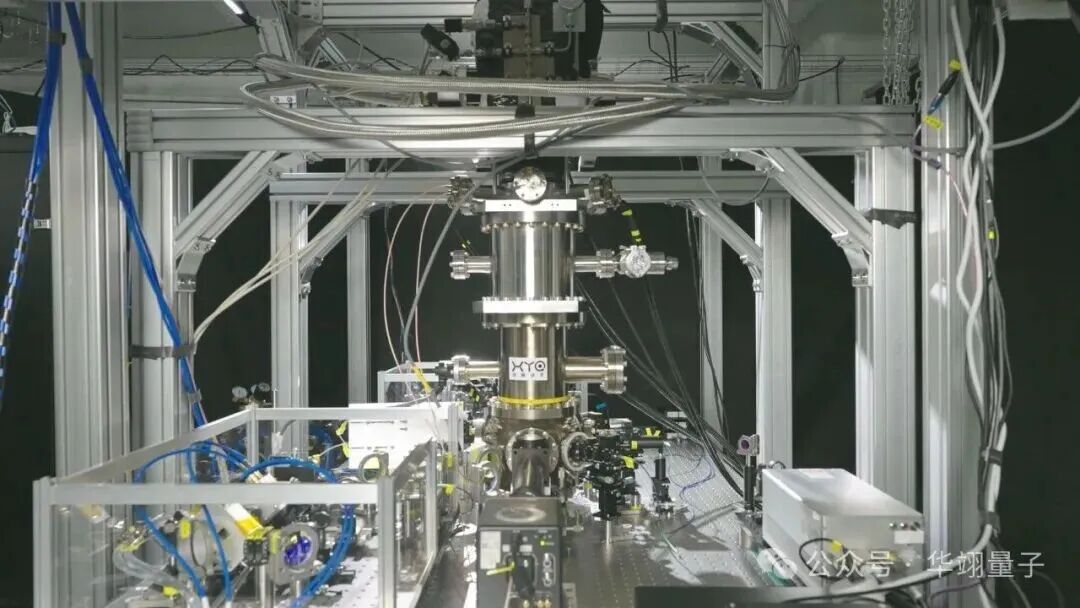
HYQubit HYQ-B100 ion trap cavity
Turning Quantum Compute into Real Productivity
Quantum technology has been placed at the top of the "15th Five-Year Plan" future-industries agenda, with expectations that it will break through the physical limits of classical computing and deliver exponential leaps in processing power for cryptography, materials science, drug discovery, and other fields. Guided by this national strategy, HYQubit is accelerating the conversion of quantum compute into practical productive capacity.
The company has established a deep partnership with PetroChina's Digital Intelligence Research Institute, focusing on core pain points across the oil and gas value chain — including supply chain optimization, reservoir numerical simulation, and catalyst and new materials modeling — leveraging quantum computing's advantages to crack complex industry problems and drive digital and intelligent transformation in traditional industries.
At the same time, HYQubit is building out comprehensive coverage across mobile communications, financial engineering, and pharmaceutical R&D, aiming to provide standardized quantum cloud computing services and one-stop solutions.
"Quantum computing is moving from scientific exploration into a critical window for industrial application," said Lin Yao, CEO of HYQubit. "HYQubit will stick to a two-wheel-drive strategy of 'hardware performance improvement' and 'industry application deployment' — on one hand, accelerating our push on quantum error correction and large-scale universal quantum computer development; on the other, deepening partnerships with industry leaders so that quantum compute can truly serve national strategic needs and real economic development."
About HYQubit
Founded in January 2022 and spun out of the Center for Quantum Information at Tsinghua University, HYQubit was established by Luning Duan, academician at the Chinese Academy of Sciences and director of the Center for Quantum Information at Tsinghua University. Its core team comprises over ten PhDs and postdocs from Tsinghua, the University of Science and Technology of China, and other leading universities. HYQubit focuses on the trapped-ion quantum computing architecture, providing complete trapped-ion quantum computer systems and quantum cloud computing services. The company aims to fill the gap in China's trapped-ion quantum computing landscape, popularize quantum computing hardware, solve universal quantum algorithms, and promote quantum cloud computing — with the goal of becoming an outstanding quantum computing company on the global stage.