Jiang Nanchun: Crisis Is Opportunity, Right and Wrong Determine Success or Failure, Differentiation Is Evolution | Ronghui

Don't think short-term; take a long-term view. Focus on right and wrong, not gains and losses.
"Entrepreneurship is for the brave. Those with ambition and action win out." For companies with truly differentiated value, crisis is opportunity — you need enough courage and conviction to face it head-on and seize the moment.
On February 23, at Gaorong Ventures' online salon "Navigating Crisis," Jason Jiang, founder and chairman of Focus Media, joined a video conference with over 180 CEOs, executives, and partners from Gaorong's portfolio. Drawing from his experience living through three crises — SARS in 2003, the 2008 financial crisis, and the COVID-19 pandemic — he shared his reflections and distilled three insights: crisis is opportunity, integrity determines success, and divergence drives evolution.

The following is a transcript of Jason Jiang's remarks:
I was one of Gaorong's earliest LPs. I'm glad to see so many of Gaorong's portfolio companies here today, representing the rise of so many emerging industries in China. Focus Media was founded in 2003 — 17 years ago — and we can see even more outstanding entrepreneurs in this room, creating new legends across various industries.
Today we're discussing COVID-19. We've seen that outside Hubei, the epidemic has been effectively controlled. I expect that in the week starting March 2, office building recovery rates will exceed 70%; by the week of March 9, roughly 90% of people will be back at work.
At this juncture, we need to think about how to avoid the "secondary disaster" after the pandemic — what I call the "economic epidemic." This outbreak will cause significant revenue declines for many companies, tightening cash flow and widespread losses. There will definitely be people "jumping out windows to slash prices." No lowest, only lower.
But I believe the "economic epidemic" brought by COVID-19 is short-term. Focus Media is a barometer of China's economy and its startups. Currently, our ad placement rate has already reached 70% around March 2. April will definitely be sold out. I predict that China's consumer market will fully rebound in April, and May Day will become the new "Spring Festival" — the strongest May Day holiday ever. Movies, shopping malls, tourism — all of it will see rapid recovery and full revival around May Day.
How should entrepreneurs think and act in the face of crisis? I've drawn three lessons from SARS in 2003, the 2008 financial crisis, and this current COVID-19 crisis.

Three Lessons from Crisis
Crisis Is Opportunity, Integrity Determines Success, Divergence Drives Evolution
1. Crisis Is Opportunity
Focus Media was born in SARS. In January 2003, I invested 50 million RMB to start Focus Media. By February and March, SARS hit. Many people advised me to pull back and protect cash flow, but I put all the money down anyway.
Because I saw a massive opportunity and was convinced it would succeed. China was undergoing enormous change — urbanization. What's a key piece of infrastructure for urbanization? Elevators. I was incredibly excited to discover this massive opportunity. I wanted to build an elevator media company that no one in the world had ever done before, one that would become essential infrastructure for reaching urban mainstream populations.
When SARS came, should I stop? I said no, I would lay it all out. And during SARS, everyone was too overwhelmed to respond, so commercial buildings were easy to negotiate with. When SARS passed in June, I had all the buildings wired — including the top-tier commercial office buildings. By then, if anyone wanted to follow, the buildings were gone. This was my counter-intuitive thinking.
What I feared most wasn't SARS. What I feared most was that while I was wiring these buildings, someone else was wiring the ones next door. Our model had no real barriers — could others do it? Yes. The only question was whether you seized the time window, captured all the positions, and locked them in with five-year exclusives. Then others couldn't play.
I think all entrepreneurs need to be sufficiently optimistic. If the world ends, we die early and reincarnate early.
Entrepreneurship really is for the brave. Those with ambition and action win out. The most interesting dynasty in Chinese history was the Song. At the time, its GDP was one-third of the world's, yet it was beaten to a pulp by the tiny Jin kingdom. The world constantly proves that the brave win.
When you have sufficient ambition and courage, you'll find infinite opportunities. However big your heart is, however much energy you have, that's how big a business you can build.
So my biggest takeaway from SARS was: crisis is opportunity. While others contracted, we went all in. The key is not to have a fragile psychology.
In his book Heart, Kazuo Inamori tells a story I find fascinating. He said when he was young, his uncle had tuberculosis. Every time he passed his uncle's room, he would hold his nose, terrified of infection. His father stayed by his uncle's side caring for him. His older brother thought, "How likely is it that I'd get infected?" and remained calm. In the end, the only one in the entire family who got infected was Inamori himself. Why? He had read a sentence in a book: "In our hearts is a magnet that attracts disaster. We get sick because we have a fragile heart that attracts germs."
The more people fear something, the more it comes to them. The more convinced you are that you'll succeed, the more you will.
Recently a colleague said, after the pandemic, the advertising industry will be such-and-such. I only said one sentence: you have distracting thoughts. In your heart, you think problems will emerge, that you won't complete your mission. Once you have this distraction, you definitely won't complete it. So I said, step down. We don't need people with distractions. We need people who say "I will definitely succeed."
2. Integrity Determines Success
In 2008, Focus Media also went through a major crisis. Our market cap fell from $8.6 billion all the way to $600 million. Many people say "cut in half" — I was someone who got "vertically sliced." The 8 was gone, only the 6 billion behind it remained. I've been through that. What else is there to fear?
By 2005, Focus Media was already a company with a $3-4 billion market cap on NASDAQ. Once, the chairman of the world's largest fund company visited China. He held many China concept stocks. I asked him one question: why was Baidu trading at 100x PE, while we were at 25x?
He told me: you're not sexy enough. Focus Media occupied many buildings in China, but physical space is limited. How will you grow in the future? Baidu is an internet company with unlimited imagination.
I went back devastated. That night I couldn't sleep. I'm an advertising expert myself. I thought, this means our tagline was wrong. Calling ourselves "China's largest lifestyle circle media" wasn't working. That night I wrote a new sentence to redefine Focus Media: "China's largest digital media group." When I finished, I was excited. At the time, Google and Microsoft were also buying digital media.
And Focus Media was a digital media company. I could tell a new story to the capital markets. After telling it, people said you only have digital out-of-home media. So I acquired Allyes, bought a bunch of internet advertising companies and mobile advertising companies. Once I had them all, I pieced together a story. Did it work? Yes. Market cap went from $3-4 billion all the way to $8.6 billion by late 2007. $8.6 billion — over a decade ago — and I owned more than 10%. I thought, finally it's my turn to sell stock, finally time to improve my life. Around 2008, I was basically ready to sell.
But when you're ready to sell, disaster strikes one after another. First, CCTV's "3.15" exposed a Focus Media subsidiary for sending users spam SMS ads. We had to cut it, market cap dropped over a billion. Then the May 12 Wenchuan earthquake — national mourning. We didn't have remote control then, had to shut everything off. Performance differed hugely from market expectations, so we dropped another billion-plus. Finally during the Olympics, stock recovered a bit. We went on a roadshow, told people Q4 would have $79 million net profit, stock stabilized. Unexpectedly, the moment we stepped off the plane, Lehman Brothers collapsed. Clients canceled orders one after another. That quarter we only made $50 million. Americans thought you guys are completely unreliable. And many companies we acquired — the people left, no value remained. In the end, stock crashed to just $600 million.
Looking back, we told the capital markets a story, we pumped up our PE, we wanted to sell our own stock. The result? We didn't sell any stock. Why? I later summarized: integrity determines success. Because my heart was wrong, my heart had gone astray. At this point you discover, when your heart isn't right, the world won't go the way you want. In the end, you're the one who bears the consequences.
Often, what is the pain of life? It's the comparison between short-term gains and losses and integrity. In the short term, was I wrong to pump up my stock? Was I wrong to tell a capital markets story? Neither was wrong — that's short-term gain and loss. But from the perspective of integrity, was it right? No.
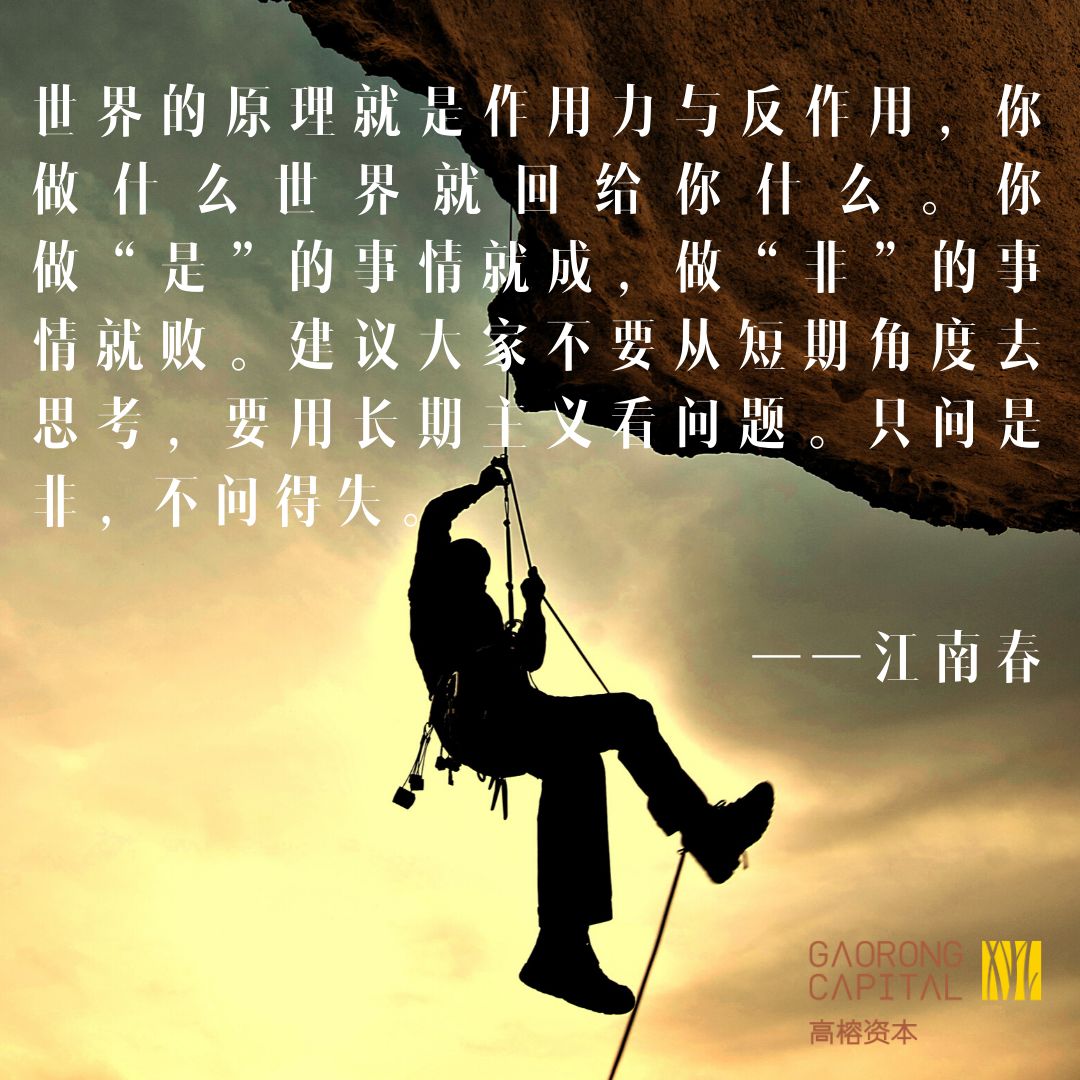
The principle of the world is action and reaction. What you do, the world returns to you. Do what is right, and you succeed. Do what is wrong, and you fail. I suggest not thinking from a short-term perspective, but using long-termism to view problems. Only ask what is right and wrong, not what you gain and lose.
3. Divergence Drives Evolution
After this COVID-19 epidemic ends, companies will polarize.
First, leading companies in each sector will face enormous opportunity. Recently we've had many phone conferences with leading companies. Ambitious entrepreneurs all feel opportunity has arrived. They're stepping on the gas, definitely not the brakes. The chance for the first tier to pull away from the second tier has come.
Focus Media's thinking is the same — not only not contracting, but adding more budget. We decided to push digitalization of screens from 80% to 100%. This outbreak made up my mind. And we will accelerate building expansion, pushing market share from 80% to 90%. We have abundant cash. What leading companies need to do now is clear the battlefield.
Second, for second-tier companies, it depends whether you have differentiated value, and whether post-pandemic market trend shifts favor your differentiated value. If yes, the post-pandemic period is also a major opportunity to overtake on the curve.
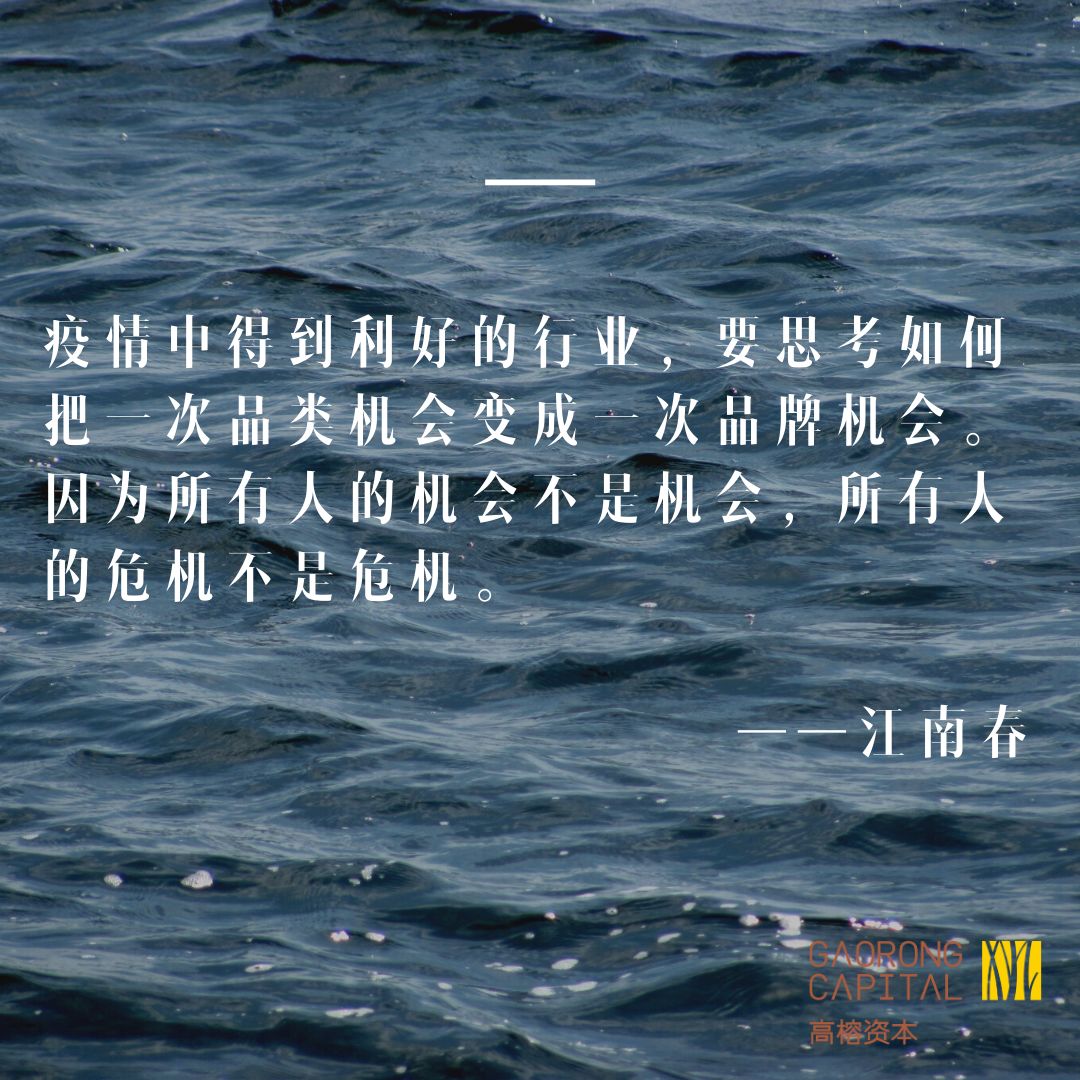
During this outbreak, some companies' traffic has risen — online education, online healthcare, online grocery shopping, etc. I see these as category opportunities. Think about how to leverage this attention to turn a category opportunity into a brand opportunity. Because opportunity for everyone is no opportunity; crisis for everyone is no crisis. You need to use a category opportunity to establish recognition in consumers' minds, thereby turning it into a brand opportunity. For example, after the pandemic, if consumers think of Dingdong Maicai when they think of grocery shopping, that's turning a category opportunity into a brand opportunity.
I also said that after the pandemic, many small and medium enterprises will die. Many SMEs felt disheartened hearing this. But small businesses without differentiated value would have exited the market anyway. The pandemic only accelerated the survival-of-the-fittest process. People often say support SMEs, but what can truly be supported must be businesses with differentiated value. As long as you have sufficient value, capital will discover you, will support you to surge ahead at a curve-overtaking moment.
So personally, I don't agree with just protecting cash flow. Protecting cash flow is also dying slowly. Whether you can protect cash flow depends on whether you have true value, whether you're solving unique problems for society, whether you're meeting consumer needs that haven't been met. If yes, then have enough confidence to act. China's market scale is there, demand is there. After the pandemic, everything returns to normal.
The Way Is People's Hearts; Hearts Matter More Than Traffic
After this short-term "economic epidemic" from COVID-19 ends, I believe China's long-term "economic epidemic" is not yet over. This long-term "economic epidemic" began in 2018, mainly for two reasons — the disappearance of demographic dividend, and the end of traffic dividend.
For China's economy, this causes two results on one hand, demand growth has slowed; on the other, traffic costs have risen. This creates "simultaneous price and volume killing" — you try to win volume through price cuts, but you can't win volume, because others are also slashing prices.
This cycle causes commercial system breakdown — prices keep getting pushed down, traffic costs keep getting pushed up, and the middle gets squeezed. I believe this is the core of China's "economic epidemic."
Where is the cure for the "economic epidemic"? Branding is crucial.
1. Find the Switch in Consumers' Minds
What is branding? Looking back at China's 40-plus years of reform and opening, the core of economic competition has shifted. From earliest production-side competition, to channel-side competition, and today China has entered an era of production overcapacity, with choice returning to consumers — an era of consumer sovereignty.
So the real competition brands face isn't competition in the physical world, but competition in consumers' minds. Every brand must answer one question — what is your differentiation? In white-hot competition, how do you gain cognitive advantage with consumers?
The question I get asked most everywhere I go is: our product is so well made, why won't it sell?
Many entrepreneurs focus their management internally — quality, supply chain, cost, channels, organization. These are all important; they're the foundation of competition. But real decisions happen outside the company. If you haven't managed consumers' minds, haven't managed consumer perception, you have a big problem.
So we say: beyond innovation, you need the feeling of innovation. Perceived innovation is real innovation. Therefore entrepreneurs need external thinking, standing from the user's perspective, thinking about how to gain advantage in users' minds.
Many people say everyone wants to build a brand, but branding is hard — we've spent so much on advertising with no effect. In fact, 80% of advertising in China is wasted, because it never found the switch in consumers' minds.
2. How to Position a Brand
What are the prerequisites for successful brand positioning? First, clarify product advantage. Second, clarify differentiation from competitors. Third, clarify user pain points. Only when these three are "three-in-one" can you possibly find a truly correct positioning.
I often find positioning through three paths: first, pressure the boss — have the boss state in one sentence why customers should choose you over competitors; second, interview top salespeople — what top salespeople say is often right, because sales results have proven their words; third, find loyal customers — observe how customers explain their reasons when recommending to others.
Then, how do you evaluate whether your brand positioning is successful? There are three criteria: first, do customers recognize it? Second, do salespeople use it? Third, do competitors hate it? For example, "Afraid of getting angry? Drink Wang Lao Ji." Customers recognize it, salespeople use it, and competitors definitely hate it because the path is blocked.
After having brand positioning, you also need to test whether this positioning has sufficient market scale, whether it fits market trends, whether it can resonate with consumers. Once resonance is established — click — you flip the switch in consumers' minds, then through saturation attacks, build the brand in a short time.
3. Focus All Force, Saturation Attack
After brand positioning is done, you need brand strategy support, making all resources "focus through one hole." Trout has a view that it's not strategy that determines tactics, but tactics that determine strategy. Tactics are finding advantage relative to competitors; strategy is mobilizing all resources to maximize tactical advantage. Every company's resources are limited, so resource allocation must push toward the direction where consumers can perceive differentiation.
So, after striking first and capturing consumers' minds, you must continuously increase channel penetration, achieve effective reach with target audiences, seize market discourse power. Often, once you propose a differentiation point, many competitors will imitate. Therefore you need saturation attacks to solidify the positioning in consumers' hearts. You can have a siphon effect, become an "industry black hole" — when others advertise, they're advertising for you.
4. The Way Is People's Hearts; Hearts Matter More Than Traffic
I especially recommend everyone find time during the epidemic to read a book — The Art of War. Twenty-five hundred years ago, it started at the peak. Much of my business understanding comes from this book. The Art of War addresses the most important issue: right at the beginning, it states that warfare isn't about stratagems, it's about calculation.
Zhuge Liang won countless battles, yet finally died of illness at Wuzhang Plains, coughing blood. Why? Countless small victories cannot change fundamental results, because your national strength cannot compete with others. Calculate that you can definitely win, then fight — this is "first seek victory, then seek battle."
How to calculate? The Art of War opens with five words — the Way, Heaven, Earth, the Commander, and Method.
"Heaven" is celestial phenomena, timing — entrepreneurs must ask whether what they're doing aligns with major trends, whether the time window is right. "Earth" is channels, layout. "The Commander" is the team. "Method" is operational management efficiency and incentive mechanisms. Heaven, Earth, Commander, and Method are all incredibly important. But what do Chinese people put first in warfare? They put the Way first.
What is "the Way"? Those who gain the Way have much help; those who lose it have little. Those who win people's hearts win the world. The Way is people's hearts.
Why are people's hearts so important? Everyone talks about traffic, but hearts matter more than traffic. Mao Zedong versus Chiang Kai-shek — 20,000 Red Army versus a million Nationalist troops. The forces were not on the same level. Yet Chairman Mao won. The core reason was his use of the Way, his grasp of people's hearts, thereby changing the principle of force. Facing 400 million Chinese peasants, he wrote the most important advertising positioning line — "Beat the local tyrants, divide the land." 400 million peasants, follow me and you can change the world, follow me to beat the local tyrants, the world is yours. At this point, his principle of force had changed. 20,000 Red Army definitely couldn't beat a million Nationalist troops, but a million Nationalist troops couldn't beat 400 million peasants.
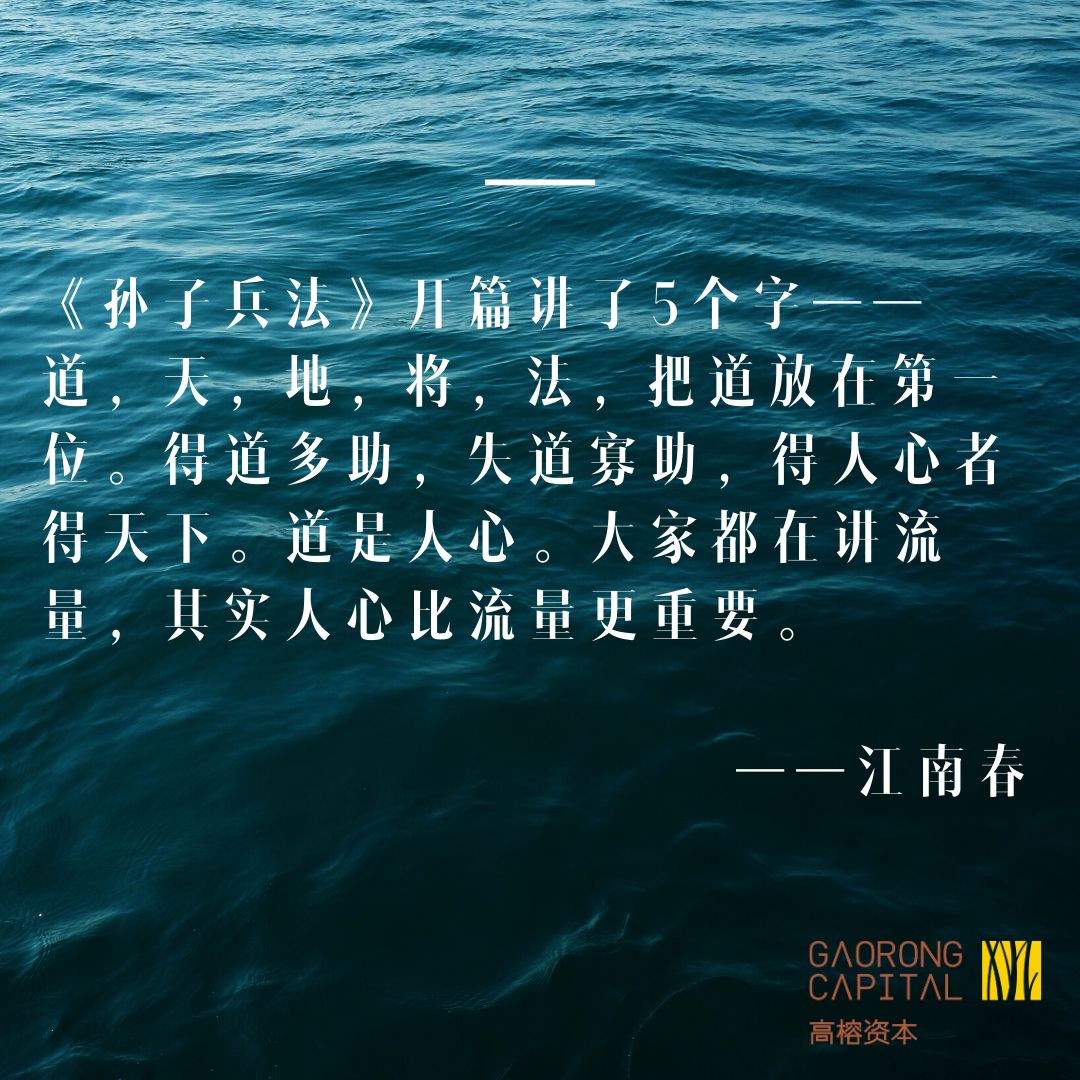
The most terrifying force in this world is the power of consumers' minds. When mind power forms recognition of you, it erupts with enormous energy. Many internet entrepreneurs are very good at playing with traffic. If you find traffic value pools, find裂变 [fission/viral] methods, play with private domain traffic — all of this is very correct. But these are one-time traffic dividend opportunities, excellent catalysts for building momentum.
But can you rule forever with these? No. Many things you grasp at the beginning that others don't, but eventually others will grasp too, others will learn. And today's dividends will disappear. You must, in phase two, solidify the advantage you've gained into a mind advantage.
Many people think traffic is important, but is traffic the essence of all business? No. Traffic is the result of a brand winning people's hearts. In today's China market, once you can form and solidify a cognitive advantage in consumers' minds, you have sustained free traffic.
To summarize finally: for crisis, it's three sentences — crisis is opportunity, integrity determines success, divergence drives evolution. Facing long-term competitive dynamics, the Way is people's hearts. Learn to seize users' minds and win people's hearts.
Thank you, everyone!



Congratulations to Roborock on its successful STAR Market IPO! | Gaorong News
Under the Pandemic, How to Make Decisions, Rally People, and See the Future? | Rong Ask