Liu Xinhua: How to Crack the Growth Code for Products in the Second Half of the Internet Era | Gaorong Ventures Share

A 10,000-word transcript systematically breaking down the four modules of the growth model — clarifying principles, seizing momentum, refining tactics, and reading people.
In today's internet competitive landscape, growth is a topic talked about too much and a source of acute anxiety. Viral growth, KOL/KOC marketing, traffic pools, growth hacking, private-domain traffic — concepts proliferate endlessly, dazzling to the eye. But how do we understand the essence of growth? In the second half of the internet era, do products still have opportunities for explosive growth? How can startup teams find the key to cracking growth?
Allen Liu, investment partner at Gaorong Ventures and former chief growth officer at Kuaishou, has over 22 years of experience in product, strategy, growth, brand, marketing, operations, and investment at high-tech and internet companies, and has participated in growing multiple products with tens of millions in DAU and two with hundreds of millions in DAU.

Recently, Liu spoke at a youth innovation camp co-hosted by Gaorong Ventures and OnePiece Work, delivering a systematic presentation on "The Growth Code for Internet Products" that was praised as "textbook-level growth theory plus practical methodology." Drawing on Chinese philosophical frameworks, Liu summarized the four most important modules of the growth model as: understanding the fundamental principles (明道), capturing momentum (取势), refining tactics (优术), and recognizing talent (识人). "True entrepreneurs are particularly able to grasp the essence of growth and leverage growth momentum, rather than getting bogged down in specific tactical maneuvers. If you lack understanding and guidance at the level of fundamental principles, you may lose your way or head down a path of no return in the mad rush forward. Growth must also return to common sense and human judgment — human nature is the variable most easily overlooked in growth, and the one that should never be overlooked."
Beyond thinking about underlying logic, Liu also systematically deconstructed practical methodologies in his presentation: how to capture growth momentum, how to identify signals of growth momentum, how to build products with strong traffic positioning, and data-driven lean growth models. These insights should prove valuable for today's internet and new-brand entrepreneurs to learn from, adapt, and use as frameworks for innovative experimentation and iterative optimization.
The following is a full transcript of Liu's presentation (16,144 words — we recommend bookmarking for immersive reading):
How should we understand growth? I believe the core of growth lies in the "growth" (长), not the "increase" (增). "Increase" is merely the action; the "growth" in user numbers, stickiness, and value is the core and the goal. The market has far too much empty increase with little real growth, much increase with little growth, and fast increase with slow growth.
When We Discuss Growth, What Are We Actually Discussing?
Growth is an exceptionally broad category — like how there are a thousand Hamlets in a thousand people's eyes. When facing growth, we often fall into the trap of blind men touching an elephant, with various concepts becoming "so many flowers that they nearly dazzle the eye." In the U.S., only one term has been coined in recent years — growth hacking. China seems to produce new concepts every day. For example:
Viral growth (裂变). In an era of soaring traffic costs, viral growth is an extremely important concept. Its essence is transforming users into disseminators, achieving user diffusion and growth — activating existing relationships and converting them into new traffic.
KOL/KOC matrix marketing. KOLs are opinion leaders and super-nodes in social networks. This concept has existed in communications studies for a long time, and China's livestream commerce boom this year has amplified it further. Super KOLs like Viya, Li Jiaqi, Li Ziqi, Sanda Ge, and Xinba influence user behavior far beyond traditional marketing methods. KOLs are not only super-nodes for reaching massive user bases, but also super-hubs that can carry deep user trust. Through KOLs as communication agents, brands and products can effectively shape product reputation, driving user growth and value monetization. KOC refers to diffusing product reputation through a larger scale of core fans within user networks, driving user growth.
Traffic pools. This concept was proposed by Luckin Coffee's operating team — containers for accumulating user traffic. These containers can exist in users' minds, such as brands; they can be pure private-domain territories of products, such as apps and websites; or they can be private-domain positions on other public platforms, such as mini-programs, groups, and various social accounts. Traffic pools emphasize the accumulation of traffic value.
Growth hacking. A concept proposed in the U.S. over a decade ago, it has become particularly hot in China in recent years. The exemplars of American growth hacking were Facebook, along with LinkedIn, Pinterest, Airbnb, and Dropbox. Four or five years ago, this concept was introduced to China. In the past two to three years, we've seen Kuaishou and Pinduoduo's lightning expansion, taking the growth practices centered on the AARRR pirate model to a higher dimension. These companies comprehensively leverage data, algorithms, and experiment-driven approaches to find high-value growth levers, while using automation and intelligence across multiple core links to enhance growth efficiency and effectiveness, achieving lightning expansion for products while also improving long-term retention and building more robust bilateral or multilateral networks.
Private-domain traffic. So-called private-domain traffic operations are fundamentally aligned with the D2C (Directly to Consumer) operations advocated by a new generation of American brands. In the second half of the internet, rising traffic costs rival pork prices, making private-domain traffic operations increasingly important. In essence, private-domain traffic is about operating private-domain users, establishing long-term emotional connections with users, and continuously discovering user value through sustained interaction. Private-domain traffic has different emphases across markets and cultural contexts. In the U.S., for new brands, private-domain traffic focuses on independent sites, apps, email EDM (Email Direct Marketing), and homepages and channels on Facebook, Instagram, YouTube, and Reddit. In India, Indonesia, and Latin America, where WhatsApp is the national application, WhatsApp groups may be the focus of private-domain traffic operations. Private-domain traffic is the basic foundation of user growth; without proper private-domain traffic operations, lean product growth cannot be achieved.
Livestream commerce. This year's explosive livestream commerce, whether Taobao Live's hundred-billion scale or the popularity of Viya, Li Jiaqi, and Xinba, shows how livestream commerce is reconstructing users' purchase decision processes, turning social influencers with personal branding into shopping decision entry points.
Additionally, concepts like group buying, super membership, second growth curves, automated advertising, and dramatized ad creatives emerge endlessly.
So, setting aside these concepts, how do we understand the essence of growth? Growth is not simply violent user acquisition or lightning expansion. Growth is a combination of multiple strategies, a balanced allocation of models and resources in pursuit of growth objectives.
Traffic vs. stock. Many growth operators focus solely on traffic, but traffic comes and goes. How much traffic converts into stock? Can new traffic match or exceed the quality of existing stock? What is the growth rate of traffic? As traffic dividends further tighten, stock optimization and refined operations — even generating new traffic from stock — become more important.
Acquisition and activation. Acquisition focuses on continuously finding new traffic sources; activation focuses on improving user stickiness, including churn prevention. These are the basic paths of growth. Growth is the continuous optimization and balancing of three fundamental operations: acquisition, activation, and churn prevention.
Exposure and conversion. Especially when pursuing transaction-oriented growth, don't just look at front-end traffic conversion. Trace conversion across the entire chain and examine overall ROI.
Consumption and supply. People always think growth must be viewed from the demand side, the consumption side. This is wrong. In multilateral networks, we need to balance consumption-side growth with supply-side growth. If the two fail to achieve balance and matching, systemic collapse risk may emerge. Typically, people believe consumption and user-side growth can only be improved from the consumption side. But growth masters can improve supply structure, particularly by bringing in quality and more diverse supply, which in turn drives consumption-side growth. Considering only user-side growth is a typical cognitive trap.
Growth hacking vs. "growth black." "Growth black" is a term I coined. When growth hacking is done poorly, it can become "growth black." Common "growth black" mistakes include: 1) Growth that fails to account for back-end order fulfillment capacity, where excessive growth encounters insufficient service capability, leading to reputation decline and user churn; 2) Failure to achieve matching between consumption and supply, where rapid growth brings users that the platform cannot provide matching supply for, causing users to get less than expected and subsequently churn; 3) Improper anti-fraud and anti-spam strategies, falling victim to fake traffic from the internet's "dark world," wasting resources and causing ecological disorder to products — this point requires particular vigilance.
Paid traffic vs. organic traffic; endogenous traffic vs. purchased traffic. When many growth links are well-executed, products may generate significant natural endogenous traffic — so-called "born hits" or "self-generating traffic." We need to consider how to design products so that natural traffic continuously emerges. Purchasing external traffic and being a sophisticated traffic buyer who increases both volume and quality is a particularly sophisticated endeavor — spending money well is actually very difficult.
Having listed so many growth concepts, today I want to focus on sharing growth's fundamental principles, momentum, and tactics. True entrepreneurs are particularly able to grasp the essence of growth and leverage growth momentum, rather than getting bogged down in specific tactical maneuvers. If you lack understanding and guidance at the level of fundamental principles, you may lose your way or head down a path of no return in the mad rush forward.
Much of what I've done over the past 20-plus years has been related to growth, and I've encountered many pitfalls along the way. The growth system as I understand it has four core modules — drawing on Chinese philosophical frameworks: understanding the fundamental principles, capturing momentum, refining tactics, and recognizing talent.

Understanding the Fundamental Principles: The Underlying Laws Driving the Growth Flywheel
So-called understanding the fundamental principles means driving the growth flywheel — that is, pursuing the most efficient growth requires following three fundamental laws.

Law One: Power Laws
We must understand that everything in this world is not naturally evenly distributed — the "Matthew Effect" is the truth of the world. We see this in the distribution of global wealth, successful entrepreneurs, and even influencer impact.
Growth must always account for power laws — that is, you need to find your growth lever. Faced with a dizzying array of growth tools and mounting growth pressure, it's easy to fall into the trap of spraying and praying, attacking everywhere at once. But when you're staring down 100 possible growth tactics, a handful will naturally outperform the rest. A true growth master identifies the critical points, finds the highest-ROI growth lever, and pushes that lever to the limit to maximize growth impact. Remember: not every point can serve as a fulcrum. Only a select few can.
Law Two: Compounding
There's a wonderfully cheesy mathematical formula: 1.01 to the 365th power equals 37.8, while 0.99 to the 365th power equals 0.03. If you outperform and outwork others by just 1% each day on average, focusing on the right things, a year later you'll have left competitors in the dust. So by consistently doing what's correct for growth, you can harness the compounding effect of your growth lever over time and build a decisive lead. Faster feedback loops accelerate this compounding, further amplifying its growth advantage.
Why can the internet force traditional industries to upgrade faster? Why must so many things be digitized today? Because only through digitization can you obtain feedback more quickly and comprehensively; based on that feedback, you can iterate toward more accurate growth directions and functional improvements. Layer data-driven growth levers with the compounding effect of rapid feedback iteration, and the internet becomes a powerful accelerant for traditional industry evolution.
Law Three: Systems
All product growth operates through complex, multifaceted systems. But abstracted, any complex system or structure is simple: it's a set of connected elements. If you can decompose these elements and identify their connections, you can optimize the system's evolutionary trajectory. The study of how systems operate is system dynamics. Some call system dynamics the "God's-eye view" — it was also the first science to study growth constraints, drivers, and boundaries.
In systems, connections between elements can be distilled into four basic types: causal chains, reinforcing loops, balancing loops, and delays. Causal chains are self-explanatory; when set in motion, they form reinforcing and balancing loops. Where cause amplifies effect and effect amplifies cause, you have a "reinforcing loop." Where cause amplifies effect but effect dampens cause, you have a "balancing loop." Building a growth flywheel, simply put, means finding "reinforcing loops." In the real world, you often need sustained combinations of "reinforcing loops" and "balancing loops."
For those with deeper interest in growth, I'd recommend investing time in system dynamics, particularly the work of E.F. Wolstenholme. He synthesized more complex, dynamic combinations of the four connection types into four archetype groups and nine base models.
These four archetype groups are:
- Underachievement: An expected reinforcing loop encounters an unexpected balancing loop, stalling growth. Examples include the tragedy of the commons, growth and underinvestment, and limits to growth.
- Out of Control: An expected balancing loop encounters an unexpected reinforcing loop, leading to runaway conditions.
- Relative Achievement: An expected reinforcing loop encounters an unexpected reinforcing loop, producing winner-take-all dynamics.
- Relative Control: An expected balancing loop encounters an unexpected balancing loop, triggering zero-sum games. Typically manifests as vicious competition and goal erosion.
I'll interpret three base models from the Underachievement group to show how system dynamics helps us understand growth's essence.
First is the Tragedy of the Commons archetype: when multiple parties compete to extract profit from limited shared resources, driving everyone's returns toward zero. Essentially, a "grab more, gain more" reinforcing loop collides with a resource-constrained balancing loop. Bitcoin mining is a classic example. As most know, the Bitcoin network issues a fixed 12.5 Bitcoin every ten minutes to globally distributed mining rigs. This reward model represents a commons with rigid constraints. Early on it was profitable, but as more rigs joined, average returns dropped rapidly. When the electricity consumed by all rigs every ten minutes equals the value of 12.5 Bitcoin, mining revenue equals cost, profits shrink to zero, and everyone loses.
Similarly, over the past two to three years, many overseas tool companies exploited loopholes in Facebook and Google's ad network systems, attempting违规变现 that violated platform policies. This led to sweeping bans by Facebook and Google, with some valuable ad formats discontinued entirely — devastating the overseas tools industry.
The Limits to Growth archetype occurs when a rapidly growing reinforcing loop encounters a growth-inhibiting balancing loop — what we commonly call a growth ceiling or plateau. In the late stage of mobile internet, as penetration neared saturation, many consumer-facing products hit this plateau. A product often grows fast simply because it's small; when rapid growth meets a balancing loop, it hits a ceiling. So in investing and product development, you must constantly examine TAM (Total Addressable Market). If a product's natural TAM is small or already highly penetrated, even an outstanding growth team can't achieve major breakthroughs — unless they can reconstruct the system's growth loops or remove existing balancing loops. The hot concept of "second growth curves" in recent years represents exactly this search for breakthrough points under the limits-to-growth archetype.
The Growth and Underinvestment archetype describes when rapid growth in a reinforcing loop encounters a balancing loop of insufficient R&D, production, service, or management capacity investment, degrading service quality and user experience. Tesla fell into this trap several years ago, with production constraints and inadequate service capabilities pushing it toward bankruptcy despite surging demand. Only with the Shanghai Gigafactory coming online and subsequent service improvements did Tesla return to a high-growth trajectory. This is why people say that in growth, sometimes slower is faster — you must constantly examine whether backend R&D, sales, service fulfillment, review, and quality control capabilities can match growth pace. Adjust growth rhythm in time, ensure backend capacity keeps up, and you achieve sustained, healthy growth.
Truly successful companies do the right things at the right time. They navigate the tragedy of the commons, traverse growth cycles, fix gaps while scaling — overcoming the underachievement curse to achieve exponential growth.
In summary, mastering the law of systems helps entrepreneurs use the "God's-eye view" to understand growth systems' underlying logic, boundaries, and constraints, building more resilient growth architectures.
"Dao" sounds abstract, yet it's a matter of survival — critically important. I hope every entrepreneur can become one who truly "grasps the Dao" of growth.
Riding Momentum: Growth Masters Are Trend Masters
This year I've occasionally heard entrepreneurs lament being born at the wrong time — entering the "late-stage internet" right away, facing traffic droughts, funding shortages, and other challenges. But from a growth perspective, there's opportunity in any era; there's always room for growth.
A counterintuitive pattern: sometimes 10x growth is easier than 10% growth. Why? Ten percent growth usually just requires optimizing existing logic; 10x growth forces you to shift logic entirely and identify what truly drives the engine. Entrepreneurs easily get trapped in day-to-day operations early on, while underinvesting in questioning whether larger trends and growth levers are available.
Andy Grove once said: every strategic inflection point exhibits a 10x change, and every 10x change causes a strategic inflection point. What does this mean? As an entrepreneur, you must constantly monitor your ecosystem for which key elements are undergoing 10x qualitative transformations — then seize them. These critical element shifts can drive fivefold to tenfold massive changes in a single factor of your product ecosystem within six months to a year.
Next, I've summarized eight momentum dividends, spanning major trends and micro-trends. In fact, China's and the world's phenomenal internet companies have essentially captured these dividends — often more than one.
1. Internet Infrastructure Transformation
This wave of phenomenal internet companies without exception captured the migration from PC to mobile, from 3G to 4G — achieving population-scale coverage through infrastructure leaps. Every super-unicorn is a unicorn of its era; supernormal growth sits atop the super-momentum of capturing infrastructure transformation.
For example, China's 4G普及 began in late 2013, then added roughly 200 million new users annually through 2018. The explosive growth of domestic short-video apps aligned precisely with this exponential curve — short video and livestreaming were arguably among 4G's biggest beneficiaries.
2. Emergence of New Traffic Platforms at Scale
Capturing new traffic platforms at scale is crucial for startups. For many new brands, whether selling products or services, if you didn't start with WeChat + mini-programs in recent years, or leverage Kuaishou, Douyin, Xiaohongshu, and Bilibili's new traffic opportunities this year, or experiment with live commerce on short-video and e-commerce platforms, breaking through becomes nearly impossible.
Though the internet industry overall has reached a plateau, a growth mindset reveals abundant opportunity. The flowers look similar year after year, but the people differ — new traffic platforms emerge annually. Beyond the still-rapidly-growing video and community platforms mentioned, the upcoming WeCom 3.0 release may be one of 2020's promising new traffic platforms.
2020 is the first year of 5G; perhaps late 2020 or 2021 will bring a major device replacement wave. Every replacement wave reshuffles the app deck. 5G's user growth momentum may not match 3G-to-4G's massive population coverage, but from a device coverage perspective for certain categories, this could represent infrastructure-level rather than merely new-platform traffic dividends.
3. Generational Shifts and Platform Displacement
The waves behind drive the waves ahead. Snapchat's rise benefited from generational shift and the displacement opportunity Facebook's platform created. Many young entrepreneurs today are attempting next-generation social platforms; though difficult, opportunity certainly exists — essentially using new experiences and innovation to delight a new generation of youth.
4. Category Transformation
Consumer industry entrepreneurs and investors think daily about capturing category transformation dividends. When a category undergoes structural change — whether from booming demand in new scenarios or wild growth from category innovation delivering novel functions and experiences — category transformation may be emerging. Category transformation often strikes directly at user mindsets, driving supernormal growth.
Luckin Coffee and HEYTEA exemplify this: the former captured China's low coffee penetration category dividend; the latter captured the new premium instant tea category with social currency properties. Perfect Diary, a color cosmetics brand targeting young consumers, leveraged quality supply chains and strong product capabilities to enter the youth cosmetics category, then ignited growth through WeChat, Xiaohongshu, short video, and other new traffic platforms.
5. Technology Innovation or Supply Chain Revolution
In today's landscape, where direct-to-consumer platform opportunities are dwindling, B-side technological disruption and supply chain innovation have become especially critical. If new technologies or supply chain restructuring can deliver cost reductions or efficiency gains of 5x to 10x or more, they dissolve the balancing loops created by ceilings in existing technology and supply chain efficiency—triggering new reinforcing loops. Applying our earlier bottleneck model, the growth ceiling is shattered and the product returns to a growth trajectory.
Drawing on the winner-take-all dynamics from systems theory, when Google and Apple competed with Microsoft, there was simply no way to break through Microsoft's established Windows ecosystem. So they chose to launch entirely new growth loops: the Android and iOS ecosystems for mobile internet. Truly great entrepreneurs need not linger on old battlefields. Instead, they should seize technological disruption as an opportunity to decisively initiate an entirely new growth curve.
6. Demographic Discontinuities
Population is one of the most important variables affecting growth in economics. Shifting global demographics harbor numerous growth opportunities. In China, for instance, the rise of the single population has been striking—over 200 million single adults, with more than 80 million living alone, and both numbers are still growing. This has made mini appliances standard-issue for singletons; during Double 11, single-person rice cookers, washing machines, and refrigerators became breakout hits. In the coming years, the elderly will exceed half the global population, making ventures focused on the silver economy potentially high-growth territory.
7. Subculture Goes Mainstream
We've observed that the more a subculture represents youth, the more likely it is to break through and become mainstream—Bilibili's evolution exemplifies this. Similarly, designer toys could evolve from a niche hobby among young people into a passion for much broader circles in the coming years. When subcultures breach their圈层 walls and gain wider understanding and acceptance, they unlock far faster diffusion and growth potential.
8. Major Regulatory Shifts
Major policy changes can also serve as catalysts for growth opportunities. The rise of China's EV industry is a case in point—given that one in every two new energy vehicle owners globally is now Chinese, this reality is inseparable from the government's strong support for electric and new energy vehicles.
These eight势能红利 represent the principal scenarios and critical levers we've identified that drive qualitative change in key variables. Entrepreneurs must constantly ask themselves how to ride these forces for growth.
If trends matter so much, how does one actually capture them? Why are some entrepreneurs naturally more acute, more capable of discerning and seizing trends?
Borrowing from economics: to judge whether traffic can become viral, one must monitor the leading indicators of dust about to rise, observe the coincident indicators of dust taking flight, and assess the lagging indicators of dust already airborne.
Consider secondary-market investing: understanding macroeconomic conditions requires tracking GDP growth, but GDP data is typically released quarterly with a lag. By the time it's published, making investment decisions based on it is obviously too slow. If you can identify leading indicators—catching more sensitive signals—you can read the economic pulse more promptly. The Purchasing Managers' Index (PMI), for example, is a crucial monitoring system among leading economic indicators that reflects economic shifts at the beginning of each month.
Entrepreneurs who learn to build their own indicator systems, tracking and observing industry shifts in real time, can gain cognitive advantages over others. Some unconventional leading indicators may not be perfectly precise, but模糊的正确 beats精确的错误. Mature internet companies' growth teams must build three categories of monitoring indicators: competitors, channels, and their own products. Search indices of various kinds, competitor download volumes, upstream supply chain competitor or category order fluctuations can all serve as valuable leading indicators. App activation volumes, coexistence ratios between competitor and own apps, social media comment volumes, and shipment volumes may function as coincident indicators. Meanwhile, operator platform data on app traffic consumption, or parcel shipment counts on logistics platforms, may serve as lagging indicators. Dynamically monitoring and analyzing all three indicator sets reveals how trends are evolving.
Next I'll discuss how to refine tactics—the practical methodology of growth.
Tactic 1: Optimize the Five Factors to More Easily Attract Traffic
First, a fundamental point: good growth begins with constructing a product that occupies a traffic生态位. Building a good product that naturally generates its own traffic is paramount.
An生态位 refers to the role and position each species holds in an ecosystem—occupying specific space, performing specific functions. No two species share identical生态位s. Those that thrive typically occupy relatively advantageous生态位s, more easily securing survival resources and evading predators.
Internet ecosystems follow similar patterns. Certain products are naturally rooted in fertile traffic soil, better nourished by flows of users. I define this characteristic as "traffic生态位": the inherent体质 and positional势 of a product or service to attract, carry, and diffuse traffic—more easily accumulating traffic势能 and shaping天生爆款s.
Good products typically exhibit several of the following characteristics or factors. Get these right, and your product will naturally attract traffic more easily than competitors.

1. S-Factor / Search Factor
At its core, internet traffic divides into two major categories—search traffic and social traffic. Of course, some search traffic has evolved into recommendation traffic today; moreover, search increasingly integrates with communities and scenarios—YouTube, Instagram, and Amazon all contain substantial search volumes.
Mobile users often find manual input inconvenient across many scenarios, and with recommendation engines so prevalent, search can be easily overlooked. Yet search remains an important traffic source. Zhihu, for example, derives a significant proportion of its traffic from search. One of LinkedIn's core growth strategies was extensively optimizing individual profiles for search engines, facilitating crawler抓取 and search engine indexing—search engine-driven organic traffic in turn fueled LinkedIn's growth.
If startups can optimize features for search engines, create sufficient volumes of terms for crawlers to discover, and implement定向 optimization for different search engines, precise traffic from active search will emerge organically.
Beyond general search optimization (SEO) for Google and Baidu, search is increasingly embedded across more scenarios today.
App Store Optimization (ASO), for instance, grows more important by the day. To some degree, app stores are reducing the traffic weight of rankings while elevating search and recommendation weights. ASO doesn't mean刷词—it means restructuring product characteristics to be more easily indexed by search engines. This includes optimizing收录 of high-frequency terms and store search rankings, expanding收录 of massive long-tail terms, and maintaining active, real-time reviews.
Social Search Optimization (SSO) also deserves attention. WeChat's搜一搜 has become a significant traffic入口 today, with direct search results—when searching for a public account, brand, or mini program, hitting keywords displays relevant internal results from public accounts and mini programs, rapidly completing transaction闭环s. Mini programs'定向 optimization for WeChat搜一搜 in 2020 may have yielded unexpected growth dividends. Similar search红利s can be mined on other social platforms as well.
Finally, E-commerce Search Optimization (ESO). JD.com and Alibaba are fundamentally search companies—search is the core distribution logic for products, so targeted optimization naturally yields solid returns.
2. I-Factor / Interaction Factor
Good products must learn to leverage gamification design, interaction design, and IP attributes to create flow states for users.
First, product aesthetics matter enormously. Eighty percent of the brain's sensory receptors relate to vision—products demand good design.
Second, well-executed gamification design easily induces a flow state. "Flow," proposed by psychologist Mihaly Csikszentmihalyi, describes a mental state that emerges when people are fully absorbed in an activity—entering a self-forgetful condition where time seems to disappear.
Good flow design requires clear goals and immediate positive feedback. Why does shopping on Pinduoduo feel so satisfying? Because Pinduoduo's product design incorporates abundant game-like participation and reward mechanisms, triggering dopamine release and excitement—spending money without feeling the pain.
Well-designed creation tools within products are also crucial. Many traffic-oriented products provide users with good creation tools, encouraging sharing and content production. According to behavioral economics' endowment effect, once individuals possess something, they value it far more than before ownership. So platforms encourage user creation—LinkedIn, for example, prompts users to build profiles. Once you've invested time costs and participated in creation, your probability of retention on the platform increases substantially.
3. H-Factor / Hook Factor
The Hook Factor operates through two types of "tactics." The first is value front-loading—using爆款 and引流 items to accelerate users into active usage. If you're selling high-consideration, high-ticket products with long decision cycles, you can design引流 products to attract users into completing their first order, then guide conversion. Taobao's early rise was built on "9.9 yuan with free shipping"; Tmall's Double 11 employs similar tactics annually—pay a deposit first, then get double your deposit back on November 11th, with extremely low违约 probability from users.
The second is value reservation, extending user retention. Products should be designed so that users leave with some regret or unfinished desire each time—a "hook" that draws them back. Second cup half-price,满减券, and similar mechanisms are all forms of value reservation.
In consumer investing, there's also preference for product categories with natural taste memory. Why have Moutai and Coca-Cola sold so well for so long? Why have Fuling Zhacai and Haitian soy sauce performed well as stocks? Beyond brand recognition, they all carry taste memory and mild addictiveness—inherently carrying the hook factor.
4. K-Factor / Virality Factor
In growth, we often discuss: when N users forward your product or content, how many flow back? Sometimes KOL forwarding achieves massive回流 through fan propagation, with the K-factor spiking dramatically; other times, products possess inherent vitality, with a stable K-factor that steadily wins user口碑.
Product design can accelerate diffusion and virality through designing viral creation tools, optimizing forwarding scenarios, and mobilizing social KOL/KOC participation.
5. W-Factor / Word-of-Mouth Factor
Word-of-mouth is also critical. Good口碑 carries its own growth momentum. In product design and growth processes, friendlier口碑 collection and feedback mechanisms can激发 user participation and build core fan communities.
Growth hacking also offers metrics to assess the word-of-mouth factor. The user disappointment survey, for instance, asks how users would feel if they could no longer use the product—if over 40% respond "extremely disappointed," the product likely has strong growth runway.
Net Promoter Score (NPS) is another frequently measured metric. Tesla, Peloton, and Apple all maintain high NPS scores, providing invisible momentum that drives growth.

Tactic 2: Data-Driven Optimization of Growth Returns
Having covered how to optimize the five growth factors to make products more effective at capturing traffic, let's now examine how to optimize growth returns through data-driven methods.
1. Rich User Personas Are the Foundation of Growth Hacking
First, it's essential to recognize that rich user personas are the bedrock of growth hacking—the core foundation for product optimization, retention improvement, and transaction conversion. Mature internet companies are constantly capturing user persona data. Today's persona dimensions extend beyond natural attributes to include scenario-based and social attributes.
From the user's perspective, growth centers on three priorities—what we call the "growth trinity": user acquisition, activation, and churn prevention.
User acquisition is fundamentally about continuously identifying shifting sources of traffic and pockets of undervalued attention, establishing strong traffic potential energy. Activation focuses on boosting user stickiness, increasing usage frequency, and maximizing the conversion of traffic kinetic energy. Churn prevention emphasizes optimizing poor user experiences, rebuilding trust, proactively re-engaging low-frequency users, and fully mining user value.
Analyzing user personas starts with examining natural demographic attributes—region, age, gender, etc.—with mature growth teams conducting cross-analysis of these properties.
Next, through behavioral characteristics, teams continuously identify high-value user behaviors to prioritize optimizing. These characteristics serve as critical growth levers and can include content browsing patterns, social network/node distribution, purchase behavior, and consumption interests.
Additionally, environmental attributes based on user scenarios must be analyzed. Food delivery products need to factor in weather conditions; livestreaming products must account for users' network environments. Facebook's growth team, for instance, partnered with telecom operators to create Facebook Lite—a lightweight, zero-data product for users in Africa, Latin America, and India where network infrastructure is relatively underdeveloped—achieving rapid growth.
2. Conversion Funnels: From the AARRR Pirate Funnel to the RARRA Lean Growth Model
The traditional AARRR funnel, also known as the "Pirate Metrics" model, is a five-level funnel comprising Acquisition, Activation, Retention, Revenue, and Referral.
The AARRR model embodies typical traffic dividend thinking: maximize the top of the funnel and minimize layer-by-layer attrition.
The refined RARRA growth model, by contrast, emphasizes user value and efficiency dividends. It optimizes the bottom of the funnel, boosts user stickiness and viral efficiency, and pursues the most efficient growth possible. RARRA aligns with lean startup philosophy—I call it the "lean growth model."
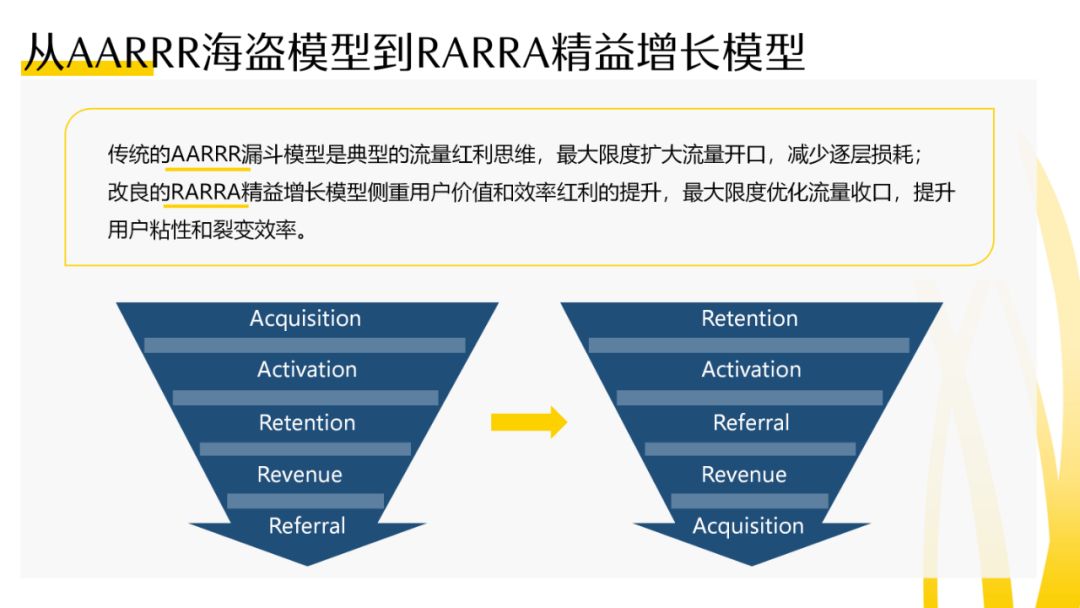
The RARRA model prioritizes Retention as the foremost element—the core of all growth optimization. A product that cannot retain users, regardless of how powerful its features or innovative its design, holds no value. Different product types have different retention benchmarks. Facebook's classic "40-20-10" rule, for example, serves as a reference retention metric for evaluating whether a content or community product meets basic standards.
Once Retention is solid, the model moves to optimizing Activation—getting users to their "aha moment" as early as possible. Then it optimizes Referral, improving viral coefficients, expanding sharing scenarios, and driving sharing-based traffic backflow. On this foundation, it calculates the Revenue model and unit economics (UE). Only after achieving positive gross margins or hitting ROI targets does it finally consider Acquisition—where channel, creative, and new user experience optimization are again guided by retention and UE metrics. This cycle repeats, iterating through data and experimentation until reaching the optimal equilibrium of acquisition volume, retention, and unit economics.
The efficiency-first RARRA lean growth model provides an implementation framework for the lean startup's advocated minimum viable product (MVP) and product-market fit (PMF). Because retention is the first indicator testing a product's value hypothesis, only when retention meets targets can MVP success be assessed. Once entrepreneurs elevate retention to a certain threshold, they can calculate which other环节 is performing best—identifying the optimal growth lever for targeted optimization before addressing other areas. When RARRA reaches a certain combined value, benchmarking against industry-leading products, combined with user research and NPS, can indicate whether PMF has been achieved. Only in a PMF state should large-scale paid acquisition be seriously considered.
RARRA applies not only to pure internet apps. Enterprise services, hardware-plus-software offerings, online-offline integrated new retail, and DTC brand founders can all leverage the lean growth model to optimize product and operational efficiency. In the fresh grocery sector, for instance, many entrepreneurs focused solely on new customer volume, order volume, and GMV—without spending sufficient time optimizing user retention, repurchase rates, and frequency, then adjusting supply chains and optimizing UE accordingly. The results, as many have seen, were disastrous. In the toughest sectors, respecting and adhering to lean growth principles and discipline matters even more. If a startup's growth isn't retention-based but purely acquisition-driven, and it never finds optimization levers, the outcome won't be favorable.
3. Behavioral Slicing
Behavioral slicing refers to continuously grouping and segmenting user data—also known as "Cohort Analysis." Through slicing analysis and thorough datafication, teams build associative models between user behavior and RARRA metrics, thereby identifying the most critical optimization points. Slicing analysis based on massive, multi-dimensional behavioral data can yield profound insights and counterintuitive correlations within products.
The most common slicing application currently involves grouping channels and creatives against retention or revenue metrics to optimize acquisition efficiency. However, various new user behaviors, interaction strategies during usage, and algorithmic strategies can each be mapped against the four RARR targets for combinatorial analysis—a process that surfaces numerous "magic numbers" pointing to optimal optimization points.
For example, analyzing which user behaviors drive high retention: Facebook found that users who followed 7 friends within 10 days showed strong retention; Baidu found that first-search satisfaction above 50% correlated with good retention. Such slicing analysis enables targeted product optimization.
Many startup teams analyze growth channels, user volume, or sales data but fail to adequately record and understand user behavior—missing the opportunity to deeply establish relationships between user behavior and retention, activation, referral backflow, and transaction conversion. Slicing analysis capability is among the most important tools for helping a startup team build competitive insight, and deserves particular attention from founding teams.
4. Retention Analysis, North Star Metrics, and the Aha Moment
As noted earlier, retention is the starting point for growth optimization. Concrete retention analysis should be multi-dimensional: examining both new and existing user retention states, and retention across short, medium, and long timeframes. Retention fundamentally enhances user perceived value and increases switching costs. In cultivating long-term user value, products should incorporate more "hooks" and increase users' "sunk costs." This explains why short video platforms add shopping—transforming from entertainment entry points to life decision entry points—and why users' long-term tipping and interaction with livestream hosts evolves weak relationships into companionship-based strong relationships, driving long-term relationship chain formation and sustained value.
As product managers and founders, you must contemplate your product's long-term value and sustainable competitive advantages. Otherwise, your moat remains narrow.
The "North Star Metric," also called "OMTM" (One Metric That Matters), is the single most important metric that predicts a product's long-term value. It needn't directly tie to monetization but should be highly correlated with future commercialization potential. Different industries and products define different North Star metrics, but several principles apply:
Never define vanity metrics as your North Star. For example, looking solely at registration volume without considering retention and activity.
The North Star metric must be actionable. Through appropriate analytical frameworks, it should decompose into a series of executable "constellation metrics." LinkedIn's North Star, for instance, was Quality Sign-ups with 5+ social connections—completing profile information, listing at least one position, establishing at least 5 connections, and enabling social discoverability.
Strong North Star metrics are long-term oriented, directional, non-vanity, and connected to monetization and long-term value. They typically fall into three categories: attention-centric, transaction volume-centric, and creativity-centric.
Facebook's North Star is "effective feed ad viewing time." Netflix's is "number of subscribers watching content for X+ hours per month." Amazon's is "purchases per Prime member"; Walmart's is "purchase volume per store visit." Salesforce's is "customer data volume recorded per account"; Adobe's is "cloud user subscription volume."
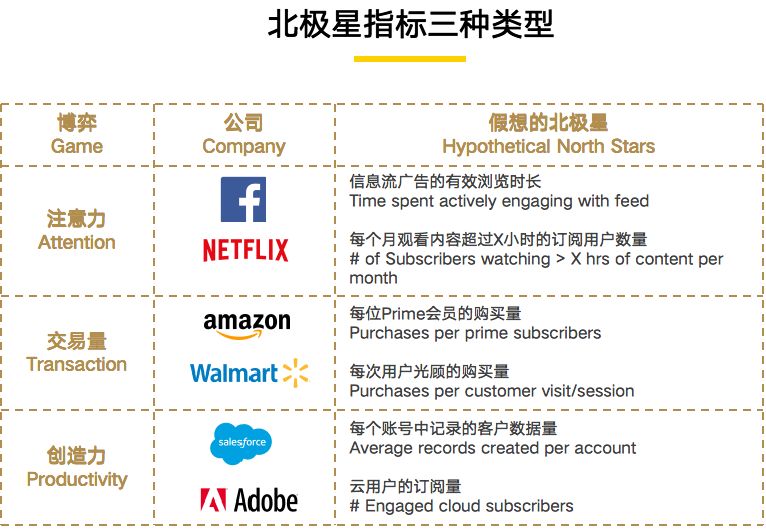
Source: Amplitude
The "aha moment" refers to that instant when product use makes users' eyes light up or their hearts skip—when they discover the product's core value: why it exists, why they need it, what they've already gained. Sustained aha moments create flow states. When we say great products are "addictive," this is the sensation. Aha moments can be extracted through slicing analysis to identify the corresponding behavioral combinations at that moment. Understanding the internal logic of these combinations enables product design that guides users toward aha moments faster, and guides acquisition teams to target users most likely to experience them quickly.
5. Building a Testing Framework
When testing frameworks come up, A/B testing is the most familiar approach: creating two variants for the same optimization objective (e.g., improving purchase conversion rate), deploying variant A to one user segment and variant B to another, then selecting the superior option through statistical comparison to improve operational efficiency. Typically, product or growth strategies are decided beforehand based on reasoning. With A/B testing, teams can retrospectively select validated optimal strategies.
A/B testing works well for products with substantial user bases that are fully digitized. But for early-stage startups with limited data samples, or products where offline experience is a critical component, A/B testing becomes far less practical. In these cases, simple grayscale rollouts and A/A comparisons tend to be more meaningful, helping validate product value and growth hypotheses.
Even for products where A/B testing is highly effective, growth teams must remain vigilant about its limitations. People naturally gravitate toward data that supports their existing views. Fallacies like survivorship bias, combined with modeling constraints and incomplete data, mean that blindly trusting A/B test results — without understanding the logic behind the data — often leads to outcomes that backfire.
6. Traffic Pool Operations
When we think about traffic today, we need to shift from a pure acquisition mindset to a traffic pool operations mindset. Modern traffic falls into three categories. The first is "organic traffic" — the flow generated by extreme product-market fit and strategically positioned ecosystems, as discussed earlier. The second is "paid traffic" — literally bought traffic, including feeds, search, app stores, and e-commerce platforms. This requires continuous operational optimization, deep understanding of platform algorithms, and relentless execution to maximize efficiency. The third is "operational traffic," where effective approaches include KOL network empowerment, sustained wave-making capabilities, and subculture or community operations. These are, in fact, critical tools for building brands and establishing user mindshare in the new traffic era.
Private domain traffic has been buzzy over the past couple of years. From a traffic pool operations perspective, the evolution should be from private domain traffic operations to private domain user and KOL network operations. The core is accumulating trust capital with specific demographics to catalyze exponential expansion of products or services.
Knowing People: Gaining Growth Leverage Through Cognitive Management
Ultimately, growth requires learning to "know people." Most day-to-day decisions in growth teams are data-driven, and over time, teams can fall into "metric hallucination" — losing sight of the human beings behind the numbers. We habitually abstract users into a collective, but no two users are alike. Each has distinct preferences and cognitive patterns. Users make different decisions and behave differently across contexts. Their preferences and cognition can be shaped and changed. Users always seek to maximize their total utility. While users pursue rationality, their capabilities and attention are bounded; they operate with limited rationality.
Understanding users as humans with bounded rationality and specific decision processes helps growth teams design solutions that minimize cognitive friction at every stage of RARRA. It also guides us in effectively helping users create long-term value, enabling sustainable product growth.
Over recent years, economists, psychologists, and sociologists have developed numerous important theories that illuminate user decision logic. I'll briefly introduce several that have proven particularly valuable in practice.
1. Dual-Process Theory
The first is dual-process theory, elaborated in Nobel laureate Daniel Kahneman's Thinking, Fast and Slow. He posits two modes of brain activity: System 1 and System 2. System 1 is fast thinking, or intuitive thinking — representing instinct and habit. It enables rapid decisions with minimal energy expenditure, an evolutionary adaptation. Humans make roughly 95% of decisions through System 1. System 2 is slow thinking, or rational thinking — representing logic and reason. Its activation is passive, slow, energy-intensive, and consciously controlled. Only about 5% of human decisions involve System 2.
For growth teams, dual-process theory implies that humans are subject to cognitive biases. Research in behavioral economics and psychology identifies approximately 200 such biases. Recognizing these bias types can reduce user choice costs, improve conversion rates, and accelerate growth momentum. Notable cognitive biases include:
-
Attribution error: Because only sufficiently simplified theories can be processed by System 1, people tend toward simplistic causal explanations — attributing success to themselves and failure to circumstances or others.
-
Anchoring effect: When evaluating unfamiliar things, people anchor to familiar analogues or recently encountered irrelevant numerical values. Specific manifestations include Kahneman's peak-end rule, where users remember the peak and final moments of an experience most vividly. Experienced growth operators can design peak experiences to boost NPS and conversion. Another operational concept is mental accounting — people maintain separate cognitive accounts for different scenarios and spending categories, each with its own budget and reference frame. Typically, effortless gains like windfalls or unplanned bonuses are spent more painlessly. Conversely, spending related to health, family bonds, or positive psychological associations tends to feel more justified. These insights apply to marketing and pricing. Other relevant concepts include framing effects and the endowment effect.
-
Discrimination and stereotyping: Regional biases, occupational biases, halo effects, and primacy effects (first impressions). Understanding these is critical for establishing positive product personas and delivering strong initial user experiences. Additional biases like loss aversion, egocentric bias, and ratio bias merit attention but I'll leave for your own exploration.
2. Cognitive Dissonance Theory
The second theory is cognitive dissonance, developed by social psychologist Leon Festinger in 1957. It's among the most central theories in communication studies, particularly in persuasion research. Simply put, human cognition comprises numerous cognitive elements — any knowledge, opinion, or belief about the environment, oneself, or one's behavior. These elements exist in consonant, dissonant, or irrelevant relationships. When individuals discover they hold two or more contradictory cognitive elements, they experience a dissonant state. Festinger identified four types of dissonance: A) logical inconsistency; B) cultural norm inconsistency; C) cognitive relationship inconsistency; and D) past experience inconsistency.
When cognitive dissonance arises, individuals experience psychological discomfort or tension, generating motivation to resolve the dissonance, with attitudes shifting accordingly. Beyond actively resolving dissonance, people may also avoid situations or information that would amplify it.
There are three primary methods to reduce or eliminate cognitive dissonance: 1) Change behavior — upon learning milk tea causes weight gain, choose not to drink it or drink less; 2) Change cognition — embrace being a foodie, or learn that milk tea reduces anxiety, reducing guilt while drinking; 3) Introduce new cognitive elements — find research showing milk tea has lower calories than lattes or cola, or that its components metabolize more easily, so drinking it won't cause weight gain.
Branding is fundamentally cognitive management, and the underlying logic of cognitive management tools derives from cognitive dissonance/consonance theory in designing communication and distribution models. For new brands seeking positioning and mindshare establishment, cognitive dissonance and consonance theory offers substantial insight.
3. Flow Experience
The third theory is flow experience. Flow, coined by positive psychology founder Mihaly Csikszentmihalyi, concerns optimal psychological experience and the pursuit of happiness. Flow describes a state of complete absorption and immersion in an activity. It produces distorted time perception — hours pass unnoticed, even with loss of self-awareness. This closely resembles the state of deep game engagement. Consequently, flow is widely applied in game design, and increasingly adopted by sophisticated growth practitioners for community and social products, e-commerce (Pinduoduo is a classic case, as are Alipay's gamified designs), and new brand community operations.
Flow generally requires several conditions: 1) Clear goals — the purpose that triggers flow and the source of happiness; 2) Immediate feedback — indicating whether we're approaching goals, with proximity generating positive reinforcement loops; 3) Continuously optimized challenges — creating challenges matched to user ability, typically 5-10% beyond current capability, to sustain interest. Per the flow channel diagram, when user ability exceeds challenge, users exit the flow channel into boredom; when challenge exceeds ability, they exit into anxiety. Only through dynamic matching of challenge and ability can users remain in the flow channel.
Other theories merit careful study by growth and product managers, including microeconomic concepts of transaction costs and utility, and peak experience design based on Kahneman's peak-end rule. In summary, advancing to growth mastery requires not only strong data analytics capabilities and extensive operational experience, but also drawing from psychology, economics, system dynamics, statistics, and sociology — deeply understanding the underlying logic of human decision-making and complex systems — to gain cognitive advantage in comprehending growth patterns.
In an era where growth remains the eternal pursuit of entrepreneurs, I hope this integrated framework of "clarifying principles, seizing momentum, refining tactics, and knowing people" can help founders acquire the knowledge, common sense, and wisdom of growth — and develop its methodology, mindset, and execution. Thank you!