Moonshot AI K3 Model Released: World's First 3-Trillion-Parameter Open-Source Model, Pushing New Frontiers in Intelligence

2.8 trillion parameters, million-token context window; complex tasks, fully advanced.

In the early hours of July 17, Moonshot AI officially launched Kimi K3, its most capable model to date. Kimi K3 is a 2.8 trillion parameter model built on the KDA hybrid linear attention mechanism (Kimi Delta Attention) and Attention Residuals technology, with native visual understanding and a 1 million token context window. It is the world's first open-source model at the 3-trillion-parameter level, designed for frontier intelligence scenarios including long-horizon programming, knowledge work, and reasoning.
While Kimi K3's overall performance still trails the strongest closed-source models Claude Fable 5 and GPT-5.6 Sol, it demonstrates frontier-level capabilities across the full benchmark suite and stably surpasses all other models.
The Kimi K3 launch is just the beginning. Moonshot AI will continue to unlock the potential of the K3 model and steadily improve its performance on real-world tasks.
Starting today, Kimi K3 is available through kimi.com, the latest Kimi mobile app, the latest Kimi Work desktop client, Kimi Code, and the Kimi API. The default thinking intensity is currently set to max (extreme); low and high modes will be added in a future update.
Moonshot AI is currently working closely with inference partners and open-source maintainers to align on technical details and ensure reliable deployment across the ecosystem. Full model weights will be released by July 27, 2026.
A 3-Trillion-Class Open-Source Model
Kimi K3 is the first open-source model to reach 2.8 trillion parameters. This is the latest step in Moonshot AI's ongoing push to expand model scale boundaries: for 9 of the past 12 months, Kimi models have held the scale ceiling among open-source models.
Kimi K3 is built on Kimi Delta Attention (KDA) and Attention Residuals (AttnRes). Both architectural updates are designed to let information flow more smoothly across longer sequences and deeper models. Kimi K3 also further increases the sparsity of its Mixture of Experts (MoE): combined with the Stable LatentMoE framework, the model can efficiently activate 16 out of 896 experts. Together with training method and data recipe optimizations, these structural improvements give Kimi K3 roughly 2.5× better overall scaling efficiency compared to K2, more effectively converting compute into capability.
Programming
Kimi K3 has strong long-horizon coding capabilities. With minimal human supervision, it can sustain extended engineering tasks, understand and work with large codebases, and coordinate terminal tool usage.
Kimi K3 also excels at tasks that combine software engineering with visual reasoning. It can leverage screenshots and visual feedback to optimize game development, frontend, and CAD scenarios.
The cases below demonstrate how Kimi K3 translates coding ability into open-ended software development and scientific research capabilities.
Kernel Optimization
The team built a kernel optimization arena to test whether Kimi K3 could truly optimize GPU kernels from start to finish. Each model ran independently in its own GPU sandbox, with identical tasks, test frameworks, and production workloads. Given up to 24 hours, the model could analyze existing implementations, rewrite kernels, and iteratively benchmark results.
The arena spans two hardware platforms, three kernel categories, and four tasks: Attention Residuals and KDA linear attention on NVIDIA H200 GPUs, a from-scratch 512-head-dimension MLA kernel, and a KDA task on a domestic Chinese GPU. At maximum thinking intensity, Kimi K3's performance approaches Fable-5 (with fallback mechanisms) and clearly leads Opus 4.8, GPT-5.6 Sol, and GPT 5.5.
GPU Compiler Development
The team further tested whether Kimi K3 could build a GPU programming system from scratch. Kimi K3 developed MiniTriton: a compact Triton-like compiler. Built on MLIR, it constructed its own tile-level intermediate representation and implemented a complete optimization pass to PTX code generation pipeline.
In supported Roofline benchmarks, MiniTriton's performance matched or exceeded Triton and torch.compile, and surpassed Triton on some workloads. It currently supports FP32 and FP64 computation; TF32 and BF16 are in development. We did not expect its early Tensor Core implementation to beat highly optimized Triton, but the results show that without benchmark-specific shortcuts or obvious hardcoded optimizations, MiniTriton already generates competitive GPU code.
As end-to-end validation, the team trained nanoGPT using TensorLite and observed normal convergence. This demonstrates that Kimi K3 did more than generate a few isolated kernels — it built a genuinely usable compiler stack: programming abstractions, intermediate representation, optimization passes, backend code generation, and integration with real training workloads.
Creating Digital Works
Kimi K3 combines powerful 3D reasoning, programming, and visual capabilities to transform concepts, images, and videos into fully playable interactive experiences. It seamlessly iterates between code and live screenshots, achieving true vision-in-the-loop — seeing output instantly, optimizing immediately.
Some examples:
- 3D simulation of the Long March 10 rocket launch and recovery
- 3D open-world game
- 3D GBA emulator
- Recreation of the black hole Gargantua
Visit: https://blackhole-visualizer.ok.kimi.link/
Chip Design
As an early proof of concept, Kimi K3 designed a chip to run a nano model built on its own architecture. During 48 hours of continuous autonomous agent operation, K3 independently completed the chip's construction, optimization, and verification using open-source EDA tools and the Nangate 45nm process library. The chip occupies 4 mm², integrates 1.46 million standard cells, 0.277 MB SRAM, and an INT4 MAC array with fused dequantization, achieving timing closure at 100 MHz with simulated decode throughput consistently exceeding 8,700 tokens per second. A chip designed by a model, for a model — this is the portrait of K3's long-horizon agent capabilities.
(Video generated by Kimi K3 with Blender MCP integration)
Scientific Research Programming
Kimi K3 can bridge scientific literature and executable code, autonomously implementing, verifying, and analyzing complex computational research workflows.
In one case, Kimi K3 completed in approximately two hours what would typically take a senior researcher one to two weeks. To reproduce the I-Love-Q universal relation in computational astrophysics, it read and cross-validated over 20 papers, implemented the complete numerical pipeline, evaluated more than 300 equations of state, discovered inconsistencies in published formulas, generated over 3,000 lines of Python code, and produced an interactive HTML dashboard for exploring results.
Knowledge Work
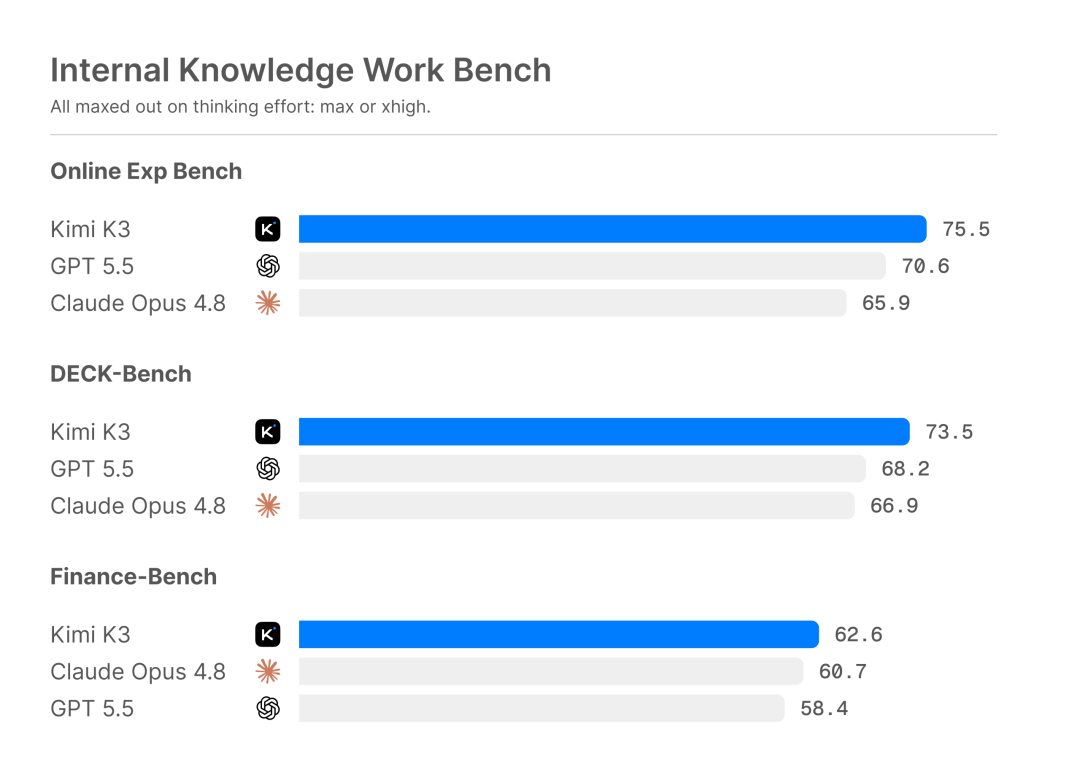
Kimi K3 advances end-to-end knowledge work. Beyond public benchmarks, Kimi K3 (max) shows steady improvement in internal evaluations drawn from recurring task patterns and challenges in real user-agent collaboration workflows. Kimi K3 demonstrates consistent advantages across different production-scenario-oriented workflows, indicating comprehensive improvement in agentic knowledge work capabilities.
■ Research and Visualization
Below are examples of what K3 in Kimi Work can accomplish in financial advisory and research scenarios.
Inference Chip Industry Research: Covering 42 years of ASIC industry history, generated by K3 through 120+ rounds of recursive self-improvement. K3 transforms evidence into custom charts, animated diagrams, and interactive visual narratives. Throughout the process, it completed 2,800+ web searches and crawls, 1,100+ terminal data pulls, and processed 87 quarterly reports and 99 original PDFs totaling over 11,000 pages.
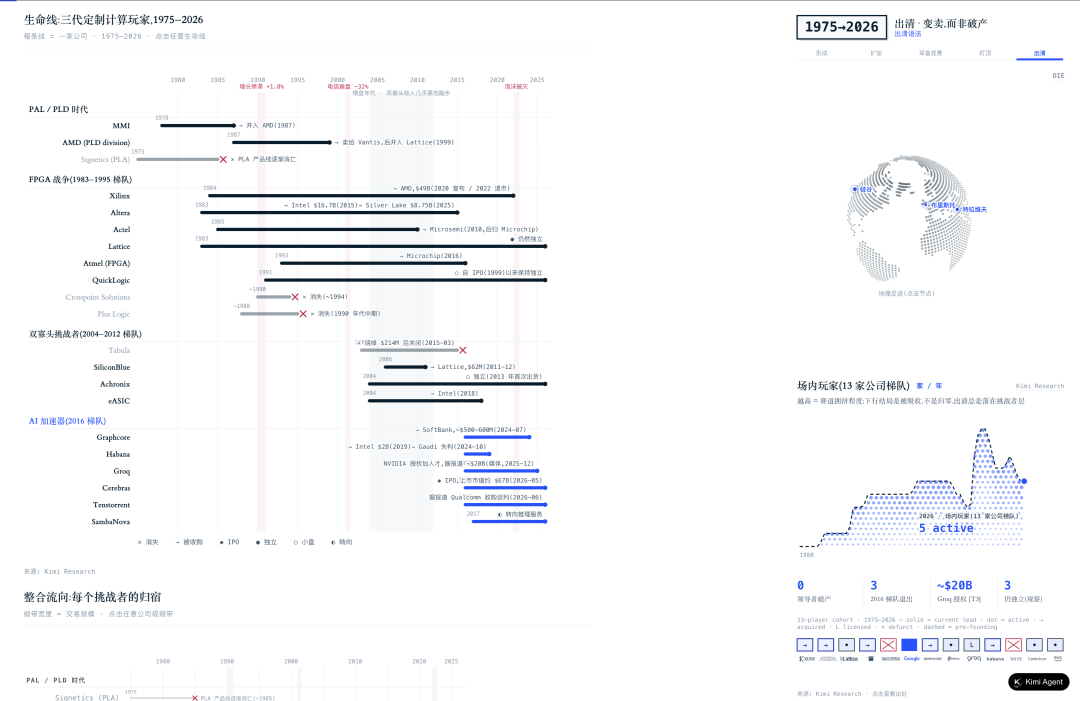
View the full interactive report: https://asic42cn.ok.kimi.link/
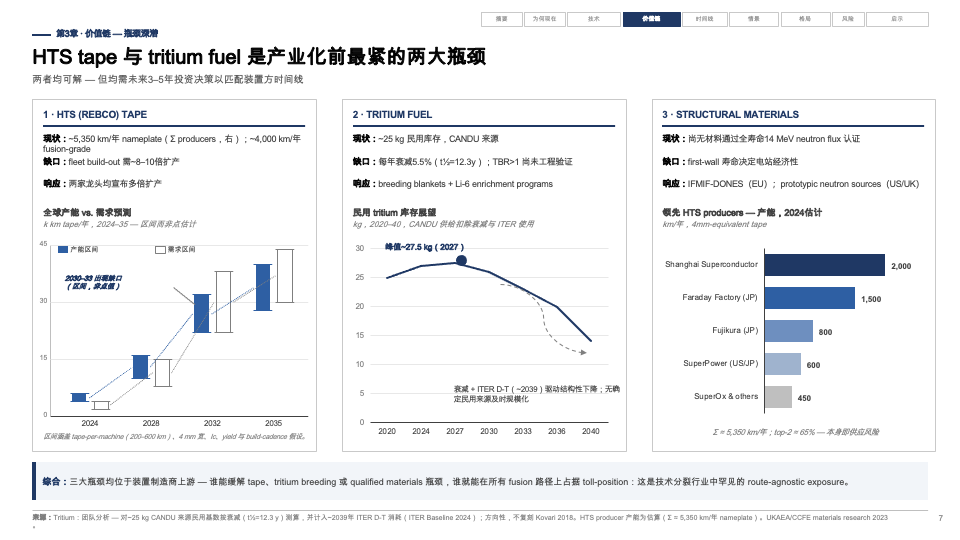
Controllable Nuclear Fusion Industry Research: A consulting-style industry report with timelines, tree diagrams, waterfall charts, Gantt charts, and publication-ready presentations.
GWTC-5 Gravitational Wave Analysis: An analysis of 391 gravitational wave events using 20+ concurrent subagents, producing 7 scientific visualizations, 2 tables, and synthesizing literature from 10+ papers.
■ Widgets and Dashboards
Kimi Work also introduces two new features: Widgets and Dashboard, making interactions with Kimi K3 more visual and persistent. Widgets can generate interactive components directly in conversation, connecting to local data or external plugins for continuous updates. Dashboards aggregate your most important widgets into a persistently saved personalized view, organized around themes, projects, or goals.
■ Video Editing
Kimi K3 excels at motion design, animation, and video editing because its native multimodal architecture understands text, images, and video within a single model.
In one case, K3 produced a "3Blue1Brown"-style motion graphics explainer video introducing its own architecture, translating technical concepts into animated diagrams and transitions — 4.5 minutes long.
In another case, Kimi K3 edited its own brand video from 56 raw clips, completing clip selection, action-matched editing, frame-by-frame beat syncing, audio processing, and multiple revision rounds. Information-dense short videos like this typically require an experienced editor 1–2 workdays; a novice might need 3–5 days.
Architecture and Infrastructure
Kimi K3 is built on Kimi Delta Attention (KDA) and Attention Residuals (AttnRes). KDA provides an efficient foundation for attention scaling, while AttnRes selectively retrieves representations across depth rather than simply accumulating them uniformly layer by layer. Together they form Kimi K3's architectural backbone, enabling the model to scale beyond trillion parameters.
Kimi K3 adopts Stable LatentMoE, actually activating 16 out of 896 experts. At this level of sparsity, routing and optimization become critical challenges. Quantile Balancing allocates experts directly based on quantiles of routing scores, avoiding heuristic updates and sensitive balancing hyperparameters. Per-Head Muon extends Muon to optimize independently per attention head, making learning more adaptive in large-scale training. Sigmoid Tanh Unit (SiTU) and Gated MLA enhance activation control and attention selectivity respectively. These improvements collectively support stable, efficient training at 2.8 trillion parameters.
Kimi K3 adopts quantization-aware training from the SFT stage, using MXFP4 weights and MXFP8 activations to accommodate broader hardware. To avoid throughput impact from expert load imbalance in large-scale expert parallelism, Moonshot AI introduces fully balanced expert-parallel training using static shapes with no host synchronization on the critical path. Since inference efficiency also benefits from larger high-bandwidth communication domains, deployment of Kimi K3 is recommended on supernode configurations of 64 or more accelerators. Finally, because KDA poses new challenges for traditional prefix caching, Moonshot AI has contributed the corresponding implementation to the vLLM community and will release it alongside the model. With KDA plus prefill cache, Kimi K3 can be served at competitive token prices even at large model scales and long context lengths.
Getting Started with Kimi K3
Use Kimi K3 Agents: Search for and download or upgrade to the latest Kimi app in your mobile app store, supporting iOS, Android, and HarmonyOS, or visit kimi.com directly.
Work with Kimi K3: Download the latest Kimi Work desktop client (version 3.1.0 and above), supporting Windows and Apple Silicon Macs.
Program with Kimi K3: Kimi Code runs in your computer's terminal; select the K3 model via the /model command to start.
Build applications with Kimi API: Visit the Kimi API open platform, select model kimi-k3, priced at 2 RMB per million input tokens (cache hit) and 20 RMB (cache miss), output at 100 RMB. Leveraging the Mooncake disaggregated inference architecture, official Kimi API programming scenarios achieve over 90% cache hit rate, making effective input pricing just 1/4 of standard input price. A top-up bonus of up to 30% is also available.
Subscribe to Kimi for your team: Kimi Enterprise supports enterprise-grade data privacy protection and member management, with complete data isolation between personal and enterprise accounts. Find the "Activate Enterprise" button to subscribe for your team online.
Additionally, Moonshot AI will soon launch a hosted agent platform for enterprises: Kimi Hosted Agent, providing agent harness, isolated sandbox, and long-task runtime environments. Join the waitlist to be among the first to test.
Limitations
-
Sensitivity to historical reasoning content: Kimi K3 uses reasoning history retention mode throughout post-training. If an agent framework fails to return all historical reasoning content as required, or if switching to Kimi K3 from another model's ongoing session, context interference may occur, leading to unstable generation quality. We recommend using agent frameworks with verified compatibility such as Kimi Code, and avoiding switching to Kimi K3 mid-session.
-
Overly proactive: Kimi K3's training prioritizes long-horizon, high-difficulty tasks. Therefore, when encountering minor issues or ambiguous user intent during task execution, it may make unintended decisions on the user's behalf. If your application requires agents with stronger boundaries and less free rein, apply clearer behavioral constraints to Kimi K3 through system prompts or AGENTS.md.
-
Although Kimi K3 is overall a highly competitive model, there remains a certain gap in user experience compared to Claude Fable 5 and GPT-5.6 Sol.