Moonshot AI Releases and Open-Sources K2.5 Model: Visual Understanding, Coding, Agent Clusters — The Most Intelligent and Capable Model Yet

Delivers all-new visual understanding, coding, and agent-clustering capabilities.
The soul never thinks without a mental image.
— Aristotle, De Anima
Today, Moonshot AI released and open-sourced the Kimi K2.5 model:
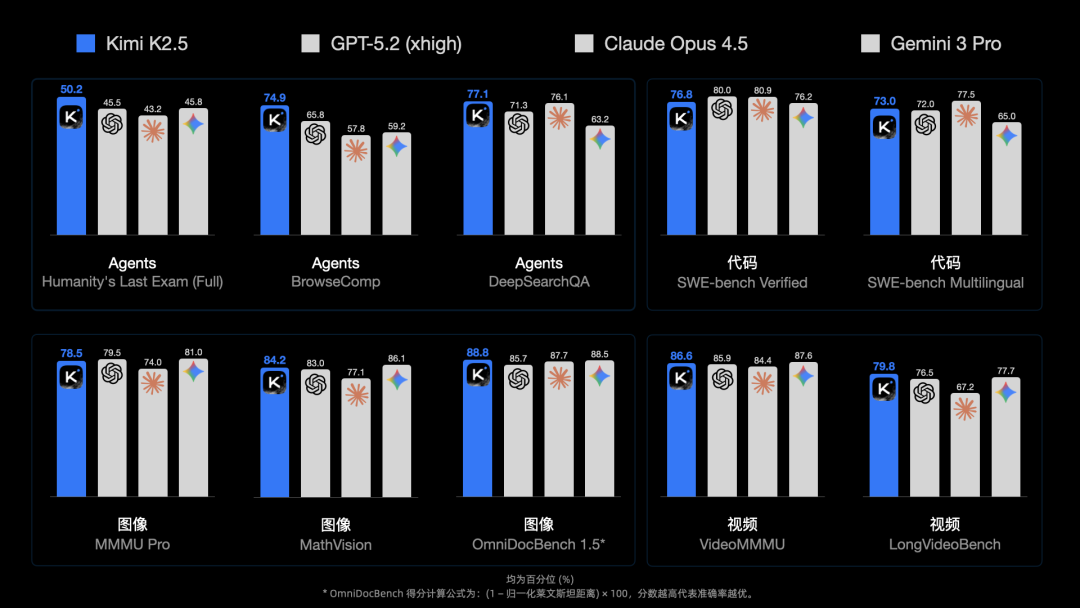
- It is Kimi's most intelligent model to date, achieving open-source state-of-the-art performance on agentic tasks, coding, image understanding, video analysis, and a wide range of general intelligence benchmarks.
- It is also Kimi's most capable model, built on a native multimodal architecture that simultaneously supports visual and text inputs, thinking and non-thinking modes, and both conversational and agentic tasks.
Moonshot AI believes that more intelligent, more capable, and more proficient models will help democratize technology and benefit more people:
- Kimi K2.5 makes intelligence more accessible. By combining visual understanding with reasoning, coding, and agentic capabilities, K2.5 lowers the barrier to interacting with AI: when words fall short, users can simply snap a photo, take a screenshot, or share a screen recording to communicate beyond the limits of text.
- Kimi K2.5 makes everyone an Office power user. The K2.5 model extends Kimi's agentic capabilities into everyday office work, mastering intermediate-to-advanced skills in Word, Excel, PowerPoint, PDF, and other common software — enabling users to deliver near-professional documents directly.
In the future, AI agents will give everyone "superpowers." Just as human society tackles truly complex work through collaboration, K2.5 introduces "Agent Clusters" for the first time — allowing K2.5 to autonomously spawn its own "clones," assembling on-demand teams of different roles that work in parallel, achieving 10x or even 100x efficiency gains.
Kimi K2.5 is now available on kimi.com, the latest Kimi app, the Kimi API platform, and Kimi Code, the programming assistant. We welcome you to try it out.
For more technical details and benchmark results on the Kimi K2.5 model, please follow Moonshot AI's technical blog and upcoming technical reports.
Code × Vision
Making Intelligence Accessible
Kimi K2.5 further advances the coding capabilities of open-source models, particularly in frontend development. The K2.5 model can generate complete frontend interfaces from simple natural language conversations, and effectively handle interactive layouts, scroll-triggered animations, and other dynamic effects. Below is an example of K2.5 building a website from a single prompt, with assistance from an image generation tool:
By integrating visual capabilities, K2.5 truly lowers the barrier to programming: you can simply share a screen recording. Kimi K2.5 will automatically deconstruct the underlying interaction logic and reproduce it from start to finish with clean, professional code.
The advanced visual understanding and programming capabilities of the Kimi K2.5 model have also been validated by feedback from early API beta testers:
Among them, Keep AI's coach Kaka, built on Kimi K2.5's video action recognition and assessment capabilities, will be launching soon — stay tuned.
Agent Clusters
Giving You "Superpowers"
Six months ago, Moonshot AI released the first trillion-parameter open-source agent model, Kimi K2. The subsequent Kimi K2 Thinking added thinking time, enabling it to independently complete long-horizon tasks of up to 300 steps. But that wasn't enough. Solving real-world complex problems requires more than solo performance — it demands teamwork.
Today, Moonshot AI unveils a new exploration with Kimi K2.5: Agent Clusters. This time, the evolution moves from a single agent to clusters of agents.
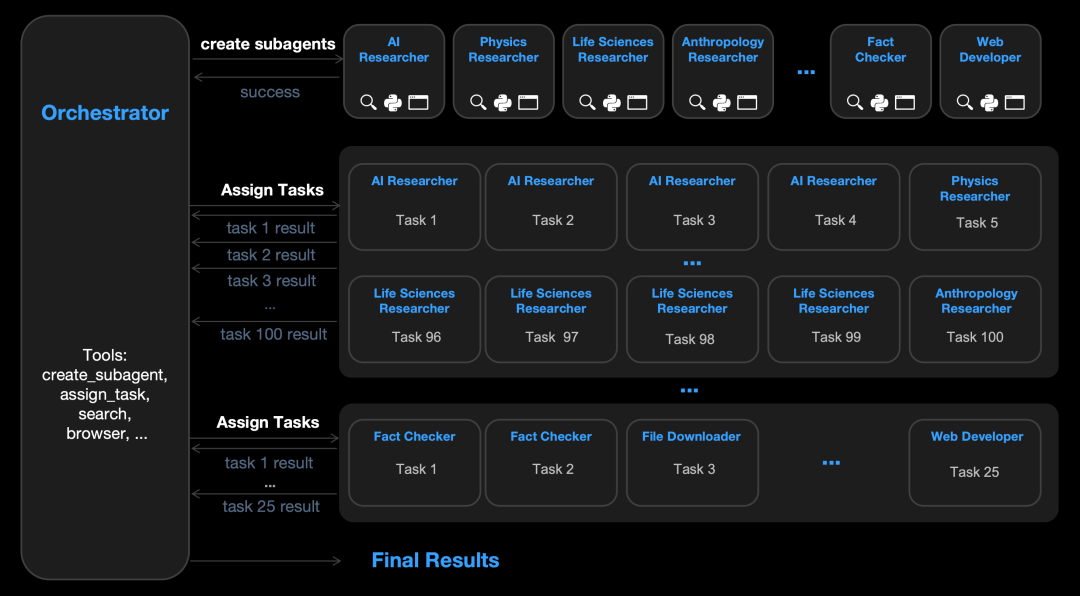
When facing complex tasks, K2.5 is no longer a "jack-of-all-trades" expert handling everything alone. Instead, it transforms into an instantly assembled "professional team." It can dispatch up to 100 clones in real time, processing 1,500 steps in parallel. All role assignments and task decomposition happen on the fly — no preset templates, entirely decided by K2.5 in the moment.
Here's an example. Feed the Kimi Agent Cluster 40 papers on psychology and AI. Kimi first makes multiple tool calls to read through all 40 papers sequentially, ensuring the complete context retains all necessary information. Then it spawns several sub-agents — essentially Kimi's "clones" — each responsible for writing different chapters. Finally, the main agent acts as quality control, consolidating everything into a professional PDF review spanning dozens of pages:
While K2.5 has already reached advanced levels on mainstream agent benchmarks, we care more about every minute it saves users. In large-scale search scenarios, compared to single-agent execution, Agent Clusters reduce the minimum critical steps needed to achieve target performance by 3 to 4.5x, with savings increasing further as target requirements rise; through parallelization, actual wall-clock time can be shortened by up to 4.5x:
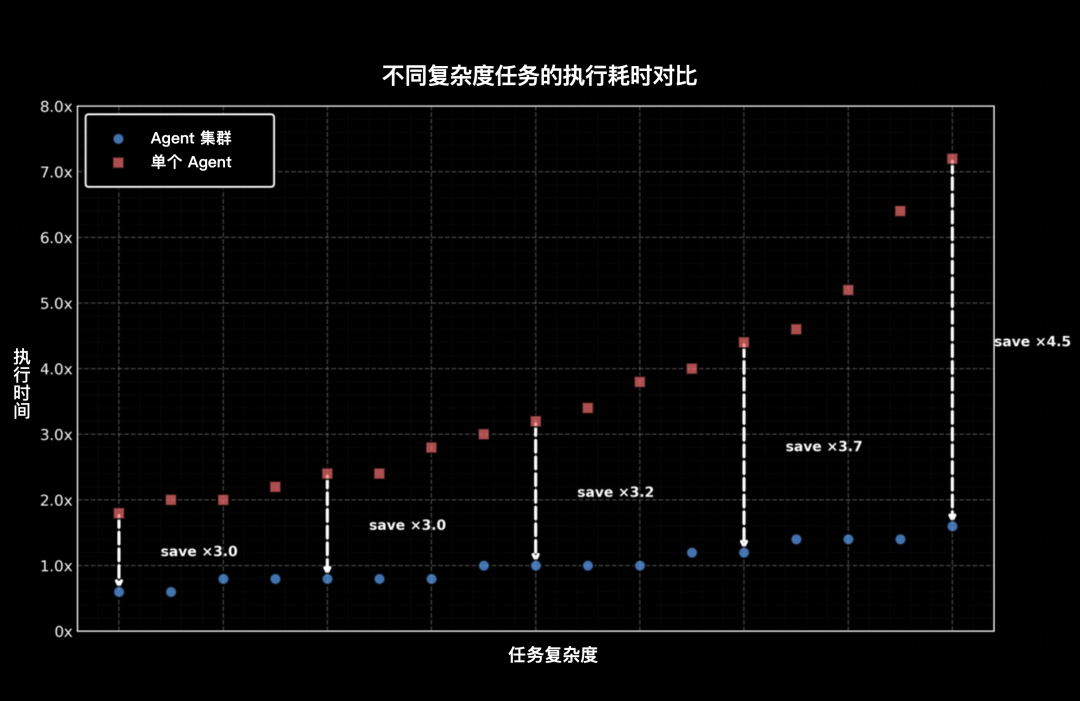
Moreover, scaling training for Agent Clusters is extremely challenging. To address this, Kimi rebuilt its reinforcement learning infrastructure and specifically optimized training algorithms to ensure peak efficiency and performance. This experimental feature is currently in beta and will be gradually rolled out soon. We look forward to Kimi K2.5's collaborative capabilities helping you tackle even more difficult problems.
Kimi Code
Official Release
Since the launch of the Kimi K2 series, the models have gained popularity among developers worldwide for their outstanding performance in software engineering. Backend data from the Kimi platform shows that many developers pair Kimi K2 series models with coding agent products like Claude Code, Cline, Roo Code, and Kilo Code. Meanwhile, coding agent products are increasingly demonstrating more general-purpose capabilities, with their user base expanding beyond technical professionals — suggesting enormous future potential.
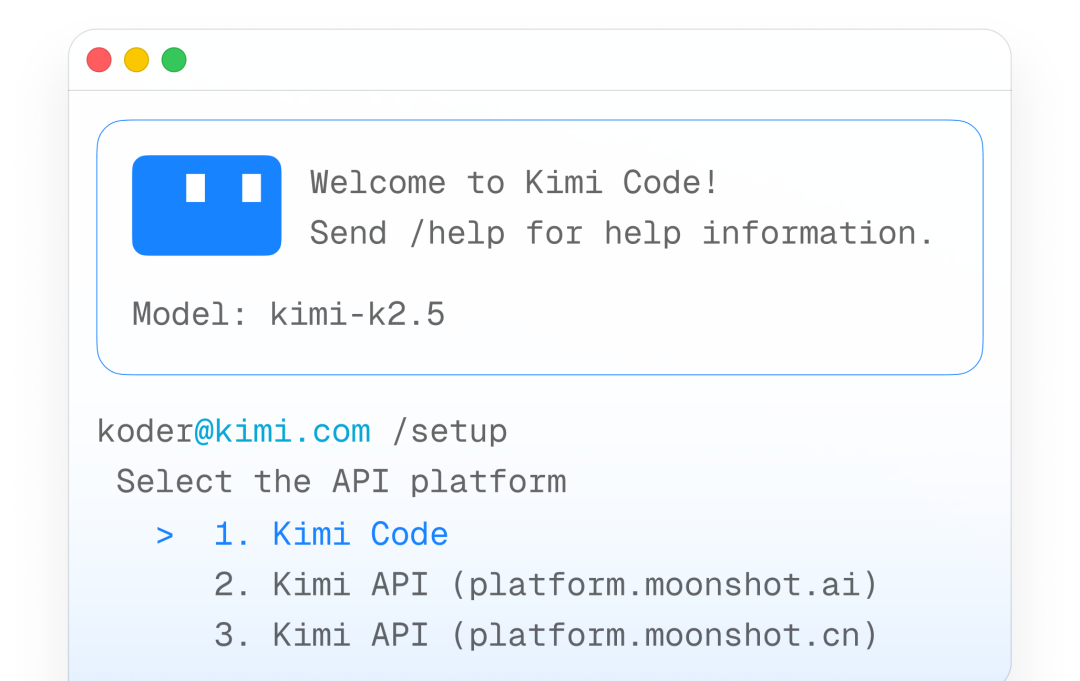
Today, we officially introduce Kimi's programming tool: Kimi Code. It runs directly in the terminal and integrates seamlessly with mainstream editors including VSCode, Cursor, JetBrains, and Zed. Kimi Code fully leverages K2.5's multimodal advantages, supporting direct image and video inputs for programming assistance, and can automatically discover and migrate your existing skills into new workflows.
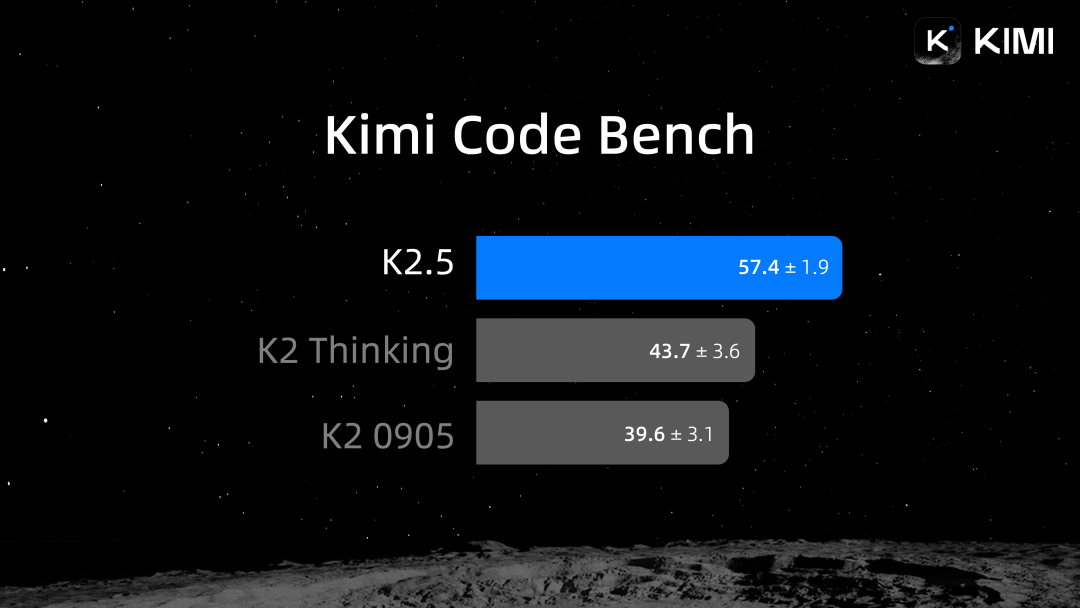
Kimi Code Bench is our internal code capability evaluation benchmark, covering end-to-end tasks from building, debugging, refactoring, and testing to scripting, across multiple programming languages. In internal evaluations, Kimi Code powered by K2.5 showed substantial improvements over previous Kimi models.
We welcome you to use the Kimi K2.5 model API together with Kimi Code, or access it through Kimi's monthly membership plan at kimi.com/code.
Additionally, the Agent SDK behind Kimi Code will also be released as open source, helping everyone customize their own agent experience. For more information, visit https://github.com/MoonshotAI/kimi-agent-sdk/tree/main/examples.
Getting Started
Kimi K2.5
Starting today, K2.5 is available on Kimi.com and the Kimi app. As Kimi's most capable model, K2.5 offers four modes:
- Fast Mode: Delivers the fastest response experience;
- Thinking Mode: For solving complex problems;
- Agent Mode: Excels at deep research, PowerPoint, Excel, Word, PDF, and webpage generation;
- Agent Cluster Mode: For complex tasks requiring parallel processing.
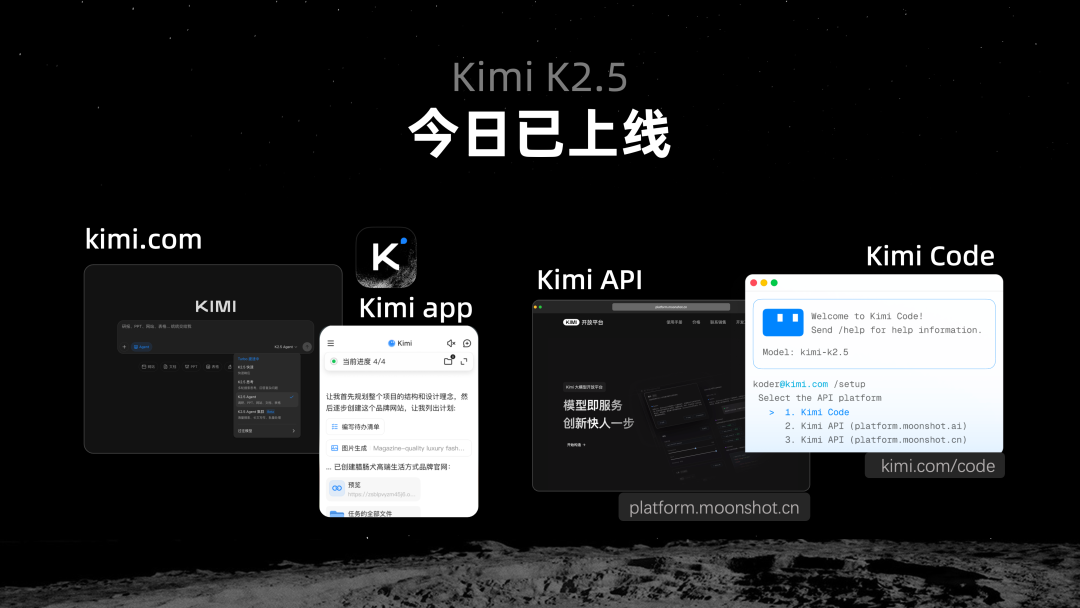
For developers, we recommend pairing K2.5 with Kimi Code.
Enterprises and developers can also access the K2.5 model API through the Kimi platform. Kimi is offering Turbo-level speed while significantly reducing API pricing.
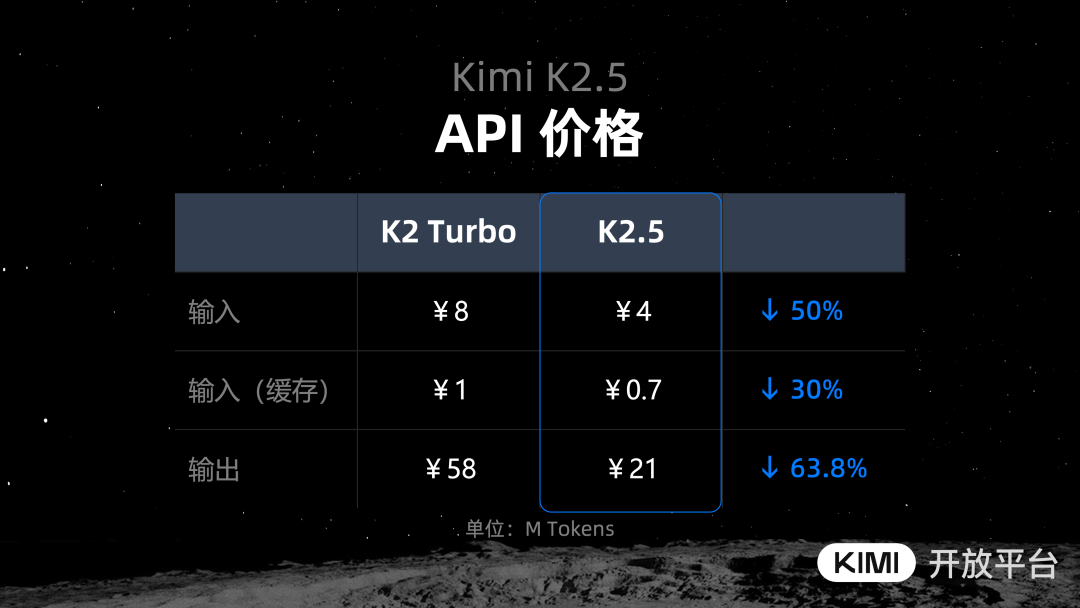
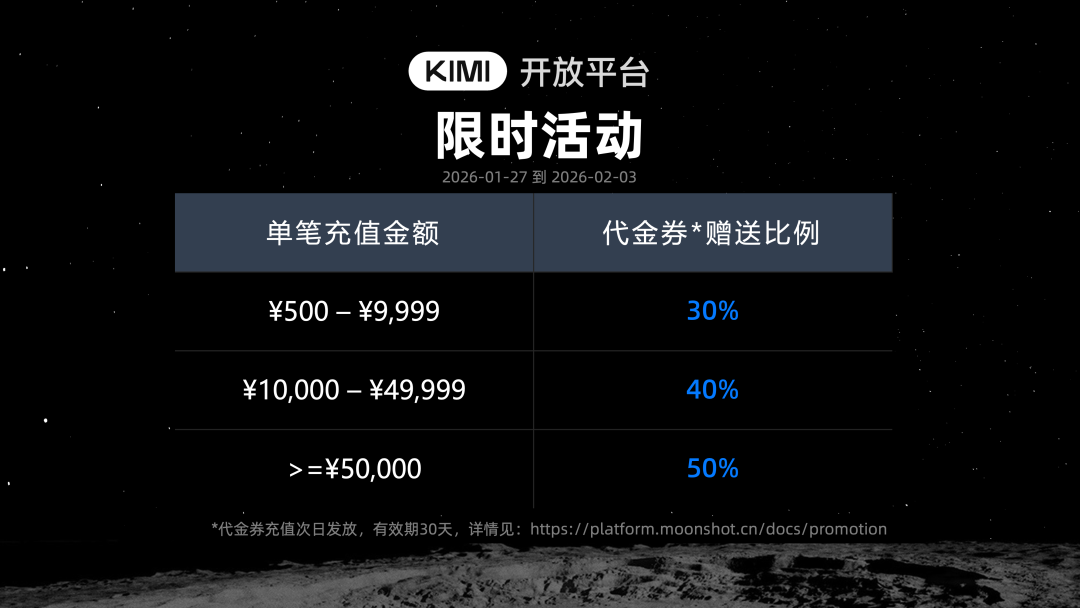
Starting today, the Kimi platform is launching a 7-day top-up bonus event. Details below — we look forward to your feedback.