Li Xilie: Former Head of Bayer and Medtronic Asia-Pacific on Nine Strategies for Chinese Healthcare Companies Going Global | Ronghui Practical Insights

"Nine Questions" for Chinese Healthcare Companies Going Global
"Over the past decade, China has produced a cohort of world-class companies in automotive, internet, and e-commerce — including BYD and Tencent. But the global healthcare pyramid remains dominated by Europe and America, with limited entry points for newcomers. Many Chinese medical products have already achieved world-class technical quality, yet they broadly lack practical experience in going global."
As globalization becomes mandatory, how can innovative healthcare companies take their first step overseas? What gaps must they cross? How should they choose their first destination?
Recently, at a Gaorong Ventures healthcare CEO closed-door session and healthcare track Demo Day, Chris Lee, founder and CEO of VentureBlick, former president of Medtronic Asia Pacific and former president of Bayer Asia Pacific, along with co-founder and CMO Yunbo Cai, shared the common challenges Chinese companies face in going global and offered practical advice to Gaorong's healthcare portfolio companies.
Chris Lee is widely regarded in China's healthcare circle as an "iconic" multinational executive. He brings 30 years of healthcare industry experience, became the first Asian executive in Bayer's 150-year history to join its global executive committee at age 39, and after joining Medtronic, grew the company's China business from $400 million to $2 billion within five years. He has lived and worked in China for 15 years, witnessing the evolution of China's healthcare industry firsthand.
Yunbo Cai, VentureBlick's co-founder and CMO, has 25 years of experience in healthcare branding, marketing, and operations, and previously served as Medtronic Asia Pacific's vice president of corporate affairs and education.



The following is an edited transcript of Chris Lee and Yunbo Cai's remarks:
Question One
Why does Asia rarely produce true breakthrough medical innovation?
We encounter many healthcare companies in Asia that claim their products are highly innovative, that their company could become a unicorn, or that they will achieve massive commercial success. First, we need to be clear: what does breakthrough innovation actually mean in healthcare?
Based on our years of senior executive experience at large multinational healthcare corporations, we have an unofficial definition: in pharmaceuticals, a breakthrough product requires a single patented product with annual revenue exceeding $1 billion; in medtech (including medical devices and diagnostics), a single patented product needs annual revenue exceeding $500 million.
By this standard, apart from a handful of Japanese innovations, Asia currently has few breakthrough medical innovations. Comparing the global top 20 pharmaceutical companies in 2013 and 2023, you'll find almost no change in the rankings over that decade — only one Japanese company made the list. In medtech rankings, only two Japanese companies broke into the top 20 in recent years, with the overall list remaining largely unchanged.
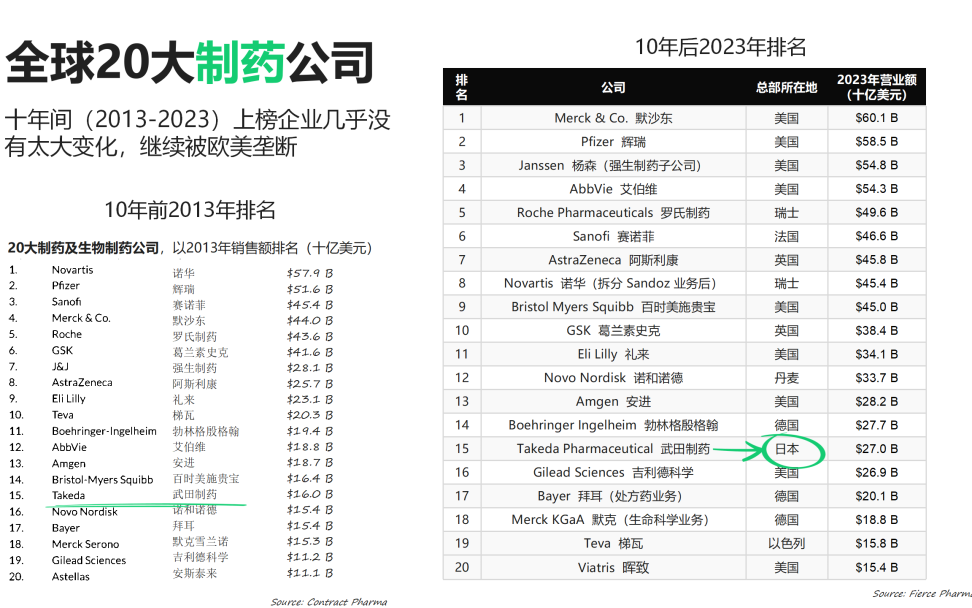
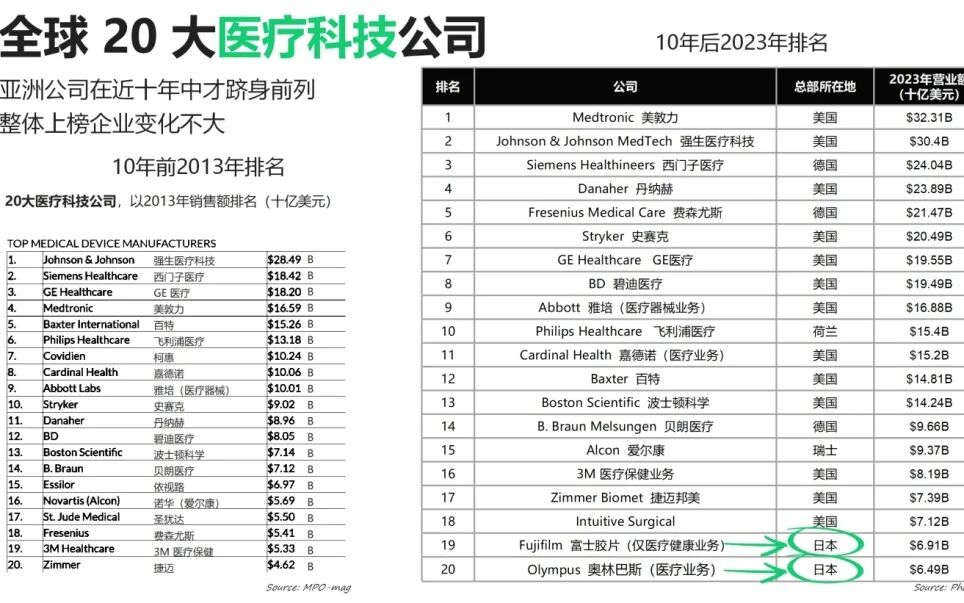
Why? Some argue that healthcare is "old money" — it requires time, wealth, and accumulated experience. Today, many Chinese healthcare products have genuinely reached world-class levels, yet they still often carry labels of being cheap or copycat, unable to command premium pricing. They tend to circulate within specific circles, lacking mutual understanding and collaboration with global networks, and more critically, lacking practical experience in going abroad.
Question Two
Does Asia have the conditions to produce breakthrough medical innovation?
The answer is yes.
We know that building breakthrough innovation requires sufficient R&D investment, smart engineers and scientists, and a large enough market. According to multiple third-party surveys, Asian countries including China, South Korea, Japan, and Singapore rank among the top of the world's 230-plus countries and regions in technical expertise, national IQ levels, and economic scale.
The facts also prove this: China has produced world-class companies like BYD and Tencent in recent years, and South Korea is home to world-class companies like Samsung and LG.
We believe that global medical progress equally needs Asia's, including China's, participation. For example, the vast majority of medical device components globally come from China — overseas medical device companies simply cannot operate without China's supply chain support.
Therefore, we need to work together to discover and support more products from the Asia-Pacific region to go global and receive the attention and pricing they deserve. In 2022, we founded VentureBlick, a one-stop platform for healthcare innovation going global, hoping to help local healthcare companies achieve global collaboration and commercialization more efficiently, meeting more unmet medical needs.
Question Three
Globalization is mandatory — how do you take the first step?
We believe that strategic global expansion requires three elements simultaneously.
First, you need to work with people who truly have global mindset. Many companies fall into the trap of thinking that someone who has worked in Europe or America and speaks English has global vision. In reality, we need to collaborate with experts who have actually worked overseas and have successful commercialization experience, not just academic or laboratory achievements.
Second, you need timely access to the latest global insights in relevant fields, and true insights must come from experienced professionals' long-term frontline practice and observation.
Finally, taking innovative healthcare products global is a massive undertaking, potentially requiring hundreds of millions of dollars in investment. Therefore, companies need very comprehensive, systematic global resource support that can be tailored to different target regions, fields, and development stages.
Question Four
What "pitfalls" do Chinese healthcare companies often encounter when going global?
Over the past two years, in our conversations with many startup healthcare companies, we've seen three major challenges Chinese healthcare companies face in going global.
First, information gap. Companies often lack comprehensive understanding of the global healthcare market landscape, characteristics, and distribution.
Second, mindset gap. Many companies equate going global with trade, or want to take shortcuts, or visit a market briefly and blindly conclude it's huge with lots of demand — missing systematic thinking.
Third, execution gap. When companies first start going global, common mistakes include over-reliance on trade shows, personal judgment, or mainstream trends; unwillingness to plan out their global expansion path; neglect of brand building; and preferring repeated trial and error that leads to one-sided conclusions.
Question Five
How to choose your first destination, and what to look for?
Overall, selecting a target market for global expansion requires five key considerations.
First, market size, local competitive landscape, and addressable user volume.
Second, pricing space and payment capacity in the target market. Historically, Chinese healthcare products going global have tended toward low-price routes, relatively neglecting pricing space issues.
Third, regulatory access and clinical feasibility.
Fourth, the target market's impact on overall global layout and internationalization path. This is something many companies overlook — Southeast Asia first, Middle East, or Europe and America? There are many nuances here, because sometimes "one wrong step leads to wrong steps everywhere."
Fifth, business model and product-market fit. For example, does the company's core profit come from services, software, or consumables? Does this align with the local market?
Question Six
Growth logic for going global: volume or profit?
The purpose of going global is to seek incremental growth — the question is whether to chase volume or profit. Let's look at a leading medtech multinational with $30 billion in annual revenue, examining how different markets contribute to sales revenue and profit margins.
The data shows that North America remains the primary market with both high revenue and high profit margins. China, Japan, Germany, and others contribute around 5% of revenue, with profit margins under 40%. India's revenue and profit margins are lower, but its annual growth rate is very high.
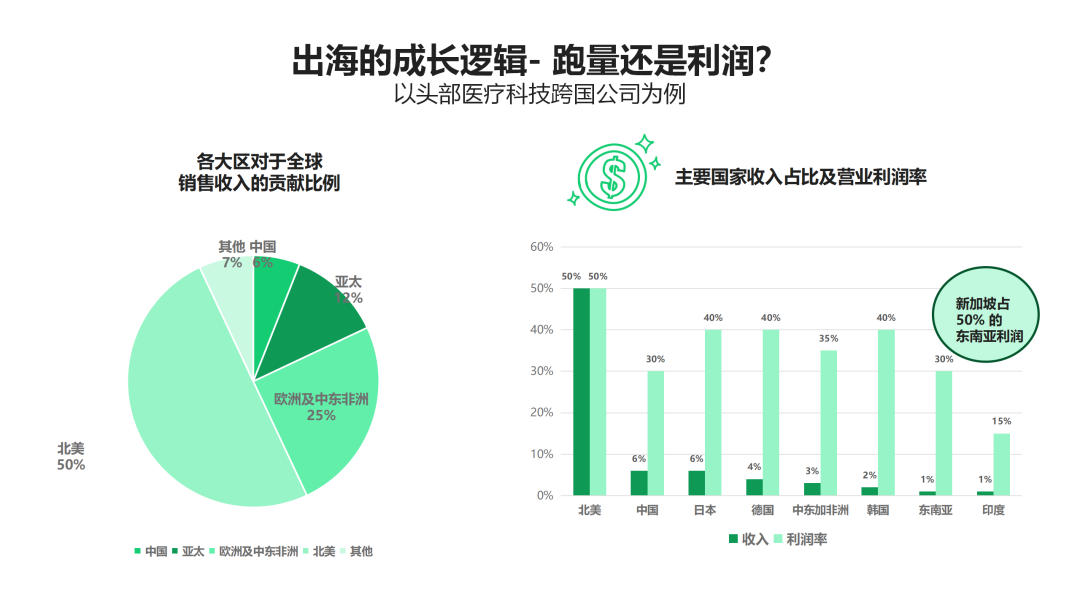
As you can see, the currently trendy destinations for going global (such as the Middle East, Africa, and India) mostly sit at the lower end in terms of revenue share and profit margins. Of course, this doesn't mean these markets are bad or not worth entering — the key is your company's strategic goal. These markets may not serve to set the tone or provide endorsement for innovative products seeking to establish global technological advantage and influence; but for basic, economy products, they may offer easier access and large potential volume.
Additionally, innovators aiming to build something substantial need to invest for long-term product and brand returns around their overall global strategy. Technology patents and clinical certifications from developed markets, sales and service partnerships, performance in entered international markets — all of these can translate into product and brand value.
Question Seven
Market selection logic: large market or small market?
Take South Korea and Indonesia's healthcare markets as examples — which is larger?
From a population perspective, Indonesia has 270 million people versus South Korea's 50 million, so some might say Indonesia is the larger market.
But data shows South Korea's healthcare market is $240 billion, while Indonesia's is only $50 billion, and South Korea's annual growth rate can reach 5-7%. From a healthcare infrastructure perspective, South Korea has a developed healthcare market with universal health coverage and minimal urban-rural disparity, while Indonesia has underdeveloped infrastructure. Of course, South Korea's healthcare market is intensely competitive, requiring differentiation for new products to enter, while Indonesia's market is fragmented and less regulated, posing major challenges for clinical and compliance work.
Comprehensively, we believe South Korea is a relatively suitable developed market for some innovative healthcare products to test the waters. There are no absolute right or wrong answers to these questions — choices must align with a company's own strategy and product positioning.
Question Eight
How can Chinese healthcare companies enhance perceived value?
From an international influence perspective, we've observed that Chinese companies tend to be relatively low-key compared to their counterparts in other countries. But perceived value matters greatly, as it largely determines whether a company can secure overseas BD opportunities, brand premium opportunities, and lay the groundwork for overseas commercialization.
So how can Chinese healthcare companies increase their "presence"? Here are our recommendations.
- Start earlier on global patent and technology protection;
- Begin global multi-center clinical trials sooner;
- Collaborate more with overseas experts to publish academic articles in international journals in English;
- Engage more with key decision-makers at multinational headquarters, getting on their radar early;
- Connect with overseas investors, bring in international board members, and strengthen international business partnerships;
- Elevate brand building to strategic importance: systematic, international, and localized.
Question Nine
Do early-stage healthcare companies have a chance to successfully go global?
In our actual conversations with companies, some early-stage projects or SMEs have expressed interest in going global but don't know where to start — they struggle to access the global information, resources, and networks needed for global expansion.
In reality, going global is no longer the privilege of large companies. Early-stage innovators, small and medium enterprises, or companies without prior global experience can still expand internationally through various approaches including overseas BD, technology licensing, and open innovation partnerships — even without their own overseas resources.
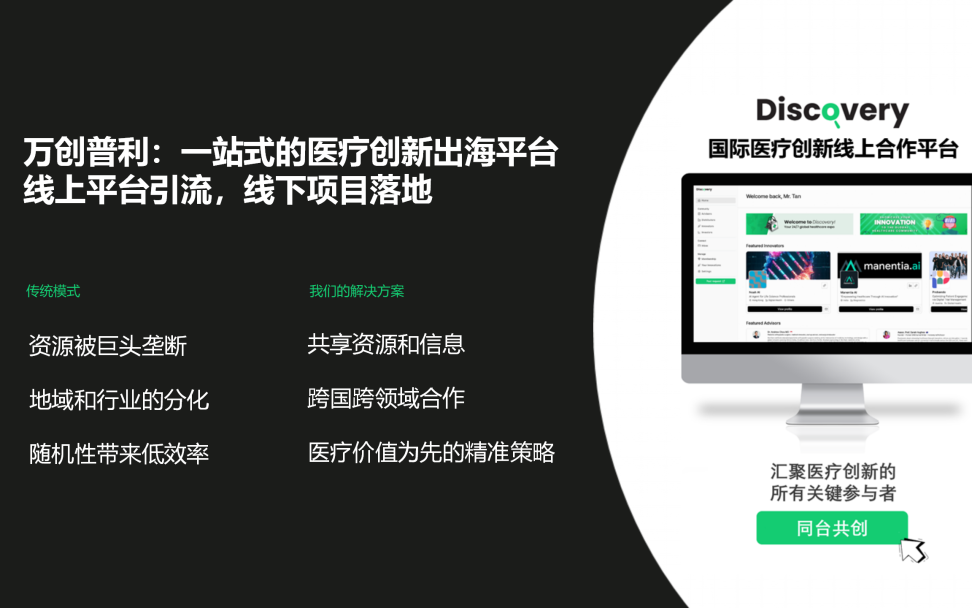
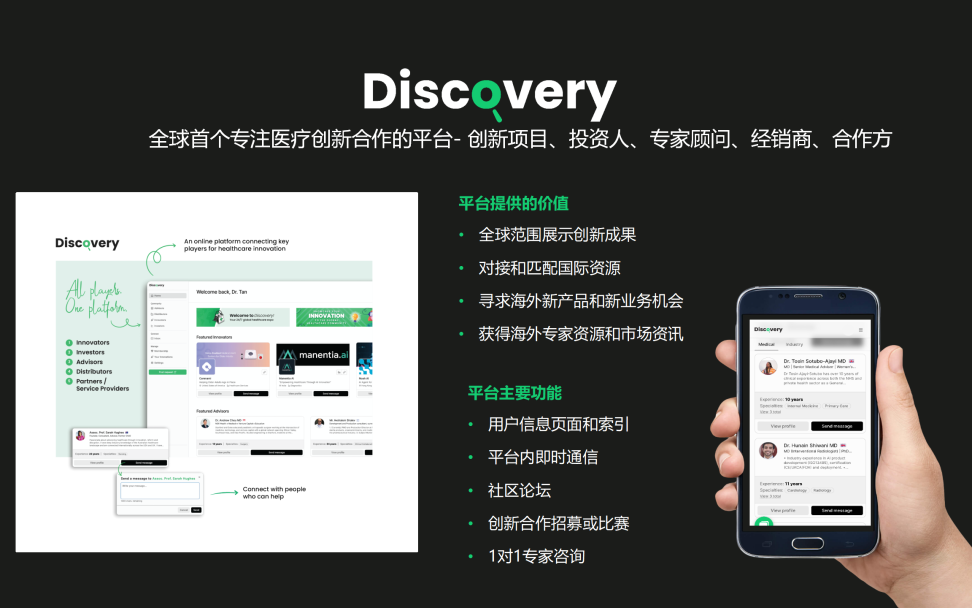
To this end, VentureBlick built Discovery, the world's first online platform focused on healthcare innovation collaboration (click "read more" to visit the official website), "which you can think of as a LinkedIn focused on healthcare innovation," enabling healthcare companies to build lightweight online international networks and addressing resource and information sharing, cross-border and cross-field collaboration, and other challenges.
This platform adheres to a healthcare value-first philosophy in supporting innovation. Healthcare innovation cycles are long — if a product goes through a lengthy R&D cycle only to find no one willing to pay, it's too late. We want to front-load the market validation and feedback process, so we built our own global expert network encompassing over 3,200 expert advisors worldwide, providing in-depth feedback and targeted support for going global.
How early-stage companies approach internationalization at different development stages varies. But fundamentally, they need to plan their path based on real market feedback, and execute with teams that truly understand local markets.

Complex and lengthy healthcare innovation can only achieve maximum return and impact through globalization. Guided by healthcare value as the north star, we look forward to more Chinese healthcare products and services going global and receiving the value returns they deserve.