"Tiny but Mighty" miRNA: How Cancer Can Be Caught at Its Earliest Stage | Gaorong Ventures "Future"

By applying microRNA to early cancer screening, we can transform cancer from a terminal illness into a chronic disease that can be intercepted at an early stage.
In the early 1960s, after President Kennedy announced the Apollo program, the media conducted a survey asking which was more likely: landing a man on the moon or curing cancer. Most respondents believed the moon landing was nearly impossible, while curing cancer seemed within reach.
As it turned out, humans reached the moon in less than a decade. Cancer treatment, however, remains a formidable challenge to this day. According to 2020 global cancer data released by the International Agency for Research on Cancer (IARC), there were 19.29 million new cancer cases and 9.96 million deaths worldwide that year. China alone accounted for 4.57 million new cases and 3 million deaths.
In recent years, immunotherapy and cell therapy have brought glimmers of hope to cancer treatment. Yet late-stage therapies remain limited. Conquering cancer requires starting at the prevention stage — catching and diagnosing it as early as possible.
MiRXES develops cancer early-detection kits based on microRNA (miRNA) technology. Its vision for the next decade: enabling more people to screen for cancer at low cost and without burden, transforming cancer from a terminal illness into a chronic condition that can be intercepted early.
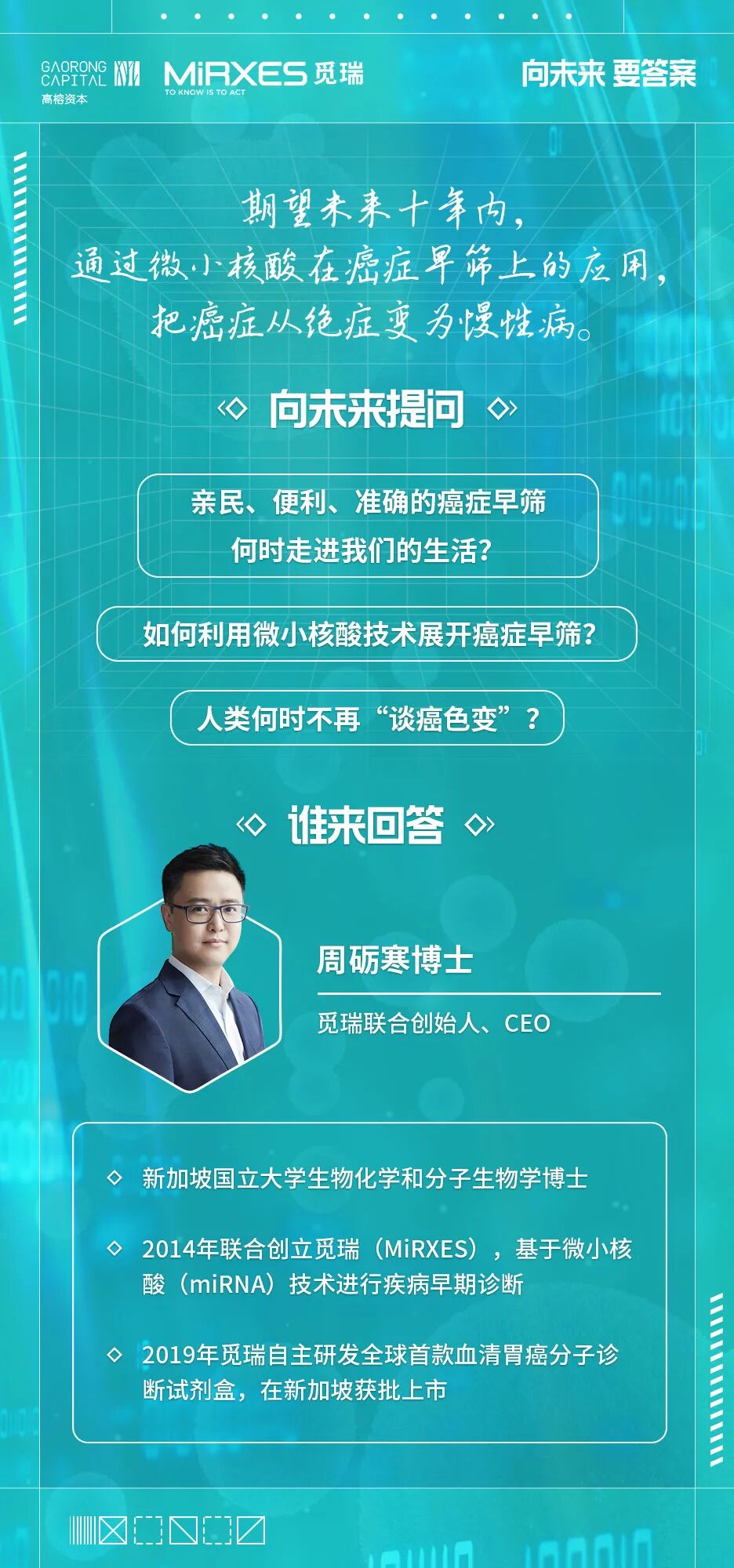
This is the second installment of Gaorong Ventures' "Future" series. We spoke with Dr. Lihan Zhou, co-founder and CEO of MiRXES, about how microRNA technology is being applied to cancer early screening.

Q: What is microRNA, and what role does it play in the human body?
Zhou Lihan: In the life sciences, microRNA is a very emerging field. From its initial discovery in the human body through early-stage research to clinical translation, the entire journey spans only about 20 years.
In 2001, Yale University biologist Professor Frank Slack first discovered microRNA in humans. Professor Slack is also a scientific advisor to MiRXES.
As the name suggests, microRNA is a tiny member of the RNA family — just 22 nucleotides long. Yet it is a critical regulator of gene expression, governing the entire life cycle of humans, animals, and plants. You could say it's "working anytime, anywhere."
As endogenous small non-coding RNAs widely expressed in animal and plant cells, microRNAs are involved in numerous processes including cell proliferation, differentiation, and apoptosis, playing key roles in tumor initiation, progression, and metastasis.
We were fortunate to enter microRNA basic research in 2003. Myself and MiRXES co-founder Ruiyang Zou were students of Professor Xingyong Zhu at the National University of Singapore. MicroRNA is extremely difficult to detect — Professor Slack originally used very complex detection techniques. Professor Zhu established Southeast Asia's first qPCR (quantitative real-time polymerase chain reaction) nucleic acid testing laboratory to explore microRNA detection technology.
In 2010, our research group received incubation support from Singapore's Agency for Science, Technology and Research (A*STAR), establishing a microRNA clinical biomarker R&D center to advance the industrialization of microRNA PCR detection technology.
Q: In what areas of life science can microRNA research be applied?
Zhou Lihan: MicroRNA can regulate nearly one-third of human genes, earning it the nickname "fine-tuner" of gene expression. Its functions span numerous physiological and pathological processes, including developmental regulation, viral resistance, immune function modulation, diseases of various organs and systems, and tumor regulation.
Therefore, in principle, microRNA has future clinical application potential across oncology, cardiovascular disease, metabolic diseases (such as diabetes), immune disorders, neurological conditions, and infectious diseases. Initially, our team compared microRNA levels between cancer cells and normal cells to optimize cancer subtype classification and help pharmaceutical companies discover new drug targets.
Later, we realized: if cancer-related microRNAs could be accurately detected in blood, cancer might be discovered and treated at much earlier stages.
This discovery thrilled us. In 2014, we formally established MiRXES to commercialize microRNA PCR detection technology globally, while simultaneously pursuing microRNA applications in cancer early screening.

Q: Why does using microRNA technology for cancer early screening excite you so much?
Zhou Lihan: First, cancer incidence is increasing globally. By 2040, nearly 40 million new cancer cases are projected annually worldwide, with half occurring in Asia.
Today, most cancer patients — including members of my own family — are diagnosed at late stages, when treatment options are limited. We know that if cancer is detected early, it can be cured or effectively controlled. The importance of early cancer screening and diagnosis speaks for itself.
As mentioned earlier, abnormal microRNA expression is closely linked to tumor initiation and progression. In early-stage cancer patients, microRNA levels in blood are significantly higher than those of DNA or proteins.
Additionally, because microRNAs exist in blood as nucleic acid-protein complexes or are encapsulated in exosomes, they can withstand repeated freeze-thaw cycles and extreme pH environments without degrading, exhibiting excellent stability. Therefore, microRNA is an ideal tumor biomarker.
Based on the unique biological significance of microRNA, MiRXES's proprietary detection method can assess whether specific microRNA expression levels in a patient's peripheral circulating blood fall within the normal range, thereby screening for specific cancers and detecting small lesions with high sensitivity.
Q: Compared with previous cancer screening methods, what advantages does microRNA-based testing offer?
Zhou Lihan: Globally, cancer screening has typically been conducted through imaging or other invasive methods.
About 40 years ago, the Netherlands pioneered breast cancer screening based on imaging technology. More familiar to many are gastric cancer and colorectal cancer screenings via gastroscopy and colonoscopy. However, these procedures are not suitable for large-scale application in healthy populations — the experience is unpleasant, and they place significant burden on healthcare systems.
As aging accelerates and cancer incidence rises, we need non-invasive methods to detect cancer more precisely.
In recent years, numerous scientists and companies worldwide have entered the field of tumor liquid biopsy. Blood vessels are the body's internal highways and primary communication channels, where signaling molecules such as hormones and cytokines are secreted and released. By detecting these signaling molecules, we can easily obtain test samples non-invasively to assess patient health.
Over the past 20 years, blood tests at hospitals have mainly detected protein-based tumor markers. However, protein tumor markers have low detection sensitivity — cancer typically needs to progress to stage III or IV with substantial lesions before protein markers show significantly elevated expression.
Compared with protein markers, abnormal microRNA expression appears earlier in the body and at higher concentrations. Consequently, leading players in global cancer early screening have gradually shifted from traditional blood protein markers toward greater focus on nucleic acid markers.
Q: What are the technical challenges of microRNA-based detection?
Zhou Lihan: MicroRNA is an ideal tumor biomarker, but the challenge lies in its extremely small size among human gene fragments — highly precise technology is essential for effective detection. Currently, fewer than four companies worldwide can truly conduct cancer early screening based on microRNA, and MiRXES is one of them.
We developed a novel method combining deoxyuridine-incorporated RT oligonucleotides with secondary structure and semi-nested real-time PCR. Building on this, we developed cancer early-screening kits that are low-cost, highly accurate, and suitable for widespread hospital use.
Q: In 2019, MiRXES independently developed GASTROClear™, the world's first serum-based molecular diagnostic kit for gastric cancer, which was approved for sale in Singapore. How has its actual detection accuracy performed?
Zhou Lihan: Theoretically, gastroscopy can detect 100% of early-stage cancers; however, after more than 20 years of use, early cancer detection rates through gastroscopy screening range from 70%-85% due to factors such as physician experience. Detection of early-stage cancer through blood protein tumor markers achieves only 20%-30%.
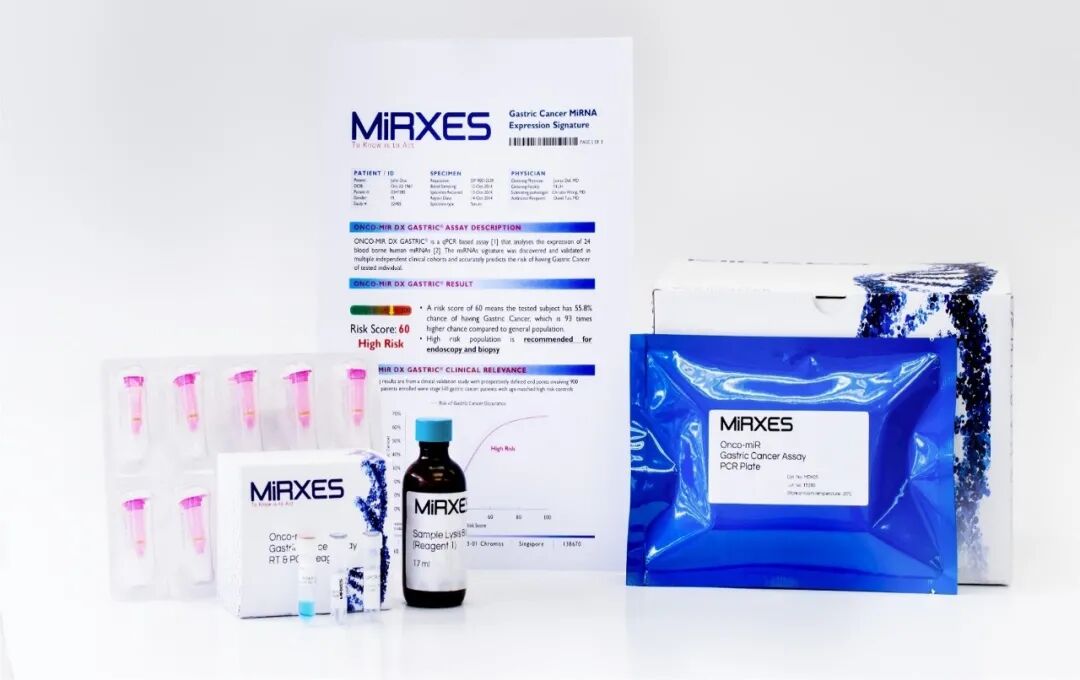
GASTROClear™, the world's first serum-based molecular diagnostic kit for gastric cancer, independently developed by MiRXES
MiRXES conducted a prospective cohort study in Singapore involving over 5,000 asymptomatic individuals at moderate risk for gastric cancer. The results showed that our diagnostic kit achieved an 87% detection rate for stage I gastric cancer, and a 60% detection rate for high-grade intraepithelial neoplasia and other precancerous lesions. In other words, using our product to detect disease-specific microRNAs yields early gastric cancer diagnosis rates very close to those of screening gastroscopy. Given that blood testing is more convenient and less invasive, it has the potential to become an ideal screening solution for moderate-to-high-risk populations.

Q: Beyond gastric cancer, what other cancer early-screening product pipelines will MiRXES advance? What is your overall business strategy?
Zhou Lihan: Our next step is to continue full steam ahead with early diagnostic product pipelines for lung cancer, colorectal cancer, liver cancer, breast cancer, pancreatic cancer, and multi-cancer detection. Through our efforts, we hope that within 5-10 years, early screening and diagnosis for the six most prevalent cancers globally can be achieved through blood microRNA testing.
Globally, after 20 years of research and translation, Singapore, Japan, the United States, and China are at the forefront of microRNA applications, all having achieved preliminary clinical use.
In 2016, MiRXES began laying out its domestic market from Hangzhou, bringing cutting-edge technology to China. We currently maintain large-scale R&D and production teams in Hangzhou, and have established a clinical medical testing laboratory in Tianjin, with diagnostic product pipelines for gastric cancer, lung cancer, and other cancer types. We aim to bring our novel testing kits to the domestic market, selling to laboratories, hospitals, and health examination centers in more affordable, accessible, and user-friendly forms.
Beyond cancer early screening, we will also leverage the advantages of MiRXES's independently developed microRNA technology platform to expand into cardiovascular, metabolic, and infectious disease research and clinical diagnostic applications.
Q: When do you expect microRNA-based cancer early screening to achieve relatively large-scale普及 among the public?
Zhou Lihan: The global COVID-19 pandemic has made people realize that nucleic acid and PCR detection technologies can enable early disease detection and diagnosis, preventing disease progression. This concept has become deeply ingrained.
Moreover, the pandemic led to the establishment of numerous PCR laboratories worldwide. Before COVID-19, clinically diagnostic-grade PCR laboratories were scarce — in China, for example, they existed mainly in tertiary hospitals in first- and second-tier cities. Today, PCR laboratories have reached third- and fourth-tier cities, and even rural areas.
MiRXES's microRNA technology platform was originally designed to be applicable on mainstream, commonly available PCR technology platforms. Post-COVID, this infrastructure can be adapted for diagnosing and detecting other diseases. We believe that within 5-10 years, nucleic acid testing can achieve nationwide coverage, reaching over 90% of China's population. We hope that wherever PCR laboratories exist, microRNA-based cancer screening can be performed.

Q: What has been the underlying motivation for persisting in exploring the microRNA field all these years?
Zhou Lihan: Biotechnology is an extremely long road — you must endure solitude. The MiRXES team has essentially experienced the complete journey of microRNA PCR detection technology over the past nearly 20 years, from R&D and optimization, through preclinical research, to cancer early-screening kit finalization, production, analytical validation, and clinical approval. Only by walking this path do you truly understand what it means to spend ten years sharpening one sword.
Failed experiments far outnumbered successful ones. But despite the hardships, it has been profoundly worthwhile. Transforming a laboratory technology into a product that can enter clinical practice today for early diagnosis and treatment — saving patients' lives — is deeply meaningful. No amount of hardship matters.
My personal hope is that within the next 10 years, through microRNA applications in cancer early screening, we can transform cancer from a terminal illness into a chronic condition that can be intercepted early.
Q: How do you view the challenges and keys to success for scientist-entrepreneurs?
Zhou Lihan: There isn't fundamentally that much difference between being a researcher and an entrepreneur — both are driven by an urgent desire to solve a problem. In research, you focus more on technical solutions; when translating research to business, you think from different angles.
For example, when developing cancer early-screening products, we consider what ordinary people or doctors actually want: more accurate, convenient, and affordable testing methods. Whether the underlying technology involves proteins, DNA, microRNA, or anything else — they don't care. So in our commercialization efforts, we aim to break out of the R&D mindset confined to the laboratory and consider things from the user experience perspective: how to make products more accessible, convenient, and stable, and how to optimize the user experience.
Over the past seven years, I have also transitioned from a scientist's mindset to a product design mindset, converting technical thinking into user thinking — truly considering things from ordinary people's perspectives, and through users' eyes, thinking about what our products, testing processes, and final reports should look like.
Q: What experiences and insights do you have managing a biotechnology company?
Zhou Lihan: In biotechnology, from product design to application typically requires a 5-10 year R&D cycle. So my deepest realization is that for a biotech company's success, compared with technology and funding, the ability to attract and retain talent is the most critical factor determining whether a company succeeds or fails.
How do you attract excellent people and motivate everyone to strive toward the same goal? Whether in R&D, production, quality inspection, or business development, everyone must share the same objective: building the world's leading microRNA detection platform.
To this end, MiRXES maintains very high internal transparency. Our technical R&D directions, product pipelines in development, clinical project progress, and overseas business expansion — all of these developments are clearly known by the entire team from top to bottom.
Additionally, we consider how to leverage the local advantages of our operating teams across global regions to build MiRXES into a leading global enterprise. We encourage cross-regional team interaction — for example, R&D positions in China can transfer to the US or Japan, and production positions in Singapore can transfer to Hangzhou.
Through seamless team communication and complete transparency, we enable better cohesion to achieve our shared vision.