Nuancin closes $500M Series C+ round, accelerating 'China speed' in visual brain-computer interfaces

Gaorong Ventures led the round.
On November 3, Hangzhou Nuancin Electronic Technology Co., Ltd. (hereinafter referred to as "Nuancin") announced the completion of a 500 million yuan Series C+ funding round. The round was led by Gaorong Ventures, with follow-on investments from PICC Equity, Monolith, C&D Emerging Investment, Orient Capital, Danhe Capital, and Hangzhou Industrial Investment Group. Existing shareholders including Legend Capital and a prominent industry-focused investor made additional oversubscribed investments.
This marks Nuancin's second funding round this year, bringing the company's total cumulative financing to 1 billion yuan.

Visual Restoration: The "Crown Jewel" of Brain-Computer Interfaces
Visual restoration is considered the "crown jewel" of brain-computer interface (BCI) technology, driven by massive unmet demand from tens of millions of blind people and hundreds of millions with vision impairments worldwide. Across the Pacific, Neuralink's visual restoration product Blindsight has received FDA "Breakthrough Device" designation, with human implantation planned for 2026. Science Corporation's retinal visual BCI product PRIMA has gained commercial approval in Europe based on clinical data published in The New England Journal of Medicine.
In China, brain-computer interfaces have been incorporated into national strategy. China's first high-resolution retinal-pathway visual BCI GCP clinical trial comes from Nuancin. Based on completed clinical cases, the first subject could recognize complex letters the day after activation, and within two months achieved writing, grasping, and定向行走. This recovery speed far exceeds international norms, marking Nuancin's global leadership in the speed and quality of visual restoration.
To date, Nuancin has successfully completed BCI clinical trials on three patients. In May 2026, a retinal visual BCI with 320 electrical stimulation channels was implanted in the eye of Lingling (pseudonym), who had been blind for nearly 20 years. The day after activation, she recognized complex letters including H and R. Over the following two months, Lingling's "new vision" gradually developed: she could write "China," pick up a water cup, walk along a white line on the ground, and turn corners.
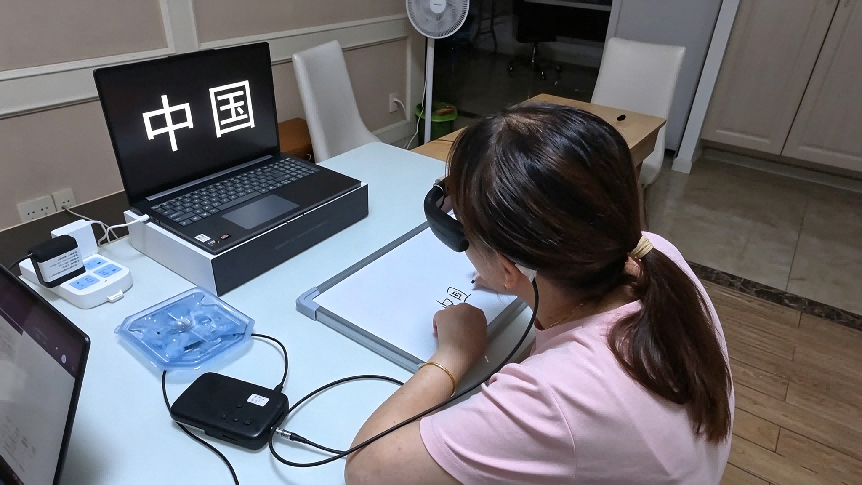
Three months later in Wuhan, 60-year-old Qiu Hua (pseudonym) received the world's first high-resolution semi-invasive retinal BCI implant — non-penetrating to the eyeball, minimally invasive, and reversible. After four years of darkness, Qiu Hua could recognize numbers, write Chinese characters and letters, grasp objects, and walk independently following activation.
In October 2026, 66-year-old Auntie Li (pseudonym), blind for eight years, underwent China's first macular choroidal-subretinal implantation of a retinal-pathway visual BCI. From having only faint light perception, she progressed to tracing numbers, letters, and Chinese characters, precisely grasping objects, and — for the first time without family assistance — completing a walking test on her own.
Globally Rare: Dual Coverage of Retinal and Visual Cortex Restoration
Looking globally, most visual BCI companies bet on only one approach: Science Corporation's PRIMA follows the retinal pathway, while Neuralink's Blindsight follows the visual cortex pathway. As one of China's earliest deep-tech companies in visual function restoration BCIs, Nuancin has innovatively pursued a complete solution with parallel E-BCI (retinal pathway) and V-BCI (visual cortex pathway) approaches, offering visual restoration possibilities for different types of blind patients.
The foundation supporting Nuancin's dual-track progress is a shared full-stack self-developed technology system. Since 2014, Nuancin has built a comprehensive self-developed system spanning core chips, precision electrodes, MEMS processes, packaging technology, intelligent algorithms, and system integration. The company has overcome multiple "chokepoint" core technologies, establishing a leading visual BCI technology R&D and industrialization platform — domestically and globally — that secures the technical foundation for clinical translation and long-term iteration.
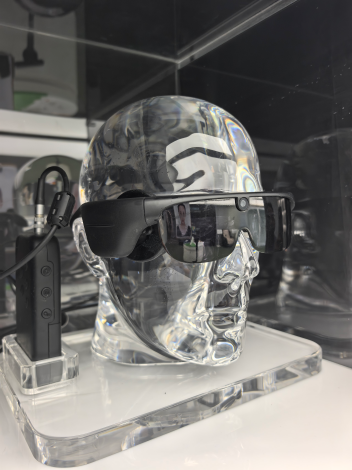
Nuancin's visual BCI external device
Currently, the 320-channel retinal visual BCI E-BCI has formally entered standardized GCP clinical trials, with significant interim results demonstrating safety and effectiveness in preliminary clinical validation. It represents one of the few domestic companies to achieve substantive breakthroughs in invasive visual BCI human clinical trials.
Meanwhile, the 1,280-channel visual cortex BCI product is in development, with clinical validation planned. From "seeing" to "seeing clearly," the next leap in resolution is about to begin.
A More Distant Destination: Vision That Can Be "Software-Defined"
Nuancin's three clinical trials have proven the possibility of "seeing" again. In the future, when visual signals no longer come from the eyeball but from cameras and algorithms, the boundaries of "seeing" will be redefined.
Elon Musk's roadmap for Blindsight describes an initial low-resolution dots stage, with eventual potential to surpass natural vision — enabling perception of infrared, ultraviolet, and other wavelengths. Science Corporation founder Max Hodak believes BCIs could reshape human experience, predicting that biohybrid neural interfaces will "reshape the world in unexpected ways."
The world that an implant "sees" is fundamentally rewritable, augmentable digital signal. Electrical stimulation channels can double from 60 to 320 to 1,280, with resolution scaling accordingly. Neural encoding can progress from 256-level grayscale to full color. Cameras can zoom, enable night vision, overlay navigation and text information. Vision becomes a human sense that can be "upgraded."
The people in today's clinical trials read letters and numbers. As technology advances, visual restoration will continuously expand the boundaries of human perception. "Every doubling of channel count, every generation of algorithm iteration — Nuancin takes another step forward on the path to visual restoration."
Gaorong Ventures stated: "Globally, approximately 2.2 billion people suffer from varying degrees of vision impairment, with at least 43 million living in complete blindness. To truly conquer blindness — a world-class medical challenge — establishing high-throughput human-machine visual connection is becoming the critical breakthrough. Visual restoration BCIs transcend the limitations of traditional medicine, bringing unprecedented hope to these patients. In this ultimate intersection of neuroscience, chip manufacturing, and biomedical engineering, Nuancin has demonstrated inspiring innovation. The team has not only broken through the highly challenging technical barriers of high-density artificial retina technology, but also built solid underlying core component infrastructure. As the lead investor in this round, Gaorong looks forward to a long-term partnership with Nuancin to jointly advance this future technology in clinical settings to benefit more patients."