Peng Kaiping: Entrepreneurship Is a Long-Distance Race — Physical and Mental Strength Early On, Resilience for the Long Haul | Ronghui Practical Insights

Behind every successful entrepreneur who takes their craft to the highest level lies a shared trait: psychological resilience.
Psychology is rarely discussed in business circles. In intellectual circles, there's long been a tendency to "look down on people who talk about positivity" — to see optimism and happiness as mere self-help fluff, while viewing pessimism and gritty realism as the mark of true wisdom.
Professor Kaiping Peng, known as "the father of positive psychology in China" and dean of Tsinghua University's School of Social Sciences, has been a tireless advocate for bringing positive psychology into the corporate world. After interviewing China's top entrepreneurs over the four decades of reform and opening up, he discovered a shared trait behind their extraordinary achievements: an unyielding spirit, what psychology calls resilience.
Drawing on Tsinghua University's motto, Professor Peng summarizes resilience as "holding virtue and bearing the world" — the idea that resilience is a competitive advantage forged over millions of years of human evolution, a gift and natural endowment we all possess. And this endowment must be actively exercised, embodied in the principle of "striving tirelessly for self-improvement" — continuously honing, training, and cultivating resilience through unending practice.
"Pain, negativity, indulgence, and going with the flow are easy. Positivity is hard." At an organizational upgrade series co-hosted by Gaorong Ventures and Amazon Web Services, Professor Peng offered a scientifically grounded, universal framework for building resilience, along with advice for founders on creating resilient organizations and navigating cross-cultural communication.
The following is a transcript of Professor Peng's talk, edited for clarity:

Why Talk About Positivity in Today's Era?
A Positive Mindset Is a Rational Choice; Positive Emotion Is a Renewable Resource
Evolutionary Psychology: Negative Psychology Keeps Us Alive, but Positive Psychology Helps Us Thrive
The Bible speaks of the Four Horsemen of the Apocalypse — war, plague, famine, and death — heralding the end of days. Yet humanity has faced countless "apocalypses" throughout history and survived. Survival meant evolving a stress-response axis centered on the hypothalamus, pituitary gland, and adrenal glands. These regulate hormone secretion, releasing stress hormones when we encounter challenges, setbacks, blows, or failures, putting us into a fight-or-flight state.
In this state, our senses sharpen, heart rate and blood circulation accelerate, and muscular-skeletal strength increases — enabling fight or flight. In other words, humans must discharge stress hormones through action.
But when the neocortex evolved, humans gained the capacity for thought. Many stopped discharging stress hormones through action and tried instead to think their way out. When that failed, emotional reactions followed — anxiety, depression, frustration, irritability, repression, fear, and more recently, trends like involution, lethargy, and "emo."
Psychology, born in the 1870s, has tried countless methods to resolve human distress — Freudian psychoanalysis, Jungian analytical psychology — but none truly solved the problem.
Then in the 1980s, Daniel Wegner conducted an experiment asking participants to not imagine a white bear. The result was immediate rebound — the image of a white bear quickly appeared in their minds. Wegner proved that avoiding, suppressing, or controlling pain, trauma, and distress only causes these symptoms to return in more negative forms; actively redirecting, substituting, and sublimating through positive psychology works far better — the famous "white bear effect."
In 1999, Martin Seligman, "the father of positive psychology," proposed using rigorous scientific methods to redirect psychological science and practice toward humanity's positive psychological strengths, aiming to enhance universal well-being and enable people to live flourishing lives.
From an evolutionary perspective, the human brain is instinctively negativity-biased. Because the brain can only process limited information, and in harsh environments, ignoring bad things had more severe and irreversible consequences than ignoring good things. So we have "negative bias" — a protective mechanism.
One important manifestation of this in intellectual circles is the tendency to "look down on people who talk about positivity." In reality, pain, negativity, indulgence, and going with the flow are easy. Positivity is hard. As Leibniz said: optimism is a naturally rational mode of cognition. A positive mindset is itself a rational choice, requiring dedicated cultivation and unyielding perseverance.
So evolutionary psychology reveals: negative psychology keeps us alive, but positive psychology helps us thrive.
Positive Emotion Is a Renewable Resource
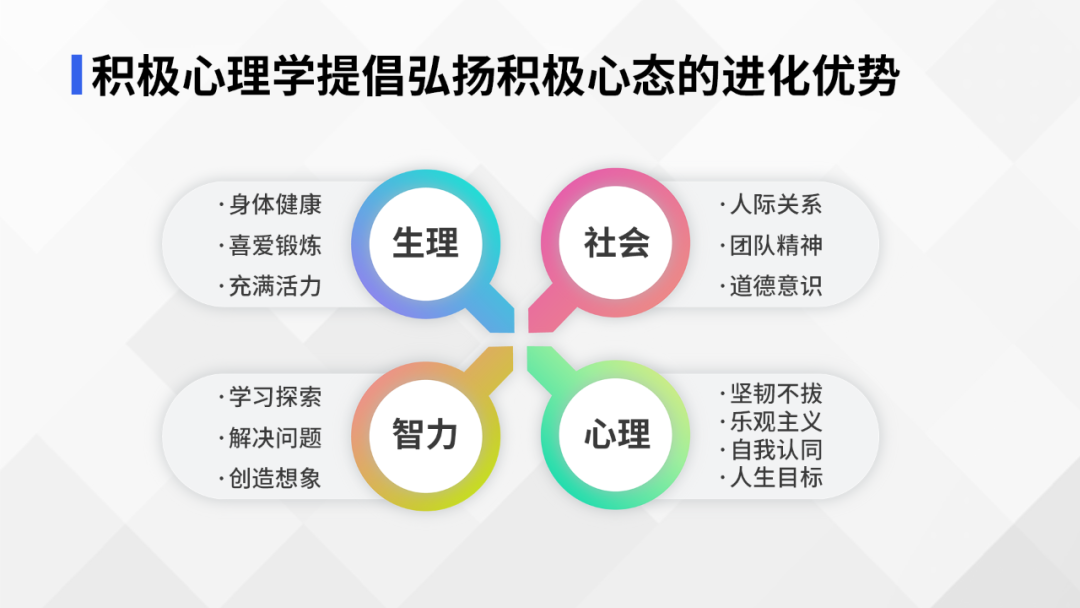
Positive emotion is also an extraordinarily valuable renewable resource. Barbara Fredrickson proposed the broaden-and-build theory of positive emotions. When people experience positive emotions, their physiological, social, intellectual, and psychological resources all expand.
Physiologically, positive people are healthier, exercise more, and brim with energy. Positive mindsets help expand social resources — relationships, team spirit, moral awareness. Psychological resources include resilience and optimism. Intellectually, our learning capacity, problem-solving ability, and creativity are all closely tied to positive mindset.
The same holds in business. The secret of commerce isn't cutthroat competition — that's the animal kingdom's game. True skill lies in cultivating your own charisma, helping others succeed, and loving humanity. Not so-called wolfishness, but a return to human nature.
What Is Resilience?
Three Levels: Recovery, Perseverance, and Post-Traumatic Growth
Among many forms of positive psychology, "resilience" is especially vital today. I once researched great entrepreneurs across 40 years of reform and opening up and found one shared trait: resilience — an ever-upward spirit in the face of hardship, blows, and setbacks. Life is a marathon, not a sprint. In social competition, early success depends on physical stamina, mid-stage on intellect, and later stage on resilience.
How to understand resilience? It has three levels. The first is recovery — the psychological capacity to quickly bounce back from adversity, conflict, pain, failure, and stress, also called "bounce-back-ability." As Mandela famously said, the greatest glory in living lies not in never falling, but in rising every time we fall.
The second level is perseverance — sustained effort and endurance toward long-term goals, pressing forward resiliently even through repeated setbacks. Chinese-American psychology professor Angela Lee Duckworth's research at West Point found that the academy produced successful entrepreneurs at higher rates than business schools. A crucial reason: the academy cultivated cadets' perseverance, grit, and stress resistance. Many successful Chinese entrepreneurs also have military backgrounds.
Resilience has a still higher level: post-traumatic growth (PTGD — post-traumatic growth and development) — positive psychological change and enhanced psychological functioning resulting from adversity and other challenges. This goes beyond merely returning to "normal" to using adversity as a pathway or opportunity for growth and gain. Nietzsche expressed this with particular force: "What does not kill me makes me stronger."
Universal Methods for Building Resilience
The "Eight Corrections" and "Five Bestowals"
How to Build Recovery: The "Eight Corrections" for Controlling Negative Emotions
The "Eight Corrections" are methods we've distilled from decades of psychological research for quickly returning from negative emotional states to normal.
Deep breathing Elite Olympic athletes often take a deep breath before competing. Inhalation is remarkably effective for emotional regulation — roughly three deep breaths produce results.
Aromatherapy The brain's center for processing negative emotions is the amygdala. When it becomes engorged and heated, fear, anxiety, anger, and sorrow readily emerge. Su Dongpo wrote of "snow flying, the burning sea turning cool" and "where the heart finds peace is my homeland" — because coolness physically lowers the amygdala's temperature. Beyond cool air, pleasant scents also alleviate unpleasant feelings. The Chinese tradition of "the gentleman wears fragrance" embodies this principle.
Self-touch You might touch the danzhong point at the center of the chest; rub the belly, as many neurons in the digestive tract connect to emotions; massage the neck, which contains the vagus nerve — one of humanity's most ancient neural pathways; or press the palms, rich in tactile neurons, which is why clapping and high-fiving bring joy.
Humor In leadership development, cultivating humor is among the most effective methods. True humor — "pondering deeply, smiling quietly" — requires spiritual connection and wisdom; it's connected to creative thinking.
Confiding This isn't casual small talk but deep exchange. Everyone needs different amounts of time, but if we must set an objective standard: no less than 30 minutes.
Exercise Exercise is a panacea for psychological issues. It doesn't just metabolize stress hormones; during exercise, the brain produces neurochemical transmitters that actively promote neural network connectivity, slowing brain aging and making us smarter.
Mindfulness An Eastern invention: mental activity can also generate positive neurochemicals in the body. Mindfulness isn't mysterious — it's simply focused concentration, gathering all attention to a single point.
Writing Writing is an extraordinarily important method of psychological healing. During writing, reason gradually gains ascendancy while impulsive emotions are inhibited, enhancing rationality and cognition.
How to Build Happiness: The "Five Bestowals" for Cultivating Joy
To build perseverance and achieve post-traumatic growth, there are the "Five Bestowals." Buddhist teaching holds that humans are born with five capacities we must be willing to practice: facial bestowal — first, smile; bodily bestowal — second, move; verbal bestowal — third, speak; heart bestowal — fourth, comprehend; and eye bestowal — fifth, observe.
Facial bestowal First learn the Duchenne smile — the most attractive and infectious smile, produced when the orbicularis oculi, zygomatic major, and levator labii superioris all activate together.
Bodily bestowal Includes action, touch, contemplation, doing good, and more. One simple technique: stand tall with head held high, which opens the vagus nerve. This is why humans love gazing at starry skies and facing the ocean; why buildings symbolizing the sacred and sublime across human societies are built to towering heights.
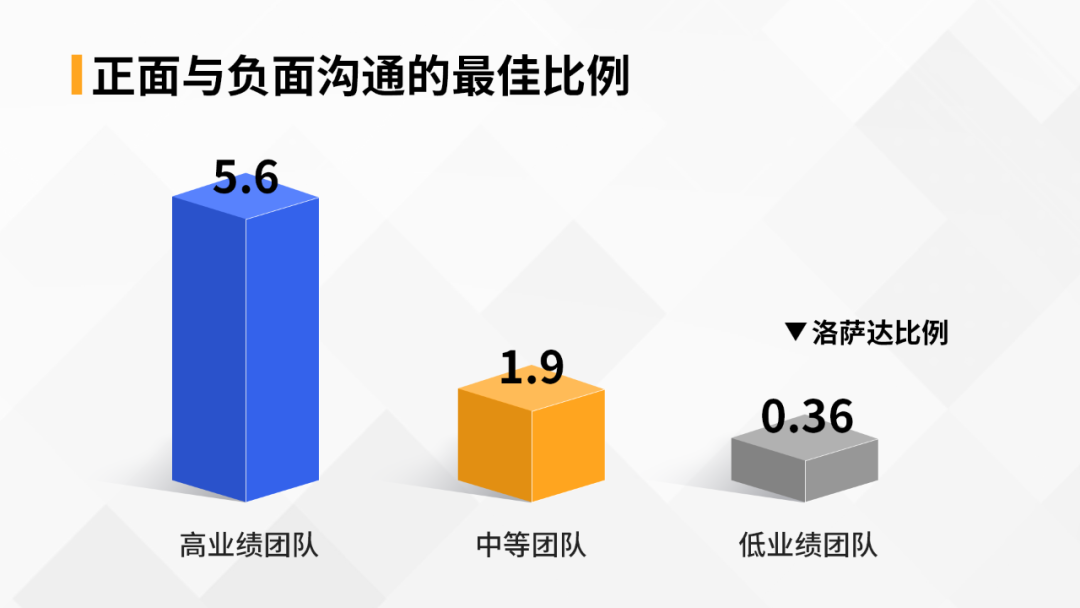
Verbal bestowal Positive communication — Nonviolent Communication offers excellent guidance. Of course, in organizational life, sometimes warnings and criticism are necessary. Psychologist Losada proposed a ratio: in high-performing teams, the ratio of positive to negative communication is 5.6 — roughly five positive statements for every one critical comment.
Heart bestowal Open your heart to produce beautiful insights, especially what we call "flow." Flow's characteristics: complete concentration and focused attention; a state of selflessness where self-awareness, spatial awareness, and temporal awareness temporarily dissolve; effortless mastery with full control; immersion in process with precise feedback; and afterward, a feeling of exhilaration and profound clarity. What produces powerful flow? Something you're deeply interested in, sufficiently challenging, and from which you can derive creative satisfaction upon completion.
Eye bestowal Learn to observe — "观" (guan) means "to see again." Don't merely see with your eyes; see with your heart. Harvard's Hubel and Wiesel explored the structure of the visual cortex and discovered that human vision isn't just the eyes — everything we see must travel through the optic chiasm to the prefrontal cortex before we truly "see." The Chinese concept of "wisdom eye, Zen heart" means overcoming inattentional blindness. Start with what's around you, in the details; make new discoveries daily; see what others miss.
Advice for Entrepreneurs from a Positive Psychology Perspective
Organizational Management and Communication
Building High-Resilience Organizations
Organizational resilience parallels individual psychological resilience. When organizations face setbacks, pressure, and blows, they must first maintain cohesion and avoid falling apart, recovering from挫折 and errors; then effectively respond to crises; and ultimately emerge from困境 to continue developing. That is, organizational resilience has three dimensions: recovery, stress resistance, and development capacity.
Six factors influence organizational resilience: organizational assets, commitment, leadership, learning, culture, and networks. So entrepreneurial organizations should accumulate strength across these dimensions to face challenges with greater resilience.
Building high-resilience organizations can proceed along three dimensions: people — selecting talent with high psychological resilience; systems — creating a positive mental health environment; and skills — providing stress-coping techniques and resources.
Both high and low resilience individuals exhibit certain traits. Founders can use several psychological indicators for rapid assessment when judging talent or developing management pipelines.
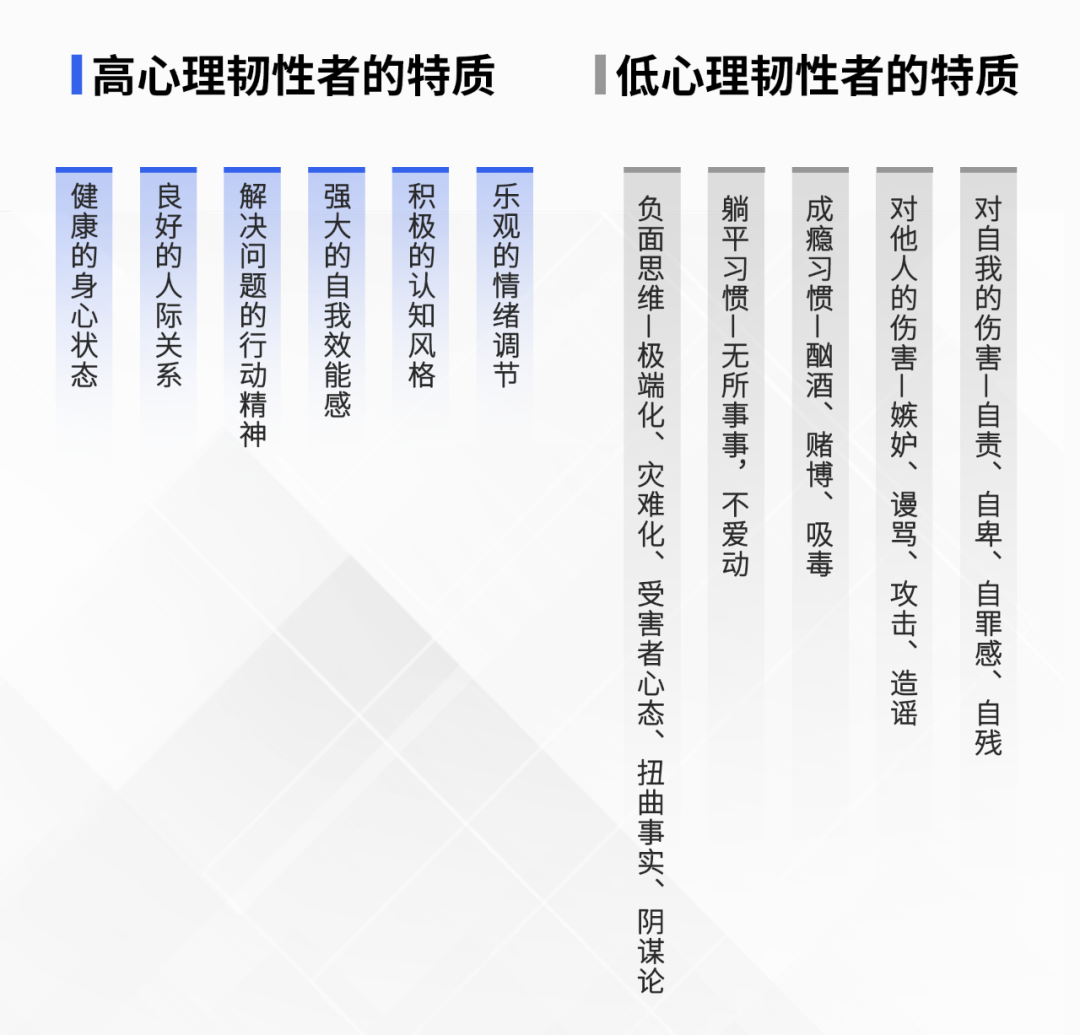
High-resilience individuals tend to: 1) maintain healthy physical and mental condition — physical health matters; 2) have good interpersonal relationships; 3) possess a problem-solving spirit of action — pressure isn't resolved through rumination but through action; 4) strong self-efficacy — "I can, I have, I am able," believing in one's sufficient talent and wisdom to achieve goals; 5) positive cognitive style — global thinking, change thinking, and dialectical thinking when approaching problems; 6) optimistic emotional regulation.
Low-resilience individuals tend toward: negative thinking,躺平 mentality, addictive habits, and even harm to others and themselves.
Cross-Cultural Communication in Global Organizations
As more global organizations emerge, many teams comprise employees from multiple countries and even ethnicities, raising cross-cultural communication challenges. Such communication operates on three relational levels. First is the working relationship — communication here is purposeful and directed. Chinese communication tends to be high-context, emphasizing implicit understanding and reading between the lines; some countries are low-context, requiring explicit statements. So identify which context your counterpart belongs to, then adapt your strategy accordingly.
Second is values-based relationships — differences in fundamental philosophy are hard to change, so avoiding such topics is often the best strategy.
Third is interpersonal relationships — affection, support, caring. These require non-verbal communication to maintain.
In cross-cultural communication, I advocate the 3C principles. First, Contact — sufficient time together eventually produces positive effects. Second, Communication — verbal expression. I advocate talking less about concrete matters and more about things without quantitative standards, using limited time to discuss infinite questions. Finally, Culture — those things that make us human, including music, art, sports, aesthetics, and so on.
Facing Immense Setbacks and Changes: How to Be with Yourself?
Facing external challenges and the trauma they bring, humans have evolved two defense mechanisms. Proximal defense mechanisms only temporarily resolve issues — denial, repression, regression. To thoroughly resolve post-traumatic fear and cultivate post-traumatic growth, an important method is establishing distal defense mechanisms, with three main pathways.
First is sense of meaning. People who can find meaning in their lives can better face various setbacks. How to find meaning? Beyond cultivating the wisdom eye and Zen heart, one can also embrace social values. Don't assume Chinese people lack faith — we believe in noble ideals, kind values, and social justice. These are all forms of faith.
Second is family bonds. People must draw strength from friendship, family love, and romantic love. We constantly undervalue love's role, yet one of the greatest distinctions between humans and animals is our capacity for love.
Finally, find feelings of pleasure and happiness. When you do things you're skilled at, find meaningful, and that create value, you will be happy.
I sincerely wish all entrepreneurs the spirit Su Shi expressed in Ding Feng Bo — "in a straw cape, through mist and rain, I let life take its course" — living with hearts blooming and flow surging.