"GravityXR" Closes Hundreds of Millions of RMB in Pre-A+ Round to Accelerate Development of High-Performance XR Chips

Designing core chips from the user experience backward.

GravityXR, an XR chip R&D company founded in September 2021, recently announced the completion of a Pre-A+ round worth several hundred million RMB. The round was led by Tongge Venture Capital — a fund jointly established by Goertek, PICO, miHoYo, and 37 Interactive Entertainment — with participation from miHoYo, Zhongyuan Capital, Eastern Bell Capital, Eight Roads, Jianshi Capital, Ningbo Yongjiang Sci-Tech Innovation, and Ningbo Zhenhai Industrial Capital. Gaorong Ventures had led GravityXR's angel round in 2021 and continued to invest in the Pre-A round.
The funding will be used primarily for team expansion, tape-out production, and R&D of next-generation chips.

Focusing on the Core of XR Computing, Driving the Ultimate User Experience
Extended Reality (XR) is an umbrella term encompassing AR (Augmented Reality), VR (Virtual Reality), and MR (Mixed Reality) — technologies that blend real and virtual visual information to create an interactive virtual environment. XR is considered the ultimate form of future human-computer interaction, poised to reshape numerous industries and transform how we live and work.
The importance of XR chips for terminal products manifests across performance, power efficiency, integration, and compatibility. High-performance XR chips are therefore essential to delivering outstanding user experiences. As XR technology finds broader application in social entertainment, production and daily life, industrial manufacturing, healthcare, and education and training, market demand for high-performance XR chips continues to grow.
XR chips differ substantially from conventional smartphone or PC chips. On the hardware side, they typically incorporate multiple graphics processors and neural processing units to meet highly compute-intensive application demands. These processors handle massive volumes of imagery and data, enabling smoother, more immersive VR and AR experiences. Additionally, XR chips must deliver higher power efficiency and lower latency to ensure users can interact with virtual environments more naturally and comfortably.
GravityXR's founding CEO previously led R&D teams at Apple for years, while the core founding team hails from companies including Huawei, Apple, and Meta, bringing deep expertise in chips, displays, sensing, and computer vision for XR. With industry-leading technical experience, capabilities, and vision, the team has accumulated know-how across chip design, component R&D, and terminal product design and manufacturing. This gives them a distinctive competitive advantage: the ability to work backward from user experience to design core chips. The company currently employs approximately 200 people and continues to recruit like-minded technical talent.
Innovative, Disruptive Debut Product Expected to Enter Mass Production in 2024
GravityXR's first product is a dedicated chip for VR/MR applications. It enables targeted performance optimization for VR/MR-specific system components such as displays and sensing sensors, providing real-time image rendering, sensor data processing, and mixed reality interaction capabilities.
GravityXR chose to enter the XR market with a specialized XR chip because while incumbent chip companies hold advantages in resources, ecosystems, brand recognition, and economies of scale with their general-purpose products, a startup can move quickly to develop disruptive, innovative offerings. The company selected VR/MR as the entry point for its first chip based on the clear direction of VR/MR component development and the urgent need for high-end chip products in this segment.
GravityXR stated that its first chip is expected to enter mass production in 2024. This dedicated chip assists with rendering to reduce the load on the main processor. Its self-developed algorithms reduce motion sickness from visual content while providing some image correction capability to enhance display quality.
The company currently operates on a fabless model, focusing on design while outsourcing production to chip foundries. Its first-generation product employs a relatively advanced process node. Beyond selling chips directly to terminal manufacturers, GravityXR plans to explore bundled offerings with various platforms and product solutions, providing multiple pricing models. The company is already engaged in orderly communication with potential customers and signing letters of intent.
Driving Innovation at the Source of XR, Leading Coordinated Industry Development
The XR market represents the most promising consumer electronics opportunity since smartphones. The XR industry chain is long and still nascent, making industry-wide collaboration especially critical. This process requires close cooperation among diverse players — technology providers, application developers, hardware manufacturers, content creators — to jointly advance the XR industry.
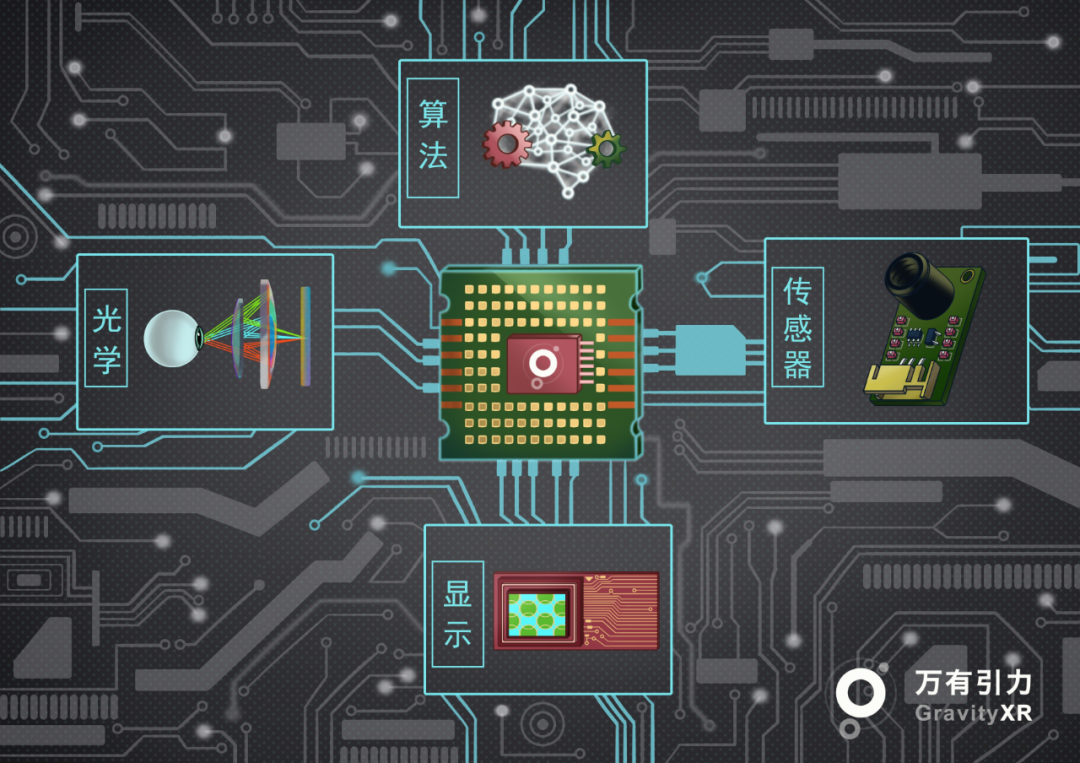
XR chip platforms sit at the source of the industry chain; their evolution drives innovation in terminal technology. GravityXR's mission is to power extreme innovation in the XR industry from its source, while actively seeking collaboration with upstream and downstream partners for mutual development.