Richard Liu: As the Pandemic Enters Its Global Second Half, How Can Chinese Startups Seize Antifragile Growth Opportunities

Ten Growth Tips for Founders
COVID-19 had become a global pandemic, and the outbreak was still raging. Through the "first half" of China's fight against the epidemic — Wuhan's lockdown, a society-wide Level One mobilization, and a timely nationwide medical resource response — China had effectively brought the outbreak under control. But as Europe and the US became the new epicenters, the battle entered the "global second half," where risks and challenges intensified.
Facing a war that might have no visible end in the near term, along with its massive disruption, damage, and uncertainty to economic systems — and the profound societal paradigm shifts that followed — how should entrepreneurs think about restarting growth?
Xinhua Liu, investment partner at Gaorong Ventures and former chief growth officer at Kuaishou, has over 22 years of experience in high-tech and internet. He has led growth for multiple products reaching tens of millions in DAU and two reaching hundreds of millions in DAU. (Click to review: Xinhua Liu: In the Second Half of the Internet, How to Crack the Growth Code?) Recently, Tsinghua University's PBC School of Finance Global Entrepreneurial Leadership Program (click "Read More" at the end of this article for details) partnered with Gaorong Ventures to invite Liu to share Restarting Growth for Startups Under Extraordinary Circumstances in the GELP in Action online public welfare lecture, reaching over 3,000 viewers.

Liu noted that this "century's catastrophe" was indeed painful, but reflecting through the lens of evolution, human society — like nature — possesses innate antifragility. What does not destroy us ultimately makes us stronger. For entrepreneurs, regardless of the immediate damage, the correct mindset is to recover from the shock of the stress response and seek antifragile growth paths under the new normal. Combining the latest global pandemic developments, Liu analyzed growth opportunities for Chinese startups, pointed out how to reconstruct growth value networks after the battle against the epidemic, and offered entrepreneurs 10 practical growth recommendations for the pandemic era.
(Full text: 15,469 words; recommended to save for deep reading)
Below is an edited transcript of Xinhua Liu's sharing:
The past week (referring to March 9–13) was particularly dramatic. What was thought to be a "Black Monday" turned out to be a "Black Week" — US stocks triggered the circuit breaker twice in one week. Since the outbreak began spreading in Europe and the US in early March, global markets had been in a two-week "ICU-rave-ICU mode." The three major US stock indices plunged nearly 30%, while European indices basically dropped 40%, nearly halving. Even so, it was difficult to say whether global capital market turmoil had reached bottom. The sudden pandemic exposed the enormous "fragility" of many overseas economies and social governance systems.
In contrast, although China faced enormous systemic challenges early in the outbreak, it quickly found effective responses. In the process of fighting the epidemic, many governance and business innovations emerged — driven by internet companies and entrepreneurs — that possessed antifragility. These new capabilities will bring entirely new opportunities as China fully resumes work and as the global pandemic enters its second half.
Great plagues bring great changes; great changes breed new opportunities. Gaorong believes the pandemic will give certain顺势而为 technologies and business innovations tremendous growth momentum, accelerating them across two thresholds: trust and habit. Under normal circumstances, the kinetic energy to cross these two thresholds is providing user experiences "ten times better (10X)" than traditional solutions. Traditional face-to-dominated work, healthcare, education, lifestyle, and offline business models suddenly halted due to the pandemic, accelerating the diffusion and penetration of products and services unconstrained by physical boundaries and with higher efficiency. Among these, products and services with superior experiences could allow users — during prolonged homebound and contactless states — to perceive the efficiency and convenience of new models, accelerating new habit formation, cognitive migration, and crossing over to become new species of growth.
For example, in China we have already seen innovative attempts emerging from the crisis: online office and collaboration, online education, home-based fresh grocery and medicine delivery, telemedicine, and more. For companies that had prepared for online operations and digital operations before the pandemic, this crisis catalyzed user recognition and selection of new models, ushering in their "moment in the spotlight" — such as DingTalk, WeCom, Gaotu Techedu, Dingdong Maicai, and Ping An Good Doctor.
Secondly, the earlier popularization of long and short video and livestreaming driven by 4G also made companies like Kuaishou, Taobao Live, Bilibili, and iQiyi-Youku-Tencent Video winners in this pandemic. The outbreak will also accelerate the deployment of 5G and other "new infrastructure." China's early lead in 5G普及 will win it first-mover advantage for the economy, and the 5G internet also harbors directions for the evolution of new species.
Another point I want to emphasize is the opportunity of the "Chinese governance model" based on digitalization and technology. The new paradigm of Chinese social governance and services will profoundly affect post-pandemic economic recovery, national strength, and the risk immunity of social systems — a huge antifragile dividend after the crisis. Examples include epidemiological investigations based on big data and AI, and nationwide joint prevention and control; the rapid-release production capacity of medical supplies like test kits, masks, and protective clothing based on rapid-response supply chains; and the deployment of health codes in over 100 Chinese cities for work resumption, community management, and transportation systems.
Given China's large population and vast territory, traditional person-to-person coverage models would involve too many governance units to manage effectively; continuing such models during the pandemic would only make things worse. This required government departments to engage in unprecedented cross-departmental collaboration to manage community isolation, tiered diagnosis and treatment, and work resumption. But departments could not meet in person, so they had to partner with technology companies to empower social services with data and AI, while using remote work for social governance.
The crisis acted as a catalyst, breaking traditional collaboration boundaries between government agencies, research institutes, and enterprises, forcing everyone out of their comfort zones — and the result was finding more efficient models of social governance and collaboration. These are all long-term positive changes that Chinese social governance can look forward to.
Originally, in the "first half," we were deeply concerned about the pandemic's blow to China's economy, worried about secondary disasters after the outbreak, especially the potential overflow and转移 of China's years-long position as the world's largest supply chain. But observing the current situation, China has not been defeated by the pandemic; instead, it has gradually developed antifragile capabilities. These emerging capabilities are expected to drive strong rebound and recovery in China's economy and entrepreneurial ecosystem in the pandemic's second half and beyond.
I have previously shared that, borrowing from Chinese philosophy, I divide growth into four models: 明道 (understanding principles), 取势 (seizing momentum), 优术 (optimizing tactics), and 识人 (recognizing talent). Today I will focus on the first three. "Principles" means the underlying logic of growth — understanding it improves your predictive power, and without prediction you cannot make quality decisions. "Momentum" means leveraging new incremental势能 rather than being confined to traffic争夺 in存量 channels and red-ocean competition in存量 markets. At the "tactics" level, in the second half of the internet and the pandemic, we face enormous cash flow pressure and can no longer pursue "extensive growth." We need a digital-driven "lean growth" model to find the most important growth levers.
Reverse Thinking on Growth: What Causes Negative, Zero, and Fake Growth
Charlie Munger has a classic saying: "If you want to understand how to be happy in life, first study how to make life miserable; if you want to study how to make a business strong and large, first study how businesses decline." Applying this "reverse thinking" to growth, we can first consider what causes negative, zero, and fake growth during the pandemic.
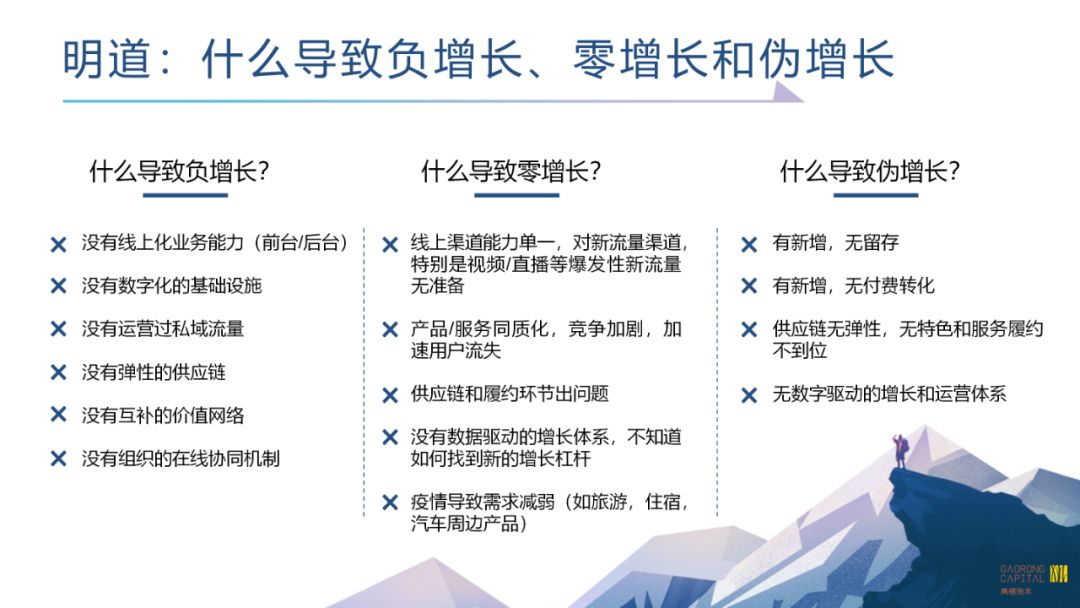
What causes negative growth during the pandemic?
The most important factor is having essentially no online business capabilities before the pandemic — including front-end online products and services facing users directly, and the back-end online infrastructure supporting service delivery, fulfillment, and analytics. When such companies' offline business halted and they had no way to deliver any products or services online, negative growth naturally followed.
Second, some industries inherently saw demand plummet due to the pandemic — travel, accommodation, car purchases, and so on. Even if these companies had online capabilities, it would be difficult to return to pre-pandemic levels; negative growth was highly probable.
Third, lacking digital infrastructure meant inability to quantify consumer attributes, behaviors, and scenarios, and inability to perform precise人货 matching. Even with online product display pages, they could not identify and segment consumers by capability, scenario, value, and habits, only offering "one face for a thousand people" — and if this single face was not刚需, it likely resulted in negative growth.
Lacking private domain traffic operation capabilities could also cause negative growth. Private domain traffic is hardly new in internet circles, but can companies achieve底层 data打通 and deep personalized operations based on user scenarios? Can they activate users, build community engagement, drive repurchase, and develop super users based on data? Many companies lack these capabilities. The pandemic may worsen many startups' finances and intensify online traffic competition; without private domain traffic operation capabilities, escaping negative growth becomes difficult.
Inflexible supply chains also cause negative growth. Even with traffic, if supply chain capacity issues mean no inventory, users will come and leave.
Another factor is lacking complementary value networks — particularly partners that can reduce costs through shared front warehouses and delivery networks, or that can share orders or accelerate online capability deployment. Especially in a fragile business environment, if enterprises haven't built value networks adaptable to extraordinary circumstances, negative growth is highly probable.
Finally, lacking organizational online collaboration mechanisms leads to inefficient operations, and business may also fall into negative growth. As the pandemic develops globally, companies that cannot form real-time online organizational collaboration may well become extinct species.
What causes zero growth?
Likely having some online capabilities but with single online channel capabilities, and being unprepared for new traffic channels — particularly explosive new traffic sources like short video, livestreaming, and mini programs. For example, a company may have caught the wave of WeChat official account裂变, but failed to fully utilize new traffic sources like livestreaming, short video, and mini programs in combination with their business. Additionally, homogeneous products or services intensified by pandemic-driven online competition may result in gaining PV but losing conversion.
And what causes fake growth?
We've also spoken with several companies recently, and some genuinely saw traffic explode because of the pandemic — livestreaming, online education, online entertainment, and SaaS companies, for example. But often we find they have new users but no retention, or new users but no paid conversion. This is actually a kind of "false prosperity." The reason is that the product lacks differentiation and hasn't achieved PMF (product-market fit). Users came out of panic, and they'll leave once they compare with competitors or when the pandemic subsides, resulting in no retention and no payment — much ado about nothing.
To sum up, only after eliminating these causes of growth's "return of cold spring" can we possibly restart growth.

The Five Fundamental Laws of Antifragile Growth
When pursuing growth, especially considering that black swans may be the new normal, the following five fundamental laws reveal the essence of growth. These are distillations of human wisdom about growth. Deeply understanding and following them will benefit us greatly.
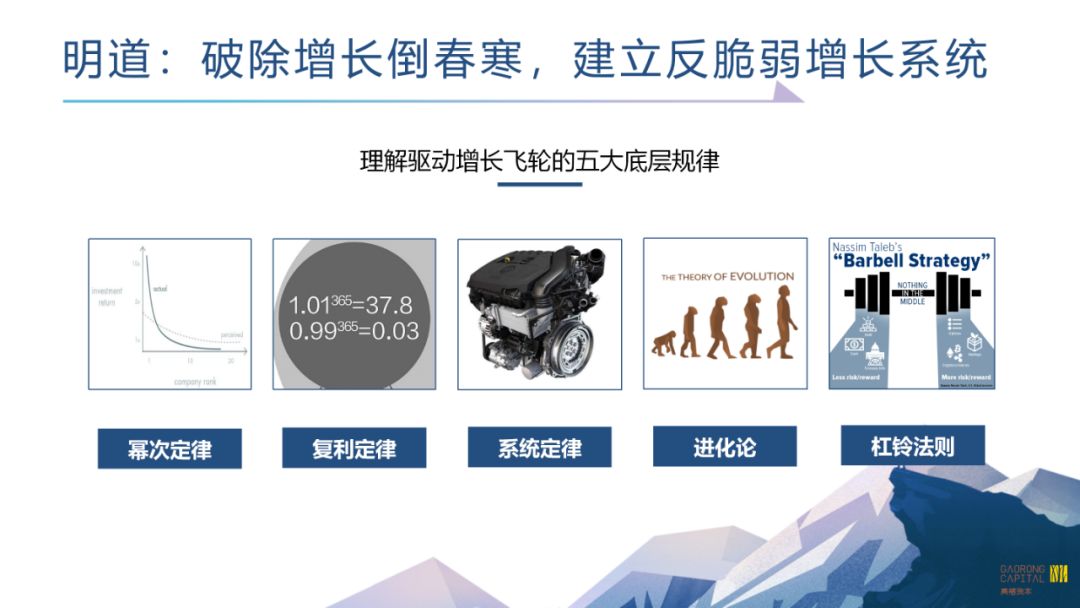
Law One: Power Laws
Also known as the "Matthew Effect" — nothing in this world is ever evenly distributed. We often face numerous growth tactics, but a few are naturally the most effective. When resources are limited, rather than spreading them like "sprinkling pepper," it's better to concentrate on the growth levers with the highest ROI and push that lever to the maximum. Power laws teach us to "do subtraction" — focus on the complex. Not every point is a fulcrum; we must identify the tactics that generate the most growth momentum and invest our energy there.
Law Two: The Law of Compounding
There's a motivational math formula: 1.01 to the 365th power equals 37.8, while 0.99 to the 365th power equals 0.03. If you're 1% better and more hardworking than others on average each day, after a year you may have left your competitors far behind. Growth requires consistently doing the right things, with feedback and iteration cycles as fast as possible. Over time, you can leverage compounding effects to gain advantages over rivals. Why are viruses so terrifying? Because viral replication and spread naturally follow both power laws and the law of compounding.
Combining Laws One and Two, a good growth framework is simply this: do complex things with focus, and do focused things consistently — over time, the power of growth will explode.
Law Three: Systems Thinking
Any growing business is essentially a system driven by one or more growth engines. Abstractly, any complex system is a set of interconnected elements, and these connections can either reinforce or weaken the system. The simplest way to categorize connections between things is into four types: causal chains, reinforcing loops, balancing loops, and delays. Causal chains are self-explanatory; when made dynamic, they form reinforcing and balancing loops — where cause enhances effect and effect enhances cause, that's a "reinforcing loop"; where cause enhances effect but effect inhibits cause, that's a "balancing loop." Delays are also widespread.
A fundamental law of systems thinking: structure drives behavior. To produce desired behavior, the most fundamental approach is to design the corresponding structure — the combination of the four connection types above. Otherwise, even if behavior changes in the short term or people comply passively, in the long run they'll revert to their previous state.
The study of how systems operate is system dynamics. From a system dynamics perspective, healthy and sustained growth of any enterprise, institution, or business can and should be designed and managed — from running a street stall or corner shop to national economies and public health systems, even pandemic response, all can be designed and managed using systems thinking.
What we commonly call a "growth flywheel" is essentially finding "reinforcing loops." Systems dynamics master Eric Wolstenholme summarized more complex and dynamic combinations of the four connection types into four archetype groups and nine archetypes. Among these, the "Underachievement" archetype group and the "Out of Control" archetype group are both typical structures of "fragile states."
The Underachievement group refers to expected reinforcing loops encountering unexpected balancing loops, stalling growth. We often see three situations — the tragedy of the commons, growth and underinvestment, and limits to growth.
The tragedy of the commons occurs when multiple parties profit by competing for limited public resources, ultimately driving everyone's returns to zero. For example, overgrazing on a meadow until all the cattle starve. Early in the COVID-19 outbreak, due to insufficient testing capacity and no tiered diagnosis system, panicked Wuhan residents flooded hospitals, competing for medical resources and causing the hospital system to rapidly collapse — this was a tragedy of the commons.
Growth and underinvestment refers to rapidly growing reinforcing loops encountering balancing loops of insufficient R&D, production, service, or management capacity development, leading to declining service quality and experience. What's scarier about COVID-19 compared to the flu is that the proportion of severe cases is 15-20 times that of H1N1, and critically ill patients are dozens of times higher. When confirmed cases suddenly surged, hospital ICU beds, ventilators, respiratory physicians and nurses, and other medical equipment were rapidly depleted — this is also a typical example of growth and underinvestment. And the fake growth we mentioned earlier often occurs precisely because related capabilities and investment haven't kept pace.
Limits to growth refers to rapidly growing reinforcing loops encountering balancing loops that inhibit growth — what we commonly call growth ceilings and plateaus. For example, China's daily mask production capacity, especially for N95 masks, has an upper limit. This capacity ceiling is a limit to growth. During the pandemic, if the government and some enterprises hadn't found ways to break through the mask production ceiling, the epidemic prevention system would have been pushed to the brink of collapse.
The Out of Control archetype group refers to expected balancing loops encountering unexpected reinforcing loops, causing situations to spiral out of control. For example, when facing problems, instead of finding fundamental solutions because they take too long to show results, people apply quick-fix symptomatic solutions that don't address root causes. Over time, problems persist or worsen until collapse.
Understanding these system structures that lead to fragile states can help us design antifragile systems, or gradually emerge from fragile state predicaments to rebuild resilient or antifragile growth systems.
We often say "you reap what you sow." Sometimes in growth efforts, things don't turn out as wished precisely because we fail to see the hidden reinforcing loops, balancing loops, or delays. Learning systems thinking prevents us from seeing only trees, not the forest; looking only at the present, not the long term; seeing only phenomena, not essence; treating symptoms rather than root causes when designing growth systems.
Law Four: Evolution
Modernization and globalization in human history span barely 100 years; all of human civilization is just over 10,000 years — very brief compared to natural species. From evolution in nature, we can derive much wisdom about business competition and growth.
In evolutionary theory, species evolution follows two basic rules: First, genetic characteristics of all species are basically stable, largely passed down through generations, with mutations occurring — but these mutations are random, without obvious directionality or purpose. Second, within the same species, different mutated individuals have varying environmental adaptability. Certain individuals that adapt well to their environment and proliferate — their preserved genetic characteristics become advantageous traits; non-advantageous traits are eliminated.
From an evolutionary perspective, nature itself, as well as the human immune system, are naturally antifragile systems, capable of sacrificing a small number of individuals to achieve better survival and evolution for the entire species.
What characteristics are advantageous? First, these advantageous traits better represent evolutionary speed, with particularly fast feedback and rapid error correction capabilities. Second, the system can process larger amounts of information, enabling the system to evolve in more intelligent directions based on information. Third, species with advantageous traits are skilled at selecting environments adapted to survival — that is, ecological niches. The more irreplaceable and differentiated the ecological niche, the greater the survival advantage. Variations based on these characteristics tend to be valuable.
Applying evolutionary thinking to business society: many new categories and products emerge endlessly, but many are trendy and fleeting; some models, however, can tenaciously develop after major systemic and environmental changes — these are more valuable business models. For example, e-commerce accelerated after SARS, the financial crisis, and this pandemic crisis.
And what about digitalization we mentioned? Why are companies with strong digitalization capabilities more antifragile? Because digitalization capability represents advantageous traits with high information volume, representing the direction of evolution. If your digitalization capability is weak, you'll easily be eliminated in future competition.
When pursuing growth, we shouldn't only see those fleeting things, but derive wisdom from evolution theory to consider which are truly advantageous traits that can bring sustained growth. Of course, new species in business civilization evolve faster than natural species, because there's no "reproductive isolation" — innovative models can be widely migrated and hybridized, achieving more innovation.
Law Five: The Barbell Strategy
During the pandemic, many people read Nassim Taleb's Antifragile. He believes everything has a triad structure — fragile, robust, and antifragile. Fragile is like a glass ball: very hard, but shatters easily when dropped from height. Robust is like a rubber ball: appears soft but lands unscathed, achieving a smooth landing. Antifragile is like a ping-pong ball: not only unharmed when it hits the ground, but bounces higher.
So the true opposite of fragile is not robust, but antifragile. Robust is the ability to resist risk; antifragile is the ability to profit from crisis and risk.
Under the pandemic, we should also consider "antifragile growth systems" — using crises to develop stronger systems that enable our growth to show better momentum.
Taleb also proposed the barbell strategy, which in investing means not putting money into so-called moderate risk for moderate returns, but investing at both ends of the barbell. Put the vast majority of resources into extremely safe, stable-yield investments to ensure asset security; allocate a small portion to high-risk, potentially high-return assets, enabling possible extra gains from black swan events.
When external uncertainty is massive, when many companies face cash flow tightness, the barbell principle is an important strategy for growth today. I suggest startups focus most resources on previously proven hit products or profitable products; stop all middle-ground, nice-to-have businesses; and allocate some resources to businesses that may benefit from the pandemic and bring huge growth leverage in the future. For traffic and channel usage, I similarly recommend following the barbell strategy.

Identify Critical Inflection Points for Qualitative Change, and Capture New Growth Momentum
Now let's look at the "momentum" side of growth. Growth always requires finding new sources of potential energy — only by riding momentum can you capture outsized growth dividends, and identifying that momentum is a question every founder must constantly grapple with.
I've told founders before that one counterintuitive principle is that sometimes 10x growth is easier than 10% growth. Why? Ten percent growth usually means optimizing within existing logic; 10x growth forces you to change your logic and thinking entirely, which may lead you to discover a traffic or business channel with far greater growth potential.
So when the pandemic brought so much of our operations to a halt, founders' minds should instead be racing to identify which critical elements have undergone qualitative change, triggering strategic inflection points, and then seize that momentum to achieve higher-return growth.
The world's iconic internet companies — Chinese and global alike — have generally captured massive momentum dividends, and often more than one. We've identified eight major types of momentum dividends.
First, step-change shifts in infrastructure. For example, 3G deployment after 2008 drove China's mobile internet development, and 4G buildout after 2013 fueled the rise of short video and livestreaming. Post-pandemic, new infrastructure like 5G, cloud, and AIoT will all accelerate, bringing a significant wave of potential dividends.
Second, the emergence of step-change new traffic platforms. From Weibo in the early days, to WeChat official and service accounts, to mini programs, short video, and livestreaming in recent years — without capturing these platform opportunities, it's difficult to reach new demographics and new scenarios, and thus difficult to grow. When new traffic platforms emerge, study their rules proactively. For instance, the explosion of mini programs during this year's pandemic, as well as WeChat Search, WeCom 3.0, and Pinduoduo livestreaming, plus other major short video and live commerce platforms — these are all traffic platform opportunities worth watching now.
Third, generational shifts and displacement opportunities from large platforms. Younger generations always have new consumption habits. New social platforms, trend-driven commerce platforms — these essentially win over new generations through fresh experiences and innovation. On the enterprise side, corporate services will inevitably migrate to cloud platforms faster and more substantially after the pandemic. The rise of many SaaS companies has also benefited from displacement opportunities in traditional enterprise software.
Fourth, technological innovation and supply chain revolution. When growth hits bottlenecks, technological innovation and supply chain revolution often break the blocked model. For example, the auto industry broadly faced difficulties during the pandemic, but SAIC Maxus had been practicing C2B models years earlier, reconstructing supply-side production processes through Industry 4.0 approaches. This enabled it to take on the demand for producing negative-pressure ambulances during the pandemic.
Fifth, category transformation. Consumer industry founders and investors in particular think almost daily about whether they can capture category transformation dividends. When observing new category opportunities, we need to apply the evolutionary framework mentioned earlier — assessing whether a new category can persist and evolve. Consumer products generally fall into several types: so-called addictive products with high retention and engagement that create memory — these offer category transformation dividends; trend products that impress initially but fatigue over time, offering perhaps some阶段性 category innovation dividends; durable categories that may not have high purchase frequency but have strong retention — if adapted to a new scenario with large potential user bases, these are also worth watching; and finally, shooting-star products driven mainly by concept, design, and marketing hype — if they can't form genuine demand, or target too small a user group, or have poor unit economics, these innovation-for-innovation's-sake categories will be fleeting and fail to create lasting category transformation dividends.
Additionally, there are three other common momentum dividends: sudden demographic shifts, subcultures becoming mainstream, and major regulatory policy changes — all requiring sufficient sensitivity from founders to identify and capture.
From Stress Response to New Momentum: Finding New Growth Levers
With the mindset of capturing momentum, facing the pandemic we must also learn to shift from stress response to discerning new growth momentum. In fact, amid the pandemic, we can identify new momentum on the traffic side, supply side, and organizational side.
On the traffic side, short video, livestreaming, mini programs, and community operations are unquestionably critical today. Additionally, we've consistently emphasized the importance of operating private-domain traffic well — essentially finding high-value users, building long-term emotional connections with them, and continuously discovering user value through ongoing interaction. This will be a foundational capability for all companies going forward. Of course, organic online traffic that drives product self-growth remains important at all times, and during the pandemic this is among the highest-benefit, longest-half-life growth levers. We'll elaborate further on traffic ecological positioning later.
On the supply side, a critical question during the pandemic is whether supply chains can adapt to online demand. We've seen many products forced online recently with still-insufficient experience — this period can be used to experiment and iterate quickly, narrowing the experience gap between online and original offline products, or creating more sticky differentiated experiences. Beyond adapting to online demand, supply sides should also gradually improve capabilities in quantitative product selection, precise curation, and person-product matching as front-end demand data accumulates.
I'd also count delivery capability under special circumstances as part of the supply side. This delivery capability may be an element enabling some companies to overtake others during the pandemic — including timely contactless delivery models like home delivery, in-store pickup, community pickup, and drive-up pickup; as well as near-field front-warehouse distribution networks that provide consumption convenience.
On the organizational side, digitally collaborative organizations can also become new growth levers. Organizational collaboration isn't limited to internal company operations — it extends to building value networks for online collaboration with customers, suppliers, and various partners. Digital organization shouldn't be manifested only in growth departments; all company operations and back-office functions can use data-driven optimization. Additionally, digital organization means using more productivity tools to replace non-core employees, increasing automation and intelligence ratios. These approaches can both activate the organization and empower efficient growth models.
During the pandemic, we've also seen the emergence of shared labor models — for example, fresh grocery retailers like Dingdong Maicai and Hema Fresh cooperated with the restaurant retail industry to share employees, addressing labor idleness while improving fulfillment capabilities.
Deriving Potential Growth Opportunities from Global Pandemic Evolution
As we observe the pandemic's global evolution, we should also consider how Chinese companies can effectively prepare to welcome potential growth opportunities. From the current situation, China has moved ahead of Europe and America in combating the pandemic. Europe and America will likely replay our past two-month trajectory over the coming months — from sensitivity, to tension, to gradual adaptation. Currently, Europe and America are in a phase of large-scale community outbreak, surging case numbers, and rapidly rising anxiety. I expect tension there to peak within roughly a month, then enter a phase of gradual adaptation and beginning to consider how to return to normal. But normalization in Europe and America will take longer than in China, with greater likelihood of repeated waves.
First, under this pattern, the feared overseas transfer of China's mid-to-high-end manufacturing supply chains may not occur; instead, we may see an opportunity for China to integrate global supply chains. For example, China's accumulated advantageous supply chains have long provided OEM and supporting services for major global companies and brands. In the pandemic's later stages, these urgently need to find new demand outlets; today, Chinese startups and domestic brands can consider partnering with these supply chains to find opportunities in affordable alternatives, collaborative R&D, and building new brands to serve domestic demand. The rise of Xiaomi, OPPO, and VIVO in China benefited partly from integrating the mobile phone component and production supply chains that Motorola, Nokia, and Samsung had built in China over many years, and using consumer data to empower these supply chains for faster feedback and more flexible innovation. Perfect Diary is also an internet beauty brand with strong supply chain management and integration capabilities.
Beyond domestic brands integrating supply chains that originally served multinational corporations, Chinese leading companies can also integrate global quality supply chain assets against the backdrop of global loose monetary policy.
Second, some innovation models that emerged in China during the pandemic can be considered for global service opportunities. For example, UNESCO recently recommended a list of remote education products, including Chinese tech companies like DingTalk.
When employees and companies have grown accustomed to remote work and online collaboration, mastering numerous online collaboration tools, a new trend may emerge: many functional departments within companies begin to independentize, particularly some specialized teams resembling internal platforms. These teams may discover that rather than serving as an internal service team for one large company, they can serve many peer companies — potentially generating greater synergy and professional advantage. These gradually independentizing teams, spun off from internal structures, could become a new trend in the post-pandemic innovation ecosystem, and such independent teams will be important members of the "value network" that companies should pay attention to.
Reconstructing the Value Network for Post-Pandemic Growth
After this pandemic, I'd also like to offer a new framework: reconstructing the value network for growth. We all know Michael Porter's "Five Forces" model, which examines five forces determining the competitive intensity and attractiveness of an industry: competitive rivalry, threat of new entrants, threat of substitutes, bargaining power of suppliers, and bargaining power of buyers.
But as global collaborative innovation becomes increasingly prevalent, Clayton Christensen, author of The Innovator's Dilemma, proposed the "value network model." Compared to the "Five Forces" model, the value network model emphasizes win-win cooperation — companies collaborate with customers, suppliers, and complementors to create value, rather than extracting value primarily through competition against various forces. Every actor in the network becomes part of value creation.
Alongside the development of internet and enterprise services, the U.S. has seen what we call "building-block innovation" value networks emerge in recent years — increasingly independent, specialized innovation companies joining corporate innovation value networks. For many companies, competitive advantage no longer lies in their own capabilities alone, but in their ability to leverage the innovation and delivery capabilities of their value network.
Facing special circumstances, no one fights alone — a company's openness is critical. Many companies that have thrived during the pandemic have done so precisely through their ability to leverage more flexible value networks, collaborating well with supply chains and innovation partners to gain direct access to more users.
Post-pandemic, I recommend that companies reconstruct their growth value networks — whether collaborating with super-users (nano-influencers) to promote products and services, coordinating with supply chains on quantitative and precise product selection, or thinking about how to more openly share and connect various capabilities with partners — such as sharing fulfillment networks, users/orders, supply chains, product innovation, human resources, or even rules and data — to achieve low-cost, high-efficiency growth.
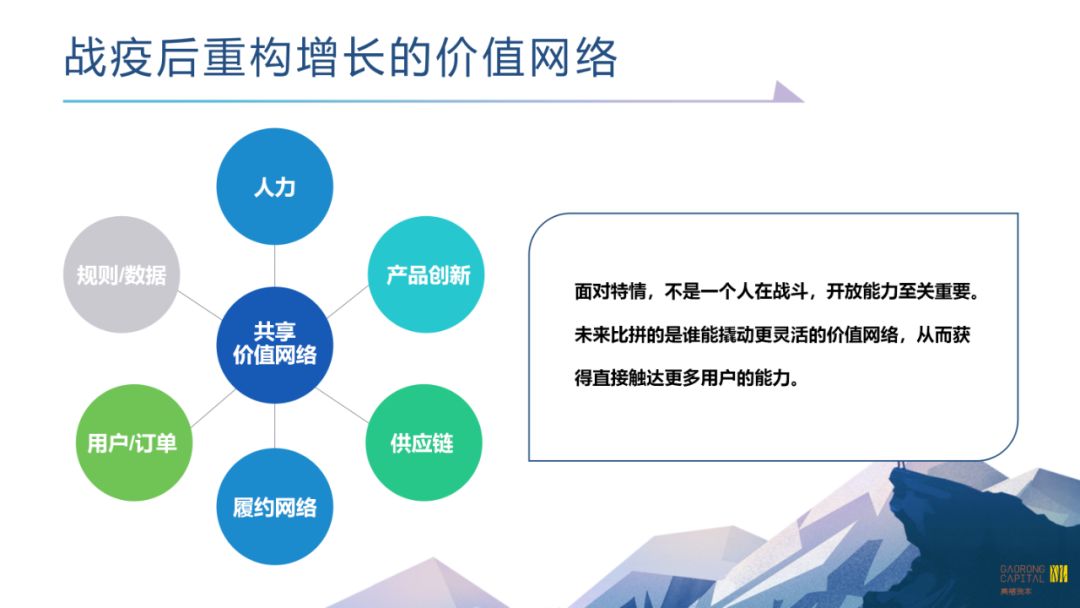
I see this as an upgraded version of the sharing economy — call it "Sharing Economy 2.0." The previous generation was mostly about sharing time, space, and assets. This generation is about sharing capabilities at a more fundamental level, within a more open ecosystem.

Learning Viral Growth from the Pandemic
Turning to the "tactical" level — good growth tactics aren't one or two traffic hacks. They're a systematic engineering project.
First, good growth starts with constructing products that occupy a traffic niche. That means designing products to maximize organic traffic acquisition. "Niche" is also a term from evolutionary biology — every species has its unique habitat. Nature doesn't favor the biggest or the strongest; it favors the fittest. Many seemingly weak species survive for eons because they occupy excellent niches, making it easier to access resources and withstand predation pressure.
Growth works the same way. Some products naturally live in fertile traffic soil — they possess the constitution and positioning to attract, carry, and spread traffic, making it easier to accumulate traffic potential and become born hits. Others live in saline-alkali land. Some grow in swamps that look lush but leave you sinking with every step.
So what kinds of products occupy advantageous traffic niches? I've identified five factors.
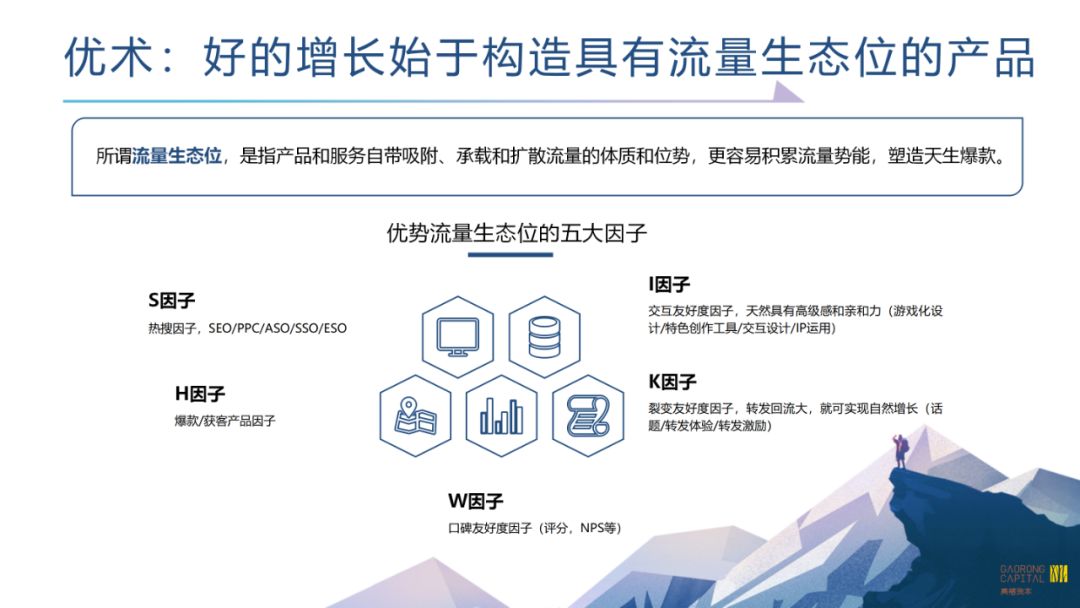
S-Factor / Search Factor
At its core, internet traffic divides into two categories — search traffic and social traffic. Of course, some search traffic today has evolved into recommendation traffic. We often overlook search, but it remains an important traffic source. It's especially critical for B2B enterprise services and even for B2C community products.
Within the S-factor, App Store Optimization (ASO), Social Search Optimization (SSO), and E-commerce Search Optimization (ESO) all deserve attention.
I-Factor / Interaction Factor
Good products need to leverage gamification design, interaction design, and IP properties to create flow states for users. In growth, there's a concept for new user activation called the "excitement index" — it tracks how a user's excitement about a product changes from hearing about it, to engaging with it, to downloading or unboxing it. Products with strong interactive experiences, word-of-mouth potential, and gamification can maximize excitement throughout this journey from awareness to trial. This makes purchase conversion or activation retention more likely. There's a conversion formula in growth: Desire - Friction = Conversion. So minimizing user friction while maximizing excitement is the core of I-factor optimization.
H-Factor / Hook Factor
This means getting users to gradually store value in their mental accounts, building goodwill and trust as they use the product. There are generally two approaches: front-loaded value and back-loaded value. Front-loaded value often uses loss leaders or hit products to accelerate user adoption. Back-loaded value leaves users with some regret or longing after each use — or reserves future benefits like vouchers for next time, extra discounts for inviting friends, or bonus rewards for completing task sets — leaving a "hook" that draws users back.
W-Factor / Word-of-Mouth Factor
Products with good word of mouth carry their own growth momentum. In product design and growth, you can build core fan communities by providing more user-friendly mechanisms for gathering feedback and sparking participation.
K-Factor / Viral Factor
Recently everyone's learned about the R0 value, the basic reproduction number. In epidemiology, R0 is the average number of people one infected person will transmit a disease to in a fully susceptible population with no interventions. When R0 exceeds 1, the virus spreads continuously.
We can use this pandemic to think about viral growth. The so-called K-factor measures how many people flow back when N users share your product or content. There's a simple formula where the K-factor is a single, static ratio of invites sent to conversion rate.

The next formula gets closer to actual viral propagation:

Viral payload is how many people each user sends links or messages to each time. The second factor is invitation conversion rate. The last is how frequently people receive invitations. These three are the viral growth levers — optimize each separately to create growth.
Effective viral spread can be divided into incentivized and non-incentivized viral spread. I believe non-incentivized viral spread is very important, and mechanism design is critical here. Poor design means even with high viral payload, conversion rates and frequency will stay low, limiting effectiveness. Some effective approaches: First, the invitation reason should align with users' desire to show off or help others, so they naturally invite friends with minimal resistance — like the Ice Bucket Challenge, or Pinduoduo's friend-assisted price cuts. Second, both inviter and invitee must benefit, or it won't sustain. Third, multiplayer gamified design accelerates viral circulation frequency. Fourth, introduce network effects into the product. WeChat Pay initially had no network effects — users treated it purely as a payment tool. But WeChat used red envelope grabbing to create network effects and achieve massive viral growth.

Digitally-Driven Lean Growth
The growth framework means using digital drivers to find the optimal product-market fit, channel-product fit, and channel-monetization fit. Looking at the interplay of traffic and existing user base, growth comes down to doing three things well: acquisition, activation, and retention. From the user perspective, this means optimizing growth funnels for new and existing users, and optimizing growth and monetization funnels for high-, medium-, and low-value users.
To optimize growth returns, start with user profiling, behavioral segmentation and grouping, and retention analysis to carefully examine which channels are most valuable, which users are most valuable, and which user behaviors best lead to long-term value. Then use a testing system to continuously test growth strategies, iterate on product, and coordinate with traffic pool operations to leverage greater growth.
1. Retention Above All: From AARRR Pirate Metrics to RARRA Lean Growth
If you've read Hacking Growth, you're familiar with the AARRR funnel model (also called "pirate metrics"). The AARRR funnel embodies typical traffic-red-mindset thinking — maximize the top of the funnel and minimize attrition at each layer.
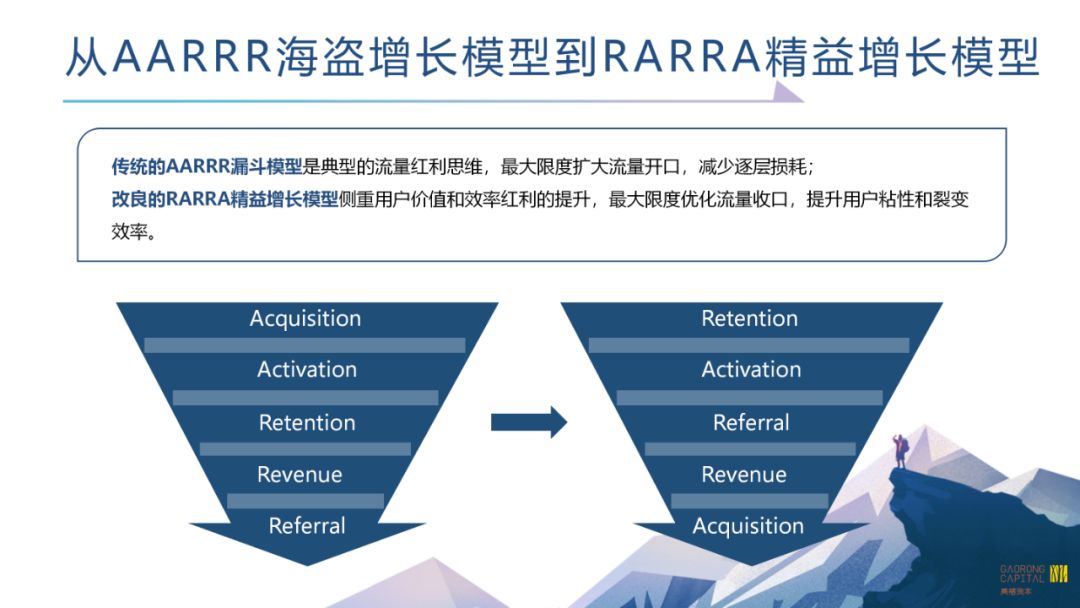
Today, we advocate for an improved RARRA growth model that emphasizes user value and efficiency dividends, optimizes traffic capture to the greatest extent, improves user stickiness and viral efficiency, and pursues the most efficient growth possible. RARRA is aligned with the philosophy of lean startup; I call it the "lean growth model." For companies seeking low-cost, lean growth during the pandemic, the three most important levers in RARRA are the first three R's — Retention, Activation, and Referral. Regarding referral, we just covered some effective referral mechanisms in viral growth, so I won't elaborate further today.
The RARRA model emphasizes that Retention is paramount — it is the core of all growth optimization. Retention metrics are the most important evidence of a product's value hypothesis. If retention is poor and the product fails to meet the expected value hypothesis, there is simply no point in scaling up paid acquisition.
Next is Activation. User activation is the most critical conversion point in growth, and new user activation in particular is one of the most important levers in the growth journey. New user activation encompasses the process from a new user's first login, completing account registration and necessary setup, to their first use of the product's key features. Because this task falls between the traditional division of labor between marketing and product teams, it becomes something of a "no man's land" and is easily overlooked.
Why do growth experts place such heavy emphasis on new user activation? Because if new user activation is done poorly, there is no subsequent usage. First, data shows that the vast majority of apps lose over 75% of users within three days; new user activation is the most important window determining whether a product survives. Second, new users have very short attention windows and face numerous distractions. A product has only a brief window after a user decides to try it to deliver value and convert them into long-term users; if users try it but churn because they don't understand how to use it or fail to perceive the product's value, winning them back may be harder than acquiring a new user entirely. Third, new user activation has an amplification effect. Generally, user retention follows a smooth downward curve; a small improvement in early user activation rates propagates through to the subsequent retention curve, so new user activation affects not just new users but overall user retention. Finally, strong new user activation improves marketing budget ROI. A better new user experience means more new users become long-term users, shortening the payback period and improving unit economics.
There are several particularly important concepts in defining new user activation. First, focus on the new user's "Aha Moment." The so-called Aha Moment is that instant when using the product makes the user's eyes light up or their heart skip a beat — the moment they discover the product's core value. If Aha Moments can be sustained, they form flow states. For example, when a user places their first order on Dingdong Maicai, or takes their first selfie with a beauty camera, the sense of satisfaction and delight they experience is the Aha Moment.
Aha Moments matter not only for consumer products but also for enterprise software products with network effects and consumerized interfaces, such as Zoom, Slack, Dropbox, LinkedIn, and DocuSign. An increasing number of B2B products make getting new users to the Aha Moment quickly a critical component of their growth strategy. Some well-known products' Aha Moments are defined as follows: Facebook new users adding 10 friends within 7 days; a new Slack team sending 2,000 messages; LinkedIn new users adding four connections with complete profiles within a week while also completing their own profile; Twitter new users following 30 accounts with a certain proportion following back; Baidu users achieving over 50% satisfaction on their first search.
From these examples, we can see that Aha Moments are clear, specific, and measurable — they are the moments when users form a "sweet spot" with the product early on, typically fitting this formula: (new user / new user team) completes (key behavior) (X times) within (time period).
Key behavior is another important concept related to activation. Key behaviors are typically those that embody the product's core value, and statistically are also the behaviors most highly correlated with user retention. A product may have one or several key behaviors; defining them is key to cracking the product's activation code and improving retention.
Beyond Aha Moments and key behaviors, activation rate and activation funnel conversion rate are also very important concepts and metrics for optimizing activation.
Additionally, in the lean growth model there is one metric that cross-functional teams care about most: the famous "North Star Metric." This refers to the single most important metric for observing a product, capable of predicting its long-term value. The North Star Metric must be directive and can be decomposed into a series of executable metrics through appropriate analytical frameworks. Good North Star Metrics are long-term oriented, directional, and connected to monetization and long-term value. For example, Facebook's North Star Metric is "effective feed browsing time," while Amazon's is "purchases per Prime member."
2. From Traffic Acquisition to Traffic Pool Operations
When we think about traffic today, we need to shift from a pure traffic acquisition mindset to a traffic pool operations mindset. Traffic today can generally be divided into three categories. First is "organic traffic" — traffic brought by extreme product virality plus an ecological position with inherent momentum. Second is "paid traffic" — bought traffic, including continuous optimization of information feeds, search, app stores, and e-commerce platform paid advertising; the core is understanding platform rules, quantifying creative and material selection, and executing proper cold starts for new users. Third is "operational traffic" — traffic that enters private domain operations. More effective approaches include KOL link empowerment, sustained wave-making capability, and subculture and community operations.
Under pandemic conditions, paid traffic is something many large companies can afford; but for startups, the priorities are thinking about how to obtain organic traffic that basically costs nothing, and how to improve conversion of operational traffic. For example, when working with KOLs, I believe the marginal returns of using KOLs are already declining — you must cultivate your own nano-influencers, that is, core users, and whether you can jointly operate communities with them is critically important.
When we say private domain traffic, this actually includes traditional private domain apps and websites, social presences, WeChat ecosystem, Kuaishou, Douyin, Xiaohongshu, mini-programs and other community networks, as well as transaction platforms like Tmall. Every link can be optimized.
In the long term, the evolution goes from building traffic ecological position products plus private domain traffic operations, to elevating toward private domain user and KOL network operations — the core is accumulating trust capital with specific populations to catalyze exponential expansion of products or services.

How Startups Should Build Growth Teams
Many entrepreneurs are concerned with how to build growth teams. I believe startups need to match different growth capabilities to different growth stages.
The first stage is product-market fit, typically with a team of 10–20 people. During this period, validating product-market fit (PMF) and mining product stickiness is the growth team's top priority. At this stage, growth only needs one person — the CEO or a growth hacker is sufficient. The growth hacker is an amalgamation of marketing, product R&D, and data analytics roles, with growth as the sole objective, acquiring substantial growth through the fastest methods, lowest cost, and most efficient means. Their capabilities are: creative/technical/results-oriented/focused on lifecycle/data-driven/adept at productizing growth mechanisms. At this stage, be extremely focused on user retention and user feedback.
The second stage is channel-product fit, with a team of several dozen to around 100 people. This period is the prelude to rapid growth; you need to gradually build a lean, small growth team, with responsibility gradually transitioning from the CEO to a dedicated growth lead. The growth team is mainly composed of generalists, with each person ideally having experience across several areas. The growth lead possesses data analytics capabilities, marketing capabilities, and engineering or product capabilities. At this stage, the growth team needs to find channel-product fit, focusing on viral growth, organic traffic acquisition, paid channels, and other key links. This stage requires extensive experimentation, trial and error, and evaluation to ultimately judge the effectiveness of different channels before large-scale expansion.
The third stage is rapid growth. Further along, some teams may enter blitzscaling, requiring a more powerful and professional growth team.
From the third to fourth stages onward, growth teams typically adopt one of three models — independent growth teams, virtual growth teams, and hybrid growth teams. Independent growth teams have the advantages of being controllable, having less organizational friction, moving fast, and showing clear results. The downside is they tend to generate considerable cross-departmental friction. Virtual growth teams are assembled by drawing relevant personnel from product R&D, marketing, operations, and strategic analytics teams; such teams can be quickly formed and connect growth responsibilities to all teams, but require balancing core user experience with growth. Because general product R&D teams are responsible not only for growth but also for core product value and user experience, balance is needed between these two. Its downside is the need for internal departmental balancing, unclear priorities, and lower efficiency. Hybrid growth teams are a synthesis or compromise between the above two, but also suffer from ambiguous organizational structure and unclear priorities.

Ten Growth Recommendations for Entrepreneurs
To conclude my sharing, I'd like to offer 10 growth recommendations — prioritize those with high returns and long half-lives.
- Build digital user operations capabilities (online/offline)
- Drive full business operations through digitalization
- Master the lean growth model
- Operate private domain and organic traffic
- Assess product online adaptability
- Optimize supply chain resilience and quality, especially opportunities to find quality, affordable alternative supply chains
- Build contactless fulfillment systems (delivery systems, front-warehouse near-field networks, community self-pickup)
- Invest in and deploy automation and analytics tools to replace non-core manual labor
- Full cloud-based organizational collaboration / flexible workforce systems
- Last but not least, cut costs and increase efficiency, maintain good fundraising rhythm
There's a well-known line from the bestselling book Take the Best Step: "The best time to plant a tree was ten years ago. The second best time is now. Because ten years is enough for a sapling to grow into a towering tree that blocks the wind and rain, fills the air with fragrance, and bears abundant fruit. A decade can accomplish much and change much. If you missed it ten years ago, why not plant one now for ten years from now?" I'd like to dedicate these words to founders who've weathered the pandemic and are now building growth systems. Because we believe it's never too late, and the moment everyone steps out of their comfort zone is when we begin building antifragile growth systems. Gaorong Ventures especially hopes to stand alongside entrepreneurs who have grown stronger through the pandemic, who can evolve themselves and their organizations through extreme challenges, to build a better world. We wish for everyone to develop antifragile capabilities and become truly vibrant founders who represent China's future.