Xiruan Technology: Beyond SaaS, Building Practical, User-Friendly AI Agents for China's Hospitals | Gaoruan Future

Ushering in the era of intelligent agents for smart hospital management.

- "Xiaoxi, please send me this month's orthopedic operations report — focus on discharged patient volume and surgical volume."
- "Push me all contracts pending approval this week."
- "Show me the real-time operational pressure indicators for each department."
Since June this year, Xisoft Technology's hospital operations management AI agent has been rolling out at major hospitals. Built on general-purpose large language models and hospital knowledge bases, the agent handles real-time Q&A, data analysis, and even decision support — like Iron Man's assistant "JARVIS," becoming a reliable "digital helper" for hospital presidents, department heads, and administrative staff.
Under China's National Health Commission evaluation standards for smart hospital service tiers, smart hospitals cover three domains. Beyond "smart healthcare" for medical staff and "smart services" for patients, "smart management" for administrators is becoming increasingly critical to high-quality hospital development.
In the wave of large language models, AI agents capable of human-like thinking and multi-task execution have arrived. "When AI can define and solve problems on its own, the agent may graduate from tool to producer itself" — functioning as an organizational member working alongside humans, freeing them to tackle more complex real-world challenges.
Can AI agents, combining efficiency and personalization, help hospitals achieve smarter management and better meet people's healthcare needs?
In 2024, Xisoft Technology, a leading vendor of digital-intelligent operations management services in healthcare, made its "leap moment" in smart management. It became the first in the industry to define the hospital operations management AI agent and put it to the real test in hospitals — whether it is genuinely usable, accessible, and effective.
Recently, Xisoft Technology founder and CEO Chong Chen shared his and his team's practice and thinking with us. Gaorong Ventures participated in Xisoft's Series A in 2020 and doubled down in subsequent rounds. Xisoft has now completed its Series C and is conducting a new funding round.
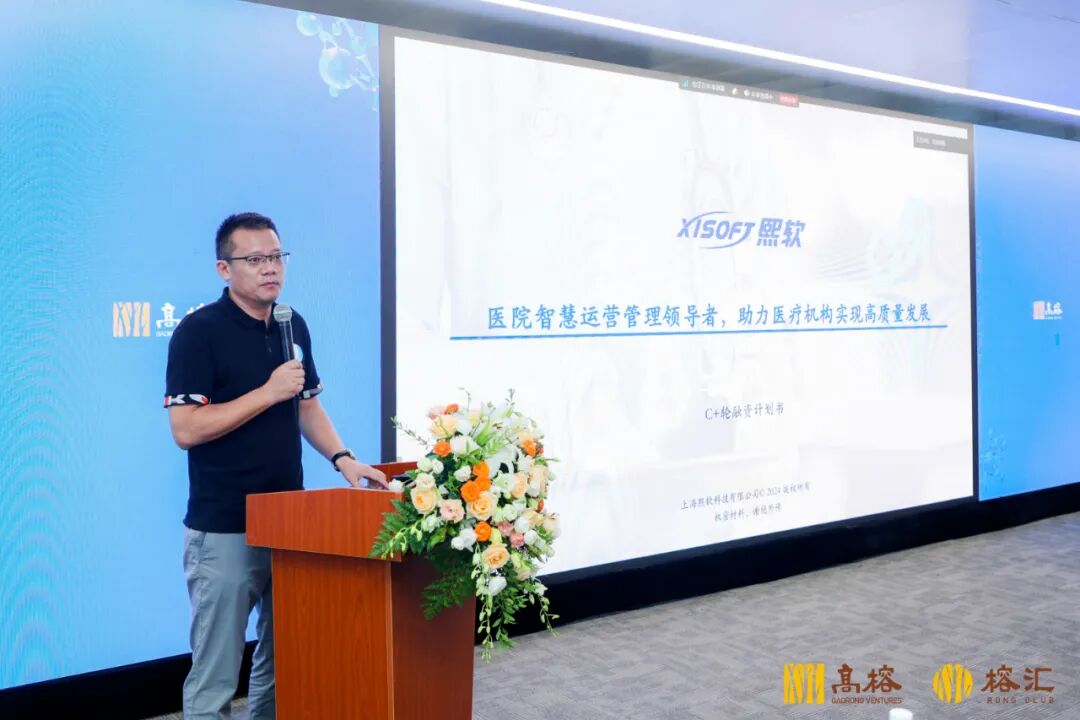
The following is Chong Chen's sharing (edited):

Hospital operations comprise two levels. First, the visible business activities — medical care, education, research, and public health prevention. Second, the resources consumed alongside these activities — people, money, and materials.
Resources are inherently scarce. The central challenge facing China's healthcare system today is how to maximize limited resources to meet people's health needs.
National health expenditure has grown steadily in recent years, exceeding 9 trillion RMB in 2023, or 7.2% of GDP. Yet many people still feel a significant gap between what they need and what they receive.
Meanwhile, hospitals themselves have entered a new historical phase. Capital demands keep rising for medical equipment upgrades, talent recruitment, and research investment. At the same time, healthcare reform has entered deep waters, particularly payment-side reforms that force hospitals to strengthen target management, control costs, and avoid waste. Both external pressures and internal dynamics call for more intelligent, refined management models.
Since its founding in 2018, Xisoft Technology has focused on healthcare smart management, dedicated to helping medical institutions improve the rationality of resource allocation and the effectiveness of resource consumption — enabling hospitals to operate more efficiently, unleash the motivation and vitality of medical staff, use drugs, devices, and equipment more rationally, and ultimately serve patients better.
So how does smart management actually get implemented?
When a patient visits a hospital, physical flows, capital flows, business flows, and information flows are constantly in motion. The registration screen showing a doctor's profile and schedule connects to the HR system. A test order triggers use of equipment and reagent supplies. Payment involves capital flow changes.
Smart management integrates the people (HR, payroll, performance), money (accounting, project funds, capital, reimbursement), and materials (procurement, inventory) of medical institutions, enabling efficient digital management across all hospital operations scenarios to achieve four "integrations" — financial-business integration, front-back office integration, intra-extra hospital integration, and cost-performance integration.

Recently, Xisoft announced a partnership with PKU Healthcare Group to provide financial, HR, and materials management systems. Beyond leading healthcare groups, Xisoft has also won recognition from large and medium-sized medical institutions, medical consortia, primary care facilities, health administrative departments, and device and supply vendors through its rich best-practice accumulation and strong product capabilities.
To date, Xisoft has accumulated nearly 700 public hospital clients, with revenue CAGR of 68% — far exceeding the healthcare IT industry average.
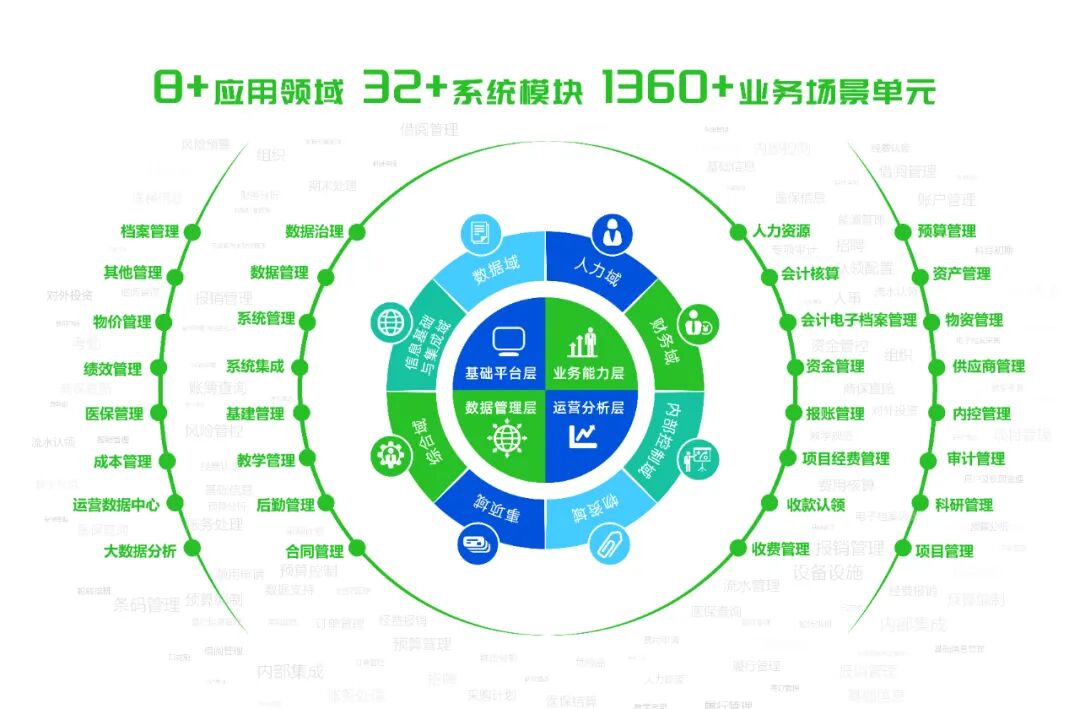
In product architecture, Xisoft built a PaaS platform, the "Xisoft Cloud" hospital operations management digital-intelligent foundation. On this basis, it launched its "Next-Generation Hospital Smart Operations Management Platform (HRP)," covering 8 application domains, 32 product system modules, and over 1,360 management application scenarios.
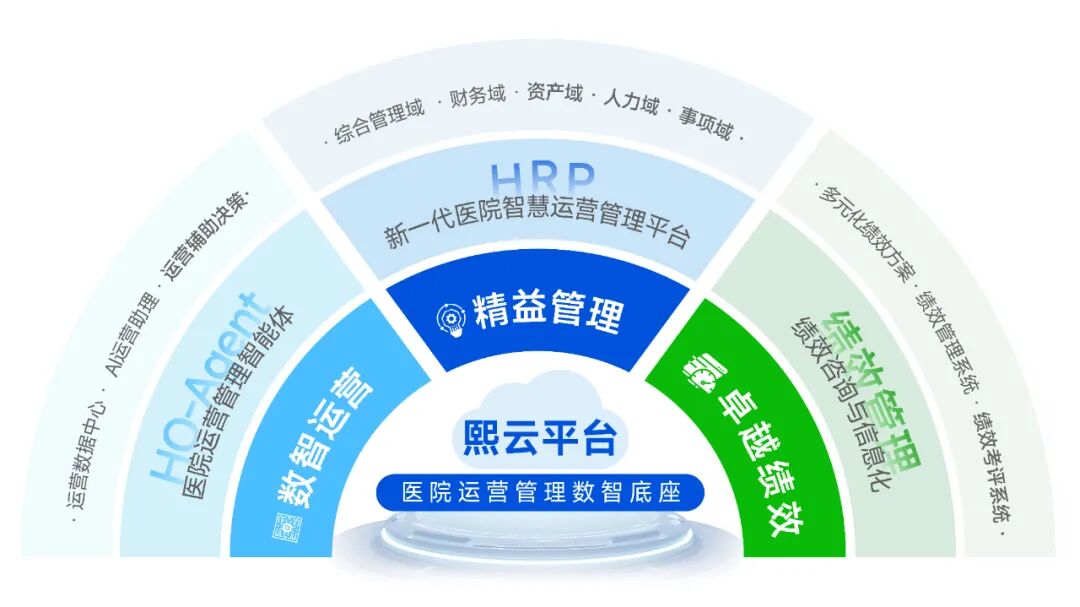
Today, Xisoft products permeate every aspect of hospital operations staff work, including comprehensive budgeting, financial accounting, cost management, materials management, contract management, human resources, reimbursement management, and operations decision-making.

As large model technology boundaries expand and costs drop rapidly, we've been thinking about how to better apply AI in hospital smart management. As one of the most promising directions for AI applications, we believe agents can disrupt past product forms, bring entirely new management experiences to healthcare clients, and truly deliver efficiency upgrades.
On November 14, the National Health Commission General Office issued the Notice on Issuing Reference Guidelines for AI Application Scenarios in the Health Industry. In the "AI+" hospital management section, it mentioned "intelligent hospital economic management decision support," stating that AI should comprehensively analyze hospital economic management activities and operational indicators to provide intelligent decision support and improve decision quality and efficiency.
In June this year, Xisoft officially released its Hospital Operations AI Agent (HO-Agent). Based on domestic general-purpose large models and pre-trained on hospital knowledge bases and corpora, it became the first agent product to be deployed and commercialized in hospital operations management.
We know that a true agent needs three capabilities —
- Adaptive environment: Behavior adapts to environment and goals, flexibly adjusting to changes;
- Memory and reflection: Ability to learn from experience;
- Decision-making: Based on existing memory and computational constraints, making appropriate choices and taking action when encountering tasks.
Combined with actual hospital operations management needs, we built the agent on three layers.
The foundation is the "Operations Data Repository (ODR)" based on data assets and governance. The middle layer is "Operations Decision Support System (ODSS)." The direct interface for hospital administrators and all staff is "Xiaoxi AI Operations Assistant."
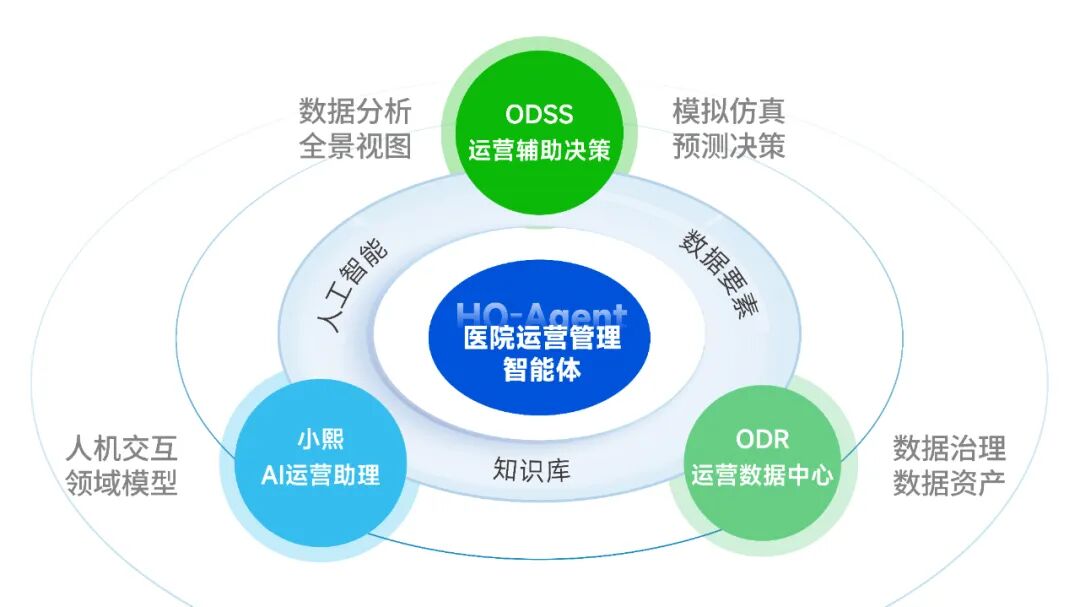
Through natural language interaction, Xiaoxi AI Operations Assistant provides knowledge base Q&A, intelligent operations data queries and analysis, and AI assistant functions. For example, querying the latest policy documents, checking real-time materials inventory data, or quickly completing cross-system contract approvals through conversational interface.
Xisoft's AI agent also aims to deliver practical decision support. Healthcare administrators face numerous decisions daily: Should we purchase this advanced equipment? How many beds to add to a department? How to optimize assessment schemes? Where should resources be allocated?
The agent provides users with real-time operational dashboards, quickly locating key data and completing analysis amid vast oceans of data and complex data lineage relationships. It can also simulate a management "cockpit," generating strategy recommendations, decision support, and simulations around these practical problems.
Data shows Xisoft's AI agent is gradually permeating medical workers' daily workflows. Clinical department heads access it an average of 3.8 times daily to check department revenue, costs, and materials — with data updated as recently as ten minutes prior.
We also look forward to Xisoft's AI agent becoming an AI operations assistant for more medical workers, readily answering their questions about medical care, education, and research.
As China's medical institutions continue advancing into refined operations, we believe agents capable of autonomous learning, decision-making, and action will bring new-quality productivity to hospital operations, pushing medical institutions' efficiency and effectiveness management into a truly intelligent era.
For financing or partnership inquiries with Xisoft Technology, contact: liys@xisofttec.com