Style3D: Putting AIGC on the Runway, and Building the Foundation Model for Fashion | Gaorong Ventures

Not just generating inspiration, but truly understanding industries.
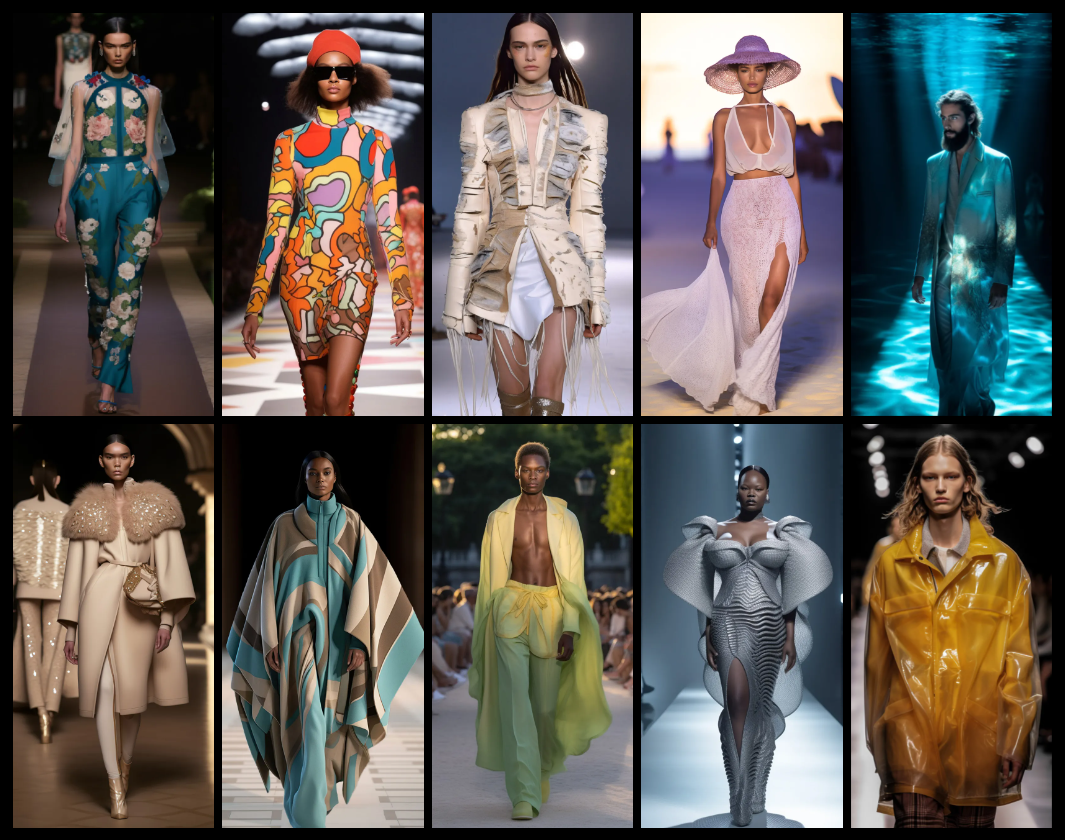
This April, an "AI Fashion Week" — a collision between artificial intelligence aesthetics and human aesthetics — took place in New York. The event received hundreds of AI-generated submissions, works that "break boundaries, take risks, and are creating something truly unique." Below are the top 10 pieces selected by the fashion week:
The new wave of AI is bringing more inspiration and innovation to the apparel and fashion industry, and is seen as having the potential to improve the sector's digitalization and design-to-manufacturing efficiency. According to McKinsey & Company analysis, over the next three to five years, generative AI could, "conservatively speaking," help create an incremental $150 billion in operating profit for the apparel, fashion, and luxury goods industry, with optimistic estimates reaching as high as $275 billion.
Lingdi Technology's Style3D (hereafter "Style3D") serves as digital fashion infrastructure, committed to providing the apparel industry with end-to-end 3D digitalization solutions from design through production. With deep technical DNA, Style3D has recently developed and launched a series of AIGC features at speed, including AI style analysis, AI pattern generation, AI pattern-piece generation, AI material generation, and rapid e-commerce image creation.
The apparel supply chain is long and complex, and requires AI-generated content to include structured data with direct production connectivity. This has driven Style3D to build an "industry-grade model" based on sector data and industry needs.
Recently, Huamin Wang, Chief Scientist at Lingdi Technology's Style3D, shared his team's process and thinking around exploring AIGC applications in the apparel industry at an acceleration camp co-hosted by NVIDIA Inception and Gaorong Ventures. Wang is a recognized world-class computer graphics scientist with nearly 20 years of academic research background in graphics.

The following is Dr. Wang Huamin's presentation (edited for clarity):

The apparel industry is a business driven by constant new releases to stimulate consumption, with an extreme pursuit of creativity and efficiency. Its high creative intensity and tolerance for diversity give it a higher error tolerance for AI compared to other industries, making it suitable for AIGC implementation and exploration.
But we must also recognize that apparel is a historically deep industry with a highly mature division of labor across its supply chain. Breaking down the apparel industry chain, each stage requires outputs ranging from 2D to 2.5D to 3D — and these outputs are "interlocked, one ring connecting to the next."
2D: The initial content designers create on paper when inspiration strikes, such as sketches or style illustrations.
2.5D: Pattern makers develop patterns based on style illustrations. The purpose of pattern-making is to turn designs into real, three-dimensional objects. In the physical world this is done through sample garment production; in the virtual world through simulation. Patterns serve as the bridge between 2D and 3D, hence "2.5D."
3D: With the development of the metaverse, 3D digital garments will become increasingly important for the apparel industry. Digital garments combined with digital avatars create interactive experiences.
2D: In the garment presentation stage, graphics technology renders three-dimensional objects into 2D visual outputs, such as e-commerce product images or videos.
These stages and characteristics of the apparel industry determine that for AI-generated content to truly create value, it must satisfy the following properties.
First, the output content and elements need to be multimodal, with different types of content generated at different stages structurally interconnected. Second, generated content must correspond to physical products, fully supporting direct production connectivity. Finally, generated content cannot be disposable — for example, patterns and design content should be preserved as data resources and support reuse.

Based on our deep understanding of industry characteristics and customer needs, from the very beginning of Style3D's AIGC exploration, we realized: we needed to train vertical domain industry models based on our accumulated large-scale vertical industry data and asset libraries.
Currently we are training our own models on top of open-source Stable Diffusion. Stable Diffusion supports local deployment and custom models, offers good controllability, and is not limited by style. We have defined this model as the "Style3D AI Industry Model," with a complete set of prompts applicable to the apparel industry.
As is well known, generative AI models are evolving extremely rapidly. Overall training costs and data dependence will gradually decrease, while stability and security continue to strengthen. In developing our products, we don't limit ourselves to any specific model, but closely track technological developments, allowing our products to iterate continuously.
Moreover, to truly develop products that satisfy customers, what's involved goes far beyond generative AI models alone. For example, image segmentation requires inferential AI models; image search and image classification involve retrieval-based AI models. So in developing truly usable products, we are committed to combining various AI model technologies.
Simulation and other graphics technologies have long been Style3D's strengths. With the arrival of the AI wave, we are pursuing a technical path that combines AI technology with graphics technology. Although AIGC has the potential to directly generate 3D content in the future, in the near term replacing real-time simulation with AIGC remains somewhat difficult.
AIGC and graphics technology can be described as complementary: AIGC-generated content can provide materials, textures, and visual enhancements for simulation; simulation can provide real-time environments and underlying effects and computational support.

Next we will focus on how Style3D uses AI technology to empower several key links in the apparel supply chain.
Fabric/Process Asset Library
Apparel designers and fabric suppliers/developers have always had extensive needs for fabric textures and patterns. Previously we built a large searchable asset library; with AIGC technology, based on existing resource data, our model supports users generating more textures/patterns through text search, helping designers and fabric merchants find desired effects faster. It also supports image search to generate more textures/patterns — users upload a reference style image, and similar-style textures and patterns can be generated. This application closely resembles mature image generation technology, except our product tools are based on proprietary data accumulated from the industry.

For processes, customers can use AIGC to generate different processes and effects based on photos. For example, for embroidery effects, AI can be used to generate the underlying displacement maps or bump maps, as well as required vector graphics.
2D Garment Style Design Generation
Through our product, designers can quickly generate style illustrations by inputting various prompts, helping find early-stage raw design inspiration. For example, they can input trending keywords; also support text-to-image and image-to-style generation; or upload multiple images to achieve style blending; of course also supporting secondary style editing and reconstruction. Overall the goal is to build a comprehensive tool to help designers find inspiration or optimize designs.
In this area, generic image generation tools struggle to support detailed design. Style3D has developed detailed design features covering dimensions including process, elements, style, and color, allowing designers to use AIGC for garment detail design.
2.5D Pattern Generation
In the apparel industry, pattern design was traditionally executed by professional pattern makers. Today using AIGC, inputting a realistic image, design sketch, or even text, all support generating corresponding patterns.
Actually achieving this is highly challenging, because patterns need to connect to real manufacturing and contain extremely rich information, such as pattern piece shapes, sewing relationships and processes between pieces, positional relationships between pieces and the human body, fabric types for pieces, production processes, and even auxiliary material information (buttons, zippers, etc.). This requires us to have substantial structured data and understanding of apparel manufacturing itself as support.
3D Model Pose Generation
From 2.5D to 3D, we primarily rely on graphics simulation technology; our current AI experiments mainly focus on 3D human pose generation.
2D Visual Effect Generation
Previously, going from 3D to 2D visual effects was mainly achieved through graphics rendering, which brought a problem needing improvement: lack of photorealism. For model try-on images, if the person isn't realistic enough, the effect suffers greatly; with AIGC technology, more realistic model images can be generated. Additionally, our developed tools support face generation, allowing customization of different face shapes, hairstyles, ages, skin tones, etc. according to customer needs.
For e-commerce or apparel brands, using AI can also rapidly generate model try-on effect images, greatly improving efficiency and saving costs.
Style3D AI Industry Model — E-commerce New Release Application
Scene/Background Generation
Previously, for presenting garments in specific scenes (such as runways, physical stores, etc.), we relied on our collected large volume of scene photos, but this was limited; using AIGC we can generate numerous scenes, which combined with model presentation produces better effect images.


From the above stages, we firmly believe AIGC will better assist designers, pattern makers, and other apparel industry professionals, stimulating creativity and improving efficiency. In this process, we have also been continuously exploring and reflecting on practical problems encountered.
1) Data For AIGC, data is extremely, extremely important. Like a chef cooking, data is the ingredients.
The biggest problem in the apparel industry is that data we previously possessed may have been unstructured, incomplete, and not meeting multimodal requirements. So-called multimodal means data must include text, images, line drawings, pattern pieces, and 3D models. Additionally for the Chinese language environment, Chinese and industry terminology have polysemy that needs to be unified.
Beyond relying on previously accumulated industry data, we are also actively mining more data, with substantial human and energy resources devoted to data accumulation. I personally consider data to be one of the biggest challenges for AIGC implementation.
2) Models On the model side, we need to solve stability, controllability, and safety issues. Beyond expecting continuous optimization of AIGC models, we also depend on data quality to achieve stronger controllability and higher safety. Beyond relying on manual annotation, Style3D has also developed some automated tools for data cleaning to help achieve safety.
3) Evaluation For AI models, another crucial point is how to define the evaluation function. For the apparel industry, on one hand it's difficult to quantitatively evaluate whether a design is good or not; second, it's hard to standardize, because design has strong subjectivity. Style3D itself has a professional designer team, and we are also exploring how to define evaluation metrics, ultimately developing a reasonable evaluation model that meets practical implementation needs.
4) Deployment Finally there's how to deploy. Engineering and computing-related issues need to be solved one by one.
Style3D AI Industry Model
Midjourney founder David Holz mentioned in an interview with tech media outlet The Verge that AI is continuously producing new aesthetics, almost like "aesthetic accelerationism," "but they're not AI aesthetics, they're new, interesting human aesthetics, and I think they're going to spill over into the real world."
And Style3D's exploration is precisely about combining AI technology with industry needs, pushing artificial intelligence to empower the real apparel and fashion industry, accelerating transformation in creativity and productivity.