A Conversation with Aozhe, the Leading Low-Code Platform, on the Two-Way Street Between Low-Code and AI | Gaorong Future

All-in-one low-code platforms are fully integrating AI capabilities.
In 2014, Forrester Research coined the term "low-code" for the first time — the idea that applications could be built quickly with minimal or no coding, using simple drag-and-drop interfaces.
Ten years of technological and market cycles later, low-code has arrived at the era of large language models and AI agents.
Under this new wave of technology, where does low-code / no-code go from here? Will it face "generational anxiety"? What value anchors do low-code vendors hold in the future AI ecosystem?
As "China's #1 Low-Code Brand" (certified by CIC Consulting), Authine's answer is to fully integrate AI technology while returning to customer needs and real-world scenarios — helping enterprise clients bridge the "engineering gap" from digital transformation concepts to actual business implementation.
Authine has ranked first in China's low-code market for large and medium-sized enterprises for multiple consecutive years, serving over 60% of Fortune China 500 companies. Its client base spans manufacturing, finance, construction, oil and petrochemicals, real estate, retail trade, government affairs, and other industries. Its product Chuanyun has held the #1 spot across all categories on DingTalk's app marketplace for eight consecutive years, serving more than 200,000 small and medium-sized enterprises.
This past March, Authine held summits in Beijing, Shanghai, and Guangzhou, releasing its newly upgraded Yunshu All-in-One Low-Code Platform with full AI integration, targeting the digital transformation needs of large and medium-sized enterprises. It also launched the AI App Designer, enabling clients to create and deploy enterprise-grade agents on their own.
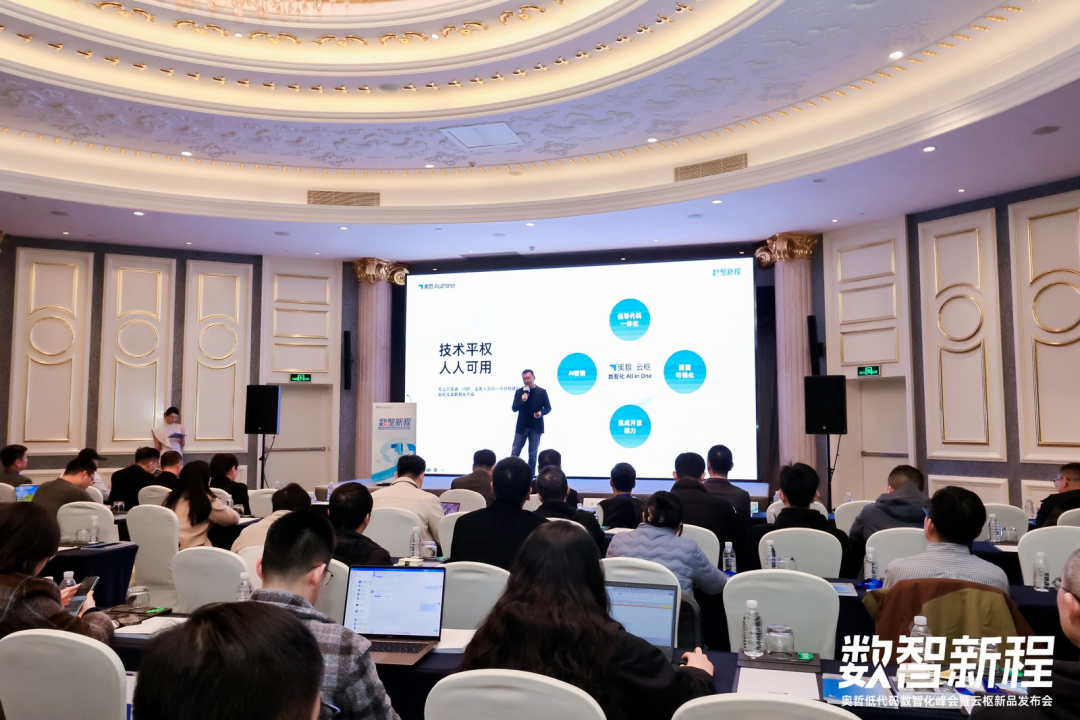
After the launch event, we sat down with Authine founder and CEO Pingjun Xu to discuss his thinking on the company's evolution from digital solutions provider to AI technology service provider.


Q: What changes have you observed in how enterprise clients deploy and implement large models during this DeepSeek wave?
Pingjun Xu: Indeed, after the release of DeepSeek's V3 and R1 models, enterprise clients — especially large and medium-sized enterprises — have shown dramatically increased enthusiasm for exploring AI, with very fast implementation timelines.
From our observations, two types of scenarios have seen particularly active DeepSeek deployment. First, capabilities where large models were already mature but are now seeing significantly reduced deployment costs, accelerating adoption across many scenarios — enterprise knowledge bases and policy repositories, for example. Second, the emergence of DeepSeek-R1's reasoning model has accelerated deployment in scenarios requiring inference capabilities, such as intelligent approval workflows and contract review and verification.
Authine has already helped multiple clients implement these two types of scenarios and applications, including China Construction Third Engineering Bureau, Gezhouba Group, and Maoming Petrochemical.
Q: How do you view AI's impact on the low-code market? Could it become a challenge?
Pingjun Xu: We firmly believe that AI will significantly accelerate the low-code market.
The commercial value of low-code as a segment fundamentally rests on two pillars — 1) making application development more efficient, and 2) lowering the barrier to application development so anyone can build.
When low-code meets AI, these two values can be pushed to their extremes. After integrating large models like DeepSeek, low-code platforms can help enterprises build and deploy intelligent applications more conveniently through AI capabilities such as agents, copilots, and plugins.
Rather than a replacement or competitive relationship, AI and low-code capabilities are converging and moving toward each other. ByteDance's agent platform Coze is incorporating low-code capabilities; Alibaba's Yida is also fully integrating with AI capabilities.
Moreover, as large models accelerate and popularize enterprise digitalization and intelligent transformation, the low-code market space and potential will expand further in the long run.
Q: With the rise of AI coding, could it replace low-code / no-code?
Pingjun Xu: In reality, low-code and AI coding serve fundamentally different audiences. AI coding primarily serves engineers who already write code; low-code is aimed more at business personnel, IT staff, and managers.
And for complex B2B scenarios and systems, the workflows involved are still quite intricate. Currently, AI coding mostly generates code for specific features — there's still some distance to go before it can achieve full system development and production readiness.
Q: What role does the low-code platform play in AI-driven enterprise intelligent transformation?
Pingjun Xu: From the practice of large and medium-sized enterprises, enterprise intelligent transformation will be supported and driven by three application forms for the foreseeable future.
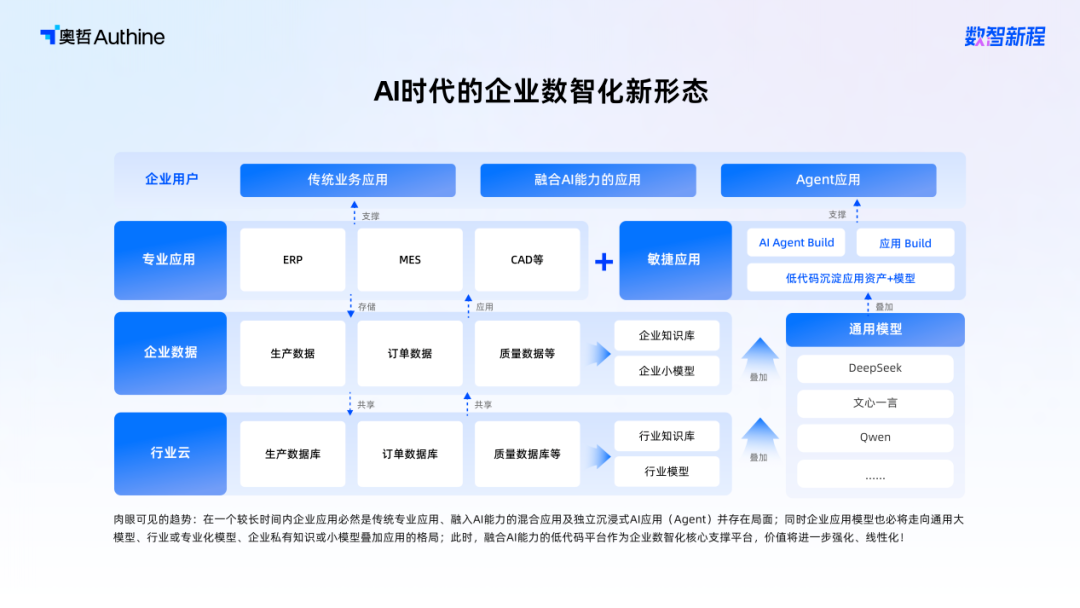
The first is traditional business applications — ERP, MES, CAD, and other specialized software will continue to hold irreplaceable value for some time. The second is AI-hybrid applications that integrate AI capabilities, such as existing applications calling upon base large models, industry models, as well as enterprise small models and knowledge bases. The third is native agent applications.
The low-code platform is well-positioned to become the "technology intermediary" connecting these three application forms and three layers of AI models, allowing enterprises to manage traditional system transformation, hybrid application upgrades, and AI-native application innovation through a unified interface, significantly reducing coordination costs.

Q: What upgrades were made to the Yunshu All-in-One Low-Code Platform?
Pingjun Xu: As early as early 2024, Authine released the Yunshu All-in-One Low-Code Platform integrating low-code / no-code capabilities, AI capabilities, and open integration. This year we've upgraded it comprehensively across all dimensions.
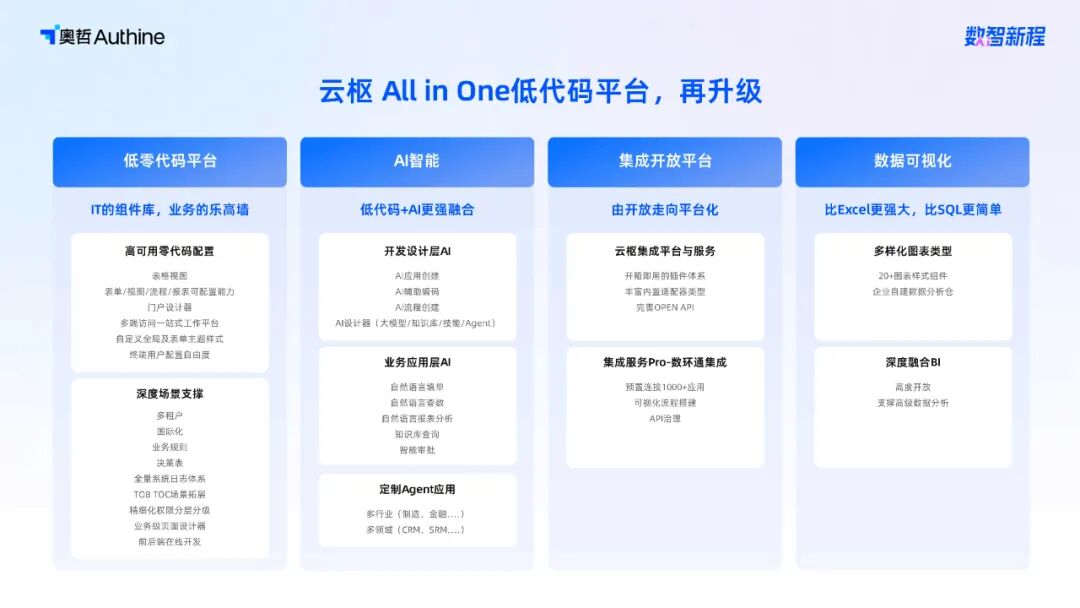
From the low-code / no-code integration perspective, we've built differentiated capability support ranging from "no-code configuration" to "deep development" for roles including professional developers, IT administrators, and business personnel.
For business personnel, we've introduced easy-to-use, visual spreadsheet views and other "no-code configuration" features. For complex business scenarios, we've decomposed and structured business workflows into modular capabilities — for example, supporting B2B unified connectivity across upstream and downstream suppliers, distribution agents, enterprises, and internal regional subsidiaries, while on the consumer side helping打通 marketing, transaction, and service touchpoints across the full chain.
On the AI intelligence front, we've fully integrated AI capabilities into the Yunshu All-in-One Low-Code Platform.
At the development design layer, business personnel can directly participate in AI workflow building through graphical interfaces. Yunshu supports AI app creation, AI-assisted coding, and AI workflow creation, further improving development efficiency, and we've launched the AI App Designer. At the business application layer, business personnel can achieve one-click access to commonly used AI capabilities such as natural language form filling, natural language report analysis, knowledge base queries, and intelligent approval. For deeper scenarios at large enterprises, Authine can also help clients customize agents and build differentiated applications tailored to different industries and domains.
The existing integration platform and data visualization capabilities have also been further upgraded.
Q: What is the AI App Designer, and how should we understand it?
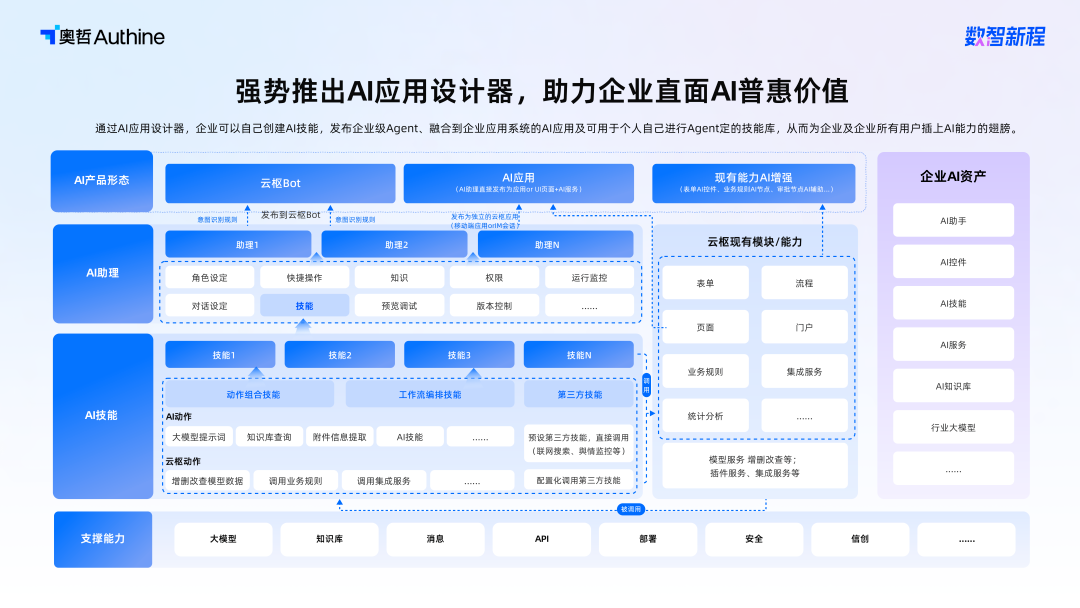
Pingjun Xu: We've packaged AI engineering capabilities into a dedicated product — the AI App Designer. Enterprises can create and deploy enterprise-grade agents based on their own knowledge bases and databases, while seamlessly embedding these agents into their workflows as needed.
For enterprises, this means being able to rapidly build intelligent assistants on a unified platform, enabling autonomous planning and execution of specific tasks.
Q: For deeper scenarios at large enterprises, Authine can help clients customize agent applications. Is this type of demand common?
Pingjun Xu: For agents to truly deliver substantive value in client scenarios — say, reaching a 90-point standard — the right scenario, high-quality data, and capable large models **are all indispensable.
Before deciding whether to customize an agent, we typically discuss three questions with the client. First, identifying whether the need is suitable and necessary. Second, assessing ROI. Third, evaluating data quality. Only after reaching consensus on all three do we develop an MVP (minimum viable product), then continuously optimize and improve accuracy.
Through these discussions, we can also sense that clients are becoming increasingly pragmatic — ultimately returning to their own scenarios to think through what can actually be achieved.
Q: What landscape do you envision for enterprise-grade agents in China going forward?
Pingjun Xu: In some ways, agents can be understood as small SaaS products. My personal view is that general-purpose agents in China will likely be made free by major vendors; complex industry agents will still require platforms like Authine's Yunshu to help clients with custom development; and a small number of vertical industry agents will require certain industry moats — in specific domains like interviews, training, or sales, combining industry practice with high-quality orchestration, some may succeed.

Q: Have you observed any common challenges as enterprise clients implement AI capabilities?
Pingjun Xu: When you dig into enterprise clients, you find that the B2B market is extremely rigorous.
Beyond the large model hype, we've found that a cognitive gap often exists between enterprise scenarios and model capabilities. It requires genuinely starting from enterprise value, conducting rational analysis of specific client scenarios, and carefully discerning which scenarios can benefit more from large models.
For example, we've analyzed scenarios with clients and found that large models weren't needed at all — the issue was that digitalization hadn't been done well, and could be solved directly with systems. In other scenarios, large models weren't necessary; small models for tasks like image recognition would suffice. Or after large model deployment, results didn't meet expectations because the enterprise's own data quality wasn't good enough.
Furthermore, there exists an "engineering gap" from large model technology to enterprise implementation. From requirements analysis and data cleaning to model training and iteration, each step requires specialized knowledge and technical accumulation.
Q: For this "engineering gap" in AI implementation, what role does Authine play? What are some actual cases?
Pingjun Xu: Enterprises need more than just an AI model — they need an "AI+" solution that seamlessly adapts to their business, is easy to deploy, and has controllable costs.
Authine aims to be a "converter" bridging technology and business, leveraging the advantages of low-code platforms — online connectivity, process-driven architecture, agile building, digital intelligence, and development for everyone — to help enterprises rapidly develop applications, upgrading from a digital engine to an intelligent engine.
For example, Xizi United, a leading domestic manufacturing enterprise, used the Yunshu low-code platform to complete research and development of its QMS (Quality Management System) in an extremely short time, encompassing 12 sub-modules and over 50 applications. The elevator lightweight application portion was supported by no-code technology, allowing business personnel to rapidly build shop floor applications for 6S inspections, raw material management, and more.

Based on the low-code platform, enterprises can both preserve historical assets — for example, connecting to core business systems like ERP and CRM — and rapidly respond to AI-native scenario innovation, addressing the challenge of surging cross-system collaboration costs.
For example, Shenwan Hongyuan introduced Authine's Yunshu, positioning it as a "digital connector" to activate existing technology assets, achieving a "low-code + RPA + AI" hyper-automation model.

Q: At this technological inflection point, what is Authine's core competitive moat?
Pingjun Xu: First is our understanding of enterprise clients' digital and intelligent transformation needs, and our experience using low-code and AI technology as engines to guide enterprises toward achieving their goals.
Second, we stand more from the enterprise perspective, thinking in terms of complete solutions for how to get enterprises from embracing AI to realizing AI. For example, for a manufacturing enterprise's needs, we might deploy and coordinate dozens of agents.
Finally, the journey from product to customer success in B2B still requires extensive experience and implementation methodology. Over the years, Authine has developed a methodology to ensure rapid digital goal implementation — the AuthineWay Low-Code Digitalization Methodology — empowering clients through full-process co-creation, which is also why Authine maintains high overall customer satisfaction today.
Q: On the path of continued low-code and AI integration, what changes and what stays constant for Authine?
Pingjun Xu: This year marks Authine's 15th anniversary. Our team has journeyed from the ERP era to the BPM era, then into the mobile internet era, the low-code era, and today's era of low-code fused with AI — we've been crossing through it all. But whether it's low-code or AI, we must ultimately return to the essence of B2B service, return to our products and solutions.**
Of course, we must also "think of danger" and "embrace change." Currently, Authine's products have integrated large model AI capabilities and are serving clients well — this means keeping pace with the times, not falling behind. The next stage, we hope that after the fusion of low-code and AI, we can produce leading solutions in more vertical industries — that would mean seizing the opportunities of the era. Along the way, we'll continue exploring the most cutting-edge technologies, such as the fusion of AI and low-code development paradigms, achieving Authine's comprehensive AI upgrade, thereby maintaining Authine's leading position and continuing to empower enterprise digital and intelligent transformation.