How a 1,000-Person Direct Sales + Channel Team Attracts, Selects, Develops, and Retains Talent to Build a Living, Breathing Sales System | Ronghui To B Growth Camp

Build a sales system that can standardize and replicate combat-ready capabilities.
"To B is grunt work and slow work. Even after you've won 1,000 customers, the 1,001st won't be any easier." Building a sales system with real vitality—one that can standardize and replicate its combat capability—is the key to scaling revenue.
Compared to other functional teams, sales teams, and especially SMB sales teams, have their own distinct characteristics. The ability to quantify management and evaluation, plus high standardization, forms the foundation for team expansion and business scaling. High pressure, high stakes, high turnover, and generally strong appetite for material incentives mean that building team culture and values becomes critically important.
Today, startups also commonly develop channel partners to help cover broader markets and capture more revenue. Managing these partnerships comes with its own challenges: how to attract partners to keep investing based on a win-win mindset, how to incentivize and evaluate them, how to resolve conflicts between partners and direct sales teams, and so on.
Youzan Vice President and Channel General Manager Chen Jinhui, drawing on nearly 20 years of frontline sales management experience, shared his methods for building and managing SMB sales systems at Ronghui's To B Growth Camp—covering both the "hire, use, develop, retain" philosophy for direct sales team management and a channel management pyramid model distilled from hands-on experience.

The following is an edited transcript of Chen Jinhui's remarks:
For nearly 20 years, I've been in sales management, covering telemarketing, direct sales, KA sales, and channels. Previously, as Baidu Waimai's first employee, I built the Baidu Waimai business system and experienced the journey from zero to rapid growth. Currently at Youzan, I'm responsible for building the channel system. Today I'll focus on sharing my thinking about SMB sales system construction and management for To B businesses, drawing on personal experience, with emphasis on the two fundamental models: direct sales and channel sales.
First, Establish Common Ground: Customer Stages and Sales Form Classification in To B
Though businesses and products differ, most To B operations follow the bow-tie sales funnel, comprising upper and lower funnels.
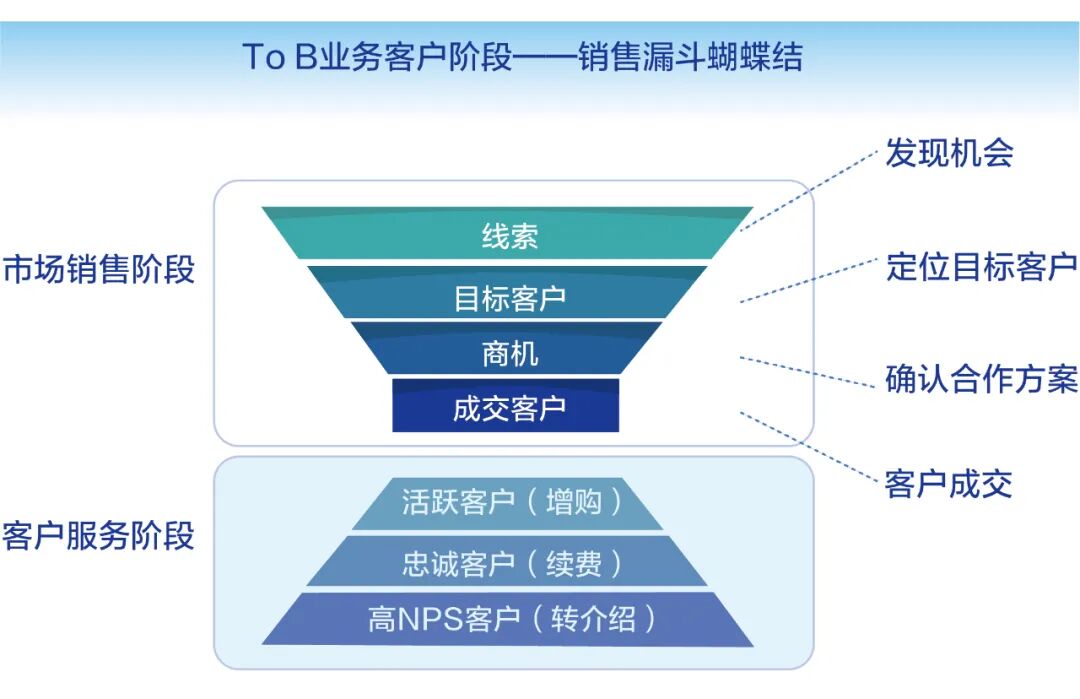
In the marketing and sales stage, the process moves from opportunity discovery to lead generation, then sifting through massive lead pools to identify target customers, confirming a cooperation plan to create a qualified opportunity, and finally converting to a closed customer. This is the basic sales funnel. As you move down the funnel, customer count decreases at each level while requirements increase.
Of course, in To B, sales is only the first phase. There's also a customer service funnel. Through extensive service and delivery work, customers become active clients who make additional purchases, then loyal clients who renew consistently, and eventually may refer more leads back to the sales team as high-NPS customers.
Regarding sales form classification, many companies simply place direct sales and channels as two parallel top-level units. A more accurate classification follows customer segments and sales pathways through hierarchical layers.
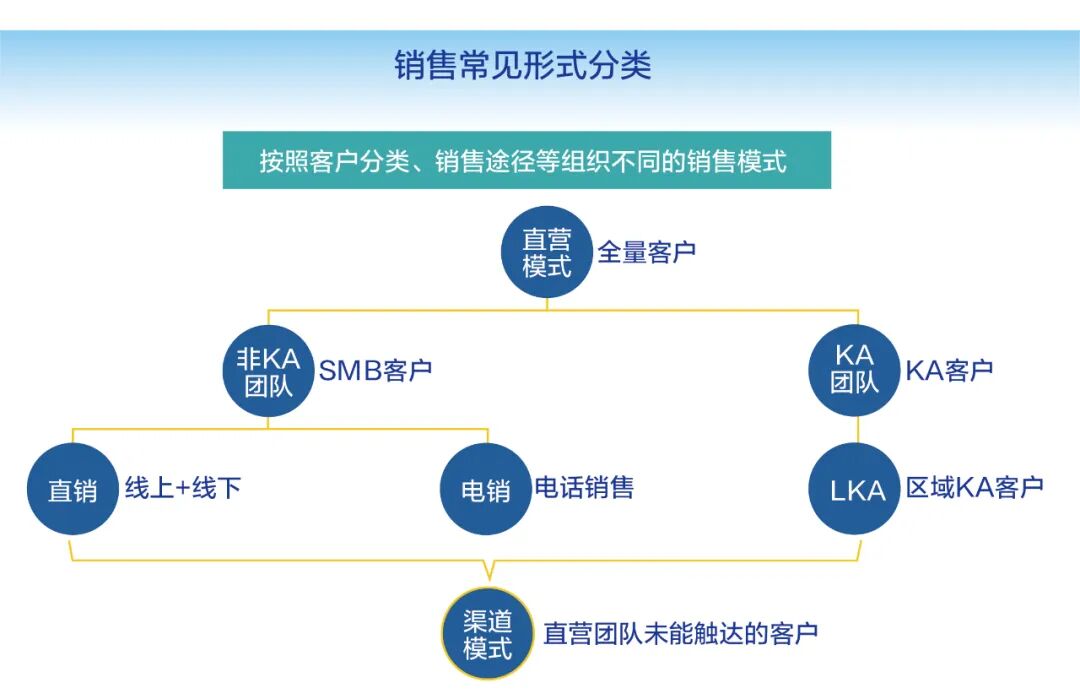
First is the direct model—employees are yours, contracts are signed with your company, salaries come from your payroll, and you face the full customer base. Based on customer differences, this splits into non-KA teams (serving SMB customers) and KA teams (serving key accounts). Within non-KA teams, different sales models apply depending on product, pricing, and sales complexity. Some businesses can operate with pure telemarketing—no field visits or demos needed, closing entirely online and remotely covering all regions. Others need more than pure telemarketing and establish offline direct sales teams in core cities, though these teams still incorporate telemarketing since their first task is typically cold-calling prospects.
Within KA teams, some companies build one large KA team, while others, as business develops, add a sub-layer—the LKA (local KA) team—where national accounts are handled by headquarters and regional accounts by branch LKA teams.
Whether telemarketing, direct sales, or KA, these are all company employees under the direct model. The counterpart is the channel model (referring specifically to sales channels, not supply or traffic channels). So channels don't correspond to direct sales—they correspond to the direct model.
Within channel systems, some partners specialize in SMB sales, while others excel at selling KA products and solutions. Depending on your business, you can choose different partner types—sales-oriented partners, resource-based partners, or system integration and solution-oriented partners. Ultimately, all help cover customers beyond the direct team's reach through partnerships.
Many founders often ask which sales model to choose. This is a comprehensive question closely tied to organizational capability, product positioning, pricing, delivery complexity, and more. Consider your specific circumstances to determine the best fit.
Core Management Experience for Direct Sales Teams
1. Five Key Characteristics of Direct Sales Teams
How do direct sales teams differ from product, engineering, or marketing teams? I've summarized five aspects.
1) Quantifiable Management and Evaluation
The ability to quantify management and evaluation is foundational for team expansion. How to evaluate—OKR or KPI? My recommendation: in early team building, when you can't yet accurately assess reasonable sales productivity, sales cycles, or average deal size, use OKR to give the team more room to experiment with different approaches, continuously pushing ceilings and exploring possibilities. However, once the team reaches a certain scale and you've clarified the basic sales model, customer acquisition methods, and SOPs, you must shift to KPI-driven management. Compensation and performance should tie to KPIs—more work, more pay; less work, less pay; no work, no pay.
2) High Standardization
This differs markedly from KA sales, which typically involves custom development and personalized solutions. For SMB customers, standardization must be sufficiently high—not just product standardization, but sales process standardization through SOPs. This includes where to find phone leads, how to break the ice on calls, how to introduce products and uncover customer needs, differences across industry verticals, how to answer customer questions, and what criteria indicate readiness to move to the next funnel stage. These are all SOP-driven, not purely dependent on individual capability. If it all depends on individuals, scaling becomes impossible.
3) High Pressure, High Stakes, High Turnover
Given these traits, morale and culture building in sales teams is extremely important.
4) Generally Strong Desire for Money
This differs significantly from other teams. It's not inherently bad—it's a fundamental driver pushing salespeople toward higher performance. When managing direct sales teams, you must establish business red lines: no malicious poaching of deals, no under-the-table rebates, no falsifying communication records. Leaders need to set these boundaries when first building the team. Once the team grows large, reining in chaos becomes extremely difficult.
5) Values Matter
Direct sales teams are the bridge and bond between the vendor and customers. Some may consider values abstract, but as business scales and the organization expands, their importance becomes increasingly apparent.
2. Building and Managing Direct Sales Teams: Hire, Use, Develop, Retain
How to build and manage direct sales teams? Let's examine through four dimensions.
1) Hire: Self-Drive Is the Top Priority
When recruiting salespeople, companies typically set different competency profiles based on business and role. I believe the most important commonality is finding people with very strong self-drive. If a salesperson lacks self-drive and needs daily encouragement and comfort from their team leader to move forward, they won't last when facing customer rejections and challenges. The team can also easily devolve into a culture of mutual complaint.
After hiring, many companies evaluate salespeople for full-time conversion based on results—make a sale and you're in, don't and you're out. I disagree with this approach. The hidden costs during probation are substantial, including recruiting and training, and these escalate as you scale. Where's the breakthrough? Breaking down stage-specific goals. Rather than simply using whether someone closed a deal as the conversion standard, decompose by the sales funnel mentioned earlier: examine call volume, visit volume, opportunity count, and accumulated A-class/B-class customer counts during probation. This approach has two benefits. First, you don't judge purely by results or mistakenly eliminate good talent, since many salespeople are slow starters with longer growth cycles but high potential. Second, through decomposed stage goals, even without revenue during probation, accumulating customer leads and resources still contributes value to the company—probation costs don't become sunk costs.
During new hire training, stress testing and learning ability testing are crucial. If you don't apply sufficient pressure during training and let people coast through, they'll likely crumble when facing real performance targets. This is why we emphasize tracking process performance and daily goal completion.
Also emphasize the importance of Team Leaders. They're easy to find in quantity but hard to find in quality. Through years of experience, we've found that one excellent sales TL is absolutely worth 10 or even 20 frontline salespeople—like how important a basketball coach is. An outstanding sales manager can quickly translate products into selling points, rapidly feed market changes back to the company, serves as the core connector between product and market, and can continuously lead frontline teams to find sales pathways. We recommend that in early market-building phases, founders must be willing to invest in recruiting truly excellent sales TLs.
2) Use: Close Attention to Process Is the Only Path to Results
For the "use" of direct sales teams, I've summarized several key points. First, process management: for SMB sales, close attention to process management is the only path to results. At the same time, you need to balance and choose between standardization and differentiated innovation based on your business development stage.
Second, the 80/20 rule. Almost every SMB sales team generates 80% of its results from 20% of top salespeople. So you need to focus on the growth and development of your top performers. Losing one top salesperson often takes ten average salespeople to fill the revenue gap.
Third, corresponding to the 80/20 rule, sales teams must cultivate role models — even if it means pouring resources into creating one. Only with a benchmark can all salespeople see what's possible, see how high performance can go. Additionally, sales teams should encourage competition: between employees, between teams, and between result metrics and process metrics. Through competition, you continuously stimulate a "competitive and driven" culture. If a sales team becomes complacent, or if people start thinking not about how to improve themselves but how to drag others down, something is fundamentally wrong with the team.
Fourth, in process management, the sales funnel is critical. Don't expect a salesperson to deliver nothing for 29 days and suddenly close a deal on day 30. If you want to ensure good results at month-end, you must start breaking down targets from the very first day of the month, clarifying weekly and daily inputs and goals. After this breakdown, sales managers must lead frontline salespeople in daily pipeline reviews: how many calls were made, how many opportunities generated, whether tomorrow's client visits are scheduled, what preparation is needed before each visit. This work accumulates day by day — that's why we say B2B business is grueling and slow. Even after winning 1,000 clients, the 1,001st won't be any easier.
Around these key points, there are two categories of work that no sales manager can avoid. The first is the "three meetings" — morning meeting, midday meeting, evening meeting. How does the morning meeting boost morale? How does the midday meeting review morning process results? How does the evening meeting let the day's top performer share experience, while helping frustrated teammates work through problems and find solutions? All of this is crucial.
The second category is the "three accompanies" — training, practice, and accompaniment. This includes extensive training, extensive role-playing with new hires, and accompanying them on client visits after appointments are secured, continuously improving their real-world capabilities.
3) Cultivate: Training and Motivation
Regarding training, my first insight is that extracting experience matters most, and learning through battle is fundamental. Training isn't about management sitting in offices, drawing on their experience to tell salespeople how to sell products. Sales training isn't about learning theoretical knowledge — the content must be practical experience extracted from frontline top salespeople. When products, markets, or pricing change, there will always be excellent top salespeople who quickly find adjusted scripts and sales methods. Sales managers must promptly extract these methods into replicable experience — this is the foundation of all training. After training concludes, everything must be applied to real sales situations; training effectiveness is consolidated and demonstrated through hands-on practice.
Training content can be divided into several categories: product training, sales training, industry training, advanced training, and management training. For product training, note that product training materials only matter when they're scenario-based around customer needs. Product managers can't just explain product features, because when salespeople pitch to clients, they must address customer needs — identifying which features and solutions can help solve customer problems.
For sales training, there's a frequently cited 16-character mantra: I talk, you listen; you talk, I listen; I do, you watch; you do, I watch.
Industry training is often overlooked in early-stage entrepreneurship. Especially when covering multiple industries, progressively introducing industry knowledge to salespeople is extremely useful — it creates the foundation for dialogue with clients and the ability to understand their needs.
For today's Gen Z and post-00s workers, growth motivation is more attractive than money. So advanced training is needed to help people plan their future development — whether to remain sales experts, or be developed as reserve cadres and sales managers.
Management training becomes necessary as sales organizations scale, for both internally developed and externally hired sales managers. Here's a point I want to emphasize — one I've personally gotten wrong: not every top salesperson is suited for management. Many top salespeople who transition to sales manager roles not only perform terribly with their team's results, but their own performance suffers too — losing the watermelon without even picking up the sesame seeds. So what kind of salesperson is suited for management? First, they must be good at summarizing; second, they must be good at and enjoy sharing, feeling accomplished when they do. These two traits matter more than performance.
One final point on training: every training must have a test; every test must have rewards and consequences. Many companies have no follow-up after training, completely unaware of how much salespeople absorbed or can apply. My recommendation: always arrange tests after training, with matching rewards and consequences, so people take training seriously and are willing to grow.
Regarding motivation, combine long-term and short-term incentives. Most salespeople lean toward short-term incentives, but excellent salespeople gradually focus on long-term incentives: whether there's room for growth, whether they might receive company options or stock, even whether they could eventually become independent branch sales leaders. Also combine material and honor incentives, individual and team incentives.
For praise and criticism, the key is to address actions not people — clearly explain what's good about the good, and what's wrong about the mistake. I once attended an agent's awards ceremony and noticed that when they read the commendation, they only mentioned the recognized salesperson's results. That's not enough. When we praise, we should describe what this salesperson did, what effort they put in to achieve these results — that's what matters to others.
Finally, motivation must "reward until hearts race, punish until hearts ache." I once visited an agent's company and attended their evening meeting. One salesperson had slacked off that day and hadn't made enough calls, so the boss made him do 20 push-ups as punishment. The salesperson laughed through it. I believe such punishment is worse than none — if you treat rewards and consequences as a joke, they lose all attraction and deterrent effect.
4) Retain: Promotion and Elimination
For "retention," this includes both promotion and elimination. For promotion, we need to establish different career development tracks. This includes a professional track, from junior sales consultant all the way to expert; a management track, from frontline salesperson to manager, director, city sales leader, etc.; a customer-related track, for those who can no longer handle sales, moving to the lower half of the sales funnel such as pre-sales or post-sales roles without sales quotas; and a training track, for those who excel at summarizing and might transition to training roles. By establishing different career paths, you can retain excellent salespeople in the team. Of course, you also need to plan different level structures and competency models, and continuously align on these standards with salespeople so they know where they stand and what gaps remain.
For elimination, first, elimination standards matter — you can't eliminate based on mood. Whether it's elimination for values, results, or work engagement, these standards should be made public so everyone knows them. Additionally, before elimination, there should be elimination warnings and PIPs (Performance Improvement Plans). If someone seemed fine yesterday and suddenly gets told they're eliminated today, it creates massive insecurity in the team. Of course, you can also match this with revival, demotion, or transfer mechanisms.
Channel Management Pyramid
So-called channels mean that manufacturers, through certain social networks or agents, sell products and services to end customers in different regions. Why have many B2B enterprises chosen to use agents? What advantages does the channel model offer?
1. Advantages and Disadvantages of the Channel Model
First, broad coverage and rapid market opportunity discovery. China has over 300 prefecture-level cities — you can't build 300+ branch offices. When business scale reaches a certain volume, you can use agents to cover more regions and markets.
Second, flexibility and the ability to try different approaches. Every agent company has its unique resources. When manufacturers partner with agents, in most cases they set a revenue target, and the agent tries different sales approaches based on their own resources and management style. Direct sales teams, receiving the same training and evaluation standards, tend to develop standardized SOPs — but the downside is insufficient innovation and easily rigidified thinking.
Third, agent partners have extensive local PR and government relations resources, which provides certain help for business.
Fourth, compared to building direct sales teams, using agents involves lower financial, time, human resource, and opportunity costs. In initial business expansion phases, if you go to a city to open a branch and build a sales team, many costs are incurred before they generate any revenue. Partnering with agents means the agent bears these upfront costs for the manufacturer; only when the agent contributes results do commissions come into play. When facing business model and product transitions, the agent partnership model also creates less pressure.
Fifth, excellent scalability with obvious裂变 effects. During rapid business expansion, the channel model can potentially cover 100 cities in about a year — a speed the direct sales model struggles to match.
Everything has two sides, and the channel model's disadvantages are equally obvious. First, low standardization and poor execution — many things require repeated orders before they're implemented. Second, inconsistent culture and values. Third, low loyalty; trust-building takes time — only by helping agents make money and providing sufficient support can trust gradually develop. Fourth, inter-company cooperation has high management difficulty; when problems arise, you can't reward and punish as clearly as with direct teams, so achieving goals requires extensive communication, management, and pushing. Finally, the channel model creates more layers — the manufacturer's channel manager first communicates with the agent boss, then with the agent's managers and frontline salespeople, before the agent can truly understand the manufacturer's goals and thinking. Thus training and communication difficulty is high.
2. Channel Management Pyramid
So how do you manage a channel system well? I've summarized a channel management pyramid.
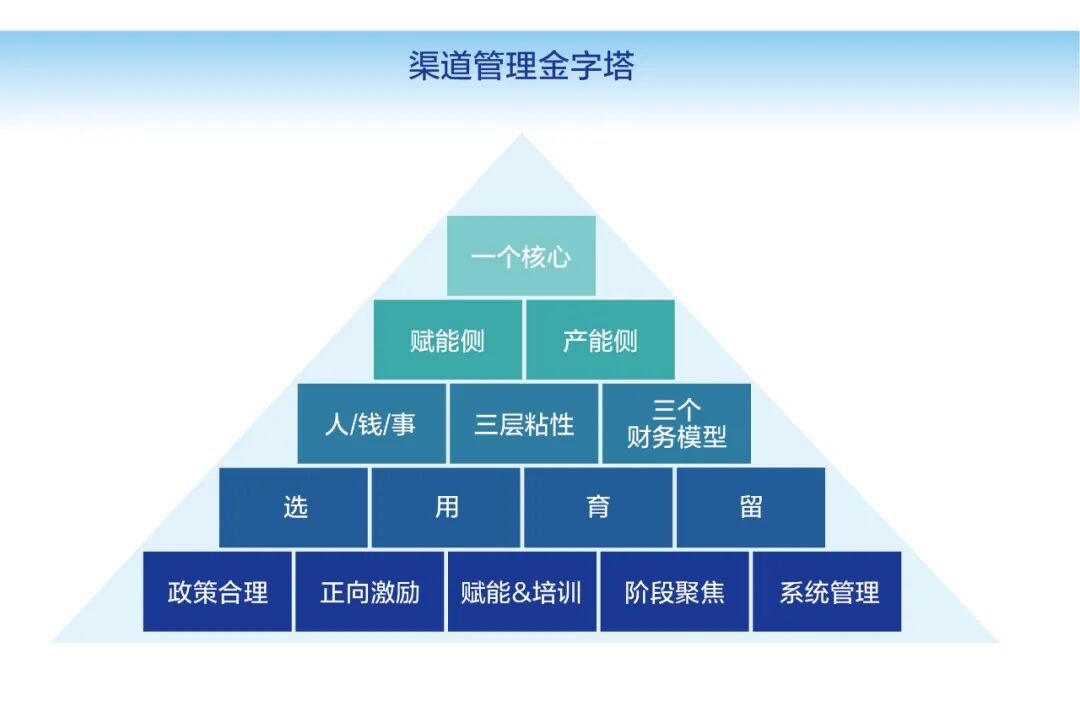
1) One Core: Win-Win Mindset
I believe the core of the channel model is a win-win mindset. When we choose the channel model, we must first be firmly committed to achieving win-win outcomes with our agent partners. Manufacturer and agent are both partners and allies — this is the prerequisite for everything that follows. If you only want to make money unilaterally and don't care whether agents profit, this model will struggle to work, let alone last. A channel system that doesn't allow agents to make money healthily and sustainably is a false channel, with extremely short-lived vitality; a channel manager who can't help agents make money reasonably and compliantly is "playing流氓."
So if you're going to develop the channel model, you must think this through clearly: you're not using agents for a day, or a month, but positioning agents as a permanent link in your future business model and commercial chain — building the ecosystem together, growing together, scaling together.
2) Two Perspectives: Enablement Side and Output Side
Building on that core mindset, let's examine channel management through two lenses.
From the channel management team's perspective — the enablement side — a qualified team needs two capabilities: recruitment and support. They must be able to recruit and deploy partners nationwide, covering untapped markets. After signing with agents, they must empower those agents to launch operations and continuously grow.
Based on these dual requirements, I've always insisted that channel managers simultaneously play two roles: strategic consultant and de facto COO. As strategic consultant, they help agent companies see the industry's prospects and vast market opportunity; at the same time, they help agents turn that vision into reality. These roles require constant switching. During early recruitment, you need strong strategic consulting abilities to attract agents to a startup's still-unknown product. As business develops, you must help agents solve practical problems. Otherwise, agents who stock your product but can't sell it, who encounter difficulties without support, will likely abandon your system. Throughout the process, agents must feel that you're building the same ecosystem together, growing the pie jointly.
From the agent's perspective — the output side — like direct sales management, you must attend to two management dimensions: process management + results management. This requires two sets of dual diagrams — business flowcharts and personnel division charts for both manufacturer and agent — to help us manage better. Beyond sales, B2B work involves product delivery, service, and other links, so there must be an efficient connecting bond between agent and manufacturer for seamless handoff.
3) Three Management Dimensions
The third layer of the channel management pyramid has three bricks. The first is "people, money, matters" — managing agents requires attention to all three. On the people front, empower agents with the direct sales team management model previously discussed: help with organizational design and optimization, focus on employee selection, development, retention, and design compensation and reward-punishment systems. Money is the core concern. Though we approach this with a win-win mindset, most agents care most about whether they can make money and when. So in management, you must pay close attention to the agent's break-even model, fixed versus variable costs, per-capita efficiency and revenue data, and how to broaden profit models. If you don't care about these metrics, you'll find yourself on completely different wavelengths from your agents. On the matters front, we must train agent teams on the sales SOPs developed by our direct sales team — how to acquire customers, how to conduct business, how to run the "three meetings," how to reduce turnover, even how to handle internal conflicts among agent management. All of this falls within our scope.
The second brick is "three layers of stickiness." Manufacturer-agent collaboration begins with contracts, but later relies on various forms of stickiness to sustain the connection. This includes product stickiness — the competitive advantages of manufacturer products, market scarcity, renewal characteristics, customer upsell revenue, brand strength — all factors influencing whether agents continue and expand the partnership. There's also management stickiness: binding through contracts and policies, system usage habits, dependence on our customer resources and leads, channel managers' enablement and management involvement, and agents' own inertia and path dependency, making agents unable to leave our ecosystem. And there's a deeper layer: emotional and cultural stickiness. All successful agent systems have strong emotional and cultural bonds; agent staff highly identify with the manufacturer's culture and values, and feel proud representing the manufacturer when on calls. Consequently, channel managers are crucial — the sole bridge and bond between manufacturer and agent. Their quality directly affects agent identification with the manufacturer, and their confidence and commitment to the business.
The third brick is three financial models. First is the product pricing model — you must dissect why the product is worth its price, with clear sales talking points and logic around pricing. Only by clarifying this first can agents convey product value to customers; otherwise agents will return from sales calls complaining the product is too expensive.
The second model is the most critical: the agent profitability model. Whatever industry or product, you must work out these numbers before recruitment begins. Otherwise, no matter how good you say your product is, you'll struggle to recruit agents.
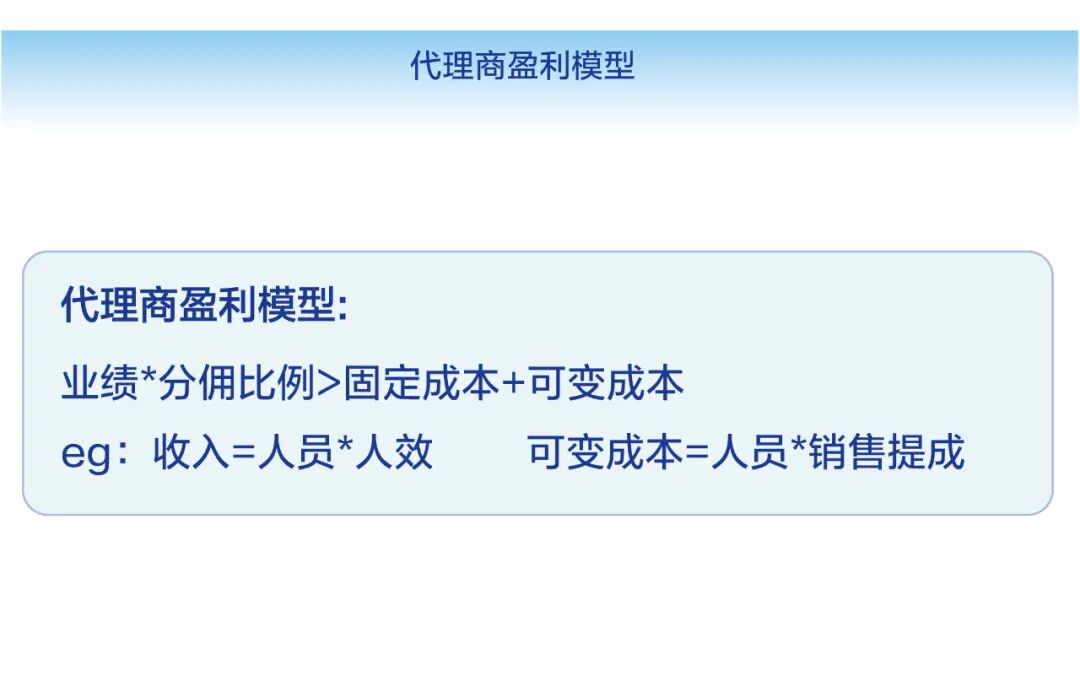
When agent revenue × commission ratio > fixed costs + variable costs, you have a sustainable profitability model, where revenue = headcount × per-capita efficiency, and variable costs = headcount × sales commission. We must tell agents: how many salespeople you need, their typical growth cycle, what per-capita efficiency to achieve to become profitable; and the larger the scale, the higher the per-capita efficiency, the greater the profit.
Of course, profitability modeling assumes we've already done direct sales for some time and validated baseline data like employee growth cycles, per-capita efficiency, and average deal size — only then can we calculate these numbers and convincingly tell agents: this is exactly how my own team did it, and this is the threshold for making money.
The third financial model is the channel profit-sharing model. I suggest offering agents a higher commission ratio when initial business scale is small, because the pie is smaller then; as we jointly grow and thicken the pie, gradually reduce the angle of the slice given away, while ensuring the absolute volume of shared pie keeps increasing.
4) Four Agent Management Stages: Select, Use, Develop, Retain
The fourth layer concerns agent "select, use, develop, retain."
For selection: which companies are suitable to be our agents? Different products and businesses have different characteristics, but four elements are universal. These include the agent boss's willingness and interest in the industry and sector; their management capability; team scale and number of salespeople; and industry and customer resources.
For agent development, I mentioned the direct sales team's sixteen-character motto earlier — "I speak, you listen; you speak, I listen; I do, you watch; you do, I watch" — which applies equally to agent management.
In development, some companies agonize over whether to use a horse-racing or horse-rearing mechanism. Horse-racing means recruiting large numbers of agents, letting them grow naturally, then focusing resources on the survivors. Horse-rearing means precise recruitment, supporting each one you bring on. The choice between mechanisms depends on the manufacturer's business stage, product form, and customer profile positioning. But whether horse-racing or horse-rearing, one issue is paramount — cultivating "lead horses": you must develop a cohort of benchmark agents so prospective partners can see that being the manufacturer's agent is profitable.
When developing agents, on one hand encourage innovation; don't set too many rules early on, or you'll only suppress agents' innovative potential. Meanwhile, channel managers must promptly extract best practices, quickly identify "lead horses," distill how they succeeded, then cultivate more agents.
In using agents, I've also summarized sixteen characters. Lure with profit — attract agents with win-win thinking; Enlighten with reason — explain our business logic to agents; Move with emotion — when agents aren't profitable, persuade them to persist in investing; channel managers' communication and management with agents must have warmth, not be cold and impersonal; Bind with law — rules and values are crucial. Agents sometimes exhibit irrational behaviors including discounting, concessions, price-cutting, and order-poaching. Regulatory rules are essential; once rules are violated, they must be dealt with ruthlessly to prevent bad money from driving out good.
Finally, retaining agents similarly uses rewards/punishments + promotion/demotion + elimination — the carrot-and-stick management approach.
5) Five Basic Principles
The pyramid's final layer is five basic principles. The first is sound policy. Policies must be reasonable and stable; assessment rules can't change constantly, or agents will feel insecure and afraid to commit fully and continuously. Manufacturers must also "not compete with the people for profit." If direct sales is our biological son, agents are like adopted sons. If direct sales and agents compete for customers, my suggestion is to actually favor the agent more — only then will agents dare to invest.
The second principle is positive incentives. As our partners, agents should be managed primarily through positive incentives, mostly encouragement; negative incentives should be supplementary, limited to business red lines.
The third principle: in channel system building, enablement and training are crucial — policy addresses willingness, but enablement determines output capacity. B2B business and product complexity are relatively high, so training should be systematic, covering agent bosses, employees, product, sales, and service.
The fourth principle is stage focus. No matter how many problems need solving, each stage should ideally have just one core priority, because agents are themselves separate independent companies; given too many targets, agents cannot focus internal resources.
The final principle is system management. Agents are scattered across locations, and we cannot observe daily work, so robust system management is necessary for scale expansion. If you want channel model sustainability, system management is indispensable.
Finally, my best wishes to B2B entrepreneurs: may you build sales systems that can standardize and replicate combat capability, and may those systems continuously grow and multiply your performance.



12 Global To B Trends and 12 New Growth Models for 2021 | Ronghui B2B Growth Camp