A Conversation with Lark, Genki Forest, and ToDesk: Organizations, Like People, Need Their Own Creed
An organization needs a creed to attract mission-driven employees.
Every business that excels is underpinned by strong organizational capability. External change is constant. If we think of an organization as a living organism, what kind of conviction does it need to weather volatility without fear? What are the rungs on the ladder toward a better, more advanced organization? How do you safeguard shared principles and find people who share your sensibility?
In the inaugural online session of the "Organization Upgrade Season" co-hosted by Gaorong Ventures and Amazon Web Services, we invited guests from Lark, Genki Forest, and ToDesk for a conversation moderated by Rui Han, partner at Gaorong Ventures. Together they discussed trends in remote collaboration and efficiency gains, their understanding of what makes an advanced organization, and their respective philosophies on talent.
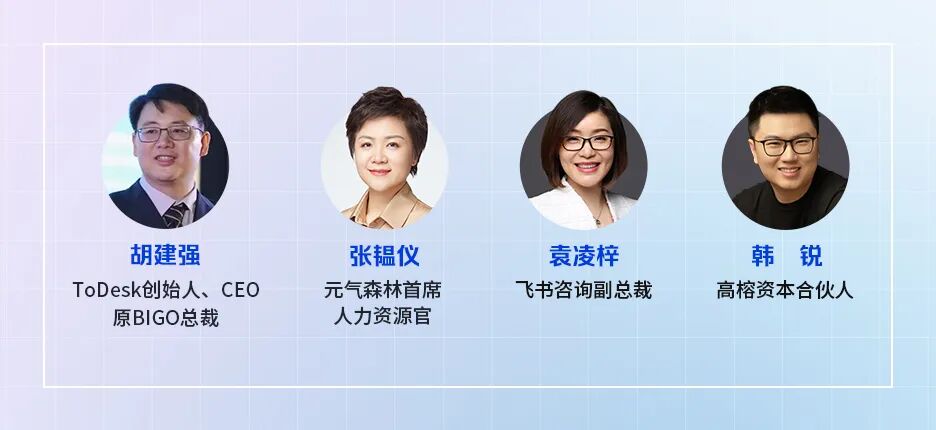
Guests
Topics and perspectives they covered
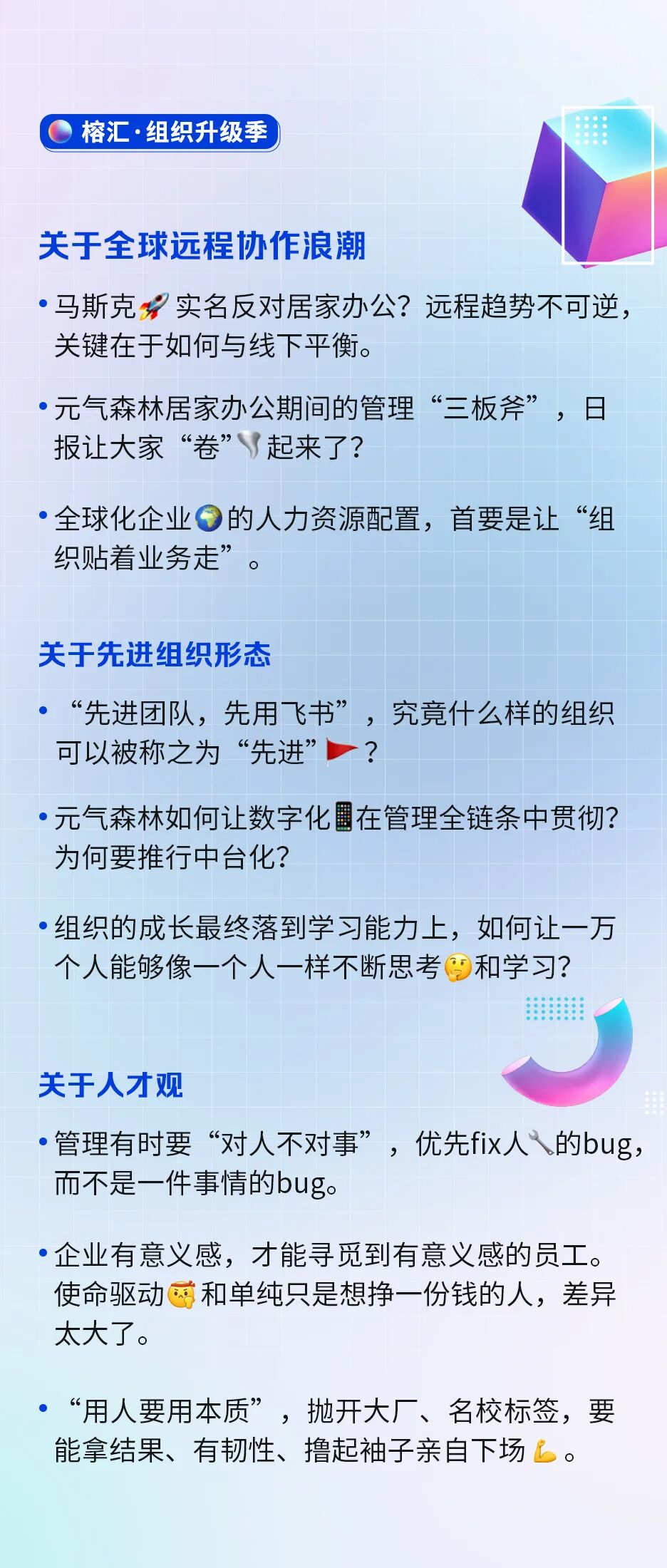
Below is a transcript of the conversation (edited for clarity):
The Irreversible Trend of Remote Work, Collaboration That Keeps Energy Online
Rui Han: Globally speaking, is remote work or distributed organizational forms a structurally irreversible trend? What needs did you see behind the decision to found ToDesk, a remote control software company, and which types of organizations were the earliest adopters?
Hu Jianqiang: I've done some homework on remote work penetration. Data shows that in 2021, the number of people working remotely worldwide grew more than 90% compared to 2020; by the end of 2022, nearly 20% of high-paying jobs were gradually transitioning to remote arrangements — these jobs were already moving in that direction, but COVID accelerated the process by ten years. I believe the remote trend is irreversible; the key is how to balance it with in-person work — it's a question of degree. Fully remote definitely doesn't work. Remote can't solve two problems: one, meeting clients; two, even with video, you miss biological scent, or subconscious rapport. The more ideal approach is a hybrid of remote and offline, with different management styles for different job functions and employee levels.
The remote work trend is also quite visible in China. But many companies, especially traditional ones, are fairly resistant to remote work, even fearful — worried about data security, for instance, or unsure whether employees are actually working.
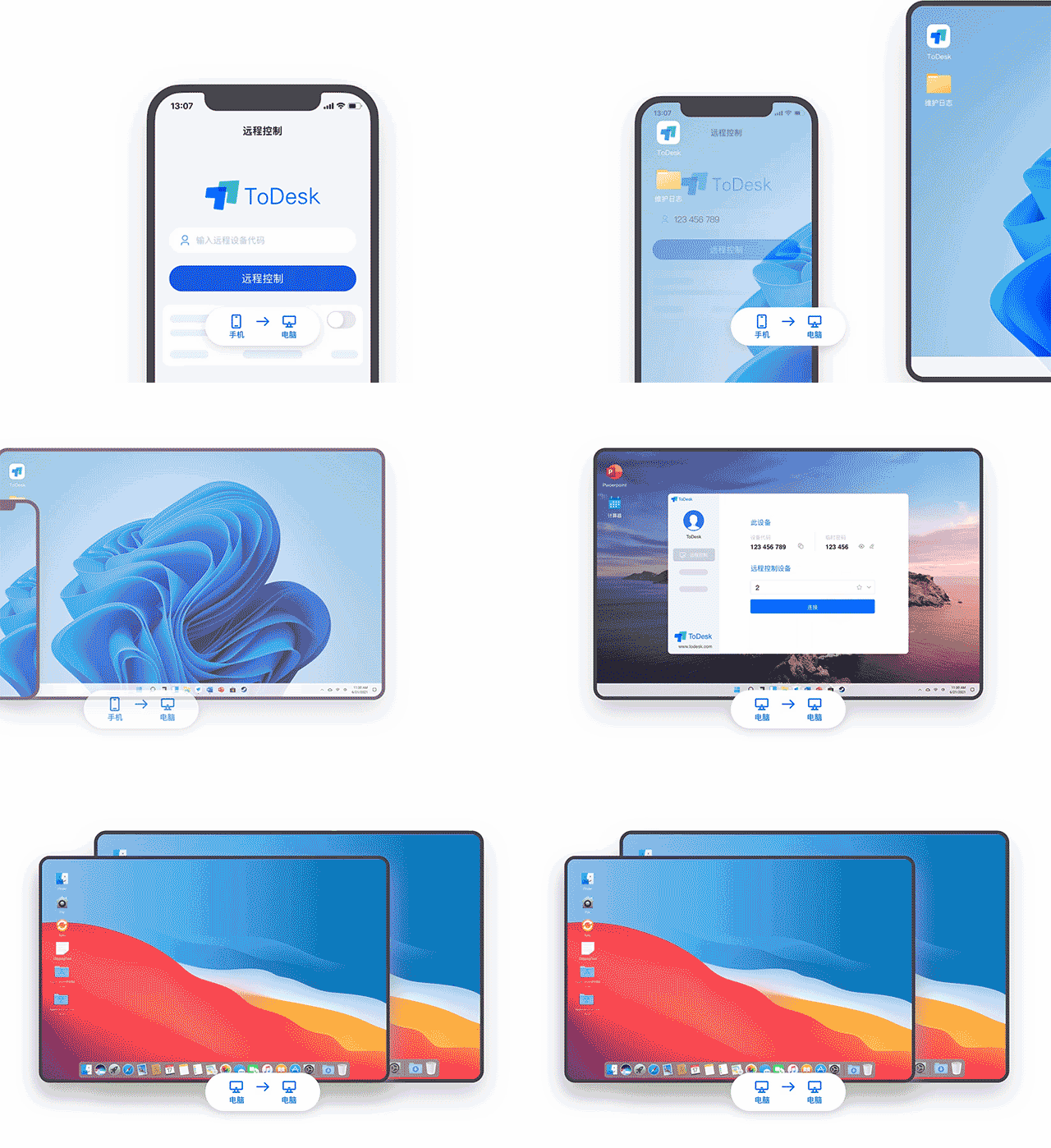
The needs arising from remote work fall into two categories. One is remote collaboration and communication, which tools like Lark and Tencent Meeting mainly address. After communication comes the actual work, and ToDesk solves the problem of giving employees remote access to their company's core computing resources.
During the Shenzhen lockdown, we saw many people lugging their computers home because they lacked necessary resources there. ToDesk's technology lets "high-performance workers" in gaming, architectural design, animation, video, and other industries access graphics workstations, GPUs, and other core computing resources anytime, anywhere, with support for multiple screens, 4K resolution, and other features. As for the data security concerns companies have, ToDesk ensures enterprise data never leaves company devices — employees only see information on their screens and can't take data with them.
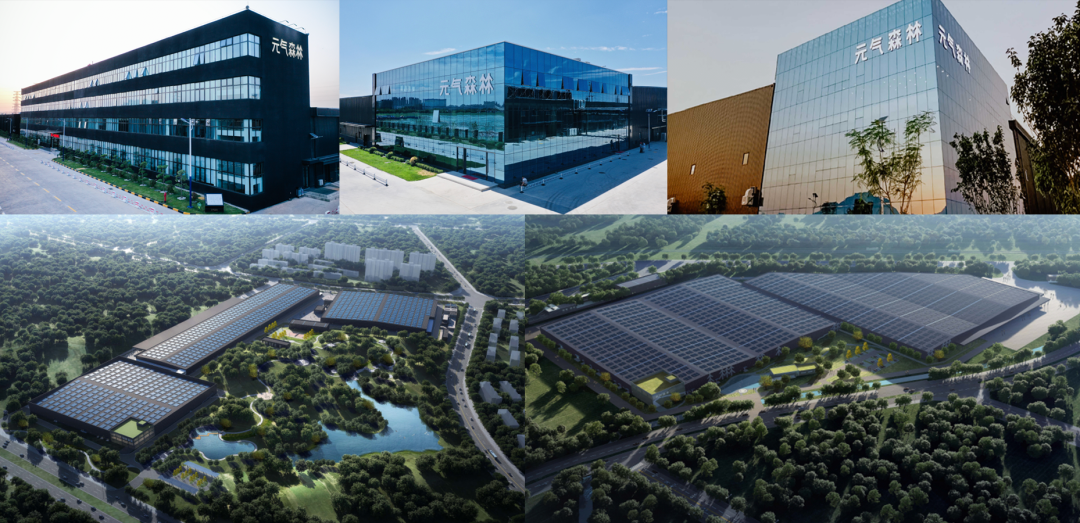
Rui Han: Genki Forest has grown extremely fast — it now has six self-built factories, over 370 suppliers, and distribution covering more than 800 cities nationwide. Under pandemic conditions, what did Genki Forest do to keep team energy and collaboration high and the supply chain running smoothly?
Zhang Wunyi: From a management perspective, it wasn't actually that complicated. During the work-from-home period, we made two key moves. First, we sent all employees a work-from-home guide so they thoroughly understood what support was available and how things differed from being in the office. Under this guidance, we developed a "three-axe" management framework for remote work: open calendars, daily standups, and daily reports with report commentary.
The daily report group was something we found particularly effective. Normally in the office, people mostly work back-to-back; with the daily report mechanism, curiosity drives people to check their teammates' reports and workload, creating a mutually motivating atmosphere. Of course, the daily report mechanism was a special measure for exceptional circumstances. In management, we've always been "experimenters" — there's no absolute right or wrong to many methods; if something helps management in the moment, it's worth trying.
On the supply chain dimension, Genki Forest's business chain is indeed very long, from product R&D to market launch, encompassing production, procurement, logistics, and multiple other links. We digitized across the entire supply chain system to minimize operational efficiency losses caused by pandemic controls.
First, we developed a proprietary "supply chain control tower" digital middle-office product that provides real-time data feedback to production, sales, and logistics. Second, based on supply chain operations algorithms, the channel side can identify the nearest factory and distributor to fulfill orders. Additionally, there's a "unified inventory" algorithm that helps design how to combine rail, road, and other logistics methods in controlled areas to get products delivered on time, also leveraging urban dealer and community logistics systems for last-mile delivery.
Rui Han: As a large-scale, diversified, and rapidly growing global organization, how do you approach top-level human resource allocation worldwide? In such an organization, how do you balance the managerial "want it all" — both effective management and collaboration, and bottom-up innovation?
Yuan Lingzi: Today, overseas employees account for roughly 15% of the entire group. Our global human resource allocation follows one core principle: "the organization follows the business." Wherever business goes, we establish presence, hire, and build teams accordingly. For example, as TikTok and Lark's To B business expand overseas, we build teams in those respective markets.
Another dimension is "following the talent" — setting up teams where more talent is available. For instance, before the pandemic, we established some R&D centers overseas, considering factors like time zones and the sustainability of local talent supply along the way.
As for balancing management efficiency with effectiveness, execution with creativity — at our current stage, we're more effectiveness-oriented and innovation-oriented. How to quickly seize opportunities and capture the market is what matters most right now. We tilt more toward empowering the front lines. For example, if the business side wants to configure solutions and support teams locally, we give them more authority to form task forces and solve problems first.
If multiple businesses concentrate in a particular region, while fully empowering them to quickly capture market opportunities, we also push for resource sharing among them in the same area to achieve cost optimization and collaboration.
Advanced Organizations Dare to Try Better Ways of Working, and Have Their Own Creed
Rui Han: A new strategy to seize new opportunities, without new organizational management to match it, is "old wine in new bottles." Just as a company saying it wants strategic transformation but doesn't change its organization is unlikely to succeed. Genki Forest has highly integrated digitization into product management and R&D processes from the very beginning. How specifically was this designed and implemented? Why push for middle-office-ization?
Zhang Wunyi: Genki Forest's founding team's internet DNA determined that we practiced digitization from day one. The internet pursues constant iteration; we both respect traditional industry and learn from it, while thinking about how to surpass it.
For example, we know the beverage industry places great emphasis on channels. In 2021, we went hard on channels; this year our goal is "internal road-paving" — making channel construction more systematic, enabling corps-level coordinated operations. On talent building, we look for people with rich experience in internet sales operations to work alongside our sales leads, learning the experience traditional industry has accumulated while using internet thinking to consider innovations.
As for middle-office construction, this relates to Genki Forest's business form. Genki Forest's business chain is very long, and cost is a critical concern; middle-office construction allows resource concentration and avoids waste. Moreover, Genki Forest's organizational growth speed has been astonishing — from just over 2,000 people at the start of 2021 to over 8,000 today. We need to accomplish in less time what traditional industry took years to do. At this speed, management challenges inevitably arise, including the maturity of young team management and organizational capability building that needs continuous improvement — so middle-office-ization is imperative.
In 2022, we will continue exploring and refining along the path of digitization and middle-office-ization.
Rui Han: As a very successful serial entrepreneur, how was building the ToDesk team different from your past experiences? What does your ideal organizational form look like, and is there a guiding North Star for the organization?
Hu Jianqiang: In reality, every startup is starting from scratch. When it actually comes to execution, some more fundamental philosophies — your worldview, for instance — may still be useful; but most concrete things need to begin anew. When I first started a company, I had to review code; now at the starting line, I still have to review code. Of course, there are also lessons learned. Previously, I didn't think as much about people's long-term development; today when I hire someone, I not only think about what problems they can solve now, but also what they can become in the future.
Regarding the ideal state of an organization, let's assume it's a living organism. First, it needs dreams — that is, organizational goals. Second, it needs its own partners, able to cooperate with the outside world. Third, it needs to constantly prove its capabilities, earning partners' greater trust and building a larger circle.
An organization is constantly striving for refinement and optimization; it's hard to give a definitive end goal, but ultimately it comes down to how the organization learns, how it can think like a person, enabling ten thousand people to learn and grow as one. For example, we use collaboration tools to accelerate communication and documents to preserve knowledge — the essence is hoping to make the organization's learning speed as fast as human brain processing speed, and then this organization will keep getting better.
Rui Han: Lark has a well-known slogan: "Advanced teams use Lark first." There are also many popular concepts about innovative organizational forms — symbiotic organizations, enabling organizations, and so on. What is an "advanced organization," and from an a priori perspective, what characteristics indicate an organization's advancement? Conversely, what characteristics would be warning signs?
Yuan Lingzi: An advanced organization, first of all, must have innovation in business and product models, able to run the full course from zero to one, achieving breakthroughs in its industry and meeting or even leading customer needs — this is the prerequisite and qualifying condition for being advanced. We never believe a company that makes its organization look impressive but whose business itself is poor can be an advanced organization.
Second, for a company to be called advanced, it needs the courage to try better ways of organizational management, combining advanced management concepts with business needs to improve productivity and satisfy people's needs. Such organizations, such entrepreneurs, are worthy of respect — even if the results aren't 100% successful.
Third, from an organizational perspective, they need to make certain forward-looking preparations and arrangements for the company's medium- to long-term development — such as talent reserves, talent development mechanism design. We mentioned earlier that "the organization follows the business," and HR standing from the business perspective to help, support, and enable the business is very good; but when the business is constantly experimenting, if there are resources and opportunities, it's also appropriate to design the organization with some lead time to respond to future changes — not too far ahead, just one step further.
Meeting these three conditions, I believe, makes for a practically meaningful advanced organization.
One very important point: an organization needs a creed, like a person. Business constantly changes with markets and customers; if an organization has no creed, no fundamental cornerstone or principles, it's like a person without conviction — they might get rich overnight, but they won't earn respect.
If an organization fails to establish such a creed over a long time, it will inevitably affect long-term business development. Because this creed influences what a company does and doesn't do, who it uses and doesn't use.
Talent Philosophy: Look at Essence When Using People, Resilient and Tenacious
Rui Han: What is the greatest common denominator all three companies care about most when hiring? Are there traits that would be pluses at peer companies but concerns or minuses for you?
Hu Jianqiang: I worked at Alibaba early on; Alibaba said "handle concrete matters abstractly, handle abstract matters concretely" — you have to ground mission, vision, and values in practice. Alibaba looks for the "Alibaba feel," ByteDance calls it "ByteStyle" — it's not just about professional capability, but also cultural fit. Harari wrote in Sapiens that once an organization exceeds 150 people, you can't manage purely by systems; you also need culture. Our previously summarized talent philosophy was smart, resilient, and cultivable. Smart means conceptual thinking, able to discover essential connections between different things; resilient, in today's terms, is "tough," able to bounce back relentlessly to achieve your goals; cultivable means having room to grow.
People often say "focus on the issue, not the person," but many times for cultivable talent, we need to "focus on the person, not the issue." If we imagine a talent as a program, we prioritize fixing the person's bugs over fixing the bugs in how they execute a particular task. Because once you've fixed the person's bugs, you've not only solved this one thing but also many future problems.
Zhang Wunyi: Recently, with the pandemic stopping many things, everyone is hurting physically and economically. And with the pandemic happening at this particular moment, my personal feeling is that we need to pause and think about the sense of meaning in individual life, turning inward rather than continuing to grasp outward. I also highly recommend a book called Future Shock — written in the 1970s, but very worth reading today.
It's the same for companies — we need to pause and think: what is our organization's original intention? Does it stop at a commercial purpose, or can it be extended further? Concepts like teal organizations, conscious business — behind them all is a larger backdrop: that people will increasingly pursue spiritual fulfillment in the future, which will drive companies from profit-driven to mission-driven. In other words, from the very beginning of entrepreneurship, you need to think about what an innovative product or business model can bring to the entire ecosystem, to society as a whole, and what connections it will form in a larger field.
As people often say: mission, vision, values. Mission, vision, and values are absolutely not things written on the wall — they must be dug out from the heart. For example, Genki Forest's founding team genuinely hopes to make good products from the bottom of their hearts; this is our most solid original intention. The goal for all six Genki Forest factories is to be "three-zero factories" (zero preservatives, zero pollution, zero carbon). To let Chinese people drink beverages without preservatives, every product line involves tens of millions in investment. Environmental friendliness and social responsibility are also consensus flowing through our organizational blood. Including the "Genki New Youth" we cultivate — we hope to send a signal to society: young people today are full of positive energy, and can achieve the lives they want through effort.
Only when a company has a sense of meaning can it find employees with a sense of meaning. The first principle of Genki Forest's talent philosophy is mission-driven — many of our employees are Genki Forest fans themselves. The difference between someone mission-driven and someone who simply wants to earn a paycheck is enormous.
The second priority is resilient optimism. For a startup, change is routine; the world will accelerate its iteration, and employees need to face it resiliently with an optimistic mindset.
The third is loving and self-reflective. Internally we call ourselves a "three-loves organization": a group of people passionate about what they do, in a loving organization, creating products users love.
Another point is continuous learning — an essential capability for all organizations and members going forward.
Yuan Lingzi: Good products indeed need good organizational intention behind them; this intention attracts a group of people who identify with each other. Our mission and vision is "Inspire Creativity, Enrich Life" — so what characteristics do people drawn to such a mission possess?
First, we like people who break through and innovate. There are many people in the company who have previously tried entrepreneurship, even among relatively young employees.
You may have seen our discussion last year: we can't rely solely on big-company experience and elite school labels when hiring — "look at essence when evaluating people, use essence when deploying people." What is essence, what exactly should we look at? We had extensive discussions, and there are several important points.
First, must be able to deliver results; second, have resilience, because an organization's stage goals change frequently — being able to survive amid change is a very important quality; third, what we call being able to "roll up your sleeves and get in the game yourself." For a technology-oriented company, if you only have pure big-company management experience and your individual contributor ability, your ability to get on the court and play ball yourself, has atrophied, that can't sustain business development.