Turning Strategy from Art into Science, and Back into Art: How Huawei Does It | Ronghui Practical Sharing

How do you execute strategy in a market that never stops shifting?
The vast majority of business strategies fail because of poor execution. As a widely recognized "CEO-led initiative," no startup can deny the importance of strategy — yet it always seems just out of reach.
Huawei has always prioritized strategic management, treating strategy as a four-in-one endeavor: formulation, tactics, execution, and evaluation during execution.
Ronghui · Macro Strategy Season, in partnership with Futu, recently visited Huawei to study its BLM strategic management methodology and learn how to achieve closed-loop execution from strategic planning to implementation in today's rapidly changing market.
Peng Peng, former member of Huawei's Consumer Business Group EMT and president of its e-commerce platform division, noted in his sharing that "Huawei's greatest success lies in making every individual's annual tasks strongly linked to the company's overall strategy." The BLM methodology and its almost "stereotyped" processes serve as relatively professional tools that get everyone speaking the same language, enabling top-down closed-loop execution — thereby transforming the artistic, fuzzy practice of management into a science.
This toolkit may not suit every company at every stage and scale, but it offers an approach: "first master it, then improvise." Only then can one move from the "realm of necessity" to the "realm of freedom."
Peng Peng brings 24 years of experience at Huawei, including 22 years in management. He is a Level 6 expert in Huawei's e-commerce business and a Level 6 expert in product management, having overseen the planning, construction, and operation of Huawei's global self-operated e-commerce.

Huawei's Key Strategic Choices and the Evolution of Strategic Management
Looking back at Huawei's development, the company made a series of pivotal strategic choices: testing overseas markets in 1996, formally expanding abroad in 2000, the "Devices-Pipes-Cloud" strategy in 2007, the "spare tire" strategy in 2008, the cloud computing strategy in 2010, the proprietary brand terminal strategy in 2011, the globalization strategy in 2012, and in recent years, entering the automotive industry, establishing the Intelligent Automotive Solution Business Unit (BU), the computing strategy, the terminal HMS ecosystem strategy, and more.
Along the way, Huawei transformed from a "project-driven" follower to an "opportunity-driven" challenger, and ultimately into a "strategy and vision-driven" leader. In the current era of strategy and vision-driven growth, we continually ask: Where is the future direction of the industry? What uncertainties do we face? What business models lie ahead? Where do we deploy our "Van Fleet ammunition"? What elements does Huawei need for sustained success?
Huawei's strategic management methodology is BLM (Business Leadership Model), and its strategic management process is DSTE (Develop Strategy To Execution).
But Huawei didn't adopt BLM and DSTE overnight. In 1997, Ren Zhengfei visited the United States and discovered that IBM was already managing through processes; Huawei began learning from IBM. In 2002, Huawei introduced IBM's MM process, and product lines started developing BPs (Business Plans) from a commercial perspective. In 2004, VDBD (Value Driven Business Design) became Huawei's strategic planning methodology. It wasn't until 2009 that Huawei introduced IBM's BLM model, and in 2013 it released DSTE Process V1.0, with continuous refinement and iteration since. Huawei's strategic management evolved from product roadmap planning to business planning, then to strategic planning, and finally to the current state of strategic management maturity.
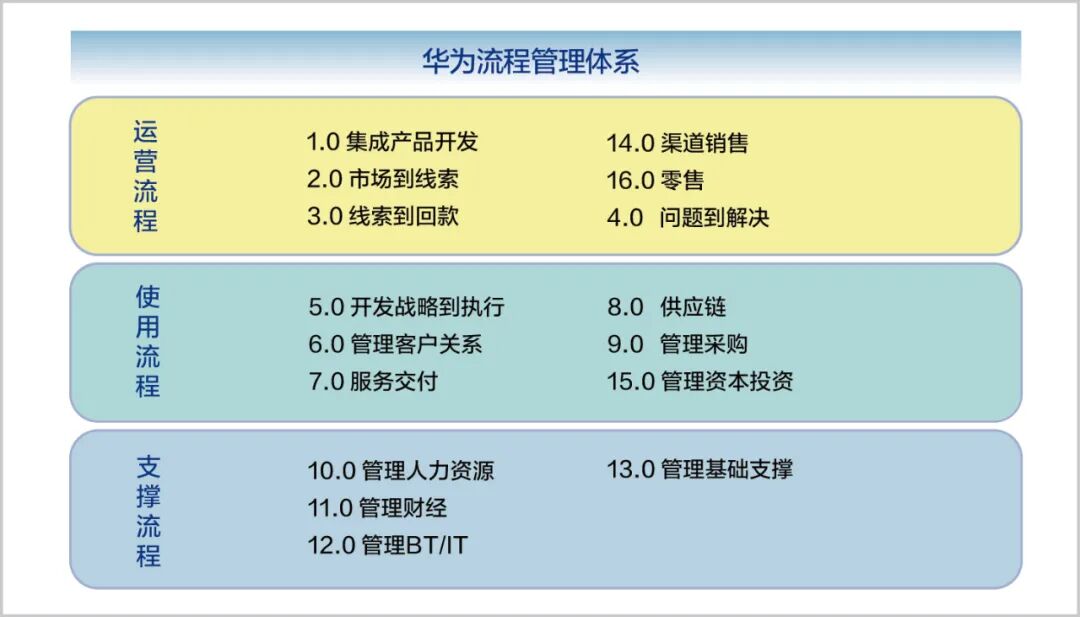
This shows how much Huawei values process systems in management. Why was Huawei's greatness foretold as early as 1997? Because from its early days, Huawei sought to manage through processes — even a "lifeless management system." A process is simply the optimal path for different people to do the same thing. Behind processes lie fundamental methods, the power of logic, and shared objectives.
Strategy Is About Choices: Focus on the Main Thoroughfare
Michael Porter offered a classic definition of strategy: strategy is about trade-offs under limited resources. Huawei believes strategy consists of the major choices made to achieve long-term goals, the key actions taken, and the persistent commitment to prioritizing resource allocation.
"Trade-offs" are critical — "doing some things and not others." Never expend strategic competitive strength in non-strategic markets. Focus on the main thoroughfare.
Strategy must first be clear: it is a top-down "CEO-led initiative" that cannot be delegated. On the other hand, when Huawei practices strategic management, the greater value lies in cultivating strategic thinking capabilities throughout the process from planning to execution — capabilities that are intangible and priceless.
The essence of strategic thinking is: understanding customers, markets, business dynamics, and technology trends; grasping principal contradictions and the principal aspects of contradictions. Simply put, seeing the business market with crystal clarity. There are four levels to measure this:
The most basic is sensitivity to market changes — being "the duck that knows first when the river warms in spring." The second is forming effective judgments. The third is discerning long-term trends and grasping the essence of the business. The highest level is focused persistence in the right direction, forming long-term competitive advantage.
Deconstructing the BLM Methodology
Many voices surround strategy. Some say strategy is good luck summarized after the fact. Taleb argued in Antifragile that strategic planning blinds companies to optionality because overly rigid courses of action can cause opportunities to slip away.
So how do you execute strategy in today's volatile market?
As the premier strategic management methodology, BLM provides a fundamental approach and relatively professional training tools, enabling organizations to align around common goals, speak the same language, and form top-down execution. We know management is a discipline from art to science, and back to art. The value of methodology lies in helping us scientize the fuzzy — first learn it, then improvise, to move from the "realm of necessity" to the "realm of freedom."
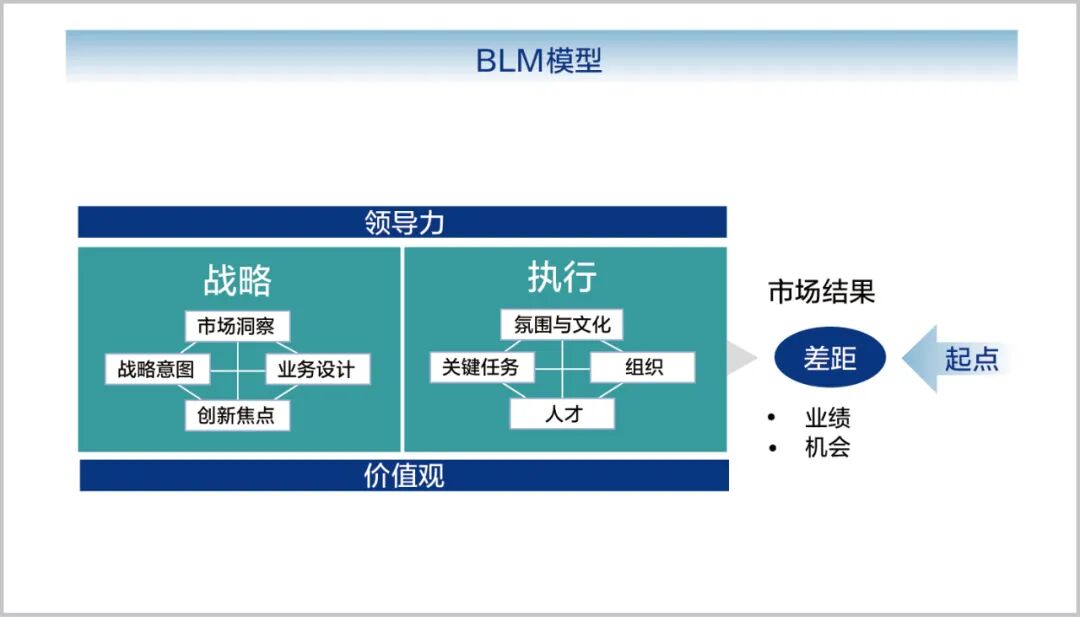
BLM has four basic principles. First, strategy cannot be delegated, but tactics and execution can. Second, strategy is competition-oriented; only with competition can gaps be seen, and gaps are the source and driver of strategy. Third, strategy and execution are always intertwined. Fourth, strategy should be viewed through dynamic management — it can be adjusted.
1. Gap-Driven
BLM is first and foremost gap-driven. Gaps generate strategic intent — in other words, strategy is sparked by dissatisfaction. First identify gaps, then prioritize key gaps, conduct root cause analysis on key gaps, and finally address them.
Gaps include performance gaps and opportunity gaps. Performance gaps are relatively easier to solve; they can be addressed by designing key tasks. Opportunity gaps are more difficult and require new business design paired with key tasks.
2. Strategy Formulation
1) Market Insight
Insight is the basic skill and starting point of strategic planning — moving from isolated data to market monitoring, injecting fresh perspectives into business activities. So insight is subjective judgment based on objective data. Even facing the same data, different people may draw different conclusions; this is where values play a role.
At Huawei, market insight follows the "Five Looks": look at macro trends, look at the industry, look at customers, look at competitors, and look at oneself.
The macro dimension covers politics, economy, society, and technology. Understanding the macro environment prevents major mistakes; even at early stages, companies must stay attuned to macro conditions.
Looking at the industry, the focus is on value migration. We must perceive where market value is shifting, seeing what used to be profitable gradually become less so. Take the automotive industry: in recent years, revenue and profit shares from vehicle sales and aftermarket services have declined, while shared mobility, digital services, and new technology/software suppliers have grown. Thus digital services, mobility, new technologies, fintech, and emerging EV companies become new market competitors.
Looking at customers means seeing their core needs. B2B and B2C require different perspectives. B2B markets have decision-making processes; even when some B2B transactions are conducted online, real negotiation still happens offline. Huawei holds an annual Customer Strategy & Pain-point Analysis (CSPA) conference — an excellent way to maintain customer relationships. For B2C customer insight, user segmentation is now essential; through refined tagging, different products, services, and solutions are planned for different customer segments.
Looking at competitors includes direct competitors, indirect competitors, and disruptive competitors. Cross-industry "assassination" is the most lethal. If we tier business models: selling standard simple products, selling complex industrial products, selling solutions, selling complex solutions, setting standards — the most advanced modern business model today is building ecosystems, where thousands fight alongside you. Hence Huawei's cloud business, its app marketplace, and its collaboration with developers to build moats. We must continually advance toward more sophisticated business models.
To look at oneself, tools like the Business Model Canvas can help conduct multi-dimensional deep dives into weaknesses, strengths, and capability reserves. The nine dimensions are: customer segments, value propositions, channels, customer relationships, revenue streams, key resources, key activities, key partnerships, and cost structure.
To summarize, market insight has several key points: it must be based on facts and data; it must look from outside in; and most critically, it requires sufficient understanding of the business to form one's own subjective judgment. Ultimately, people's worlds are subjective — take responsibility for your subjective world.
2) Strategic Intent
Management gurus Gary Hamel and C.K. Prahalad once said, "Companies that rose to world leadership over the past 20 years did so not by tracking competitors but by aiming for goals that were largely beyond their existing resources and capabilities. We term this type of goal 'strategic intent.'" There's an old Chinese saying: "Aim for the top, settle for the middle." One must have aims — and these aims are strategic intent. Strategic intent encompasses corporate vision, strategic direction, and business objectives.
Just as Huawei in 1994 declared that in the global communications market divided into three parts, Huawei would occupy one. Today, Huawei has achieved "one of three" in communications, data centers, terminal HMS ecosystem, and other segments.
3) Business Design
For growth, companies must enter new business spaces — this requires business design. Business design builds on deep external understanding, using internal capabilities for expansion. Several points are critical.
Business design first requires customer selection. Second, clarify the value proposition. Simply put, this is "what you can satisfy that others cannot, or what you satisfy better than others" — your core competitiveness. Third, value capture: the means of realizing the value proposition, or how core competitiveness is achieved. Fourth, scope of activities: clarify whether to do it yourself, or engage partners, suppliers, and alliances. Fifth, strategic control points: core capabilities you master. More strategic control points mean greater advantage. Finally, business risk management: proactively identifying business risks and uncertainties.
4) Innovation Focus
Innovation focus requires holistic thinking about future business portfolio, innovation models, and how to leverage resources — a series of deliberate deliberations.
Corporate innovation must have clear direction and boundaries, expanding products or business lines along core competencies rather than venturing into completely unrelated domains. The more underlying overlap between innovative and existing businesses, the higher the probability of success. Huawei's innovation is focused: whether building on carrier business, or expanding to cloud and automotive, the foundation is always communications technology.
3. Strategy Decoding and Execution
A Harvard Business Review study once found that companies on average achieve only 60% or less of their strategic financial targets. Often, strategic failure stems from poor execution.
Huawei has a tool called strategy decoding. All large organizations need a strategy decoding process to "carry strategic intent in mind, hold the battle map in heart, and execute with greater force."
Strategy decoding is the process of visually decomposing organizational vision and strategy layer by layer into behaviors that all employees can understand and execute. Vision becomes strategic intent, which breaks down into strategic initiatives, then into priority tasks and sub-projects — the key is transforming strategy into concrete, visible, tangible work. This aligns with U.S. military strategic management thinking: from national strategy to theater strategy, then decomposed into campaigns and tactics.
Strategic execution has four key points, of which key tasks are hard metrics; the other three are softer: organization, talent, and atmosphere/culture.
Key tasks are what must be done to support realization of the business design. Dependencies and critical success factors must be fully considered.
Key task execution requires organizational support. Huawei's organizational design principle is: process determines organization. Based on new business designs, corresponding processes are developed to set organizational structure and delegation.
Huawei uses PBC (Personal Business Commitment) for performance management: KPI + narrative. KPIs are key business indicator numbers — revenue, profit, customer satisfaction, etc. The narrative typically covers team and capability dimensions, as capabilities are hard to quantify. All Huawei employees are assessed on PBC: annually for executives, semi-annually for frontline staff.
On talent: first, identify talent needs based on capabilities required to achieve key tasks. Then systematically plan how to acquire, develop, motivate, and retain this talent, conducting global human resource deployment.
Finally, atmosphere and culture. Organizational atmosphere is the perception of the work environment; atmosphere supports business direction. If an innovative business needs an innovative culture and atmosphere, it's best to spin it off relatively independently. Left within the original cultural circle, it's difficult to nurture new business.
Achieving Closed-Loop Strategic Management: Building Capability into the Organization
Huawei's process from strategy to execution is called DSTE: a unified process framework and management system for developing medium- and long-term strategic plans and annual business plans, executing them, and monitoring and evaluating performance. Strategic planning typically covers 3-5 years; annual business planning covers 1 year. This process ensures consistency between company and business unit medium- and long-term strategic objectives and annual plan resource budgets and rolling plans.
To summarize, strategic planning has four characteristics.
First, strategy-driven business with integrated short- and long-term goals. Huawei launches its 3-5 year strategic planning every April, continuously rolling forward. It focuses on what has changed, holistically examining the next 5 years' market space, strategic intent, strategic objectives, competitiveness, capability enhancement, and 5-year financial targets and budgets.
Second, financial models validate planning rationality and logic. One- or two-year financial indicators can measure whether planning and new business investments are correct, examining input, growth, return, and efficiency separately.
Third, standardized planning tools. We conduct multiple training sessions — what we call "empowerment" — guiding everyone to execute strategy with unified methods.
Finally, closed-loop strategic management. Effectively connecting BP with performance reviews, organizational KPIs, and executive PBCs, achieving closed-loop strategy-to-execution through strategy decoding, so that every individual and business unit links to overall company strategic objectives. The closed loop is guided by strategic archive documents; today, where possible, materials at every stage should be cloud-based, including building communities for sharing and learning.
Huawei's strategic planning methods continue evolving. To this day, we continuously refine the closed loop from strategy development to execution, uncertainty management, stratified strategic decision-making, effective cultivation mechanisms, unified methodological tools, and efficient data platforms — focusing on goal achievement and results, identifying key issues through systematic thinking, ultimately building strategic capability into the organization itself, forming organizational capability.
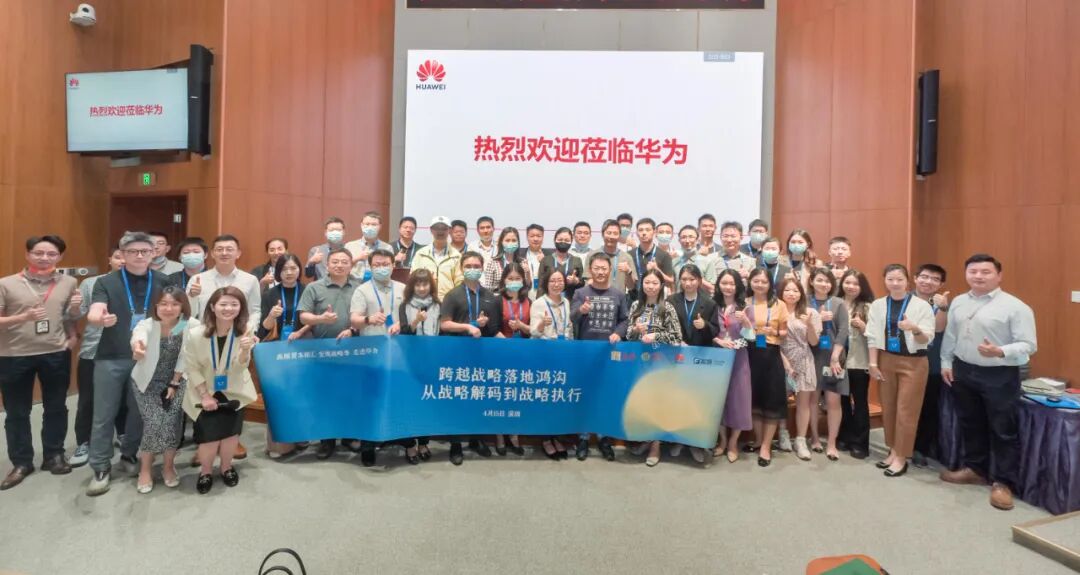
Visiting Huawei's Shenzhen Bantian Base