Weilan Stellar completes hundreds of millions of RMB in angel+ funding round, racing to build world's first high-temperature superconducting stellarator

It plans to complete the world's first medium-sized high-temperature stellarator by 2027.
In the race toward controlled nuclear fusion, a young company is stepping into the spotlight. BlueStar Fusion (合肥蔚蓝恒星科技有限公司), a startup focused on stellarator fusion, recently announced the completion of an angel-plus funding round worth several hundred million yuan. The capital will primarily go toward building the world's first high-temperature superconducting stellarator. Gaorong Ventures, which participated in the company's angel round, significantly increased its stake in this round.

Founded in August 2025, BlueStar Fusion has grown from a five-person physics design team to a nearly 100-person interdisciplinary team covering the full fusion device R&D chain over the past 11 months. It has also secured three consecutive funding rounds, with a post-money valuation exceeding 3 billion yuan.**
Its shareholder roster includes prominent VC and PE firms such as Gaorong Ventures, Boyu Capital, Weihe Investment, Oasis Capital, Huilong Ventures, and Minyin International, as well as AI industry player Xi Wang. Notable individual investors also appear, including Liang Hong, founder of Shiya Asset Management, and Wang Yiping, founder of Evolutionary Asset Management — both from firms that ranked among this year's top ten private equity performers by AUM.

How did such a young team break through so quickly?
The founder's composite background as a "scientist, engineer, and entrepreneur" — all in one Gen Z package — has left a strong impression.
"BlueStar Fusion's founder studied physics as an undergraduate at Oxford University and pursued stellarator research during his PhD at Princeton University. He took a leave of absence to start this company, seizing the moment to throw himself into China's fusion enterprise and bring cutting-edge stellarator theory and research experience back home." As an observer, Yan Jianwen, chairman of Fusion New Energy, assessed: "In him, I see the passion, boldness, and execution of China's new generation of Gen Z entrepreneurs — critical factors for success."
Another defining characteristic of this team is its concentration of specialized talent and integration of multidisciplinary expertise.**
The company's core members hail from leading institutions including Princeton, Oxford, Tsinghua University, University of Science and Technology of China, and Shanghai Jiao Tong University. Their expertise spans fusion physics, superconducting magnets, structural and precision manufacturing, cryogenic engineering, and artificial intelligence — tailored to the complex systems R&D and iteration demands of stellarator development.
In the view of Wang Xin, partner at Gaorong Ventures, BlueStar Fusion has assembled "the team in China that understands stellarators best." "BlueStar Fusion's core team comes from Princeton and other overseas stellarator research hubs, bringing together top experts from China, the United States, and Europe across physics, engineering, and AI. In just over six months since founding, the company has made very rapid progress in physics and engineering design and device construction. Their execution is strong, and once completed, their facility could become a globally leading stellarator installation." He offered high praise for the team: "We deeply recognize BlueStar Fusion's professionalism, talent attraction capability, execution, vision, and passion. Great achievements often come from the young. We believe this team can produce world-class results and make important contributions to the fusion cause!"
For the extraordinarily complex engineering of fusion, specialized physics talent alone is insufficient.
To bridge the gap between "scientific concept" and "engineering reality," BlueStar Fusion established an advisory and review system composed of senior scientists, engineering experts, and industry partners, forming an organizational structure that combines "young cutting-edge R&D force + mature engineering experience + supply chain capability."
Under this system, physics design, engineering design, model coil testing, supply chain development, financing, and talent pipeline building no longer follow traditional linear sequencing. Instead, they proceed in parallel, effectively shortening the feedback cycle from design to hardware.
Ten Months: From Design to Manufacturing
In recent years, numerous fusion companies have proposed technical approaches and completed theoretical validation. But moving from experimental design to actual hardware requires clearing multiple hurdles: R&D iteration, component manufacturing, and integrated system assembly. **This has been one of BlueStar Fusion's most important tasks over the past 11 months.
The company has completed physics design for its first-phase device, developed a proprietary AI technology platform, finalized host engineering designs with expert review, and completed high-temperature superconducting model coil testing. Multiple critical systems have entered pre-development and procurement phases. The project has transitioned from initial design and simulation validation to full-scale engineering drafting, component fabrication, and integrated system assembly. Per its roadmap, BlueStar Fusion aims to complete construction of its first-phase high-temperature superconducting stellarator by 2027.
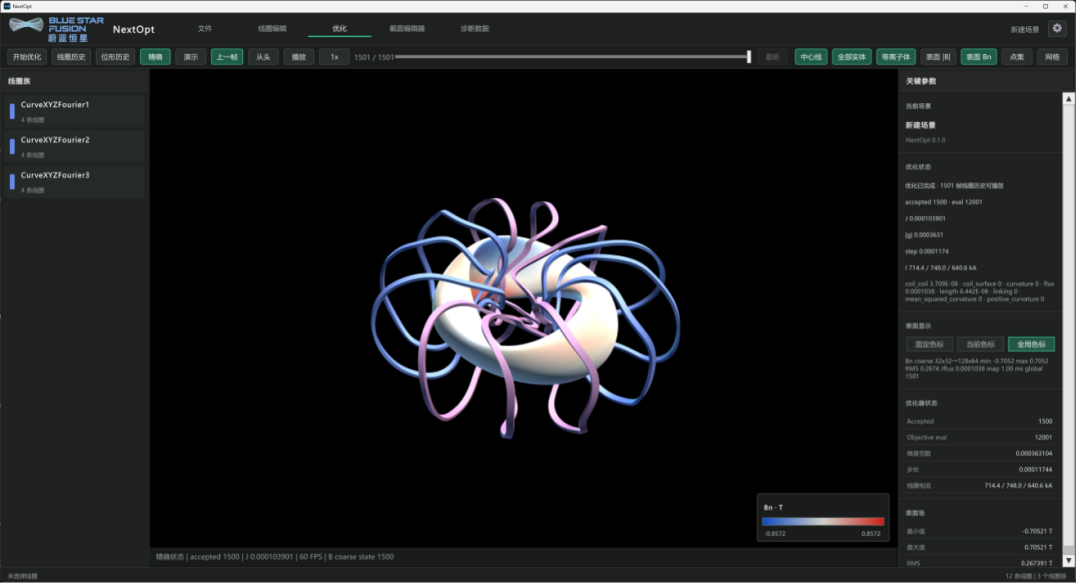 Caption: BlueStar Fusion's self-developed coil optimization AI tool NextOpt in live demonstration
For fusion projects, the gap between "completing design" and "completing the device" is vast.
A stellarator configuration that performs well in physical calculations must still be translated into concrete coils, structural components, cryogenic systems, vacuum vessels, control systems, and assembly interfaces once it enters the real world. Engineering challenges often exceed physics challenges.
Therefore, before launching full device construction, BlueStar Fusion prioritized experimental validation of high-temperature superconducting model coils. Model coils serve as a critical bridge between physics design and engineering manufacturing: they validate not only the magnet design itself, but also whether the complete engineering system — materials, processes, manufacturing, assembly, and cryogenic operation — is truly feasible.
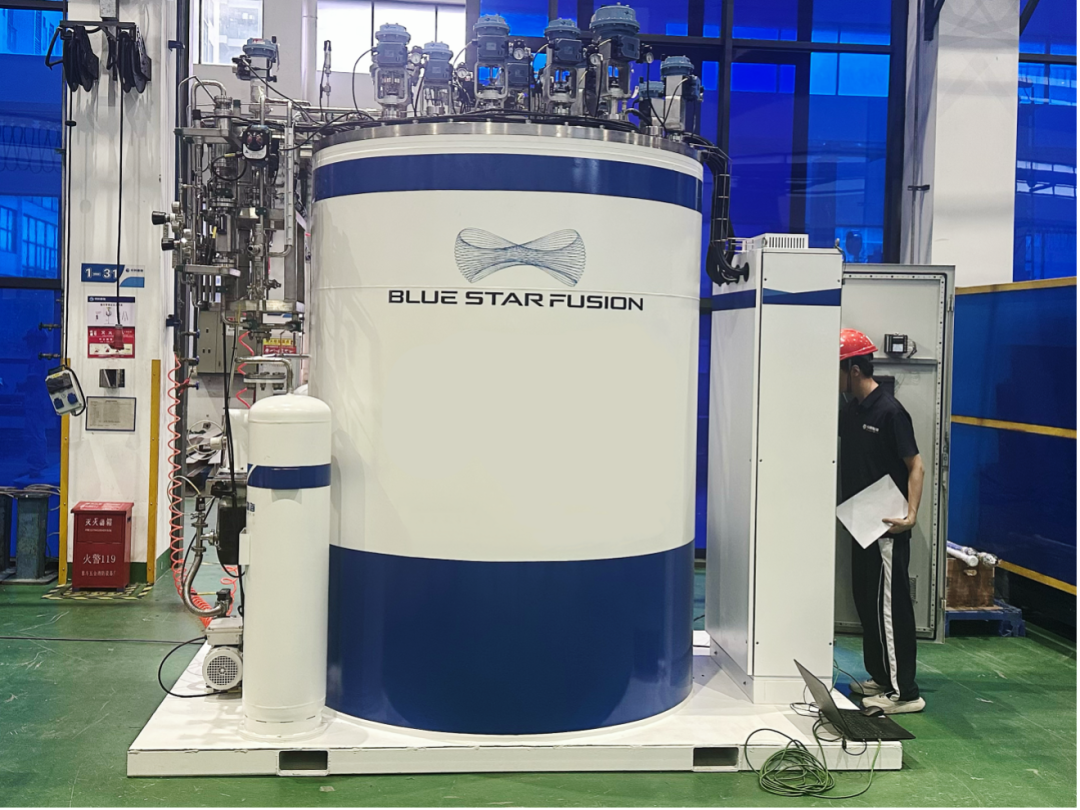 Caption: BlueStar Fusion cryogenic cooling system
BlueStar Fusion has now completed testing of its high-temperature superconducting model coil under real operating conditions using cold helium gas with conductive cooling. During testing, the model coil repeatedly reached its design operating current, and in extreme current tests achieved more than double the normal operating current — demonstrating substantial engineering design margin.
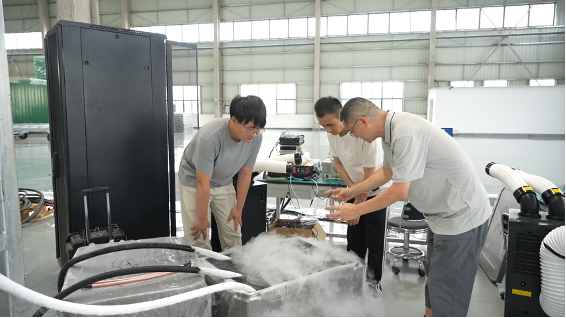
Caption: BlueStar Fusion low-temperature testing site
More critically, the coil's peak field reached 10.3 tesla, setting a new record for the strongest magnetic field achieved by a high-temperature superconducting stellarator model coil in China to date.
Why High-Temperature Superconducting Stellarators?
For decades, the tokamak has dominated global fusion research. From ITER to China's EAST to America's SPARC, nearly all landmark fusion projects have been built on the tokamak technical framework, accumulating mature talent pipelines, industrial foundations, and engineering experience.
Today, the industrial logic of global fusion is shifting. Research institutions, government agencies, and investors worldwide are no longer focused solely on achieving controlled nuclear fusion ignition. Industry consensus has moved toward a more commercially grounded central question: how to build fusion devices capable of long-term stable operation and commercial power generation.
The stellarator, which remained largely confined to laboratories for years due to the complexity of its three-dimensional design and engineering manufacturing challenges, is gaining renewed attention as AI computing power and advanced manufacturing capabilities advance.
As early as 1951, Lyman Spitzer, first director of Princeton Plasma Physics Laboratory, proposed the stellarator concept. Unlike tokamaks, which rely partly on plasma current to generate confinement magnetic fields, stellarators primarily use external three-dimensional magnets to produce the required confinement fields — giving them an inherent advantage in long-term steady-state operation. Meanwhile, high-temperature superconducting magnets can achieve higher magnetic fields, enabling more compact devices with greater long-term operating cost advantages. The stability and economic potential of high-temperature superconducting stellarators have given power and energy investors a glimpse of massive commercial possibilities.
Over the past decade, stellarator technology has continued to advance.
Princeton University has successively driven open-source optimization codes including Simsopt and DESC, accelerating stellarator design. In May 2025, Germany's W7-X stellarator facility achieved a triple product exceeding tokamak equivalents during a 43-second long-pulse run — experimentally validating the superiority and high potential of the stellarator approach.
Wang Xin, partner at Gaorong Ventures, noted that stellarator technology overseas has made considerable progress in recent years. First, two-dimensional modular magnets may solve manufacturing challenges. Second, new design optimization methods and AI introduction have significantly improved design quality. As academic breakthroughs and recognition of stellarators grow, global capital's understanding of stellarators is undergoing fundamental upgrading.
Industrial positioning confirms this trend: Germany's Max Planck Institute for Plasma Physics (IPP) and Spain's WISER project have both selected stellarators as their primary fusion experimental route based on experience. Meanwhile, European and American stellarator companies including Proxima Fusion, Type One Energy, and Thea Energy have successively secured funding rounds worth hundreds of millions of dollars, attracting tech companies and energy giants such as Google and RWE. The stellarator has become one of the mainstream routes in the commercial fusion era.
However, the complex three-dimensional magnetic fields that enable stellarators' steady-state operation also constitute their most severe technical challenge.
To achieve more stable confinement fields, stellarators employ highly complex three-dimensional magnetic structures. Around these fields, R&D teams must simultaneously consider stellarator quasi-symmetry, magnetohydrodynamic stability, boundary magnetic topology, particle transport, magnetic ripple, coil curvature, electromagnetic stress, structural deformation, manufacturing tolerances, assembly space, maintenance access, and numerous other objectives.
Addressing this industry pain point, the company independently developed a full-process stellarator AI optimization platform covering configuration generation, automatic parameter tuning, configuration screening, and coil optimization. In this system, AI agents generate candidate solutions, search optimization paths, and automatically dispatch different levels of physics solvers and engineering analysis tools.
According to the team, for certain specific optimization tasks, this platform can compress computational iterations that originally took months or even years down to several days. Both optimization efficiency and final solution quality have surpassed traditional expert manual approaches. The high-dimensional, multi-objective nature of stellarators means enormous optimization space exists, and this system is a tool for continuously finding better solutions.
AI's value lies in its ability to replicate expert experience and then perform high-quality optimization work at scale, repeatedly. While AI drives up energy demand, it also provides new tools for solving energy challenges — something particularly evident in the stellarator approach.
Through its "AI foundation + engineering validation frontloading + industrial chain coordination" model, BlueStar Fusion is using exceptional execution to lead China's stellarator race, with several goals: building the first optimized stellarator quasi-symmetric configuration; being the first to introduce AI-assisted optimization across the full stellarator design and engineering construction chain; and making a run at the world's first fully operational high-temperature superconducting stellarator device.
For the fusion industry, commercial deployment may still require time.
But at minimum, BlueStar Fusion has taken a future that long remained in the laboratory and solidly advanced it one step closer to engineering reality.
Article reprinted from: 36Kr