What Marvelous Innovations Will Quantum Chemistry and AI Bring to the New Energy Industry? | A Conversation

Frontier Tech sits down with "first movers" in energy storage and batteries.
Humanity is now living through its third energy revolution. New energy industries — including energy storage and batteries — have entered a period of rapid growth, brimming with massive opportunities and vast potential. Equally exciting is how a wave of frontier technologies is planting seeds of innovation in this fertile industrial soil, accelerating the pace of discovery.
Recently, The University of Hong Kong Beijing Center, Gaorong Ventures, and EqualOcean Auto co-hosted an online seminar titled "Frontier Tech Dialogues with Energy Storage and Battery Industry Pioneers," aimed at fostering collisions between new energy and new technologies, academia and industry.
The event featured quantum chemistry scholar Guanhua Chen, Chair Professor of Chemistry at The University of Hong Kong and Director of the Hong Kong Quantum AI Lab; solid-state lithium battery and energy storage pioneers Zheng Li, Co-founder and General Manager of QingTao Energy, and Feng You, General Manager of the Large-Scale Energy Storage Division at Wotai Energy; as well as Xin Wang, Managing Director at Gaorong Ventures. They shared insights and engaged in cross-disciplinary dialogue on the applications of quantum chemistry in new energy, product roadmaps for solid-state lithium batteries, and energy storage safety — topics of intense industry interest.


When Quantum Chemistry and AI Enter New Energy
The emergence of quantum mechanics in the late 19th century opened a door to understanding the microscopic world, fundamentally transforming human comprehension of material structure and interactions.
Quantum chemistry applies quantum mechanics to deeply understand the physicochemical properties of atomic systems. Its "holy grail" and central challenge is finding solutions to the fundamental equation of quantum mechanics — the Schrödinger equation — within finite computational resources and time. As quantum physics pioneer Paul Dirac noted in 1929: "The fundamental laws necessary for the mathematical theory of a large part of physics and the whole of chemistry are thus completely known, and the difficulty is only that the exact application of these laws leads to equations much too complicated to be soluble."
To this day, researchers have developed numerous quantum chemistry methods to approximate solutions to the Schrödinger equation, including density functional theory and the Kohn-Sham equations.
For years, Professor Chen has focused on precise numerical solutions to the Schrödinger equation and was among the first to apply artificial intelligence to solving quantum mechanical equations. In 2019, he and his team achieved a major breakthrough, demonstrating in principle that deep learning methods could accelerate the solution of quantum mechanical equations without sacrificing accuracy — enabling predictions of material physicochemical properties and design of novel optoelectronic devices without solving the many-body Schrödinger equation.
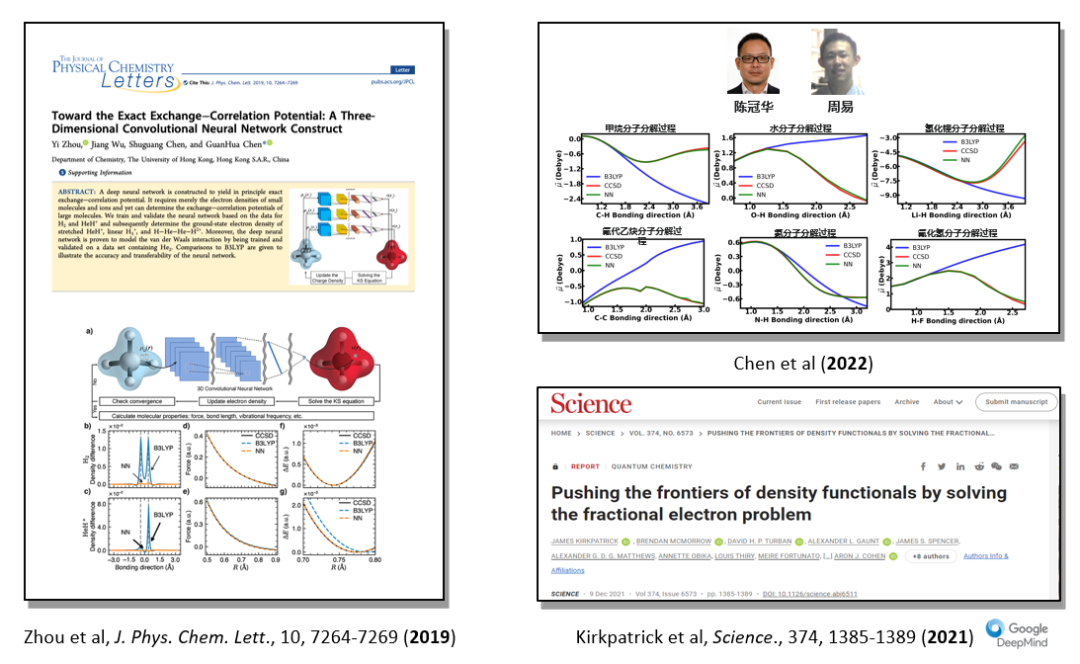
"We have a dream in quantum chemistry: to discover new materials, new drugs, and design novel optoelectronic devices on computers. Today we are incredibly excited, because that moment has finally arrived," Professor Chen shared.
Previously, Professor Chen and his team had already applied quantum mechanics in the semiconductor field, independently developing world-leading semiconductor electronic design automation (EDA) process and device simulation (TCAD) software platforms capable of atomic-scale simulation. "Today, we look forward to transferring the successful experience of EDA in microelectronics to the field of energy materials and devices, and proposing an 'EDA' for the new energy industry. Currently, this simulation platform mainly includes three modules, with more extensions to come."
The first module is the AI + Quantum Mechanics module. Professor Chen explained that this module combines AI technology with first-principles quantum mechanical methods, enabling accurate assessment of new battery materials with limited or even no experimental data, and passing parameters to electrochemical models. These parameters include ionic conductivity, interfacial impedance, electrode material capacity, thermal conductivity, aging coefficients, OCV-SOC curves, and more.
The second module is the Electrochemistry module, primarily comprising electrochemical, thermal, and aging models — which can be coupled and solved together.
The third module is the Simulation and Systems module, which uses machine learning and big data methods to abstract reduced-order models from the electrochemistry module and network them according to topological structure, enabling prediction of module and system performance, and thereby informing charge-discharge strategies, balancing strategies, safety warnings, and lifespan predictions.
In summary, the new energy industry "EDA" platform essentially spans three dimensions: quantum mechanical simulation of material properties at the microscopic scale; electrochemical simulation at the cell level; and big data/AI methods at the module and system level.
From a basic science research perspective, Professor Chen offered advice to industry practitioners: "For decades, computational materials science and computational chemistry have established various effective models that largely solve qualitative problems. Industry must leverage these models — they will greatly reduce the need for experimental data. With AI plus limited experimental data, quantitative problems in practical work can be solved efficiently."
Professor Chen further illustrated with an example: "In practical applications, even in what now appears to be a relatively mature lithium battery industry, there remains enormous room for improvement in the underlying principles and deep mechanisms of devices." For instance, in May this year, Dalhousie University in Canada collaborated with Tesla's advanced battery research team to develop a new nickel-based battery. Simply adjusting the composition of NMC battery materials compared to existing ternary lithium batteries resulted in only 5% degradation after 4.5 years of continuous charge-discharge cycling at room temperature — implying a service life of up to 100 years.
"Currently, our team is advancing the application of AI + quantum chemistry technology in the new energy industry," Professor Chen introduced. "Beyond battery lifespan prediction and safety warnings, we have also simulated the electronic energy level distribution in solid-state lithium battery systems and even discovered novel solid-state lithium battery electrolyte materials. Going forward, we will extend this to potassium-ion battery materials, hydrogen fuel cell research, and more."
The Solid-State Lithium Battery Innovation "Tetrahedron"
The solidification of lithium batteries is widely recognized within the industry as an inevitable trend. QingTao Energy is a global leader in solid-state lithium battery commercialization, having built the world's first mass production line for solid-state power lithium batteries. Dr. Zheng Li, Co-founder and General Manager of QingTao Energy, is an expert in solid-state lithium batteries and functional composite materials. In his presentation, he focused on the product roadmap and future of solid-state lithium batteries from an industrialization perspective.
Dr. Li pointed out that as a new technology, solid-state lithium batteries fundamentally solve the safety problems of liquid lithium batteries through material system innovation, and break through the ceiling on energy density improvement.
Compared to liquid lithium batteries, solid-state lithium batteries are not merely about replacing electrolyte with solid-state electrolyte. Rather, they fundamentally transform the battery from a device concept of electronic packaging assembly to a composite material system concept. Therefore, solid-state lithium battery production is a composite material manufacturing process. "We have entered an entirely new track."
Dr. Li elaborated on the solid-state lithium battery product iteration roadmap. QingTao Energy's first-generation semi-solid products have already achieved mass production, with factories exceeding GWh-scale capacity, and battery energy density reaching 420 Wh/kg. The second-generation battery is expected to enter mass production in 2024. The third-generation, fully solid-state lithium battery, will achieve energy density exceeding 500 Wh/kg. Across these three generations, energy density progressively increases, liquid content gradually decreases, manufacturing process steps continuously decline, and cost per kWh drops significantly.
In Dr. Li's view, solid-state lithium battery innovation requires a "tetrahedron." "First is material innovation — this is the crown jewel. Second is structural optimization for support. Third is process innovation for iteration. These three together support cell performance improvement."
Regarding the value of frontier technologies like quantum mechanics and computational materials science for the solid-state lithium battery industry, Dr. Li noted, "In the past, when we worked on materials, we often joked that we were 'stir-frying' — blindly mixing to see if it tasted good. With computational materials science, we can at least cook from a recipe. People were researching solid-state electrolytes back in the 1960s and 70s, but it wasn't until after 2000, with the development of computational materials science, that solid-state electrolytes began to have basic theoretical guidance. What remained was the materials formulation problem. In fact, quantum mechanics is even more valuable for all-solid-state lithium batteries, because solid-state lithium batteries increasingly resemble monolithic materials, or increasingly resemble semiconductors."
However, Dr. Li also emphasized that beyond theoretical guidance, attention must be paid to manufacturing processes to ultimately achieve true scale and industrialization. "The formulation problem still needs to return to engineering. After leaving the laboratory, we must master manufacturing capability and process in mass production."
Five Elements for Improving Energy Storage Safety
Wotai Energy focuses on providing advanced energy storage products, with over 75,000 energy storage systems installed globally. Dr. Feng You, General Manager of Wotai Energy's Large-Scale Energy Storage Division, has over ten years of experience in energy storage. He previously served as General Manager of Lishen Energy Storage and Dean of the Power Battery Engineering Technology Research Institute.
Addressing industry concerns about industrial energy storage safety, Dr. You analyzed leading energy storage safety solutions across five dimensions: mechanical, electrical, thermal, chemical, and control — mechanical safety, electrical safety, thermal management, electrochemical safety, and control safety.
"Before battery intrinsic safety is solved, I believe control is the core. Currently, essentially all our work focuses on control, but control integrates the preceding mechanical, electrical, thermal, and chemical aspects together for active safety control." For example, control systems integrate monitoring of battery parameters such as charge-discharge curves, as well as pre-thermal-runaway indicators like gas leakage, electrolyte leakage, temperature, and smoke detection.
Additionally, risk is reduced from various system dimensions, such as improving and optimizing the overall system's electrical topology architecture and communication topology architecture. Thermal management employs air cooling, liquid cooling, and other means to optimize the battery operating environment.
During the event, Dr. You also exchanged views with Professor Chen and other guests on hot topics in the energy storage industry. Regarding the application prospects of sodium-ion batteries in energy storage, Dr. You noted, "Whether from a cost perspective, or considering cycle life and safety, sodium-ion batteries may in the future serve as a complement to existing lithium-ion batteries in the energy storage industry."
This online seminar attracted participants from academia, research institutions, new energy industry players, and investors. Through mutual exchange, they collectively identified deterministic industry trends and found answers and directions for exploring uncertain questions.