When Traffic Costs More Than Gold, How Do You Actually Drive Growth? | Ronghui

Hunting for traffic in the "stock era."
Looking at China's mobile internet landscape today, we've entered a relatively mature, zero-sum era where traffic has become more precious than gold. Growing traffic now is like planting trees in a desert — it's expensive to acquire and hard to convert, an unavoidable challenge for every founder.
This demands abandoning crude, old-school traffic acquisition methods. Instead, we need new thinking, new technology, and matching organizational structures to drive effective traffic growth.
Recently, Gaorong Ventures partnered with Tsinghua University's PBC School of Finance Global Entrepreneur Leadership Program (click "Read More" at the end for details) to host an online session with traffic expert and Lightyear Lab CEO Guoping Zhang, who broke down the nature of traffic and shared core playbooks for key channels and team-building guides.
Zhang previously led Alibaba's online marketing department, responsible for traffic acquisition across 191 countries for Alibaba International, and has served as traffic advisor to over 40 major internet companies including Trip.com Group and Alibaba Cloud.
In his session, Zhang pointed out that only two traffic models exist in the world: keyword-based traffic and relationship-chain-based traffic. And there's a fundamental formula for acquiring traffic — content flows through channels. Today's "traffic hunters" must walk on two legs of data and technology to find their "oasis."

The following is an edited transcript of Guoping Zhang's session:
I'm honored to share with you today about new thinking, new technology, and new teams for traffic. My understanding of traffic comes from three cross-disciplinary experiences. In 2002, during my university years, I was a webmaster who grew a website to 150,000 daily visits single-handedly. In 2006, I joined Alibaba's online marketing team, handling overseas free traffic channels at a major corporation — that was my first crossover. Second, I came from a technical background but moved to marketing, giving me dual technical and marketing thinking. Third, I was based domestically but responsible for overseas traffic, allowing me to compare domestic and international traffic playbooks. These crossovers gave me multiple perspectives to observe and study traffic.

I. Traffic Today: The Overall Landscape, Team Structure, and Methodology
Let's first look at the current traffic landscape. Many people haven't developed sufficient crisis awareness about the present situation.
1. The Traffic Landscape: Pool Basically Saturated, User Growth Dropping Below 1% YoY
From a macro perspective, the overall traffic pool has essentially stopped growing. According to QuestMobile data from November 2019, "China's mobile internet traffic pool has basically saturated, with user scale growth dropping below 1% year-over-year for the first time." In the traffic industry, we often say "traffic is more precious than gold." Gold mines keep producing every year, but traffic has virtually no new supply — hence the saying "hoard traffic, not property."
Traffic costs rise at least 40% annually now, yet profit margins in many industries hover around 20%. This means a profitable business this year may become unviable next year once traffic costs rise — at least through paid acquisition.
2. Team Structure: 99% of Traffic Teams Organized by Channel, Doomed to Mediocrity
Today, 99% of traffic teams organize by channel — one person handles Baidu ads, another Douyin ads, and so on. This structure makes KPIs easy to calculate but creates massive problems. People vastly overestimate the specialization required for channel buying. Many assume expertise exists in buying traffic on Baidu versus Douyin, but the similarity is 90%. The differentiated parts can be learned by any competent employee within a month — how to use the backend, how to communicate with platform reps.
The problem with channel-based division is that traffic acquisition involves three steps with completely different skill requirements. Step one is data mining — a STEM task. The gap here is enormous: professional data companies can mine millions of keywords at once, while some industry players consider finding tens of thousands impressive, and many traditional companies have merely hundreds of keywords sitting in their backend.
Step two is creative — grabbing attention, driving clicks, and prompting action — a liberal arts task.
Step three is landing pages, requiring product managers and UI expertise. Currently, most companies in the industry direct all ads to the same landing page.
Expecting one media buyer to handle data mining, creative, and landing pages demands an impossibly fractured skill set. Each capability has a huge gap between mediocrity and mastery, and excelling at any one requires tremendous effort. We're planning to write an article titled "How to Build a Mediocre Traffic Team" — organizing by channel is guaranteed to achieve this.
3. Traffic Methodology: Missing Technical and Data-Driven Thinking
Most traffic training courses on the market are remarkably similar, but few recognize that doing traffic properly requires genuine technical and data expertise. Alibaba's traffic team, founded in 2002, was built on technology and data-driven growth from day one, so we developed our own methodology.
II. Case Studies: Why New Growth Methods and Team Structures Are Needed
Having covered the basic traffic landscape, let's examine one positive and one negative case to illustrate why new growth methods and team structures are essential today.
1. Positive Case: New Zhihu Traffic Playbook
This positive case is something you can apply immediately. We once grew an app by answering a single question on Zhihu, generating over 4,000 daily installs. How?
As you know, every industry has numerous relevant questions and content on Zhihu. We first used data mining to find millions of keywords that internet users in this industry cared about, then located corresponding question posts on Zhihu. Next, we monitored each post's view count by time slot to understand how traffic was growing.
Know that over 80% of Zhihu posts get zero traffic; some viral posts get hundreds of thousands of hourly views, but with too many answers, ours would get buried. However, some posts get roughly 3,000 hourly views with only a handful of answers — answering these is essentially "picking up free traffic." The reason is simple: when created, these questions didn't get much recommendation within Zhihu, but ranked very high on Baidu, attracting substantial external traffic.
This case exemplifies data-driven traffic growth. We've seen a real example: an 8-person Zhihu marketing team where each member answered over 40 questions daily, yet after six months, they only got 200 daily visits from Zhihu because many questions they answered had long gone cold.
To acquire traffic anywhere, first know whether traffic exists there — this is basic common sense. Sadly, many lack even this fundamental data-driven operations mindset. Ask someone today where Douyin's traffic is, or where WeChat's traffic actually is — many can't answer. This is why they fail at traffic.
2. Negative Case: How People Typically Do Ad Placement
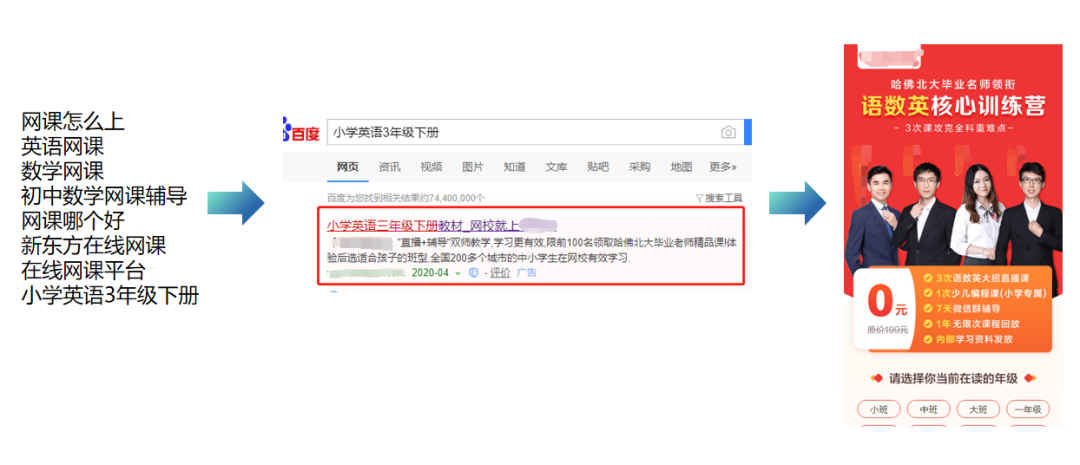
A very common negative case occurs in today's ad placement. First, search engine advertising. Here's a real education industry case: select certain keywords; for "elementary English grade 3 semester 2," the ad creative highlights "dual-teacher classes and free Harvard/Peking University teacher premium courses"; but the landing page talks about "Chinese, math, and English training camp." Many ask why ad performance is poor — this case shows complete disconnect between demand and supply.
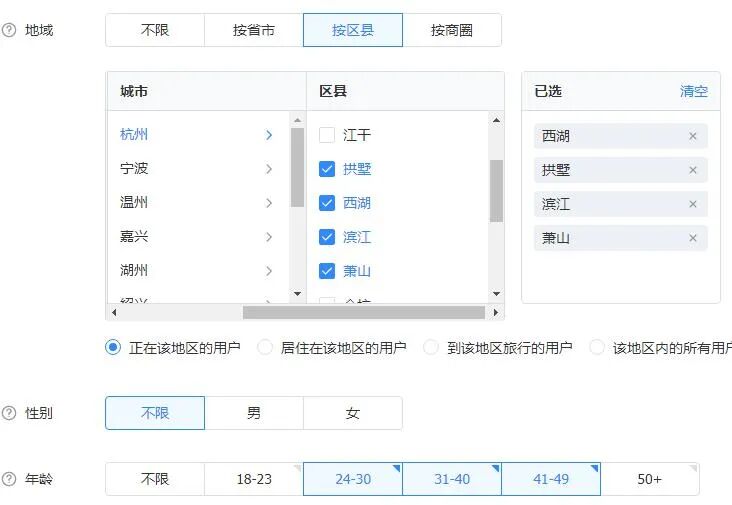
Today's feed advertising is similarly crude. Here's a typical feed ad backend, usually targeting by geography, gender, age, and other tags. It's mostly broad targeting — unsure who's interested, just thinking "expose first, someone will bite." But ad platforms charge by CPM; more impressions mean more spend. In reality, both B2B and B2C companies can achieve precision targeting, yet 99% of companies in the market can't do it.
III. Understanding Traffic: Starting from Classification Methods
Next, let's look at traffic classification methods, as classification directly impacts team building.
1. By Direct Payment: Free Traffic, Paid Traffic
"Whether directly paid" because no traffic is truly free in this industry. When you build a 2-3 person traffic team, their salaries are costs. At Alibaba, there's a system that converts any traffic acquisition activity and any resource input into monetary terms, then calculates ROI. The eternal model is ROI. Alibaba's engineers are expensive — a single SEO change used to cost roughly 1 million RMB, so if the resulting traffic couldn't generate over 1 million in revenue, it was considered a failure.
2. By Ownership: In-House Team Acquisition, Integrating Others' Traffic
Many build in-house teams, but integrating others' traffic is also viable. One children's programming education company went for a long time without an in-house traffic team, instead integrating others' traffic. For example, someone with hundreds of thousands of WeChat groups could help distribute their 49 RMB course, keeping 40 RMB for the traffic owner and only 9 RMB for themselves — appearing very generous. But education is a high-LTV industry; the 49 RMB course is like a cosmetics sample, with 9,999 RMB courses behind it. Once you get a user's phone number through the 49 RMB lead magnet and guide them to register on your app, there's a strong chance to sell high-ticket courses. Such customer acquisition costs are acceptable in the industry.
3. By Scope: Public Domain Traffic, Private Domain Traffic
The public/private domain classification also reflects traffic anxiety. Those playing private domain must also understand some public domain tactics.
The essence: public domain follows a funnel model — 1,000 enter, 50 buy; while private domain is an amplification model — 50 enter the private pool, and through various裂变 methods can ultimately influence 1,000. Doing private domain well is like owning a traffic amplifier.
4. By Content Format: Text-Image Traffic, Audio-Video Traffic
These two formats represent past and present. My judgment is neither will replace the other. Despite audio-video's current popularity, text-image traffic will persist.
5. By Key Steps: Acquisition, Activation, Retention, Revenue, Referral
This fifth classification comes from overseas growth hacking theory. The AARRR (pirate) model divides traffic into five steps — Acquisition, Activation, Retention, Revenue, Referral. But the correct order is: activation and retention first, then referral, then revenue and acquisition.
Imagine a bucket catching water — if the bucket has no bottom (zero retention), catching water is pointless, as the saying goes, "fetching water with a bamboo basket — all in vain."
6. By Function: Content/Creative, Channel Distribution
Observe your traffic growth team — broadly two groups: content/creative people and channel distribution people. How to define content versus channel will be elaborated later.
IV. How to Do Traffic: Two Models, One Formula
For how to execute traffic, I'll share a framework. Through it, you'll find many previously unimportant things become crucial, and some previously important things become less so.
1. Only Two Traffic Models: Keywords, Relationship Chains
Only two traffic models exist in the world: keyword-based and relationship-chain-based. Because humans have only two carriers for spreading information.
Behind traffic lies people's demand for information, and "information" should be defined broadly. A funny short video is information; knowing how to repair a computer is information.
So how does information spread? Back to primitive society: someone goes hunting, spots a beast too large to catch alone, and needs to call others from the village. How to spread this information? One, through language and vocabulary — keywords; the other, through the tribe's relationship chain structure, one telling ten, ten telling a hundred.
Jump to 20+ years ago, before internet普及: a shipyard master hears about underwater welding technology. He has two ways to learn details. First, keyword mode — going to the library to check materials, with libraries serving the function of today's search engines. Second, asking other masters who ask their friends — getting information through relationship chains.
Today in the mobile internet era, the underlying information传播 remains keyword-based or relationship-chain-based. This has always been true from ancient times to now; only the carriers and tools change.
From these two models, we gain new perspectives on traffic acquisition. First, keyword mode — many people fail at Baidu because they haven't found the right keywords.
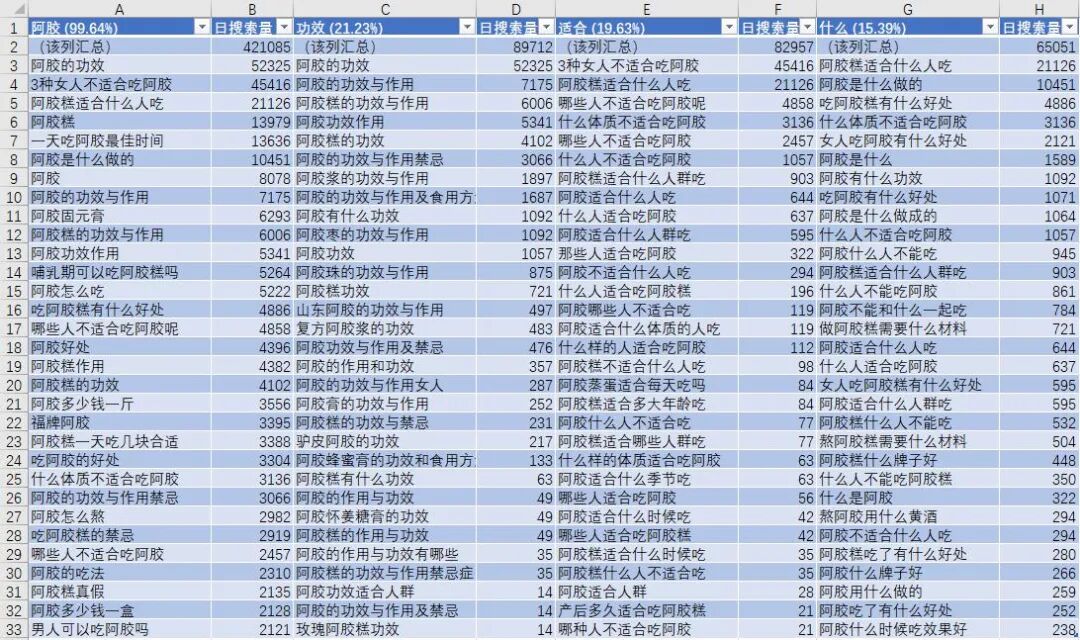
Take the "ejiao" (donkey-hide gelatin) industry. Many bidding on Baidu keywords target phrases like "buy ejiao," "Shanghai ejiao," "Hangzhou ejiao." But looking at the chart below, we see which keywords actually carry weight. Many people never find these terms; many remain unbid. More importantly, heavily bid keywords may cost over 10 RMB per click with multiple competitors fighting for the same users, leaving you ranked low. But unbid keywords cost merely 0.3 RMB per click, and you may be the sole merchant. Lower price, higher conversion — the combined ROI can be ten times higher.
When Meituan battled Ele.me, Meituan's traffic acquisition efficiency was 20% higher. Over time, this competitive advantage grew. So if you can achieve 10x better traffic efficiency than competitors, you will crush them.
In relationship-chain mode, four factors affect information传播 efficiency: number of people spreading, their influence, speed of传播, and reputation/美誉度. Picture a network structure — information flows from A to B, B to C, C to D.
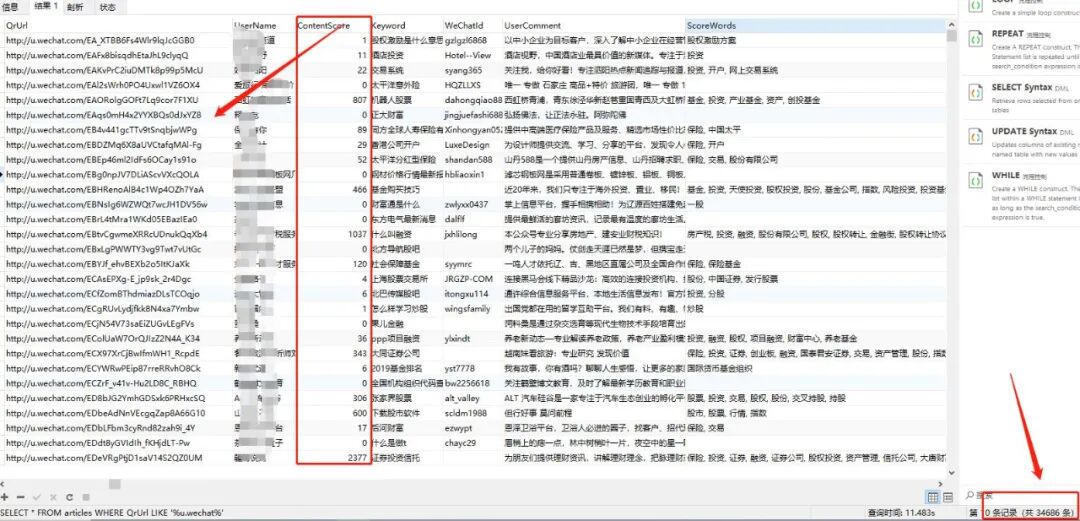
Around these four key links, we can optimize. For example, a financial services company wants many influential people spreading its information. Here's a tool we developed: finding tens of thousands of WeChat public account authors' personal WeChat accounts daily, with batch adding and communication capabilities — meaning daily outreach to 10,000+ KOLs. If you can close 100 KOLs daily, efficiency may exceed reaching many C-end users directly.
2. Alibaba's Traffic Formula: Content Flows Through Channels
Next, using Alibaba as an example, I'll explain a traffic acquisition formula — content flows through channels. Alibaba has strong traffic DNA because the founders had deep traffic instincts from the start. Three examples of how Alibaba makes content flow through channels:
First case: When I joined Alibaba in 2006, my then-boss said all Alibaba's traffic people combined couldn't match Jack Ma's individual traffic ability — he was the true traffic master. When Ma appeared as a guest on CCTV's Win in China, he first identified CCTV as a powerful channel, proactively approaching the show to be a judge, essentially contributing quality content to the channel. Today, in airport bookstores, you still see TVs playing Ma's speeches from over a decade ago — that's flow.
Second case: Alibaba's PR strength. The PR department had a KPI of writing 150 books annually. This content found a strong channel — publishing — where people pay dozens of RMB to buy it, and it's often prominently displayed — walking into a bookstore, you're greeted by Alibaba Iron Army.
Third case: How Alibaba creates channels when none exist. Today's Alibaba Cloud栖 Conference evolved from the Hundred Cities Tour. When Alibaba Cloud first launched, few understood it. Through the Hundred Cities Tour for宣讲 and evangelism, the tour not only cost nothing from group budget but actually made millions per event through booth sales.
So Alibaba treats all of real life as a large stage and platform for traffic, but it all boils down to one formula — content flows through channels.
V. Key Channel Traffic Acquisition Methodology
Here are traffic acquisition methods for channels of common interest.
1. How to Choose Channels for Placement
Today, channel placement involves three critical steps.
First, adopt a global, worldwide perspective on traffic. When entering any country, list its top 1,000 websites and apps.
Second, observe which channel traffic spreads through keywords versus relationship chains. Take WeChat — it has both models, with over a dozen traffic channels within this single app. Analyze channel rules thoroughly.
Third, use data to洞察 where traffic actually is — which keywords, which KOLs? Without this, it's like swimming in unfamiliar waters without knowing the depth; data helps us see clearly.
After these three steps, you can find traffic洼地 in any channel, but all three require hardcore capabilities.
Another channel consideration: you don't necessarily need to bring all customers to your own app. You can retain them within the channel's ecosystem for conversion and delivery. For example, doing traffic on Baidu or Douyin, you can directly use the platform's mini-programs for承接.
Because any platform has an unwritten rule: once you try to take users off-platform, the ad system charges more. And users happily scrolling feeds aren't keen to download an app. Overseas, Facebook advertising also has two approaches: driving to your own app or H5, or driving follows to your Facebook Page — but this requires confidence in your private domain operations capability.
2. How to Use WeCom for Private Domain Traffic
We've been researching private domain traffic through WeCom since last year. We judge WeCom to be the future. Because personal WeChat account bans mean instant归零 of data assets — what people call "cremation overnight." WeCom is at least officially permitted for private domain positioning, with functionality meeting most needs, though Moments capability remains unclear.
We've already跑通 private domain and裂变 processes using WeCom's official tools. And one WeCom employee account can add 250,000 contacts — enormous volume. While主动 adding has limits, passive adding has none.
One caution: many using WeCom for private domain have path dependency, simply porting personal WeChat playbooks — this doesn't work. You need to re-examine WeCom's ecosystem and explore new methods combined with your business.
3. SEO Traffic Acquisition
Search engines remain critically important traffic sources. Using the traffic formula mentioned earlier, you can still find more efficient, lower-cost acquisition methods.
Take a financial services company offering loans: at peak, it got 2 million daily visits from Baidu at zero cost. The approach: first, data mining found millions of industry-related keywords, discovering "calculator" ranked second — massive searches for home-buying calculators, loan calculators, car calculators, etc. Next, consider how to meet these search needs. We should define content broadly — an article, a founder's story is content; a tool is also content, and tools have higher LTV. So instead of writing articles about home-buying calculators, the company developed 40+ calculator tools, each averaging 10,000+ daily visits. And results weren't displayed directly — users left their phone number to receive results via text, meaning sales got 10,000+ leads daily.
Another example: rental housing. Rental information itself is content; many users search for it. If you can H5-ify your app's content and optimize for search engines, such investment yields high returns.
4. Content as Hook for App Growth
Here's a content-as-hook method for app growth, widely used abroad — using compelling content as bait, combined with deep-link technology, to drive installs. For example, Uber in Hangzhou used "One-click to book a West Lake cruise" as a content hook. Users saw an H5 page that guided app download; post-download, it jumped to the cruise-booking interface. Meituan used this early on too — dining users scanned QR codes on tables, triggering app download links that led to the restaurant's page for continued ordering. This is why merchants willingly posted QR codes — they saw it as self-promotion.
So pay close attention to categorizing, refining, and surfacing your app's content as hooks to attract users.
5. Douyin/Kuaishou/Bilibili Marketing
Today, many young users spend fragmented time heavily on short-video platforms like Douyin, Kuaishou, and Bilibili. How to build user mindshare through content marketing? For vertical industry companies, building an in-house creative content team quickly isn't easy. Beyond building teams, nurturing accounts, and developing KOLs, another approach is directly harvesting people who already have traffic. Many have traffic but don't use it well. My suggestion: find mid-tier KOLs, integrate their traffic at extremely high cost-effectiveness, potentially generating results within a week.
How to find good KOLs? Still data-driven: first find relevant videos and KOLs around industry keywords, then track KOL data changes — follower growth, likes per work. Once you spot a KOL exploding from few followers, it's like discovering a promising investment project; move quickly to find and batch-communicate with them. Western KOLs sometimes don't even need money — appeal to their values, like sending your product, which may become their next video material or主动 promotion. So while competitors still "with millet and rifles" negotiate KOLs one by one, data-driven approaches are like using artillery to碾压.
VI. What Talent Is Needed for Traffic Today
The term "growth hacker" is apt — traffic people need hacker spirit, pursuing clues relentlessly to "get to the bottom of things." Doing growth today is like planting trees in a desert — everyone says trees won't grow there, yet you must exhaust all methods to grow them. Every successful traffic person I know has this trait.
Technology and data are traffic people's two legs. Doing traffic and placement without technical or data knowledge is like being a lifeguard who can't swim — you can alert others to danger, but you'll always lack something. Moreover, growth today requires your own data collection and processing capabilities — you must get first-hand data. Traffic itself is an arena; second-hand data leads to poor decisions and no competitive advantage.
Finally, in China, "guanxi" and circles matter enormously for traffic. Operating in any channel requires communication and exchange with platform officials, building relationships, and提前 understanding upcoming rules and playbooks — hugely helpful for growth. At Alibaba's overseas site, we maintained communication with Google officials, giving us massive advantages.

HiCTO Founder, Former Dianping CTO Shihai Gong: How to Build a High-Combat Technical Team The Advancing Enterprise Service Track: New Growth Ideas for 2020? | Gaorong Sharing Gaotu Techedu Co-Founder Weisheng Lv: "Drive" Is the First Thing I Look for in Hiring; Winning Battles Is the Best Team-Building | Gaorong