When Young People Live by "Save Where You Can, Splurge Where It Counts," How Should Brands Harness Youth Power? | Inside Dewu

Frontline Insights on Youth Power.
The consumer-brand landscape is undergoing a seismic shift. Strategies and tactics vary widely, but one constant remains: winning over young people. China's youth are relatively more optimistic about future consumption, shop more frequently, show stronger willingness to pay, and possess a mindset more open to engaging with brands.
As a next-generation online community for trendy shopping, Dewu App boasts a 70% penetration rate among China's 260 million post-95s, making it a crucial hub for young users and a key entry point for emerging brands to reach this demographic.
- What do young people like to buy on Dewu, and which differentiated products are more likely to become hits?
- What does the "save where you can, spend where it counts" consumer philosophy — pursuing both value-for-money and value-for-emotion — mean for brands?
- What business opportunities do new consumer brands have on Dewu to better convert from discovery to transaction?
- Beyond trendy footwear and apparel, sports, and other categories, which other segments hold blue-ocean potential on Dewu?
Recently, Gaorong Ventures' Ronghui community invited 40+ consumer brands across beauty, digital, footwear and apparel, and food and beverage to visit Dewu's Shanghai headquarters, analyzing young users' consumption philosophies and preferences, and exploring how brands can harness youth power on Dewu to drive new growth.

The Dividend of Consumer Entrepreneurship Lies in Young Hearts
Rui Han, Partner at Gaorong Ventures
We have an internal saying: "Use a ladder of surprise to reach a table of substance." In eras abundant with dividends, startups could more easily position themselves as "specialists," searching for their super-strength; but to ultimately stay at the table, they must go through a phase of catching up on fundamentals — excellence across the board.
Today, in a new macro environment, answers to where the dividends lie are increasingly scattered. But one eternal dividend is young people. They are always the demographic opportunity for startups to get a seat at the table and achieve breakthroughs. More precisely, the dividend of consumer entrepreneurship today lies in young hearts, and young hearts are on Dewu.

Dewu: From Trendy Shopping Community to Quality Lifestyle Platform
Wendy, Vice President at Dewu
Dewu officially launched in 2018 and remains a very young platform. Its positioning has evolved from a sneaker community to a trendy culture community with authentication services, then to a next-generation online community for trendy shopping, and will eventually become a next-generation quality lifestyle platform. This evolution reflects several considerations.

User dimension: Beyond its current high penetration among post-95s, Dewu's definition of young users is becoming more diverse — encompassing not just chronological youth, but also those young at heart.
Quality dimension: Dewu aims to defend its own territory. Its average unit price is nearly 5x the industry average, largely driven by sneakers as a key category. But even as consumption recovery continues, we believe the trend toward consumer segmentation and niche communities won't change, and certain groups will maintain their demand for quality.
Category expansion dimension: On one hand, Dewu closely follows its core user base, prioritizing adjacent categories like apparel and beauty before expanding to family-related categories. On the other hand, it emphasizes creating distinctive experiences when entering new categories, ensuring users receive differentiated experiences from pre-sale product discovery through transaction to post-sale protection.
Dewu has strong community attributes. Compared to offline retail, Dewu aspires to be a mall with browsable appeal, not just a sales floor with shelf displays. On Dewu, 70% of users browse and interact with content in the community, which guides them toward products; yet unlike other communities, Dewu also has strong commercial attributes — 80% of community posts include product links.
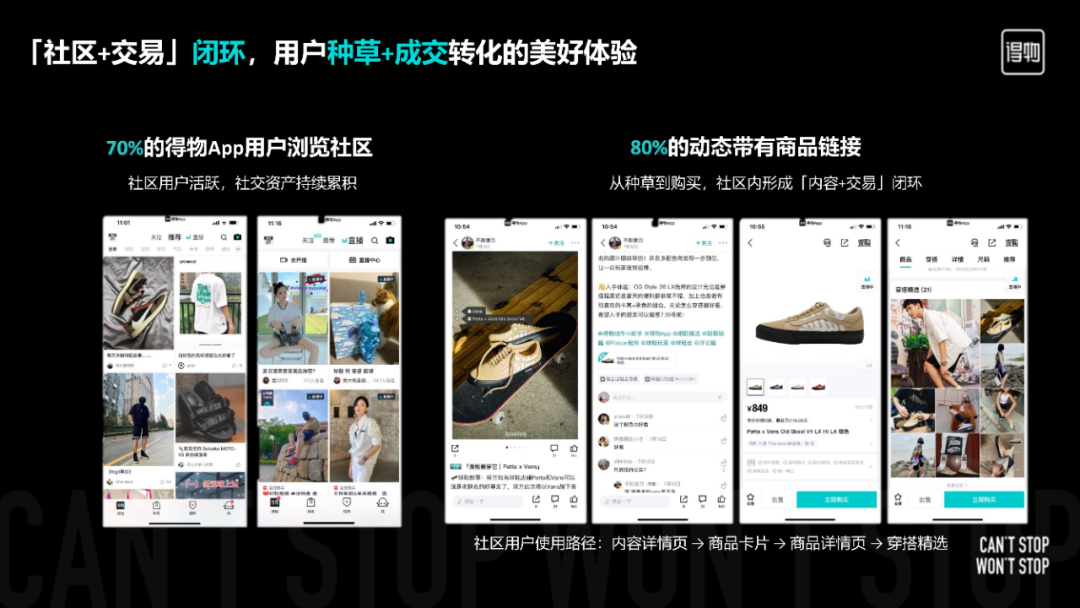
In other words, when Dewu users browse the community, they're not passively absorbing general information — they're actively seeking to learn about products and even shop directly. Going forward, Dewu aims to strengthen the content-to-transaction loop, forming a conversion path from discovery to purchase.
As a brand destination, Dewu has always maintained strict brand selection criteria: "no fakes, no shoddy goods, no tackiness." "No fakes" means zero tolerance for counterfeits, with firm investment in authenticity guarantees. "No shoddy goods" and "no tackiness" reflect commitments to quality and brand positioning.
Frontline Insights on Young Consumer Power: "Save Where You Can, Spend Where It Counts"
Tracy, Head of Platform Operations at Dewu
How does Dewu understand youth power? Much of our perspective comes from frontline operational intuition and real conversations with users — including insights from management's field visits to nearly 10 cities before National Day.

Among Dewu's mainstream user profiles are typical trend enthusiasts; young professionals in third- and fourth-tier cities with two to three years of work experience; and second- or third-year college students. They share one common trait: when discussing aspirations for a better life, they universally express the need for spiritual support and some material validation, and are willing to spend on values they endorse. We summarize their consumption philosophy as "save where you can, spend where it counts."
This translates into specific consumption preferences. First, demand for quality shopping. Their educational background, social circles, and internet-native lifestyles give these users distinct perspectives on trends, aesthetics, quality, and brands. During our visits, we found that users in third-, fourth-, and even fifth- and sixth-tier cities demonstrated surprisingly deep understanding of Dewu and brands — exceeding our own expectations.
Second, beyond value-for-money, users also pursue value-for-emotion. Many purchases stem from natural, instinctive needs — buying a birthday gift for a partner, celebrating a promotion, or rewarding oneself after a tough day at work. Users look forward to feeling emotionally rewarded and motivated by items at specific moments.
Going further, what do young users like to buy on Dewu? We identify six categories: paying for interests, co-branded products, trendy designs, domestic and emerging brands, browsing and buying with content interaction, and ritualistic gift-giving.
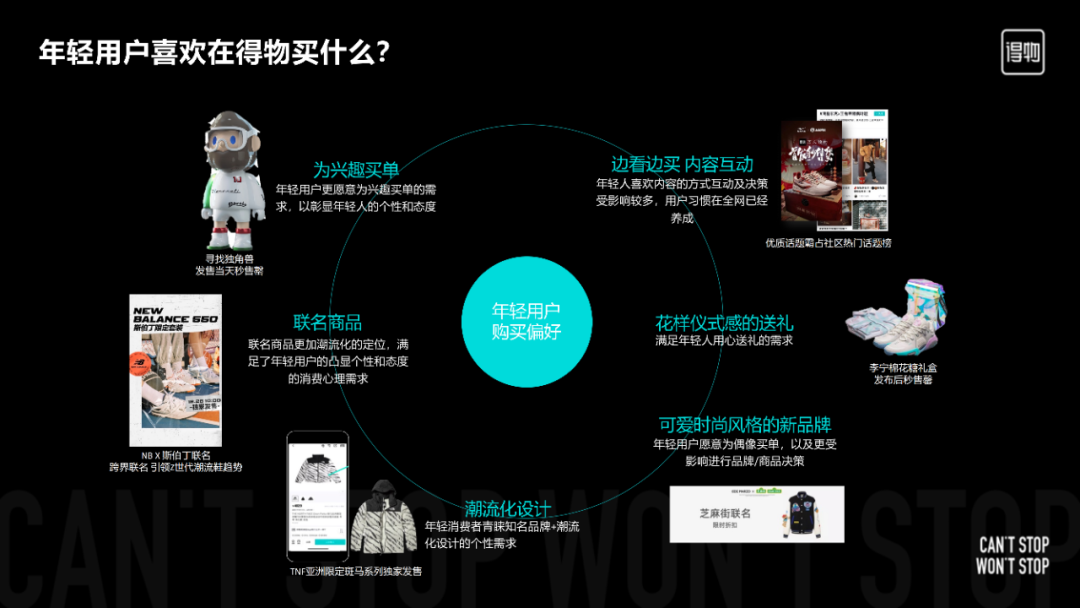
Dewu also strives to improve user experience through great content, great products, great prices, and great service.
Great content: Content featuring gift-giving, quality, brand culture, nostalgia, value alignment, and celebrity favorites resonates most with users.
Great products: Hot new releases, major brand launches, and domestic trendy brands. These differentiated product offerings are more likely to gain traffic from their very first day on the platform.
Great prices: Users certainly care about absolute prices and value-for-money; when products hit their value-for-emotion mindset, they're also willing to pay.
Great service: At the product level, Dewu aims to support consumer decision-making at every step with authentic, rich information. All product decisions are backed by extensive data and a genuine consumer-first approach — customer service inquiries, frequent questions, and negative feedback are all traced back and used for continuous iteration.
-
The "Style Picks" section features community-sourced content helping users better visualize how products look and feel when worn — essentially a premium version of buyer showcases;
-
The "Product Reviews" section aims to present genuine user experiences, including pros, cons, and neutral feedback. Going forward, it will aggregate more structured information from users' post-purchase experiences and brand perceptions;
-
Innovative product detail pages — for example, perfumes list top, middle, and base notes; bags specify whether they fit iPhones or iPads;
-
Proprietary AR try-on features.
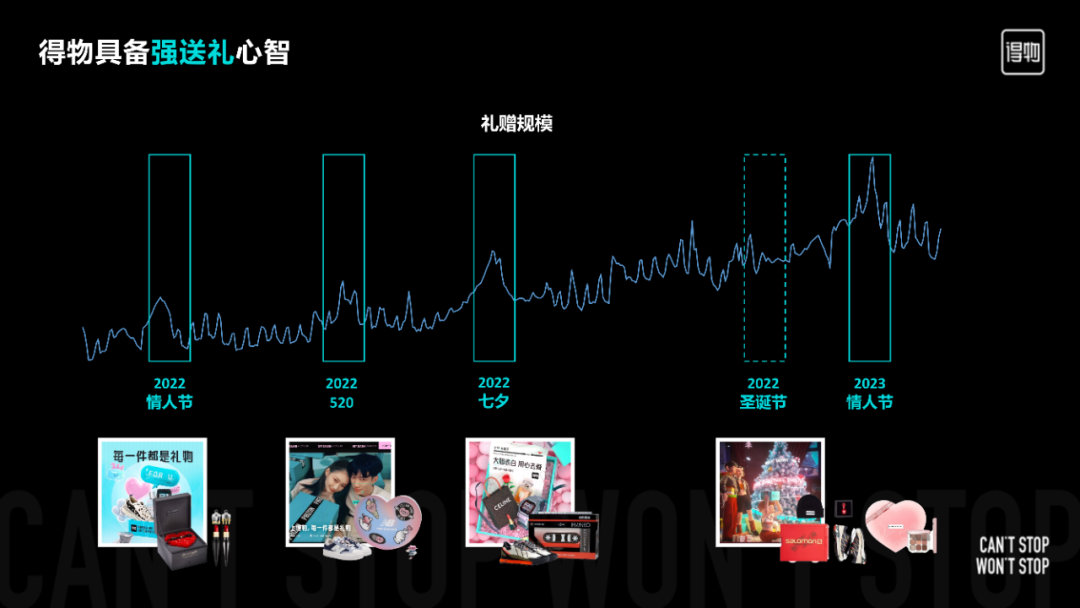
For brand marketing, beyond traditional e-commerce mega-sales events, Dewu has four distinctive marketing moments — Valentine's Day, 520, Qixi Festival, and Double Year-End. Data shows Dewu users average 2.8 trendy gift purchases annually, with these moments driving sustained high-speed growth. This reflects how gift-giving and cultivating close relationships are important parts of young people's daily lives.
Dewu Beauty Enters the RMB 10 Billion GMV Club
David, Head of Beauty and Personal Care at Dewu
Dewu's beauty category adds tens of millions of new users annually, with a compound growth rate nearing doubling over the past three years. GMV has continued growing, entering the RMB 10 billion club. Dewu beauty users have relatively high average order values, and latest Q3 data shows strong repurchase intent, meaning users' mindset to buy beauty on Dewu is strengthening.
In terms of user profiles, Dewu's total addressable beauty user base is in the hundreds of millions, with a large active customer pool. The overall demographic is very young — 26-30 is the core group, followed by 18-25. For male beauty users, 18-25 is the core group, making Gen Z males an important growth demographic worth brands' attention.
From a product structure perspective, Dewu segments beauty into luxury, premium, mass, and entry-level tiers. Luxury and premium together exceed 60%, while the mass tier — dominated by domestic and new consumer brands — exceeds 30%, reflecting Dewu beauty users' openness to domestic brands.
In transaction structure, Dewu's marketplace contributes the highest conversion for beauty products, followed by the community, so brands can make corresponding arrangements on the platform.
How does Dewu empower beauty brands? First, Dewu gathers many trendy KOLs and KOCs who can help beauty brands successfully break into trendy crowds — Fashion + Beauty. As a heavily marketing-driven category, gift season is an important explosive growth moment where Dewu helps beauty brands create entirely new incremental demand. Brands can develop gift-oriented products with distinctive positioning, with Dewu collaborating on design, content, and community co-creation. More importantly, young users show high willingness to try new beauty products, so Dewu serves as an excellent testing ground where brands can make their first connection with young users — letting them discover their first lipstick, first serum on Dewu, implanting brand philosophy from that moment, and growing alongside users.

Dewu 3C: Still a Blue Ocean
Leo, Head of Digital and Home Appliances at Dewu
Dewu's 3C category continues to achieve high growth despite overall headwinds in consumer electronics. This is driven by two dimensions of user demand: young users tend to purchase high-value standardized products on Dewu, such as premium flagship phones, high-end computers, and tablets; while also showing strong demand for low-unit-price items like phone cases and power banks. Currently, audio, smart devices, office equipment, 3C accessories, and computer peripherals present significant brand opportunities on Dewu — still a relatively blue-ocean market.
These consumption patterns stem from Dewu 3C users being quite different from all-channel demographics. Over 80% of Dewu 3C users are under 26 — even younger than Dewu's overall platform demographic. Typical profiles include students, young professionals early in their careers, and users in third- and fourth-tier cities, all showing strong spending power.
Like other categories, Dewu 3C users show strong gift-giving demand. For example, keyboard buyers are nearly 50-50 male-female, with many female users choosing keyboards as gifts; bundles also show strong growth; and fashionable, accessory-like 3C products are popular.
So what business opportunities do 3C brands have on Dewu? During major product launches, Dewu drives pre-launch community discussion to build buzz; collaborates with trendy users and KOLs to associate brands with fashion trends; and meets differentiated demand through co-branded releases and customized products.
Dewu Art Toys: Rising Consumption in Third- and Fourth-Tier Cities
Zhang Yansen, Head of Art Toys Category Operations at Dewu
Dewu art toy users differ notably from other categories: young users in third- and fourth-tier cities are gradually exceeding those in first- and second-tier cities, partly due to meeting gift-giving needs in these markets.
IP is crucial for art toys. IP serves as an important vehicle for connection, and Dewu consumers have particularly strong demand for IP — IP can drive significant sales and attention. Disney and JELLYCAT, for example, perform very well on Dewu. IP collaborations are also an important brand operation method today for art toys and beyond, with value in cross-pollinating between different IP fan bases.
Drawing from art toy operations experience, new brands entering Dewu should prioritize three things. First, ensure basic product supply and reliability. Second, continuously iterate content strategy — good content has commonalities, but traffic algorithms differ across platforms. For example, operating well in Dewu's Style Picks section can drive baseline conversion rates; data shows that for every additional grid shown in Style Picks' 9-grid cards, product conversion rates improve accordingly. Third, co-create more with Dewu, which will match resource packages to new brands to help them break through early on.
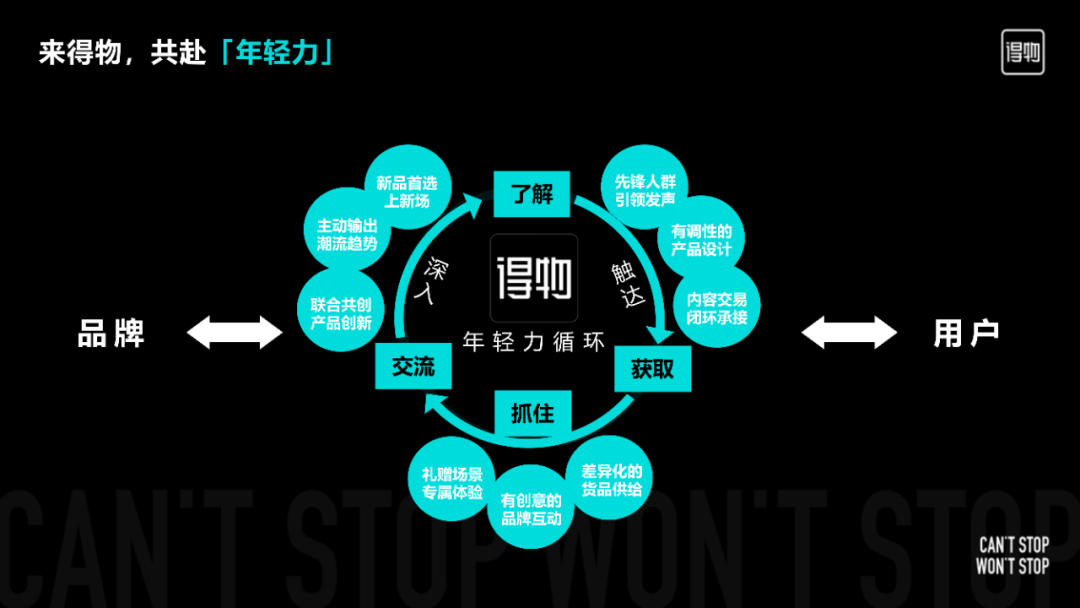
Product trends and scene trends favored by young people constantly evolve, but the underlying pursuit of quality living and emotional value endures. Based on these insights, Dewu will engage brands in comprehensive, diversified collaboration spanning onboarding, new product launch testing, and even marketing, sales, and product co-creation — together embracing youth power.
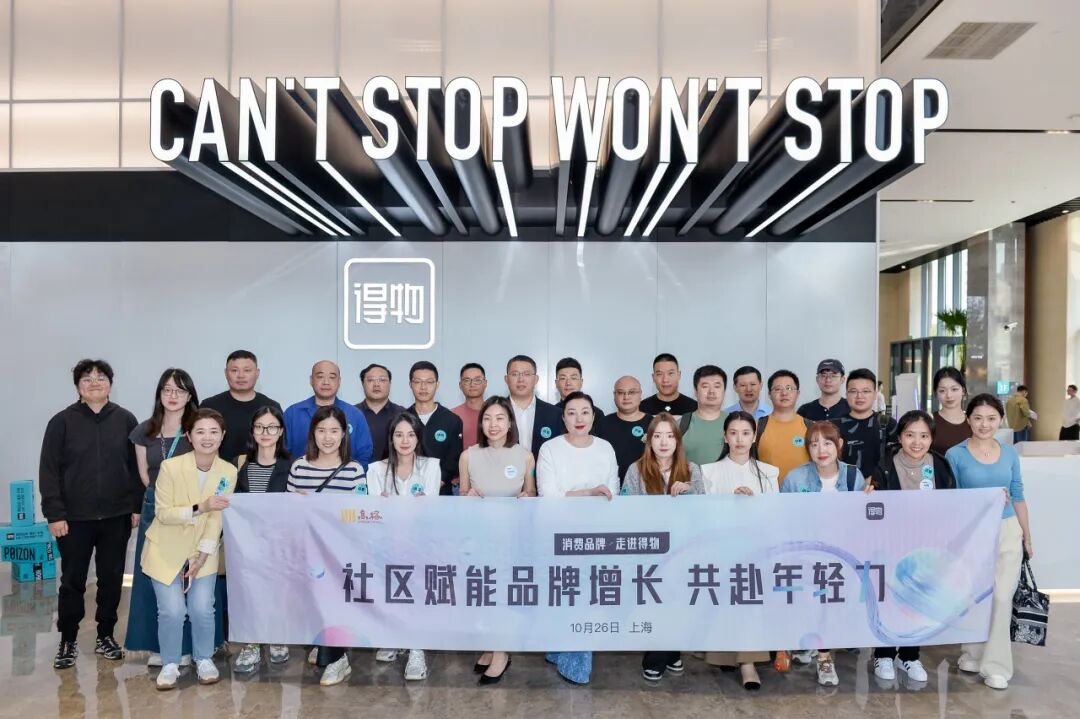




Swipe to see more event moments