XR chip developer GravityXR has raised tens of millions of RMB across angel and Pre-A rounds within six months

Focused on tackling XR-dedicated smart chips.
GravityXR, an XR chip R&D company, recently announced that it has raised several hundred million yuan across angel and Pre-A rounds within six months. The angel round was led by Gaorong Ventures, with participation from Sequoia Capital, IDG Capital, and GSR Ventures. The Pre-A round was led by a world-renowned XR industry leader, with co-investment from Gaorong Ventures, Sequoia Capital, Lenovo Capital and Incubator Group, Yaotu Capital, Zhuiyuan Ventures, 37 Interactive Entertainment, MiraclePlus, Yuanyang Capital, and 5Y Capital. The funds will be used for technology R&D, talent acquisition, and market expansion.

Developing Dedicated XR Smart Chips
Optimizing End-Device Hardware Experience
XR (Extended Reality) is the umbrella term for VR (Virtual Reality), AR (Augmented Reality), and MR (Mixed Reality). As the metaverse wave rises, XR — the gateway to the metaverse — is poised to become the next-generation mobile computing platform, bringing comprehensive transformation to how we live and work.
In the XR field, chips and related software and hardware technologies serve as the core underlying technologies that determine the end-user experience. Founded in September 2021, GravityXR is tackling XR chip R&D head-on. "Hardware development is the foundation of the XR industry's growth. Chips, displays, and optics represent the highest value nodes in XR hardware costs, and dedicated XR chips are a critical step in optimizing end-device experiences."
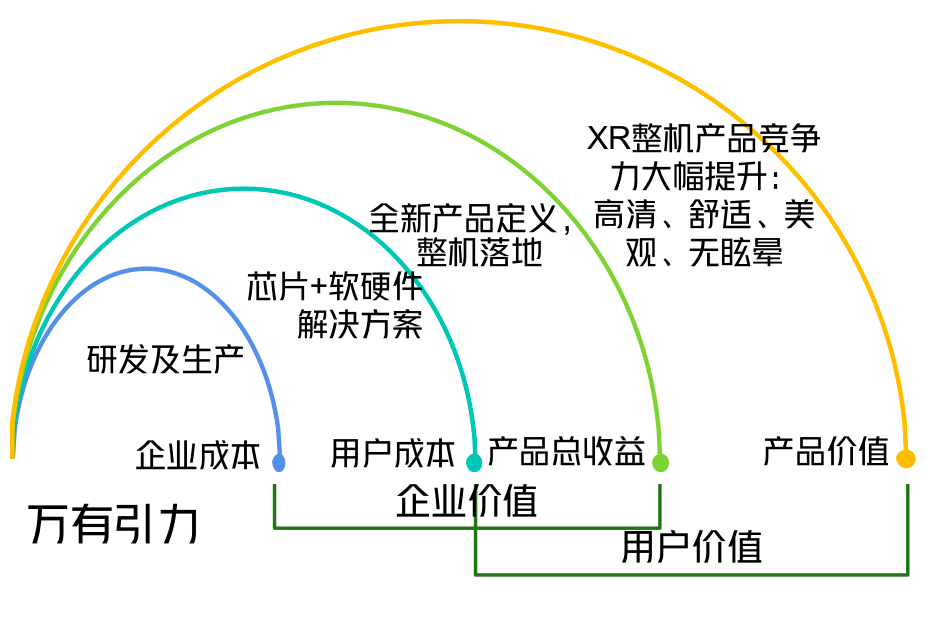
For a long time, VR headsets and AR glasses have relied on chips designed for smartphones and tablets. Traditional chip suppliers typically adapted general-purpose chips for VR devices, and current industry-standard chips cannot support retina-level clarity, leaving room for performance optimization. Yet having dedicated components marks a product's maturation — it's an inevitable step. As VR shipments grow and XR research matures, dedicated XR chips are ready to emerge.
GravityXR's CEO previously led R&D teams at Apple for years, accumulating extensive experience in XR hardware. The core founding team brings deep expertise in chip R&D and the consumer electronics industry, having held key technology and product positions at Apple, Huawei HiSilicon, Meta, and Amazon. They possess substantial capabilities in chips, displays, sensing, computer vision, and AR/VR, with industry-leading technical experience and vision.
"Compared to other domestic players developing dedicated XR chips, the GravityXR team has cutting-edge capabilities in XR hardware component R&D, giving us a core competitive advantage in designing supporting chips from the perspective of end-device experience and performance," the founding team noted. "This combination of skills is rare in China. We're actively recruiting and plan to hire 100 more people by year-end."
First XR Chip Expected to Enter Mass Production in 2024
Solving Four Key Problems
Since its founding, GravityXR has made significant progress in XR chip research and expects to complete mass production of its first-generation chip in 2024. This chip will be the industry's first platform specifically designed for XR applications, featuring highly customized hardware applications and high integration, with customized hardware acceleration for display, sensing, and image processing. It aims to solve four key problems:
First, alleviating the rendering load on the main SoC's general-purpose platform to more intelligently achieve 8K/120Hz;
Second, using video see-through (VST) to address the persistent "motion sickness" problem that has long plagued VR hardware;
Third, enhancing VR/MR image quality, including dynamic high-quality display/optical enhancement and camera processing;
Fourth, providing sufficient flexibility and computing power for sensing technologies, enabling XR headsets to flexibly allocate computing resources across different interactive sensing scenarios.
Embracing a New Chip Platform Ecosystem in the XR Revolution
Every wave of terminal technology innovation has given rise to shifts in chip platform ecosystems. In the smartphone revolution, international chip giants navigated major opportunities and challenges, ultimately forming the current industry landscape. The XR market is unquestionably the most scalable market since smartphones, with the inherent advantages of consumer electronics products.
"We have a world-class Chinese team, and we're working on something with high barriers, high value, and tremendous prospects." Going forward, GravityXR is committed to "breaking barriers and moving toward the future" in the XR revolution.
Bin Yue, founding partner of Gaorong Ventures, said: "The proliferation of AR/VR devices requires dedicated chip support. Currently, only a handful of top global tech companies are engaged in this kind of R&D. GravityXR's founder has a deep understanding of the AR/VR technology stack. Over this period, outstanding talent from world-class tech companies like Apple and Meta has gathered here. The team combines expertise across chips, systems, and algorithms. The chips they develop will drive AR/VR device advancement and improve user experience."