Zenitar Closes Nearly RMB 400 Million Series B+ Round, Multiple Global First-in-Class Drugs Enter Pivotal Clinical Trials

Structural Biology and AI-Driven Innovative Drug Discovery and Development

Zenitar (成都赜灵生物医药科技有限公司) recently announced it has raised nearly RMB 400 million in new funding. The round was led by Qiming Venture Partners, with participation from Gaorong Ventures, Jifeng Capital, Qiji Investment, 5Y Capital, and Zhongyuan Investment. Sichuan Biomedical Industry Group continued its investment in the company.
The proceeds will primarily be used to advance multiple globally competitive innovative drug candidates into pivotal Phase III clinical trials, and to support continued expansion of its R&D pipeline. At the same time, Zenitar will strengthen its three core technology platforms — its structural biology platform, AI-driven drug design platform, and organoid-PDX dual-track validation platform. Leveraging these platforms, the company is accelerating the development of differentiated molecular scaffolds and novel-target innovative drug pipelines, with the goal of addressing unmet clinical needs.
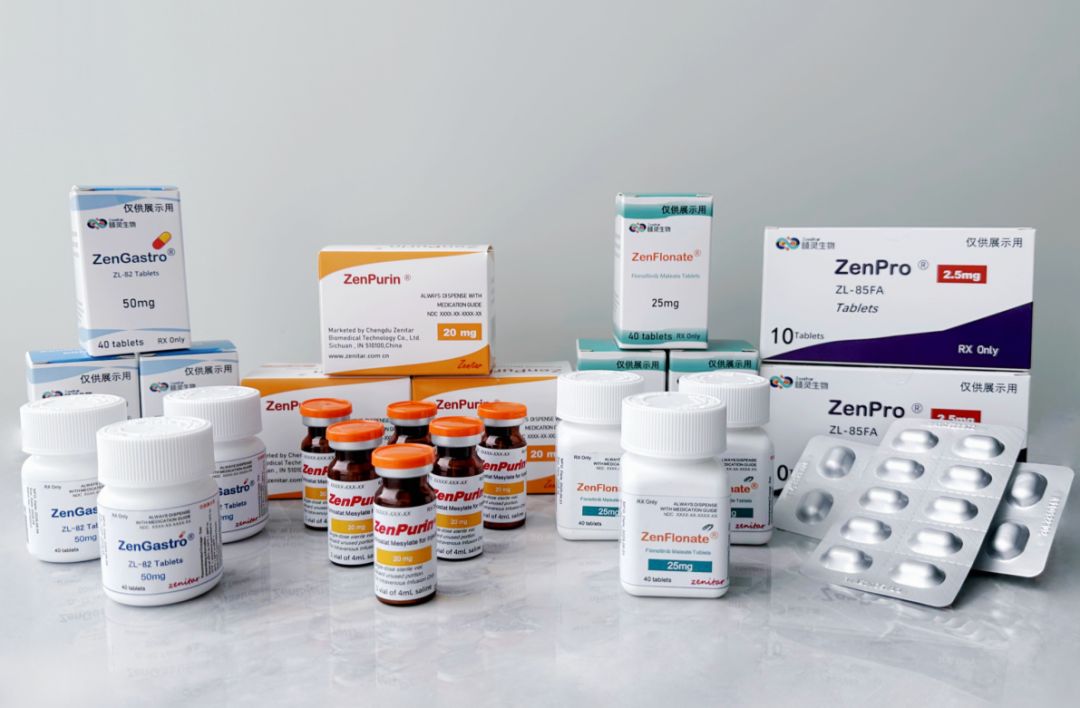
Zenitar's clinical-stage drug candidates ZL-82, PM, FM, and ZL-85FA (left to right) on display

Self-Developed, Globally Competitive
Worldwide Rights Portfolio
Founded in 2019, Zenitar is a structural biology and AI-driven innovative drug discovery company. The company focuses on major unmet medical needs, concentrating on oncology, autoimmune diseases, inflammation, and neurological disorders. It is committed to discovering, developing, and commercializing First-in-Class and Best-in-Class innovative drugs. Zenitar has built a comprehensive innovation platform covering the full lifecycle of new drug R&D, with end-to-end capabilities spanning AI molecular design, structural biology, organoid-based high-throughput screening, PDX model construction, CMC research, clinical strategy and execution, and new drug registration — continuously enabling efficient translation from source innovation to clinical value.
To date, Zenitar has independently developed seven differentiated, globally competitive drug candidates with worldwide rights, building a pipeline across multiple major disease areas. One indication has entered pivotal Phase III trials, and five indications are in Phase II.
The company's core product, Purinostat Mesylate (PM), is the world's first highly selective HDAC inhibitor to enter clinical trials as a monotherapy for relapsed/refractory lymphoma. PM monotherapy has completed Phase I trials for hematologic tumors and Phase IIa/IIb trials for relapsed/refractory diffuse large B-cell lymphoma (r/r DLBCL) in multi-center studies across China. It is also simultaneously undergoing Phase I/II trials for T-cell lymphoma, solid tumors, and breast cancer. In the Phase IIa study for r/r DLBCL, PM achieved an objective response rate (ORR) of 69.0% — non-inferior or superior to the ORR of approximately 50%-65% seen with bispecific antibody and ADC combination therapies. The product has now successfully advanced into pivotal Phase III clinical trials.
Another major product, Flonoltinib Maleate (FM), is a highly selective JAK2/FLT3/CDK6 triple-target inhibitor with First-in-Class potential that has demonstrated significant and breakthrough efficacy in the clinical development for myelofibrosis (MF). In the primary endpoint (IRC-assessed spleen volume response rate at 24 weeks), over 80% of patients in the FM treatment group achieved ≥35% reduction in spleen volume (SVR35). In some FM-treated patients, significant reduction in bone marrow fibrosis (assessed by serial bone marrow biopsy pathology) was observed, with some cases showing signs of histological reversal. Flonoltinib Maleate is expected to become an important treatment option for patients with myeloproliferative neoplasms, driving evolution in the therapeutic landscape for this disease. Its unique, globally first-in-class mechanism of action and observed clinical benefits position it as a potentially superior therapy in myelofibrosis — an indication with substantial unmet medical need — and it is about to enter pivotal Phase III clinical trials.
To date, Zenitar has accumulated 34 invention patents, including 17 international invention patents; an additional 45 international and domestic patent applications are pending. The company has obtained a total of 19 clinical trial approvals from China's NMPA and the US FDA.
By deeply integrating its three core technology platforms — "structural biology analysis," "AI drug design," and "organoid-PDX dual-track validation" — Zenitar has successfully built a unique "end-to-end" innovative drug discovery engine, seamlessly spanning the full R&D chain from target validation, molecular design, and molecular optimization to in vivo validation. This continuously drives original innovative drugs with novel target mechanisms and differentiated molecular structures into clinical development, addressing major unmet medical needs worldwide.
Small-Molecule Drug Discovery Platform
Integrating Structural Biology and AI Drug Design
Zenitar's trinity innovation engine combining structural biology, AI drug design, and organoid-PDX dual-track validation continuously empowers global new drug R&D. Leveraging its deep expertise in structural biology analysis, the Zenitar team has, for the first time globally, revealed three novel drug-binding sites on tubulin and their unique mechanisms of action — a milestone original discovery that establishes an entirely new structural foundation and design paradigm for developing next-generation tubulin-based ADC payloads.
To address the molecular design and optimization bottlenecks in small-molecule innovative drug R&D, the company has independently built multiple original AI drug design algorithm modules: the Local Structure-Directed Compound generation algorithm (LSDC) — significantly enhancing molecular scaffold diversity and efficiently exploring novel chemical space; the multi-dimensional coarse-grained data fusion molecular generation algorithm (CMD-GEN) — improving molecular generation efficiency and precision while optimizing design pathways; and the physics formula-guided brain permeability prediction algorithm (CMD-FGKp, uu) — enabling high-precision prediction of drug brain delivery potential (Kp, uu) to accelerate central nervous system drug development. This matrix of innovative algorithms substantially enhances the innovativeness of molecular design, the accuracy of druggability prediction, and overall R&D efficiency.
High-Throughput Organoid Screening Platform and
PDX Pharmacodynamics Evaluation Platform
In building its preclinical research system, Zenitar has leveraged the rich industry-university-research integration resources of West China Hospital, Sichuan University to construct an organoid drug screening platform covering major and refractory tumors including liver cancer, gastric cancer, colorectal cancer, pancreatic cancer, breast cancer, and glioblastoma. This platform highly simulates the authentic tumor microenvironment of patients, significantly shortening early-stage drug screening cycles and improving the reliability of preclinical predictions and the success rate of clinical translation.
At the same time, drawing on long-term technical accumulation, the company has systematically built PDX model platforms covering multiple genetic mutations and drug resistance patterns for hematologic tumors including B-cell lymphoma, T-cell lymphoma, and leukemia, while also establishing PDX models for various solid tumors including breast cancer, gastric cancer, and pancreatic cancer. For customized R&D needs targeting specific targets and mechanisms, the company can also precisely develop primary mouse models through retrovirus-mediated and bone marrow transplantation techniques, providing full-chain support for innovative drugs from molecular design to in vivo validation.
Accelerating Global Expansion
The participation of multiple professional investment institutions in this round fully reflects market recognition of Zenitar's R&D achievements and future potential. Zenitar will continue to adhere to its innovation-driven strategy, accelerate its pace of global expansion, further unleash its platform advantages in frontier areas such as structural biology and AI drug design, continuously enhance the adaptability and competitiveness of its products in international markets, and work with global partners to create a new pattern of multi-party win-win outcomes.
Professor Lijuan Chen, founder of Zenitar, stated: "The rapid completion of this financing round fully demonstrates investors' high recognition of our development strategy and R&D achievements. With two core products entering pivotal Phase III clinical trials, the company is firmly advancing toward international development. 2025 will be the inaugural year of Zenitar's globalization. We will accelerate our overseas market layout and advance toward the center stage of global innovative drugs."