From AI New Species to AI New Ecosystem | BlueRun Ventures at WAIC 2026
Moving Together Toward New Frontiers of Capability
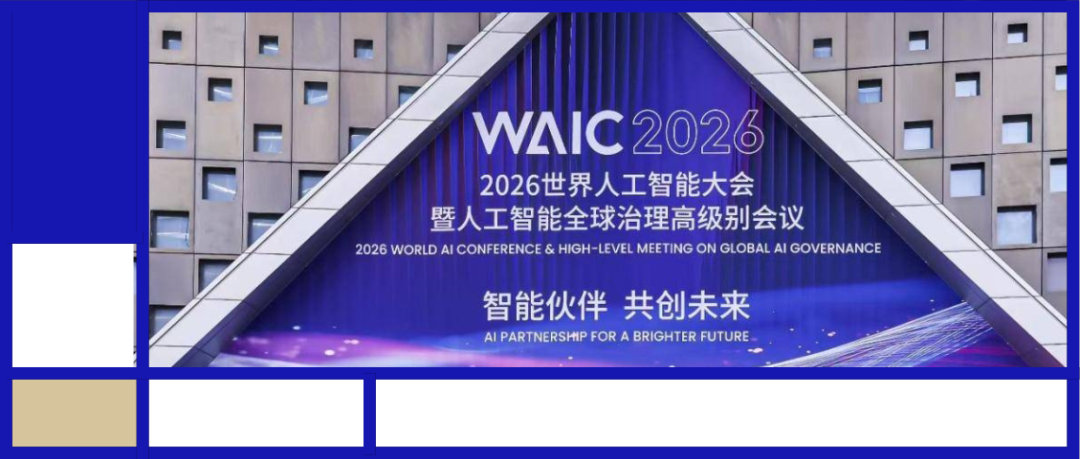
At WAIC 2026, AI edged a little closer to the real world.
On the exhibition floor, robots completed precision assembly, swarm collaboration, and long-horizon dexterous manipulation. They also navigated visitors through the venue and prepared complete breakfasts. Agents were no longer just chat windows — they began to have their own runtime environments and infrastructure. And with the release of Kimi K3, foundation models started to acquire long-horizon intelligence.
As an early-stage investor that has long tracked the evolution of AI and robotics at the底层技术 level, BlueRun Ventures has always believed that the progression of robotics and AI will gradually expand capability boundaries in real-world scenarios — from simple tasks to complex ones, from single-machine capabilities to system-level collaboration, from the lab to the factory floor.
At this year's WAIC, we were glad to see portfolio companies Moonshot AI, AgiBot, Galaxy Universal, Sudu Tech, Tashi Zhihang, Proto-Sentient Intelligence, Youibot, and PPIO showcase their latest products and technical achievements.
We will continue to walk alongside entrepreneurs, focusing on technologies that enter the real world and create lasting value.
Here are our observations from WAIC 2026. Enjoy:


Moonshot AI released its next-generation open-source model, Kimi K3. As the world's first open-source model at the 3-trillion-parameter scale, K3 is designed for complex tasks including long-horizon programming, knowledge work, and reasoning — marking a new step forward in model scale, engineering capability, and real-world task performance. More noteworthy than the parameter count is the shift in what models can do: from answering questions to persistently completing complex tasks.
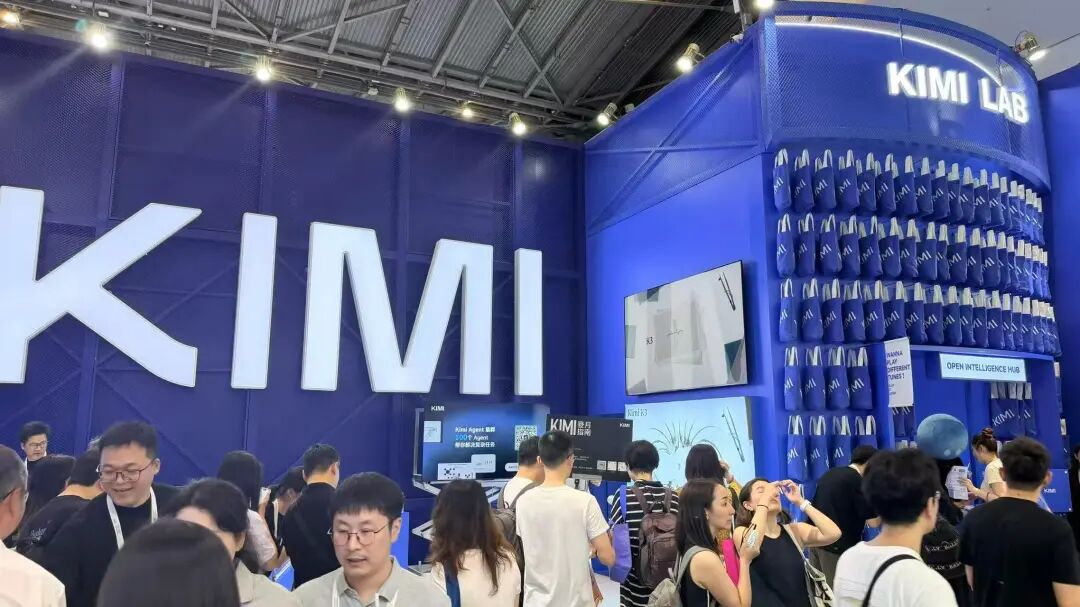
In the official demo, K3 sustained complex software engineering tasks through the full development-to-validation workflow. Beyond programming, K3 can also take on more complex, longer-process knowledge work.
⬆️ Kimi K3 can autonomously retrieve, read, and cross-verify large volumes of literature, generate thousands of lines of code, and complete research analyses that typically take researchers one to two weeks. It can also conduct web retrieval, data organization, industry analysis, and visualization report generation around industrial topics — end-to-end, long-flow work.
Kimi K3 demonstrates that as model scale increases, AI is beginning to sustain real tasks and complete complex work over longer time horizons.


At this year's WAIC, AgiBot's focus was on "deployment state." As robots enter real industrial, commercial, and public service scenarios, they must handle environmental interference, continuous operation, exception handling, and autonomous charging.
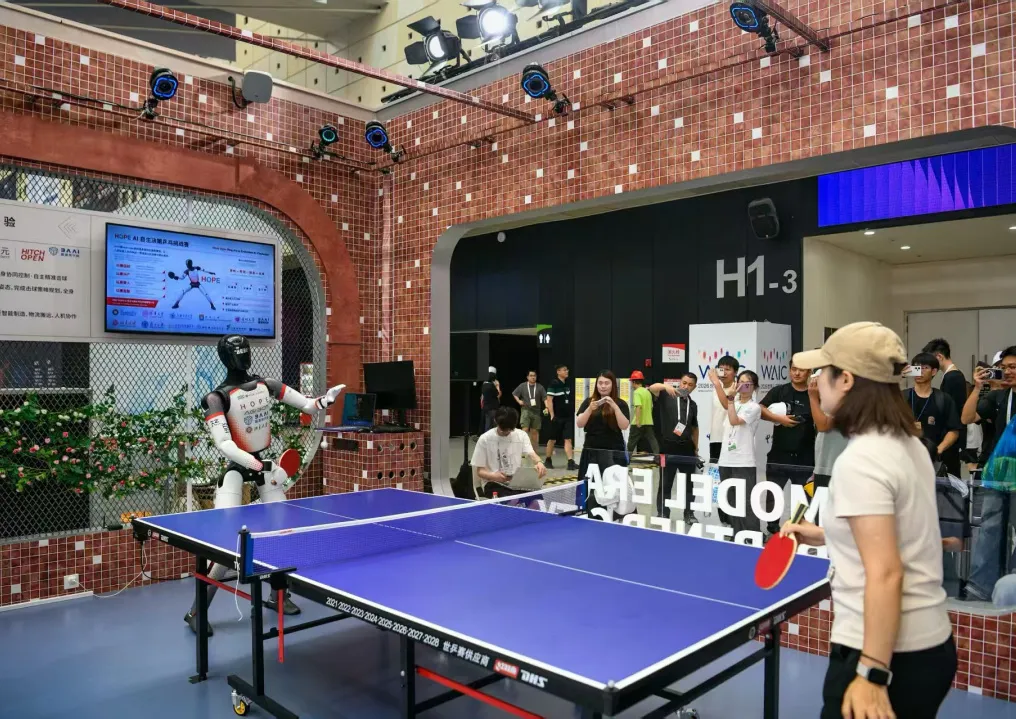
⬆️ Sixty robots of different types were deployed across the main venue and two satellite venues, providing wayfinding and guidance services in public areas.
AgiBot's proposed "Triple Intelligence Integration" architecture coordinates motor intelligence, interactive intelligence, and operational intelligence into continuous workflows — extending to whether systems can run stably, operate continuously, and iterate in real environments.
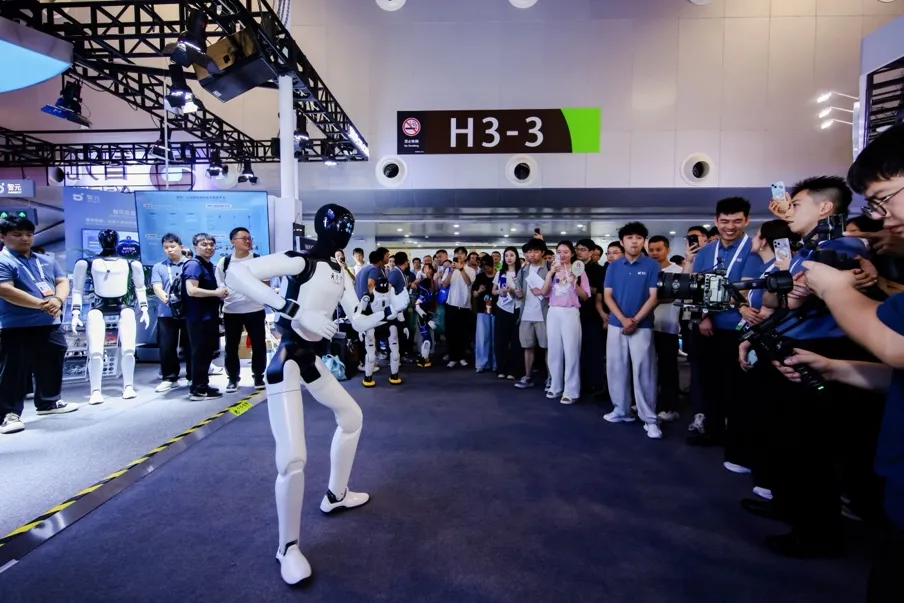
AgiBot also showcased a series of models and learning systems, including the embodied foundation model GO-2, the world model GE-2, and the closed-loop real-machine reinforcement learning system Genie Evolver 1.0. On the product side, AgiBot released the Expedition A3 Ultra, Genie G2 Max, Lingxi X2 EDU, the OmniHand 3 Ultra-M dexterous hand, and a riding robot.


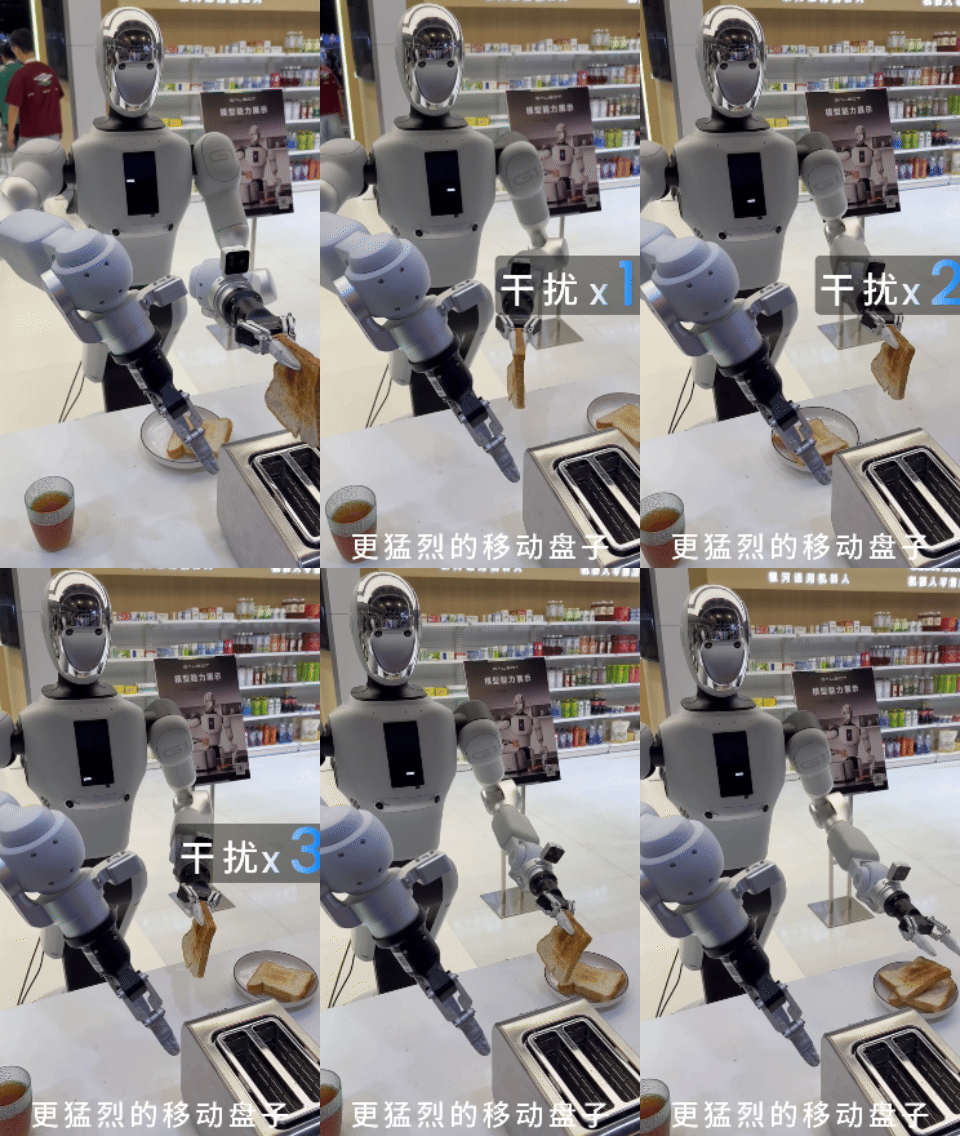
At the Galaxy Universal booth, the Galbot G1 completed a full breakfast preparation workflow, including toasting bread, pouring drinks, and plating. Staff would temporarily move the bread, cups, and other items, and the robot would autonomously adjust amid the interference — demonstrating long-horizon task execution and disturbance rejection.
The heavy-duty robot Galbot S1 demonstrated industrial tasks including screwing on new energy battery housings, transporting 30kg bins, and depalletizing/palletizing. The same robot handles both heavy-load transport and precision assembly, covering industrial workflows from material handling to assembly operations.
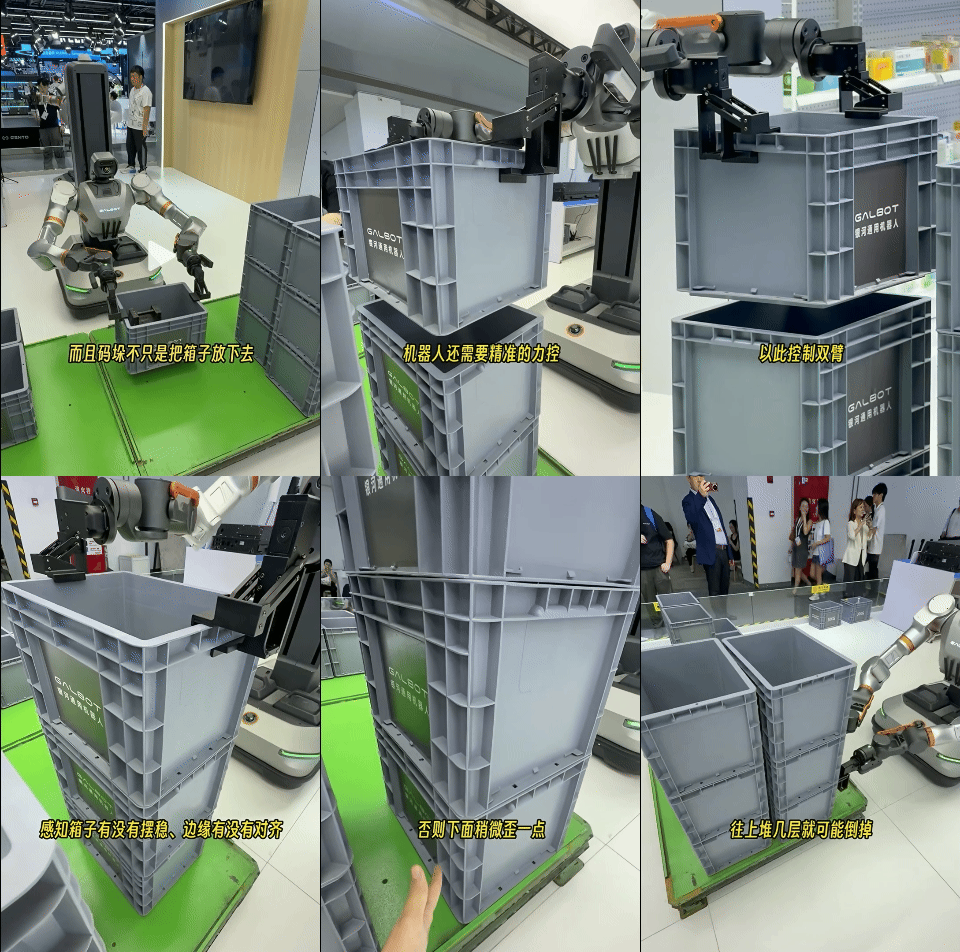
Centered on real productivity, Galaxy Universal demonstrated robots working across commercial service to industrial manufacturing. According to the company, Galaxy Universal robots have been operating autonomously and continuously on production lines at CATL and Bosch Group for over a year, with related capabilities now being validated in industrial scenarios such as new energy manufacturing.


Sudu Tech demonstrated more than ten robot capabilities including dual-arm collaboration, deformable object manipulation, precision assembly, and multi-robot coordination. When Sudu Tech's robot Sudo R1 debuted this April, it mainly showcased grasping capabilities; by WAIC, the robot could complete multiple categories of complex tasks.
This is built on Atomic Skills — Sudu Tech decomposes capabilities such as grasping, pose adjustment, force control, and dual-arm coordination into reusable fundamental units, then assembles them into more complex operations like packaging, assembly, and transport according to task requirements.
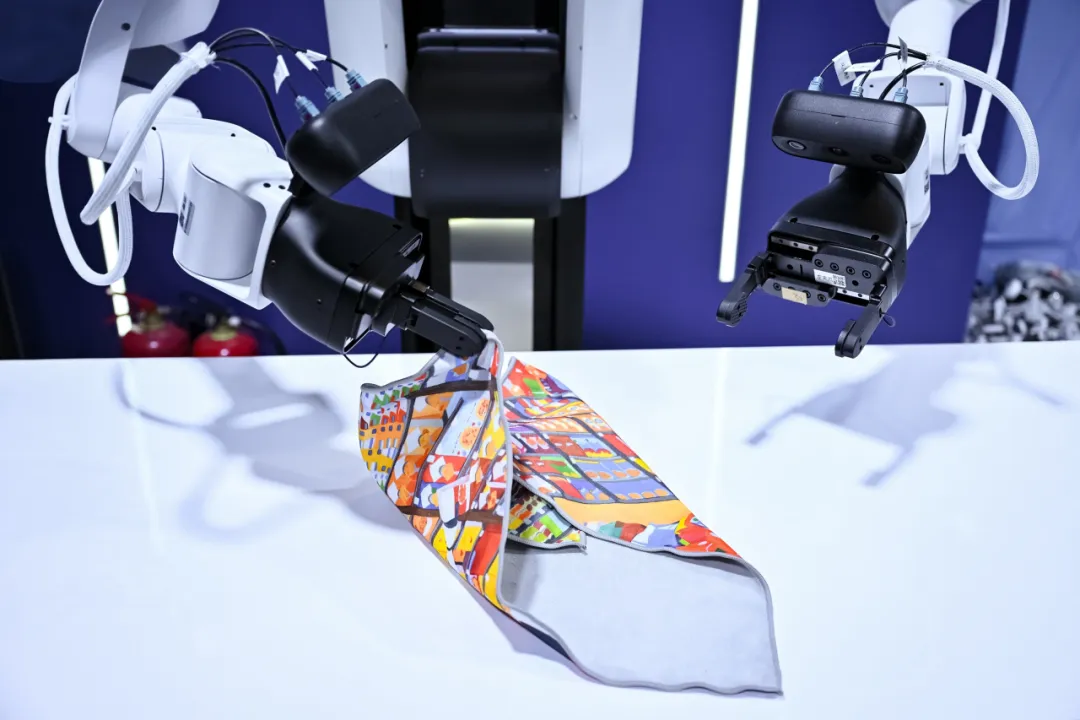
⬆️ Using dual-arm coordination, the robot wraps soft fabric around an object surface. Since the fabric continuously deforms during manipulation, the robot must persistently perceive its state and coordinate both arms to complete the wrapping.
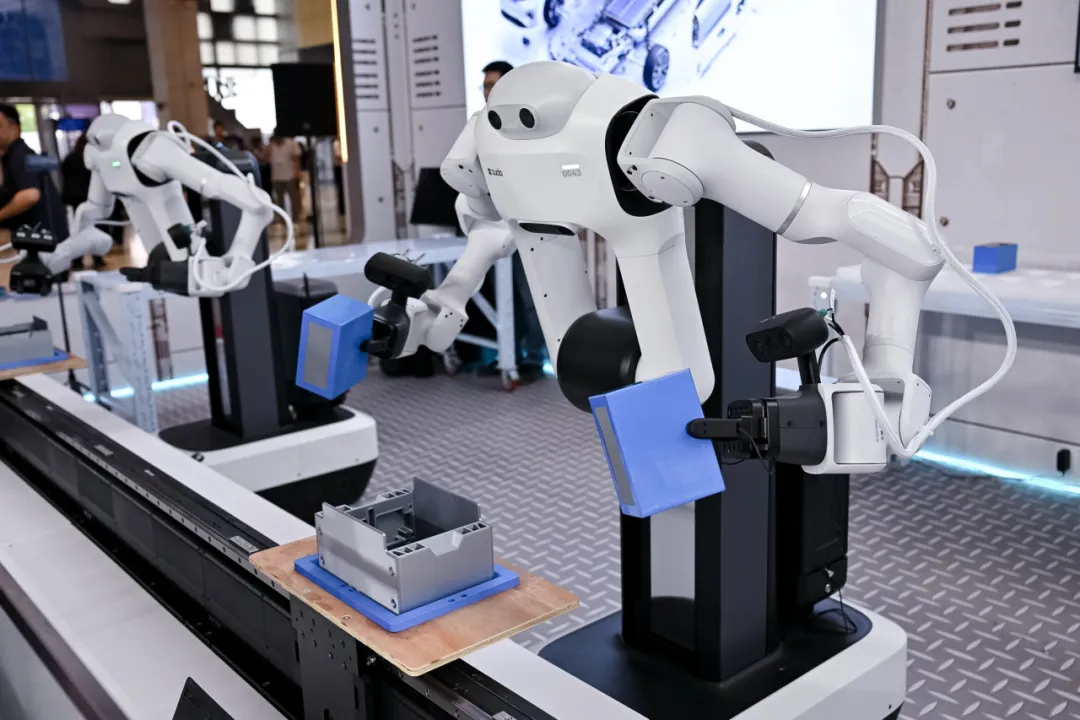
⬆️ The robot also demonstrated bimanual precision assembly: accurately inserting two parts into corresponding holes, involving capabilities including visual localization, dual-arm coordination, pose adjustment, and contact control.


At this year's WAIC, Tashi Zhihang released its next-generation embodied-native foundation model AWE 3.5, winning the conference's SAIL Star Award. AWE 3.5 is trained on over one million hours of human-centric real-world data, improving robots' generalization capabilities and stable execution in real environments.
On the exhibition floor, A1 robots powered by AWE 3.5 demonstrated tasks including phone boxing, backpack packing, and tiny screw sorting — validating the same model's adaptability across different scenarios.
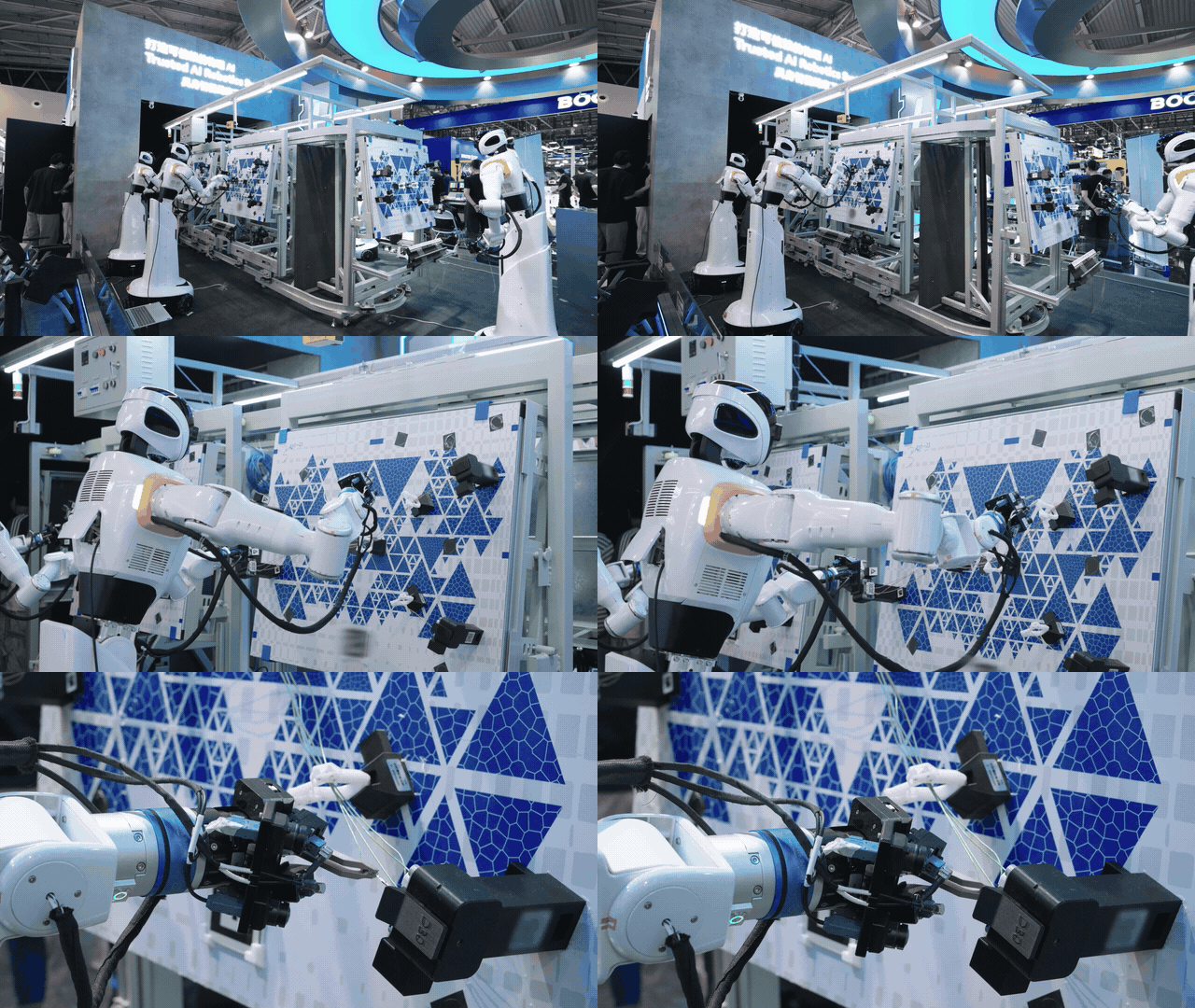
⬆️ Tashi Zhihang also recreated a real automotive wiring harness factory scene on site. Multiple A1 robots formed an operational cluster to complete key assembly processes.
⬆️ The DexHand dexterous hand was also integrated with the AWE embodied model, partnering with magician Deng Nanzi to complete a magic debut performance.
From multi-task manipulation to industrial wiring harness scenarios, Tashi Zhihang validated AWE's generalization capabilities: understanding tasks, transferring to real production lines, and completing precise feedback.


Earlier this year, Proto-Sentient Intelligence released a dual-model architecture composed of the policy model Psi-R2 and the world model Psi-W0. At WAIC, they demonstrated long-horizon dexterous manipulation — adjusting actions and force according to environmental changes to complete continuous, multi-step fine operations.
In the experience zone, visitors could wear exoskeleton gloves to complete grasping, assembly, and other actions. The system synchronously collected multimodal information including vision, touch, and joint data, which the world model then converted in real time into training data robots could learn from.
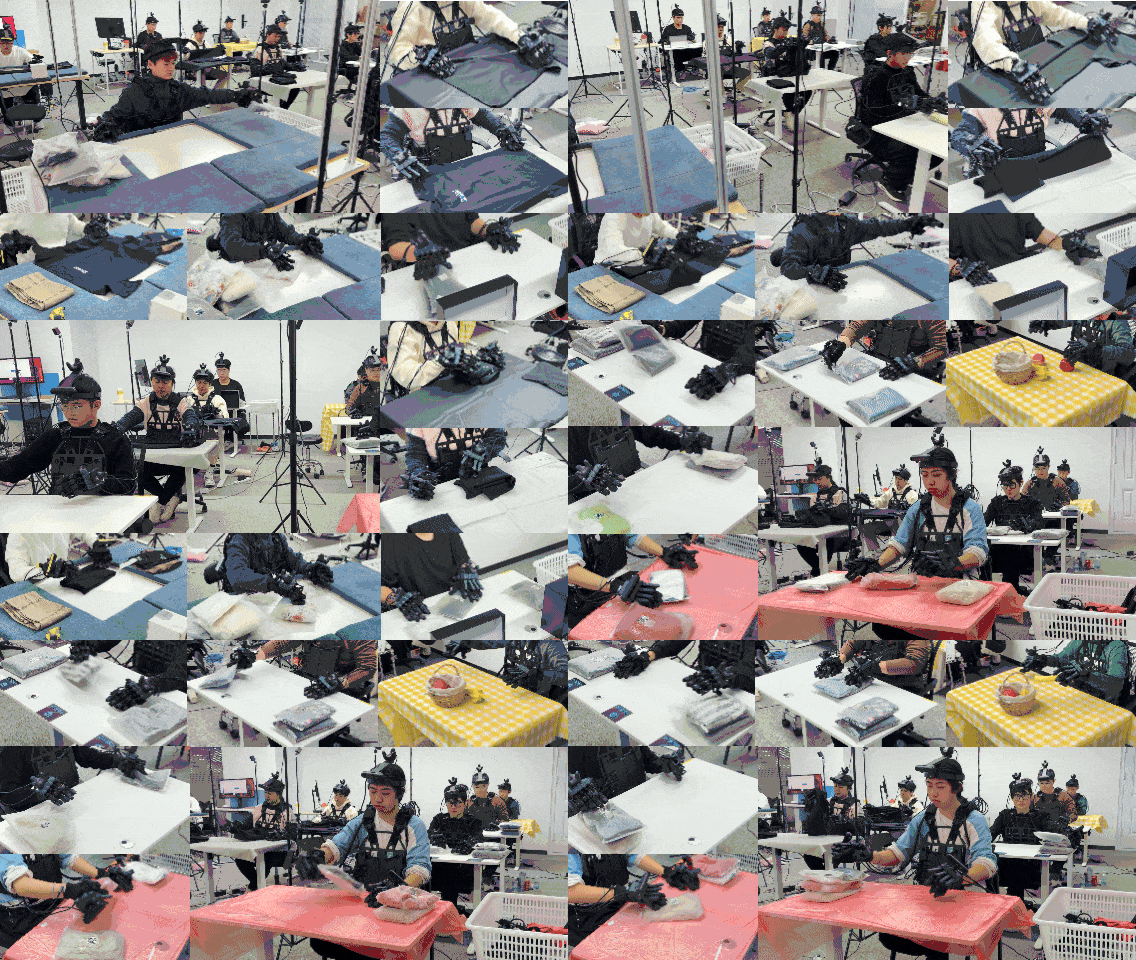
⬆️ Compared to teleoperation collection methods, this approach focuses more on human operational processes in real work environments, providing model training with data closer to real-world scenarios.
Proto-Sentient Intelligence also jointly demonstrated with Yangtze Optical Fibre and Cable (YOFC) a continuous process of optical module inspection, insertion/removal, vacuum packaging, and finished product boxing — letting robots complete long-horizon tasks in real manufacturing workflows.
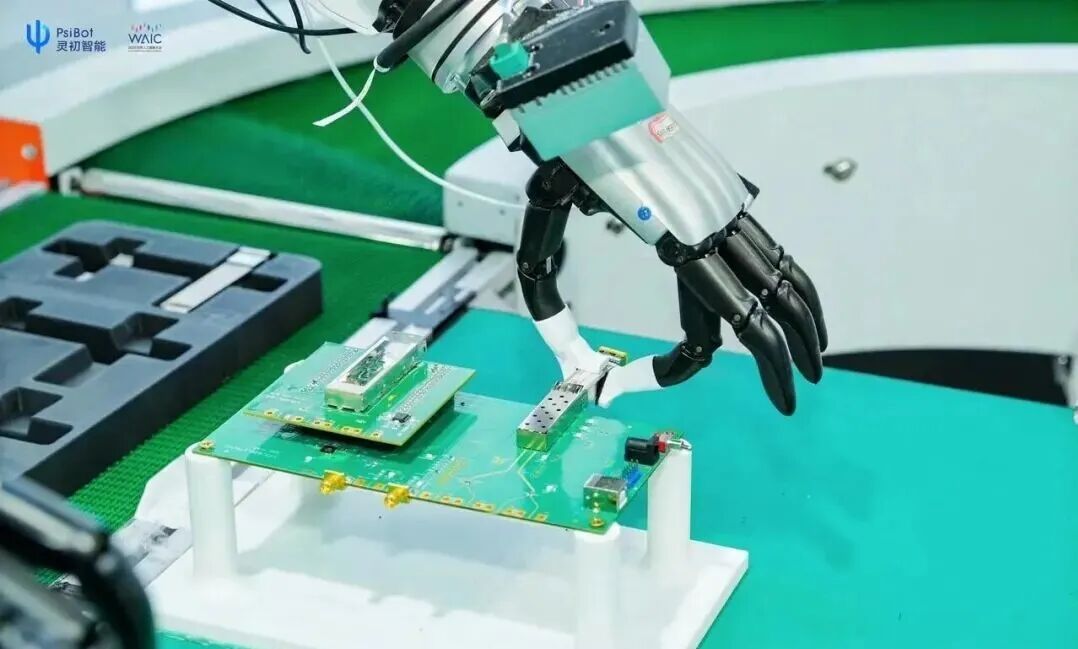
⬆️ The robot continuously completed multiple steps including identification, grasping, inspection, and packaging, demonstrating the application of long-horizon dexterous manipulation in industrial scenarios.


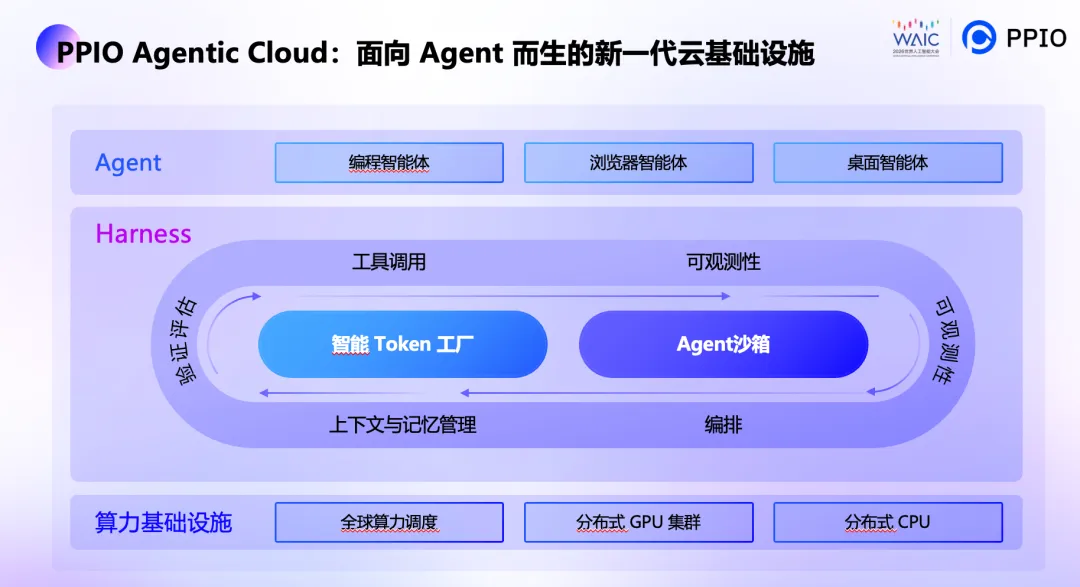
PPIO is an AI cloud computing infrastructure company, primarily providing inference, deployment, and runtime services for large models and Agents. At this year's WAIC, PPIO officially launched its new Agentic Cloud positioning. Co-founder and CEO Bill proposed: "The cloud's first customer is no longer humans, but Agents."
This stems from two layers of infrastructure in the Agent era: the upper layer supports Agent operation, task orchestration, and memory management through Agent Harness; the bottom layer provides more efficient model invocation and inference services for Agents through the intelligent Token factory.
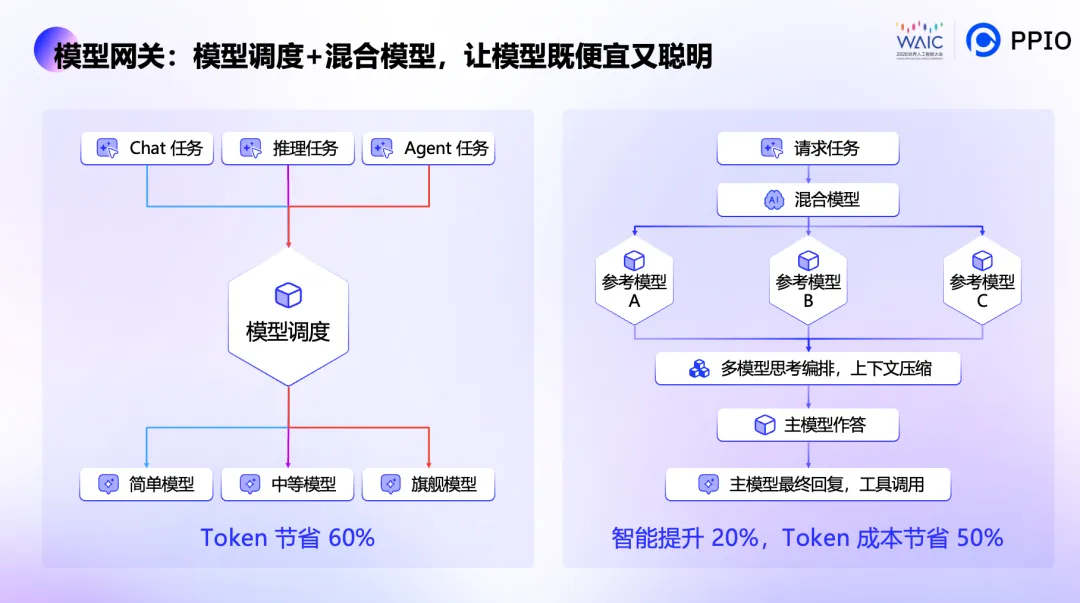
PPIO also released China's first intelligent model gateway. It can automatically select appropriate large models for different tasks: lightweight models for simple tasks, more capable models for complex reasoning, and for critical steps, can employ multi-model fusion (MoM) to complete inference.
Agents can balance inference cost with operational efficiency. Model invocation is also shifting from fixed single-model access to more flexible intelligent scheduling.


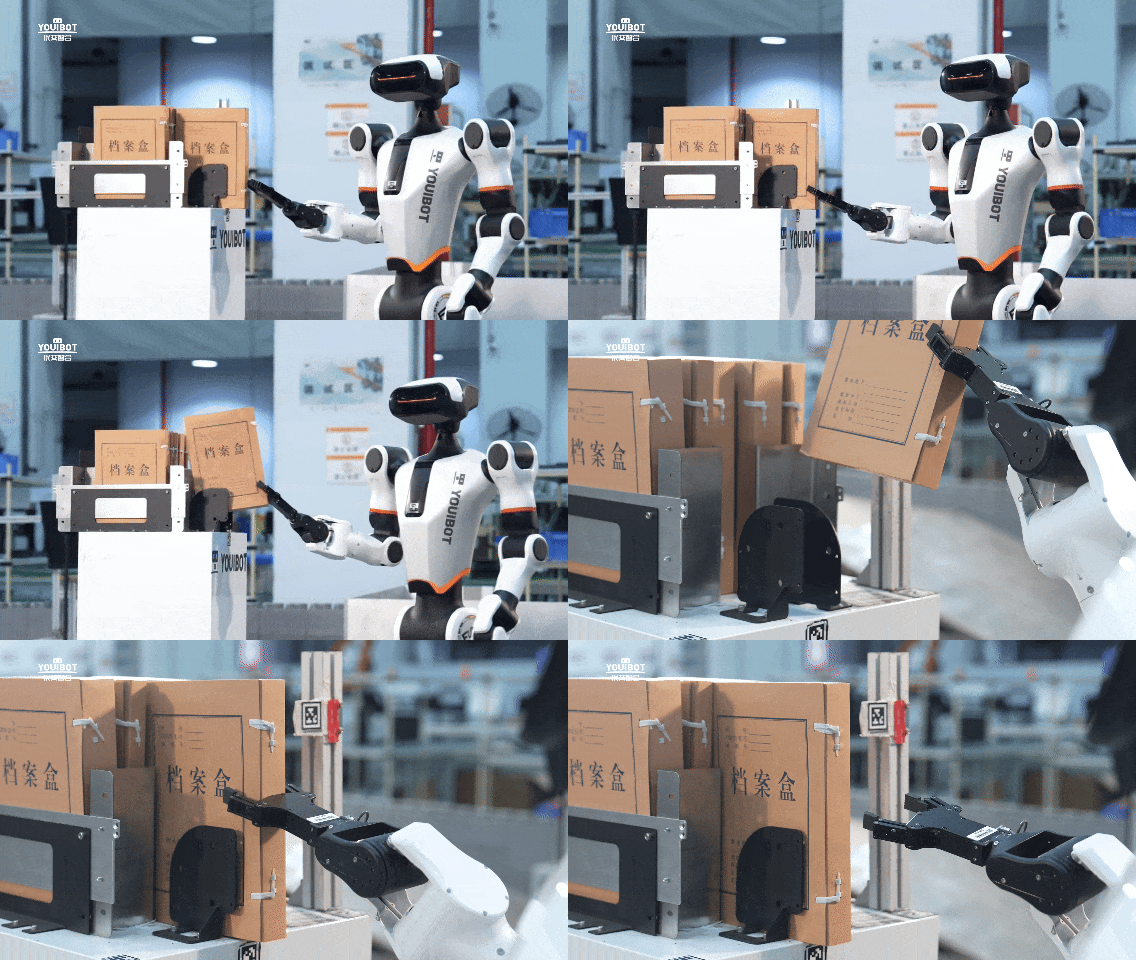
Youibot publicly demonstrated its industrial-native humanoid robot "Xifeng" at WAIC, bringing a miniature industrial production line into the exhibition hall. On the booth, five "Xifeng" robots and one mobile transport robot collaborated as a cluster to complete line-side warehouse material picking, delivery, and other tasks.
This is built on Youibot's proposed "one brain, multiple forms" architecture. The "Xifeng" robot also demonstrated rapid adaptability in industrial scenarios: accumulating data and continuously iterating during operation.
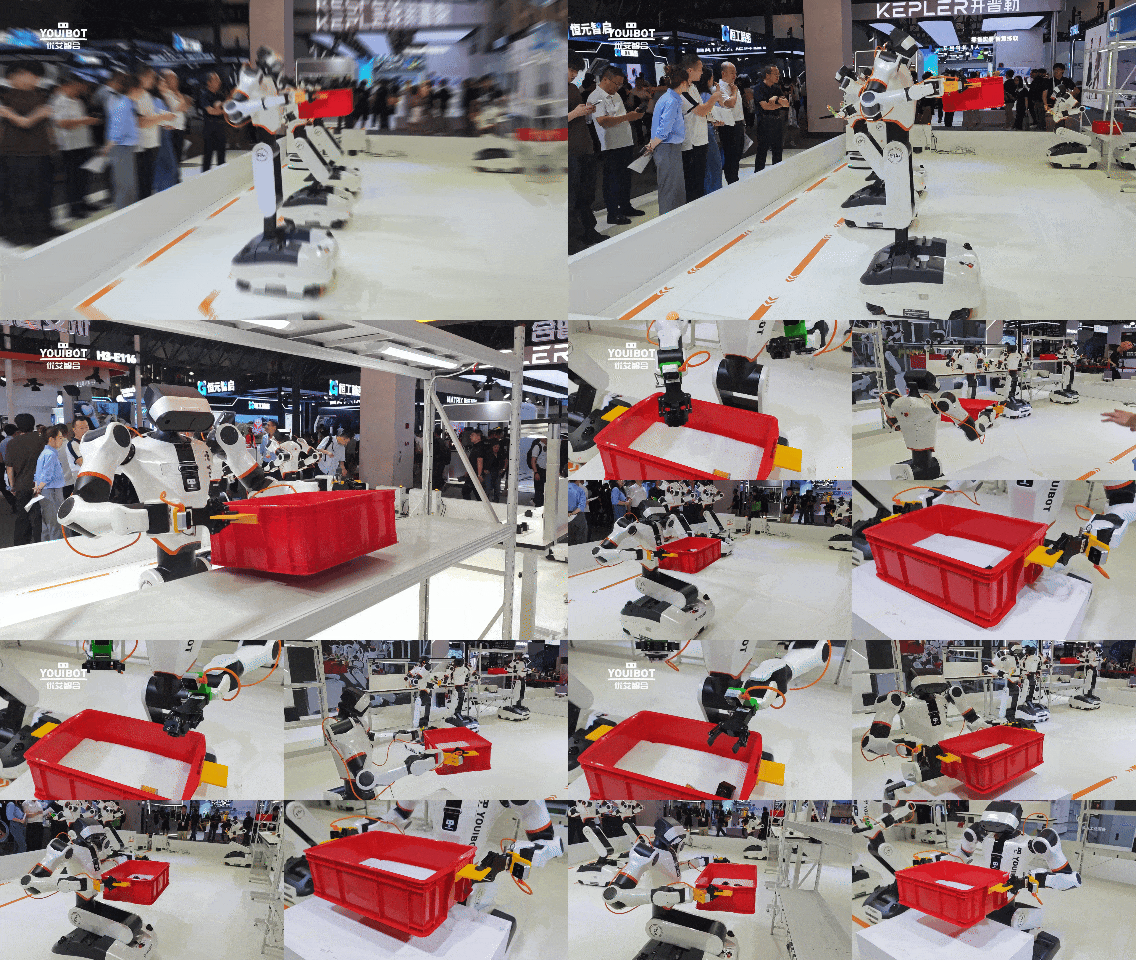
⬆️ Robots of different forms are scheduled by a unified "brain," automatically decomposing processes, assigning tasks, and collaborating to complete entire production line operations.
Another demonstration focused on rapid deployment capability in industrial field environments. The "Xifeng" robot requires only minimal on-site data training to complete new industrial tasks, and through continuous collection of operational data for cyclic training, gradually improves task completion capability.

On the bustling exhibition floor, robots were completing one task after another. Meanwhile, in the forums nearby, the discussion was: what's next, and how will AI change the real world? BlueRun Ventures partners and entrepreneurs shared their observations on the next phase of AI development.
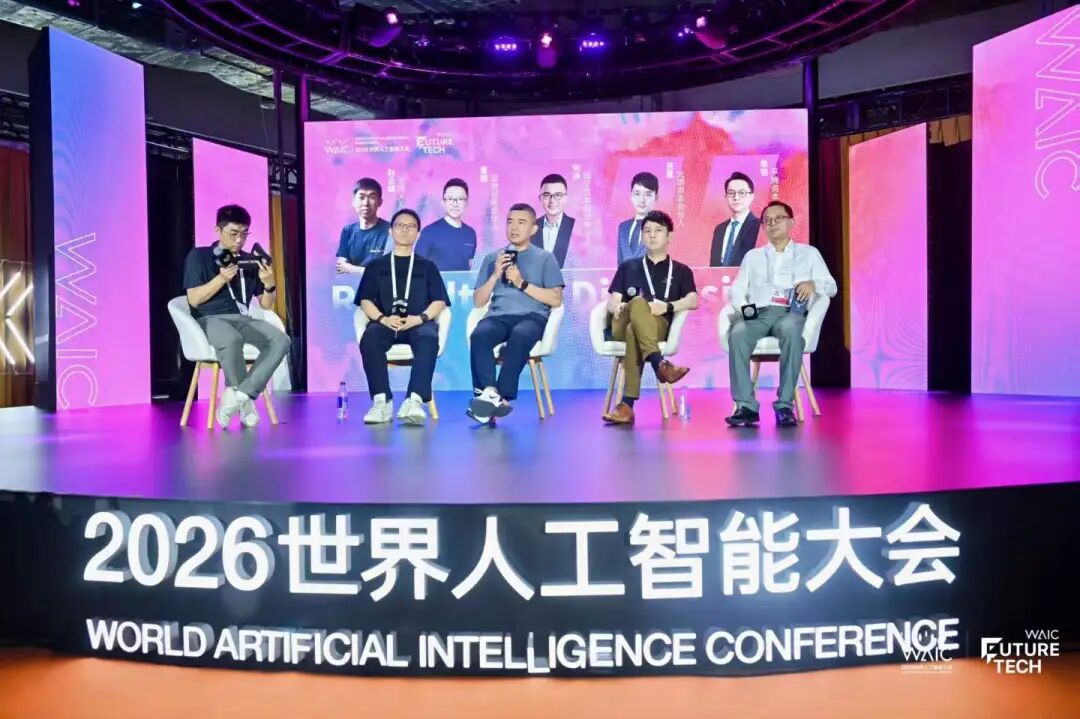

In the roundtable "From Tools to Labor Force — Productivity Restructuring on the Eve of Silicon-Based Civilization," BlueRun Ventures partner Wei Cao argued that AI's impact is not merely about tool efficiency gains, but a shift in who does the work. In the future, humans will increasingly take on roles in process design, supervision, and decision-making, while more and more concrete tasks will be completed by AI and robots.
He believes a defining feature of this wave of AI development is the unprecedented speed at which academic frontiers translate into commercial value. As AI moves from completing simple tasks to complex tasks in complex scenarios, BlueRun is particularly focused on two directions: one is Human-Centric Models — human-interaction models centered on human behavioral data, helping robots adapt to complex environments like homes and society through richer human behavior data; the other is AI-native Agent platforms, enabling ordinary users to access AI capabilities with lower barriers, achieving true "plug-and-play."

In the WAIC main forum roundtable "From Virtual to Real: How World Models Drive Embodied Intelligence," AgiBot partner, Senior VP, President of Embodied Business Division, and Chairman & CEO of Mifeng Technology Maoqing Yao proposed that the core capability of world models is not simply generating the next frame, but predicting the next state of the physical world. This means models must not only understand visual information, but also master physical laws, spatiotemporal relationships, causal reasoning, and other capabilities — thereby helping robots complete perception, decision-making, and action in real environments.
He believes world model development still faces two key challenges: first, insufficient real interactive data — internet video can provide visual information, but struggles to cover push, pull, twist, grasp, and other data generated by robot-physical world interaction; second, still-limited data scale — robots need large amounts of real-world data to gradually form understanding of physical laws. Yao also noted that the first scenarios to achieve scaled deployment will still be manufacturing and other high-frequency, rigid-demand, relatively controllable environments.

In the "From Virtual to Real: How World Models Drive Embodied Intelligence" roundtable, Tashi Zhihang founder and CEO Yilun Chen proposed that a true world model must not only predict the robot's next action, but more importantly predict how the world state will change after the action is executed. Robots need to understand the causal relationship between actions and environment, not merely generate a world that "looks real."
Chen believes that relying solely on video data, robots can learn geometric and semantic information, but struggle to obtain real interactive information such as touch and force. What truly matters is "work data" that records actions, environmental states, and final outcomes. He described manufacturing as "the coding of the physical world": it possesses both large amounts of real operational data, clear evaluation standards, and rich task types — making it an important scenario for training world models and validating physical AI capabilities.

BlueRun Ventures Portfolio, Giving WAIC a Little Taste of AI New Species Shock
BlueRun's Jui Chan in conversation with BAAI's Wang Zhongyuan, Galaxy Universal's He Wang, and ModelBest's Li Dahai: Long-term Value and the Next Curve in the Large Model Era
Kimi K3 Release: A Sleepless Night, Witnessing the Realization of Long-termism