DeepMaterial Closes A+ Funding Round: Driving Self-Evolving RSI with Real-World Data | BlueRun Ventures

Freeing Humanity from the Limits of Materials
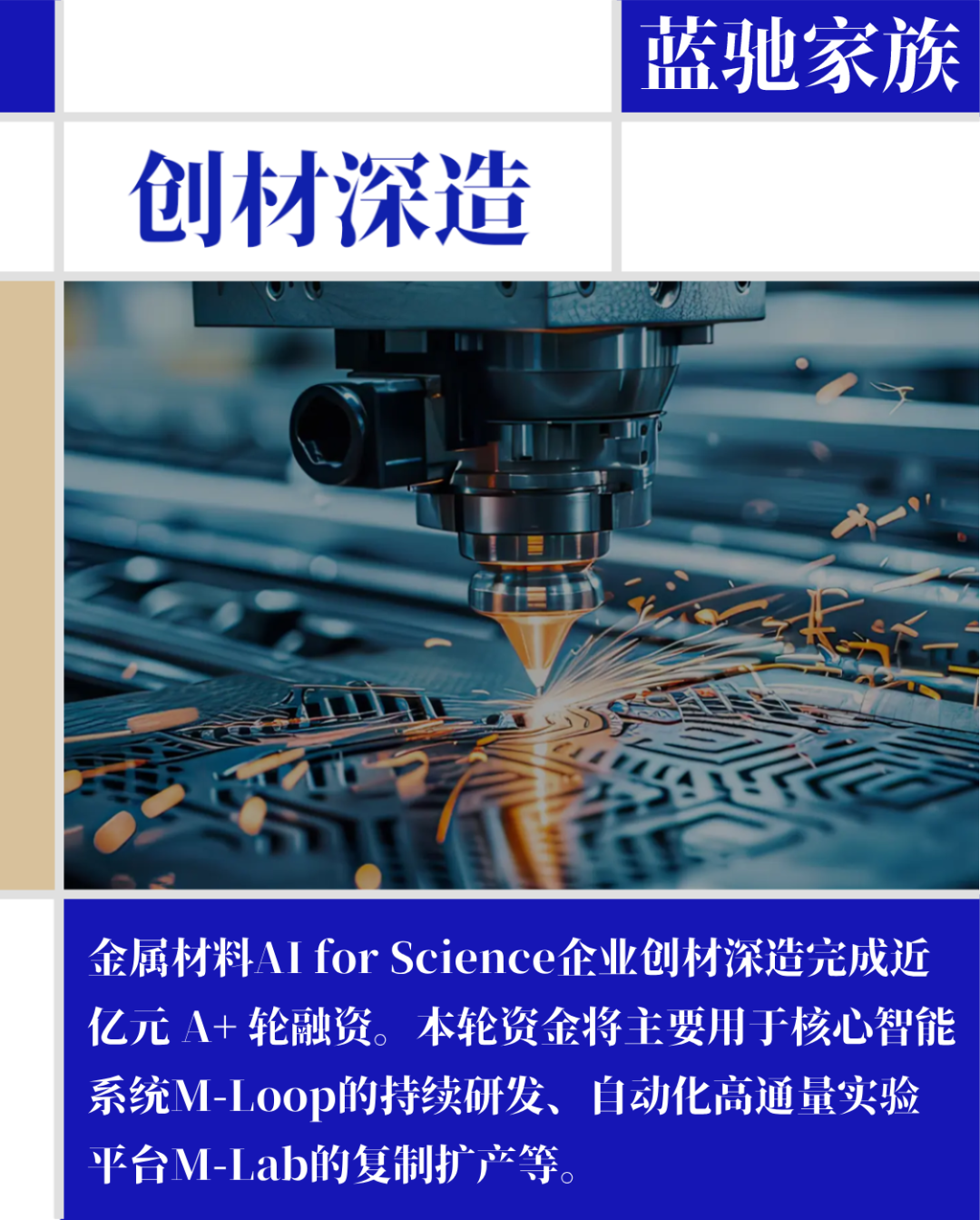
DeepMaterial, a leading company applying AI for Science to metal materials, has completed an A+ round of nearly RMB 100 million. The company has become the first to complete a full closed loop for AI-driven materials R&D and has released nearly 20 new high-performance materials, several of which are already in mass production.
BlueRun Ventures was an investor in DeepMaterial's Pre-A round.
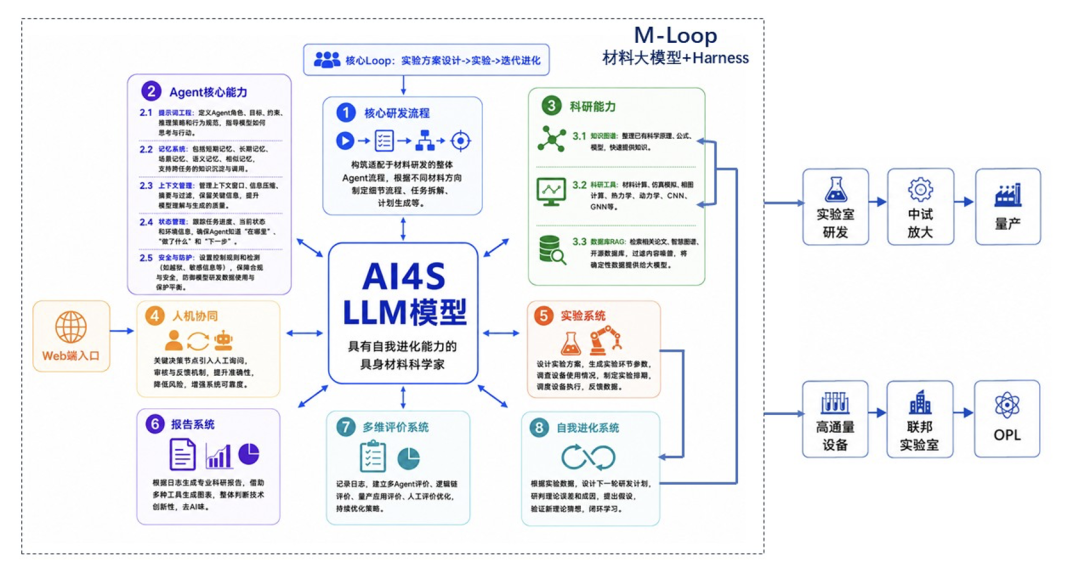
The new funds will primarily go toward continued development of the core intelligent system M-Loop, replication and scaling of the automated high-throughput experimental platform M-Lab, ongoing accumulation of the high-quality materials dataset M-Data, construction of the distributed self-driving lab network OPL (One Person Lab), and recruitment of top interdisciplinary talent — replicating its AI R&D capabilities across more materials domains and further extending its industry lead.

Over the past few years, AI for Science has continued to heat up. The key questions are whether the technology can enter real industrial settings — whether it can shorten R&D cycles, reduce trial-and-error costs, and reliably carry lab results through to process, manufacturing, and delivery. Global AI4S competition has moved from competing on models, data, and experiments into a phase of "infrastructure competition": models are increasingly easy to obtain, while high-dimensional real scientific data — encompassing experimental conditions, process parameters, failed results, and process feedback — is becoming a scarce resource. The future winners will be the infrastructure organizers capable of connecting data, models, experimental systems, compute, and industrial demand.
Policy is accelerating the shift as well. The State Council's Opinions on Deepening the "AI+" Initiative calls for AI4S application adoption to reach 70% by 2027 and exceed 90% by 2030. The U.S. Department of Energy's "Genesis Mission" is investing $5 billion to connect 17 national laboratories. Overseas giants are also moving quickly: Anthropic has launched Claude Science for research scenarios, and OpenAI continues to pour resources into scientific research.
The metal materials industry is worth over a trillion dollars and directly determines the ceiling of strategic sectors such as aerospace, new energy, semiconductors, and high-end equipment. Compared with biomedicine's lengthy validation cycles, metal materials offer natural advantages — fast validation, clear performance metrics, and complete supply chains — making them the best landing ground for AI-empowered R&D.

You propose a new material performance requirement, and days later automatically receive several formulations validated by real experiments — this "wish-granting" style of R&D is the ultimate form of AI materials development. Achieving it requires four foundational pillars: large models and agents, tooling algorithms and specialized small models, an automated high-throughput closed-loop lab, and large-scale, high-quality multimodal data suited for AI training. DeepMaterial has built leading moats across all four dimensions:
M-Cortex large model and agents: Using its proprietary, full-process multimodal experimental data, DeepMaterial has trained a materials-specific vertical large model that significantly enhances causal reasoning, scientific thinking, and extrapolation/generalization, forming an agent genuinely suited to materials R&D. M-Cortex serves as the orchestration and intelligent scheduling hub of the R&D process. Drawing on literature reviews, the company's historical data, and R&D know-how, the system automatically generates scientific hypotheses, candidate formulations, and R&D playbooks; works with M-Science to perform scientific computation and candidate screening; dispatches M-Lab to run real experiments; and continuously rewrites R&D strategies and memory based on experimental and delivery feedback.
M-Science tooling algorithms and specialized small models: The company holds a clear lead in large-scale algorithms that rely heavily on real experimental data, compensating for the failure of small-scale methods like DFT at meso-to-macro interactions.
M-Lab closed-loop lab: The self-evolution of a materials agent is reflected not only in performance iteration but also in the continuous breakthroughs and accumulation across its knowledge graph, tooling algorithms, and logical reasoning. Building an automated, high-throughput dry-wet closed-loop lab is therefore critical. DeepMaterial made a forward-looking bet starting in 2021, independently developing high-throughput equipment and building the automated lab M-Lab. Now in its 3.0 iteration, M-Lab has fully achieved automation, high throughput, and standardization — experimental data production efficiency has improved several-hundred-fold, costs have dropped by tens of times, the closed-source real-world data generated by M-Lab spans over 400 dimensions, and a single raw data record exceeds 10 GB in storage. The end-to-end solution has been procured by top universities and research institutes in China and abroad; over the next two years, the high-throughput lab footprint will expand fivefold.
M-Data, materials data adapted for AI: The company has built a high-quality dataset of over 100,000 records with unified formatting, rich dimensionality, and coverage of the full experimental process including failed results — the industry's data foundation best suited for AI training. Over the next two years, the overall high-throughput lab footprint will expand fivefold, continuously amplifying its technological lead on the data front.
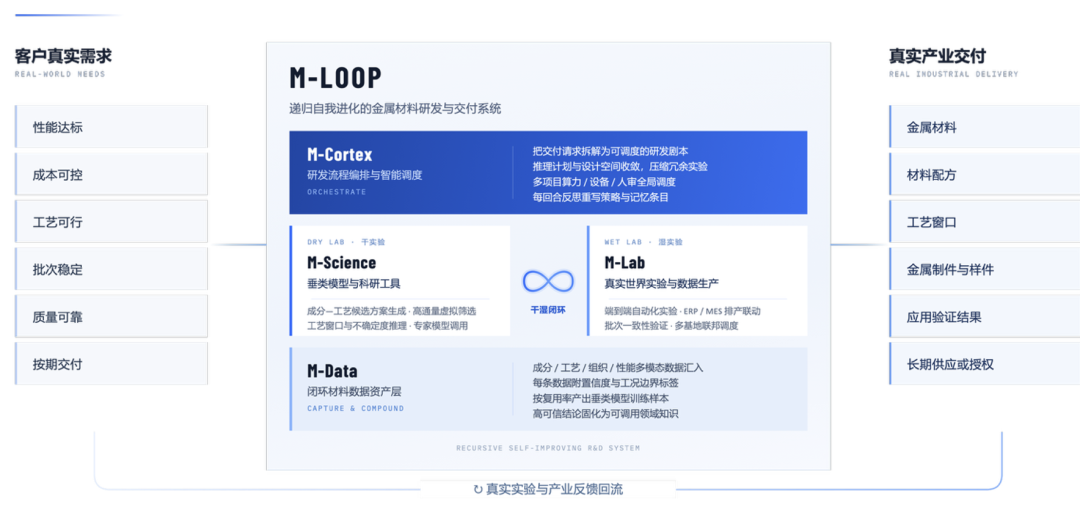
DeepMaterial approaches AI4S with the end in mind, actively building full-chain technology — with industry-leading capabilities and strong moats at every key link.

AI4S is in the early stages of mining an enormous gold deposit, and the real opportunity isn't just "selling shovels" — it's picking up the best shovel and digging for gold yourself.
DeepMaterial was the first to connect the full chain, forming a positive flywheel: "real experiments generate data → data drives system evolution → system evolution improves delivery certainty → delivery results feed the next round of R&D." The company has already cut materials R&D and testing/validation cycles from 5–10 years to 2–3 months, reduced costs to one-tenth, and released dozens of new materials with fully independent intellectual property — all tested by CNAS-accredited institutions and downstream customers, with performance far exceeding world-leading levels.
Commercial collaborations include: working with a leading global consumer electronics company on anodizable aluminum alloy housings, ultra-high-strength stainless steel connectors, and ultra-high-strength titanium alloy housings; partnering with a leading Chinese controlled nuclear fusion company on R&D and testing of refractory high-entropy alloy first walls, low-activation steel blankets, and lithium-based tritium-breeding materials; working with a leading global golf brand on ultra-high-strength stainless steel club faces, one-piece titanium alloy shells, and high-entropy alloy counterweights; partnering with a leading commercial aerospace company on superalloy engine nozzles and high-strength aluminum structural supports; working with a world-leading tire mold company on high-strength heat-resistant aluminum alloy inserts and high-strength mold steels; collaborating with China's largest titanium mining company on technology for producing high-performance titanium alloys from low-grade ore; and exploring next-generation AI4S core algorithms with a leading quantum computing company. Delivery formats span material formulations, process windows, metal parts and prototypes, application validation results, and long-term supply or licensing arrangements, with deployed applications in areas such as additive manufacturing.

Materials are the underlying code with which humanity reshapes the world. AI is liberating materials discovery from uncertainty, turning it into a path that can actually be walked. When "works in the lab" and "can be built in the factory" are no longer separated by a chasm, materials innovation evolves from an experience-dependent art into engineering that can be systematically organized.

BlueRun Ventures Leads as SiRan Bio Completes Nearly RMB 400 Million Series A Financing, Accelerating siRNA Dual-Target and Extrahepatic Delivery Pipelines | BlueRun Ventures
 BlueRun Ventures Continues to Double Down as Zhitai Bio Completes Over RMB 500 Million Series C Financing | BlueRun Ventures
 BlueRun Angel Portfolio Company Kaiwuji Completes Angel+ Round of Several Hundred Million RMB, Building AI4S-Driven Materials Intelligence Infrastructure | BlueRun Ventures