BlueRun Ventures angel project Ising Intelligent closes nearly 100 million yuan funding round to accelerate new photonic-electronic computing architecture
Toward Platform-Level Domain-Specific Compute That Can Reliably Land in Production
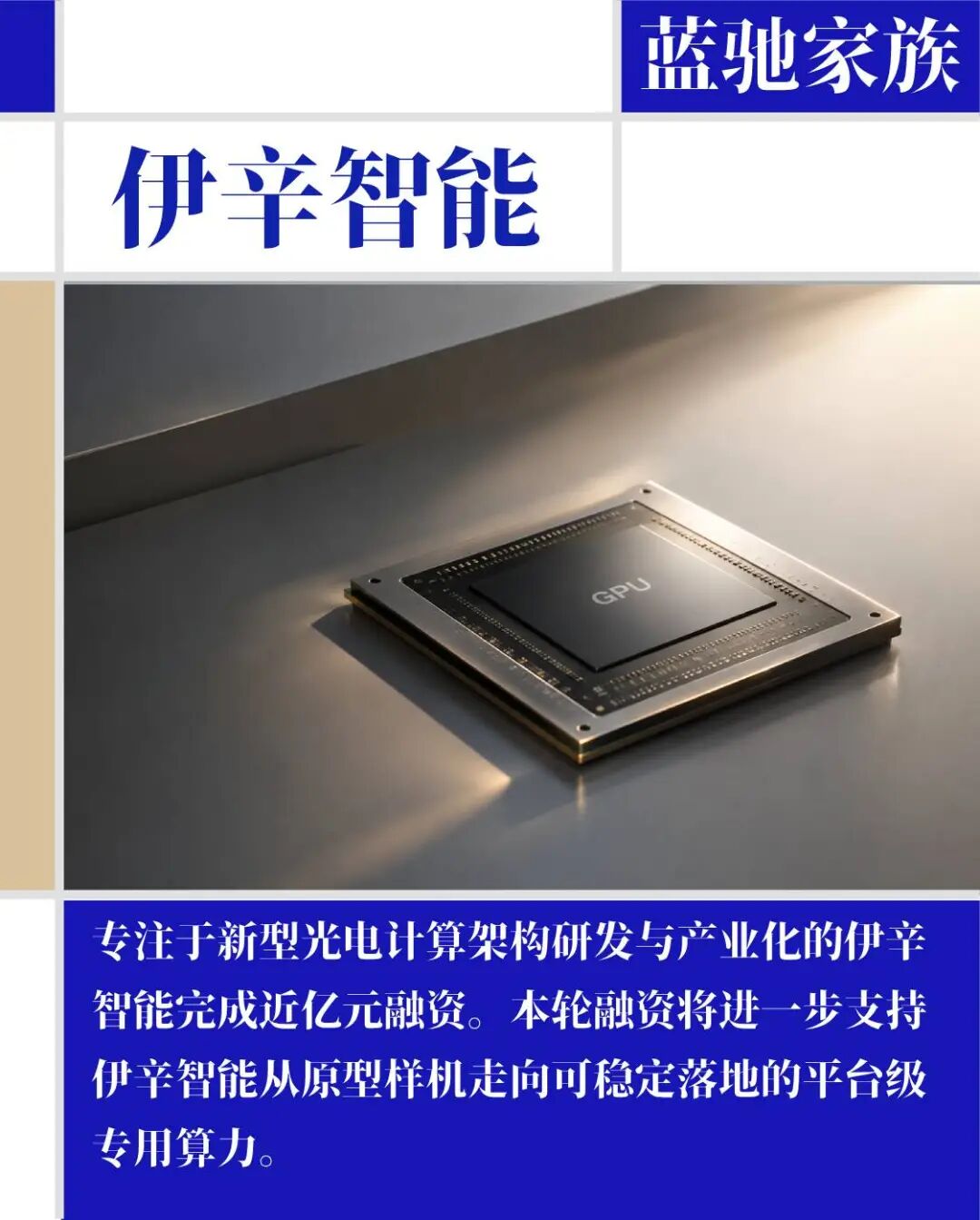
Recently, Yising Intelligence (伊辛智能) completed a new funding round of nearly RMB 100 million. The company's technology originated at the Institute of Semiconductors of the Chinese Academy of Sciences. It targets combinatorial optimization problems, using optoelectronic hardware to deliver dedicated solving capabilities, and is exploring how to integrate the Ising machine as a new computing unit into existing heterogeneous computing architectures.
BlueRun Ventures led Yising Intelligence's angel round and continued to follow on in its Pre-A round, accompanying the team as it explores the R&D and commercialization of novel optoelectronic computing architectures.
Over the past year, Yising Intelligence has also been steadily advancing productization: moving from scientific prototypes that required manual modeling, on-site programming, and maintenance toward products accessible via API calls that can plug into customers' existing software and computing workflows.
In the in-depth interview below, Xiao Ye, co-founder and CEO of Yising Intelligence, shares the technical principles and product progress of the Ising machine, along with his thinking on heterogeneous computing, productization, and commercialization. From a laboratory technology to a new form of computing power that can enter real computing systems, Yising Intelligence is validating this technical path step by step. Enjoy:
What is an Ising machine? To understand its value, let's first look at the development history of GPUs. Here's a thought experiment: what is the essence of a GPU? The most popular answer would certainly be "compute power," but that answer is actually only half right.
For a long time, GPUs were commonly called "graphics cards." Their original design purpose was to help computers process graphics, render 3D models, and handle image textures. These tasks weren't complex, but they were characterized by massive computational volume. In other words, for most of their existence, the greatest presence of GPUs was indeed as "dedicated compute power."
But who would connect this thing with the intelligence-evoking term "processor"?
NVIDIA and Jensen Huang changed all this. NVIDIA made a breakthrough by making GPU pipelines no longer fixed but fully programmable, and developed the revolutionary computing platform CUDA. With CUDA's help, the characteristics of GPUs were continuously amplified — since GPUs are essentially thousands of processing cores stacked together, they excel at parallel processing of large numbers of simple, repetitive computing tasks — neural networks became possible, and eventually the training of AI models requiring massive matrix multiplication and addition became possible too.
So for that opening question, the most fashionable answer would be that GPUs should have been seen back then as a "new computing paradigm."
In the past two years, beyond the large model arms race, compute power has also become a foundational resource that everyone is fighting for, and heterogenization and dedicated specialization are among the important directions for optimizing compute bottlenecks. CPUs handle general logic and coordination, GPUs excel at large-scale parallel matrix operations, and TPUs provide dedicated acceleration for tensor calculations in AI. The coordination of these computing units constitutes the basic idea of heterogeneous computing. And some combinatorial optimization tasks involving "how to choose, how to divide, how to schedule" leave room for new dedicated computing units. The "Ising machine" that Xiao Ye and Yising Intelligence chose is precisely a leading answer to this problem.
The name "Ising" comes from the "Ising model" in physics. Originally, German physicist Ernst Ising invented this model to describe the arrangement patterns of magnetic materials after they influence each other. Ising found that in natural states, these magnetic materials continuously adjust and eventually tend toward the state of lowest energy and greatest overall stability — later engineers realized that many real-world scenarios could be written in the same structure, designing a dedicated physical system for this entirely new class of problems.
This is the principle of the "Ising machine" — think of it as a computer specifically designed to "help people make choices." Ordinary computers excel at executing deterministic operations, such as processing documents, training models, or rendering images. Ising machines handle another category of problems: when there are too many candidate solutions to compare one by one, how to quickly find a sufficiently good one. For example, how should 1,000 vehicles be routed to minimize traffic jams and empty runs? A factory has many orders — how should production be scheduled to shorten lead times?
Among these problems, many typical cases belong to the NP-hard class. As scale expands and constraints multiply, computational volume explodes, easily becoming a critical bottleneck in computing workflows. Integrating the Ising machine as a dedicated computing unit into existing compute systems, letting it handle suitable combinatorial optimization tasks, could alleviate these solving bottlenecks, thereby improving overall computational efficiency — allowing systems to handle larger-scale problems within given time and cost constraints, or obtain higher-quality solutions.
On a solid theoretical foundation, the "Ising machine" actually began commercial exploration quite early. For example, D-Wave, the world's first company to achieve commercial quantum computing and mainly focused on superconducting circuit-based Ising machines/logic gate machines, assembled its team as early as 1999 and released its first product, the D-Wave One, as early as 2011. Today, D-Wave has become a NASDAQ-listed company, with its market cap once exceeding $12 billion (approximately RMB 80.4 billion).
On its website, the D-Wave team proudly states: "When classical approaches can't address today's most intractable modeling, simulation, and optimization problems, D-Wave moves businesses forward."
The Yising Intelligence team began researching optoelectronic oscillation, optoelectronic parametric oscillators, and early Ising machines as early as 2015, with technology originating from the research group of Professor Li Ming at the Institute of Semiconductors of the Chinese Academy of Sciences. The team believes that whether algorithmic capabilities can truly be unleashed depends largely on whether there exists a hardware foundation matching their computational structure. Under this premise, many algorithms are not theoretically infeasible, but rather computationally too costly and inefficient under existing hardware conditions, making them difficult to fully validate and scale.
In their view, the development history of GPUs shows that the value of a new computing architecture lies not merely in making existing algorithms "faster," but more importantly in shifting the feasible boundaries of algorithmic innovation. Yising Intelligence hopes to use optoelectronic technology to gradually evolve from a single-point solving device to a platform-type dedicated compute power for broad combinatorial optimization problems, and to establish a long-term position analogous to an "optimization processor" in the next-generation heterogeneous computing system.
They have also been validating their judgment step by step. In 2022, the team reached an important milestone, publishing large-scale optoelectronic Ising machine results in Light: Science & Applications, using short microwave pulses as artificial spins to achieve 25,600 spins with stable operation exceeding 12 hours. By 2026, their latest published system achieved 4,096 fully connected spins with maximum stable oscillation of 5.5 hours. In a Beijing Second Ring Road traffic data experiment, the team constructed a 485-spin model for a scheduling problem involving 1,200 vehicles, reporting a physical solving time of 2.71 milliseconds versus a simulated annealing baseline of 6.46 seconds.
So where is Yising Intelligence's next goal? As a highly anticipated solution in the era of compute power expansion, when can the Ising machine enter the market at scale and on a regular basis? As a "junior player," what advantages does Yising Intelligence have compared to unicorns like D-Wave?
To gain clearer insight into all this, ChinaVenture conducted a conversation with Xiao Ye, co-founder and CEO of Yising Intelligence, immediately after the company completed its new funding round.

ChinaVenture: Can you explain in the most straightforward, no-nonsense way what kind of company Yising Intelligence actually is?
Xiao Ye: We use optoelectronic hardware to implement a physical computing method, providing dedicated solving capabilities for combinatorial optimization to help people tackle NP-hard problems that traditional computers struggle to solve efficiently.
ChinaVenture: Then what is an Ising machine? It took me a long time to understand at first that the Ising machine brings a new computing paradigm. It doesn't execute a task according to a predetermined process — its ultimate function is solving, finding a reasonably good answer among vast possibilities.
Xiao Ye: What we want to solve are large-scale optimization problems: finding a relatively good answer from massive combinations. The traveling salesman problem is a very common example. You travel frequently — how do you visit several target cities to minimize total mileage or total cost? This problem seems very simple.
ChinaVenture: Sounds like large models could solve it.
Xiao Ye: When there are few cities, you can use computational tools to compare and calculate one by one. But as cities increase, the number of route combinations explodes. By the time you reach dozens of cities, traditional computers already struggle to compare all possibilities within acceptable time. Each additional variable multiplies the required compute power many times over.
ChinaVenture: When I was understanding the Ising machine, I had a very strong feeling: the physical world has many constraints — compute power, time, and resources are all limited. The Ising machine is a tool that helps us find a better answer within these constraints.
Xiao Ye: You can understand it that way. It targets precisely this kind of exponential explosion problem.
ChinaVenture: So what's the fundamental difference between it and large models? Model capabilities keep improving, and proactive understanding and reasoning abilities are getting stronger. Under this premise, why do we still need Ising machines?
Xiao Ye: Large models struggle to directly solve large-scale NP-hard problems. They can understand requirements, help you express problems, even generate modeling code; but when it comes to the solving stage, computational tools are still needed. That's the part Ising machines take on.
ChinaVenture: So large models are closer to understanding and interaction, while the core value of Ising machines is computation.
Xiao Ye: Right. Real-world problems are first transformed into Ising models, then handed to the Ising machine for solving. The Ising machine uses the evolution of physical systems to find low-energy states, and these states correspond to high-quality answers in the original problem.
ChinaVenture: Since it can solve real-world problems, why has the Ising machine remained a relatively niche product line until now? Where are the difficulties?
Xiao Ye: First is product maturity. People worldwide have been researching Ising machines. Representative approaches include D-Wave's superconducting route, all-optical routes, and some domestic teams working on all-optical Ising machines — different routes each have their own constraints. We take the optoelectronic route.
Superconducting Ising machines require operating environments near absolute zero, and the entire system is very large, making on-site deployment at customer data centers restrictive. All-optical routes also have engineering challenges regarding scale and stable operation time. When customers submit problems, if the system requires frequent debugging, the speed advantage of the computation itself can easily be offset by debugging time.
ChinaVenture: So in the past, people proved it could compute in principle, but it was hard for customers to use it stably.
Xiao Ye: Right. Our first external-facing product can achieve over 4,000 spins, with single-run stable operation of about 1.5 hours, total power consumption around 1,600 watts, and volume controllable to the scale of a refrigerator or even a desktop computer. At least it first meets the basic conditions for practical use.
For a technology to spread, it typically goes through stages of "can be used," "easy to use," and "good to use." Ising machines remained at "can be used" for a long time; we've just now pushed it to "easy to use."
ChinaVenture: You said the product was officially launched in June this year, but machines were already running in customer data centers before that. In what scenarios were you using it? And how did you judge that it had become "easy to use"?
Xiao Ye: We held a competition once, with the machine deployed in our lab and participants calling it entirely through cloud APIs. As long as not too many people were running loop tasks simultaneously, everyone could basically get answers within a few seconds — and that included network transmission time.
ChinaVenture: This change looks simple, but the gap from scientific prototypes is actually huge.
Xiao Ye: Huge. Scientific prototypes can complete proof of concept, but when a customer brings a problem, going from modeling, on-site programming to manually maintaining machine state, we might need one to two weeks to return an answer. Over the past year, we've gradually automated these steps. Now you don't need a PhD standing next to the machine; users upload a matrix, and the system can quickly return answers. These improvements also create conditions for Ising machines to integrate into customers' existing software and computing workflows.

ChinaVenture: I've written quite a bit about NVIDIA and CUDA in the past two years. My biggest feeling is that GPUs and CPUs competed for many years because computing solutions are hard to replace — switching costs are high. Now customers have established computing workflows around CPUs and GPUs. How does the Ising machine plug into this system, and what makes it worth customers adding a new computing unit?
Xiao Ye: Start with POCs — the results are usually very direct. Ising machines also have their own Scaling Law. As problem scale grows and spin count increases, their advantages in speed and solution quality relative to traditional computing gradually emerge.
But what you described is also true. Two or three years ago, 1,000-spin problems were already difficult for traditional computers; today GPUs have also developed rapidly, and 2,000-plus spin problems can be solved by sacrificing certain things. Yet the complexity of NP-hard problems still exists. Traditional compute power continues linear stacking, while problem scale may grow exponentially. We're targeting precisely that gap.
ChinaVenture: Now GPU compute power growth increasingly relies on stacking, data centers are getting bigger and bigger, and cooling and energy demands are also rising. If Ising machines can become widespread, can we understand it as: they use fewer resources to solve certain difficult problems?
Xiao Ye: Yes. You can place some Ising machines in compute clusters, partition tasks well, and hand off problems suitable for mapping to Ising models to the Ising machine for solving — the efficiency of the entire computing task could then improve significantly.
ChinaVenture: So it's more like part of a heterogeneous computing system.
Xiao Ye: Right. We're closer to a collaborative relationship with GPUs. After AI took off, the main compute power became GPUs, and CPU demand also rose together, because new business expanded the entire market. In the future, it may be CPU responsible for coordination and logic, GPU for parallel matrix operations, and Ising machine for combinatorial optimization.
ChinaVenture: I used to see the term "heterogeneous computing" frequently, but only after actually engaging with you did I suddenly understand its value.
Xiao Ye: The logic is actually simple. Your team has designers and editors who go out for interviews. You generally wouldn't ask editors to also do design work. Different specialists combined together usually have higher ceilings than a group of generalists. Computing is the same.
ChinaVenture: How did you explain this story to investors early on?
Xiao Ye: After ChatGPT emerged, people retrospectively analyzed: connectionism had been researched for many years, so why did it explode at this particular time? One important reason was that GPU parallel computing allowed it to truly develop. Early GPUs may have only been 10x to 100x faster than CPUs, but this comparative advantage was already enough to change many things.
I used an analogy with investors at the time. To get from Beijing to Shanghai, you can walk, bike, drive, or take high-speed rail or fly. Getting to the station and going through security take time, but as long as the entire journey is fast enough, people are willing to change habits. Computing is the same — the Ising machine provides another computing route. Combinatorial optimization is also a common problem across many industries; as long as the comparative advantage is large enough, people will migrate their work over.
ChinaVenture: That's a great analogy. NVIDIA's CUDA push was also very difficult back then — Wall Street even considered it a negative asset. Looking back today, CUDA connected GPUs and AI together.
Xiao Ye: When technology hasn't become consensus, promotion is always difficult. NVIDIA early on sent clusters to universities for lighthouse programs; many research teams have also studied quantum algorithms, QUBO algorithms, and Ising models for many years. Now that hardware is gradually becoming available, these accumulations finally have a chance to connect.
ChinaVenture: Does NVIDIA's released Ising open-source model have direct relevance to your product?
Xiao Ye: Not much direct relevance. NVIDIA mainly combines Ising models with AI technology for tasks like calibration and error correction, some of which involve real-time optimization. We're also researching related directions, but don't have sufficiently reliable results yet.

ChinaVenture: The Ising machine is now your most important calling card to the market, but it probably can't define the entire company. What other products and business lines does Yising Intelligence have?
Xiao Ye: Currently our flagship product is indeed the Ising machine, plus end-to-end projects around the Ising machine to help customers actually put it to use. But the company's underlying color is optoelectronics. Our team comes from the Institute of Semiconductors of the Chinese Academy of Sciences, and we have many cutting-edge accumulations in the optoelectronics field.
ChinaVenture: The company first described its vision to investors in 2024, and it's been two years now. In between, did you discover any early assumptions that were wrong and needed correction? And what exceeded expectations?
Xiao Ye: Although the company was registered in March 2024, real operations basically started in January 2025. The first funding tranche only arrived in September 2024. So far, the stage goals are roughly as originally envisioned: first make the product.
Once the product becomes convenient, we then have conditions to test more matrices and real problems, and to compare what the relationship actually is between Ising machines and traditional algorithms. We now have over a thousand problems in our library, and have also found partners to run comprehensive comparisons with many advanced algorithms. In the tasks we've already tested, the trend we see is that the larger the problem scale, the more obvious the Ising machine's advantages.
ChinaVenture: So the first phase is product, and the next phase is benchmarks.
Xiao Ye: Right. First let some professionals use it, then build benchmark cases. We're already seeing some promising signs; overall progress is in line with expectations.
ChinaVenture: This technology incubated in the lab for over a decade — why did it only rapidly become a product after the company was founded?
Xiao Ye: Labs mainly solve scientific problems; the Chinese Academy of Sciences' division of labor is also to do scientific research. Product R&D requires a market entity. The lab's process for hiring engineers is relatively long, and evaluations focus more on intellectual property and scientific innovation, making it difficult to fully advance around products and customer needs.
After the company was founded and the first batch of core engineers joined, productization clearly accelerated. My advisor mainly handles technology, research, and strategic direction; I handle company operations. The Ising machine is just a computing operator — like a phone having hardware but also needing software. After the machine is built, we still need to decide which fields to develop software for first. My advisor's strategic vision helps us judge these directions.
ChinaVenture: After this new funding round, where will the capital mainly be deployed?
Xiao Ye: Two parts. First, continue pushing up machine scale. According to plan, we'll launch a 10,000-plus spin product this December, then aim to double every six months — this requires significant investment. Second, do broad exploration on the business side, building modeling and algorithm teams to help customers complete end-to-end solutions, and沉淀 the modeling methods and algorithms accumulated in projects into reusable tools and industry models, lowering the access and delivery costs for subsequent scenarios.
We hope to reduce the usage threshold very low through more complete toolchains, allowing customers to achieve one-click deployment. It's somewhat like NVIDIA's lighthouse program around 2017: first let more people who understand problems be able to call Ising compute power, gradually achieving convenient deployment.
ChinaVenture: When you started market-oriented fundraising, did many institutions proactively approach you?
Xiao Ye: We've always been relatively low-key, and haven't met with that many investors. Often it's investors proactively coming to chat, and after chatting, introductions through friends' circles. Those willing to chat with us a second time, many ended up investing.
ChinaVenture: What are your criteria for screening investors? For such an unfamiliar technology, it seems unrealistic to expect investors to fully understand you.
Xiao Ye: We're a relatively pragmatic team. If an investor shows strong capital operation thinking upon first contact, we generally don't continue the conversation. Such approaches aren't conducive to long-term technology development. We prefer to find institutions willing to believe in the long-term direction and walk steadily forward with the team. The endpoint we see is Ising machines joining CPU, GPU, NPU, TPU, and quantum computing to form a heterogeneous computing system, providing compute power for different computing tasks. This process may take years, or even more than a decade.

ChinaVenture: Among existing customers and scenarios, are banks the closest to actual application?
Xiao Ye: Banks are relatively close to actual application, but the most outstanding effects may be in other fields. For example, in some scientific computing POCs, we've seen over 5,000x acceleration; in some actual business POCs, we estimate we can reduce customer costs by about 5%.
In my view, commercialization is about meeting customer needs while letting customers do the math — the input-output ratio must be greater than 1. According to calculations for one scenario, a single business can cover machine costs within three years. If we can find operational links with larger costs, or develop a few more businesses, the math becomes easier.
ChinaVenture: Listening to this, the logic seems particularly smooth — the technical path seems to have completed validation, and next it's just continuous optimization until commercial explosion is a matter of time. But entrepreneurship can't be this smooth; what challenges do you still face?
Xiao Ye: We're constantly accepting challenges. The technical stage is about proving whether something can be built; commercial promotion enters another logic. Customers look at cost-effectiveness, and also at deployment, maintenance, and sustained use.
ChinaVenture: The experimental stage validates whether the pathway can run through and results can be reproduced; the commercial stage also continuously compresses costs, turning experimental-grade equipment into standard products.
Xiao Ye: The larger the hardware scale, the more opportunity there usually is for cost reduction, especially in the microwave portion. Although we come from an academic team, we also believe in market-oriented approaches. Once the product is good enough, channels and industry partners will help it enter more scenarios.
ChinaVenture: Entering a new funding stage, what counts as passing, and what counts as full marks?
Xiao Ye: The passing grade is forming a batch of benchmark cases, letting people see the Ising machine's advantages in combinatorial optimization through these cases, and gradually forming industry consensus.
Full marks is finding the first commercially closed-loop scenario that can be replicated, with high repurchase rates. The Ising machine is a compute foundation; we develop software on top of it for an industry, and this software can substantially meet customer needs, drive production efficiency improvements, and generate large volumes of repurchases in this field.
ChinaVenture: The way you set goals is very much like scientists founding companies. Each step hopes to proceed from existing results and explain as clearly as possible what happened in between.
Xiao Ye: We want external partners and people inside the company to know the direction. Putting machines on cloud platforms and letting others actually use them gives the team great satisfaction. When others understand what we're doing, they can also bring their own problems to try. When everything is hidden, it's hard for others to believe in you or get involved.

ChinaVenture: Finally, if you had to define Yising Intelligence with three keywords, letting the outside world know at a glance who you are, what would you choose?
Xiao Ye: The first is "optoelectronic optimization computing." It explains that we use optoelectronic technology for optimization computing. In optical computing, there are optical interconnect with electrical computing, optoelectronic accelerated computing — what we do is optoelectronic optimization computing.
The second is "combinatorial optimization," or NP-hard problem solving. This is our main application scenario, and also includes the capability to transform real-world problems into computable models.
The third is "new computing capability accessible to existing compute systems." Our APIs are already quite mature, and machines are deployed and running in customer data centers. Going forward, we hope through more complete software tools to let users more conveniently hand off combinatorial optimization tasks to Ising machines, easily embedding them into existing computing systems. This is also the understanding we most hope to establish externally.
In the future, people may no longer ask about the underlying principles of Ising machines. Just as today when using GPUs, most people don't need to first understand parallel computing — they just need to know what problems it can solve.
 DeepMaterial Completes A+ Round: Driving Self-Evolving RSI with Real Data | BlueRun Ventures Family
 BlueRun Ventures Adds to Investment as MicroNano Core Completes Over RMB 1 Billion Series B, Accelerating Edge-Cloud Collaboration for 3D Processing-in-Memory LPU Chips
 Former HiSilicon Kunpeng GM and Horizon Robotics Chip President Peng Chen Found Jiwanli, with BlueRun Ventures Participating in Its Over $100 Million Funding Round | BlueRun Ventures Family