BlueRun Ventures leads Nestworks' angel round of hundreds of millions of yuan, bringing AI-powered desktop CNC to the masses

The imagination space for desktop manufacturing has only just begun to open up.
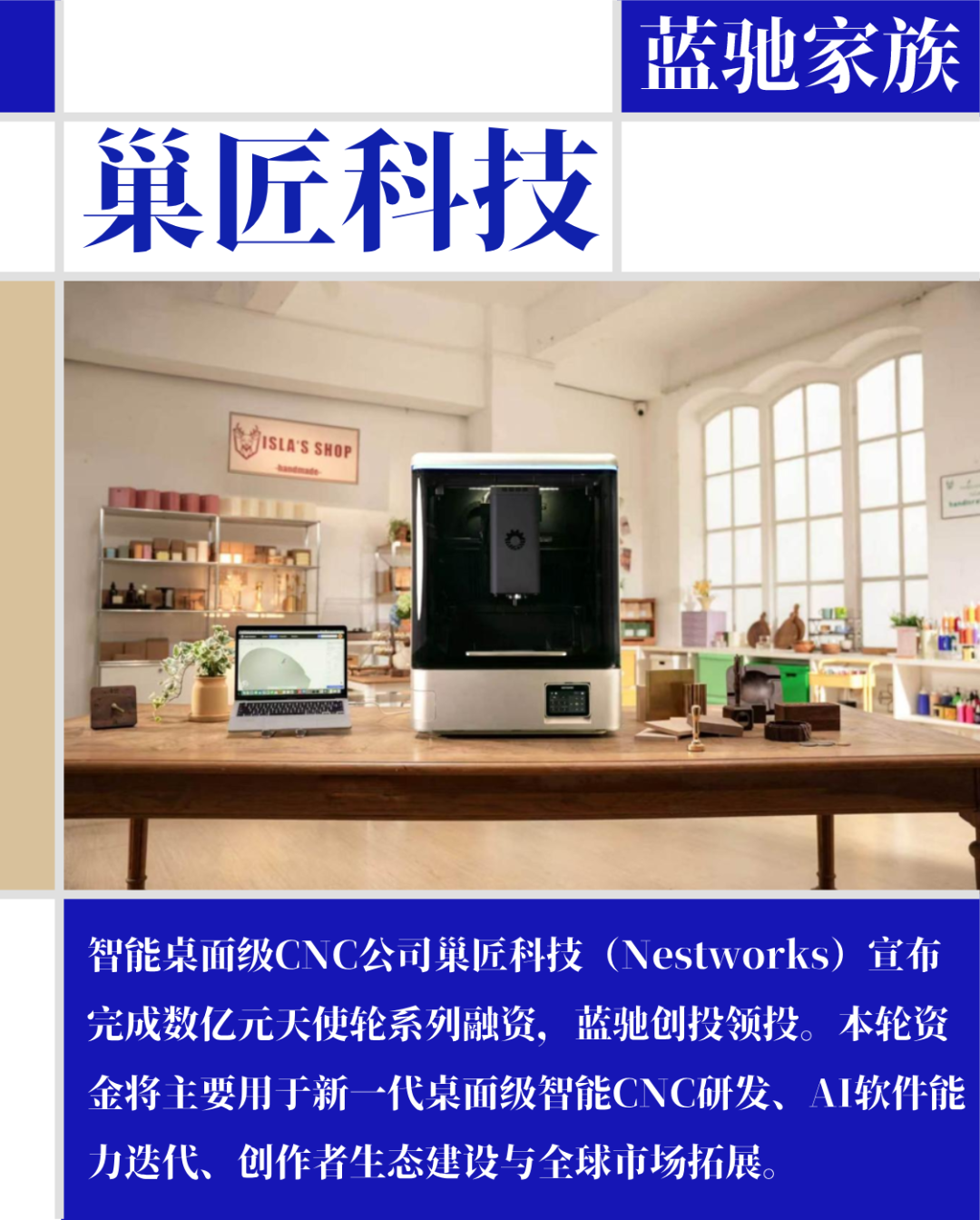
Recently, Nestworks, a smart desktop CNC company, announced the completion of a multi-hundred-million-yuan angel round co-led by BlueRun Ventures and HSG, with participation from other top-tier institutions.
The funding will primarily go toward R&D for next-generation desktop smart CNC systems, AI software iteration, creator ecosystem development, and global market expansion. The core mission is to bring industrial-grade precision manufacturing capabilities to the desktop, building the foundational infrastructure for digital manufacturing in the AI era.
BlueRun Ventures believes that against the backdrop of global manufacturing reshoring and the rapid growth of the maker economy, the small desktop CNC market is poised for explosive growth.
The Nestworks team brings extensive entrepreneurial experience in robotics and smart tools. Starting from their own needs, they have developed a deep understanding of their target users' pain points and demands, with substantial expertise across software, control algorithms, hardware design and mass production, go-to-market strategy, and global fulfillment. With its first product now in successful mass production and delivery, BlueRun Ventures sees the company becoming a leading player in distributed intelligent manufacturing.

For many people, CNC still conjures up images of "big machines in factories." Simply put, it's a precision manufacturing tool that uses computerized control to cut materials with exacting accuracy — from watch parts and phone housings to aerospace components, virtually nothing gets made without it. Compared to 3D printing or laser engraving, CNC can work with almost any material: metals, carbon fiber, engineering plastics. Its advantages in precision, strength, and surface finish are irreplaceable, making it the manufacturing tool that can actually produce "usable products."
But for the longest time, CNC has remained locked inside professional factories. The lack of market demand isn't the issue — making it "desktop-friendly" is just extraordinarily difficult. A desktop CNC for ordinary people is not simply a scaled-down industrial machine. Achieving near-industrial precision, rigidity, and long-term reliability within tighter size, cost, and ease-of-use constraints requires simultaneously solving an entire system of challenges: high-rigidity structural design, high-precision motion control, complex machining processes, professional software adaptation, and scalable mass production. Building a working prototype is easy; the hard part is stable mass production, long-term durability, and making it usable for people with no experience — this is precisely why desktop CNC has remained stuck in the "niche toy" or "professional tool" phase for so many years. What Nestworks has achieved is delivering both "industrial-grade capability" and "consumer-grade experience" on a single desktop.

Nestworks is the fastest-moving, most defensible leader in this space, and one of the few brands globally that can truly deliver "desktop form factor, industrial-grade performance." Its debut product, the C500, features an industrial-grade power spindle with machining precision of ±0.01mm, capable of reliably processing hard metals including aluminum alloy, stainless steel, and even titanium alloy — setting the performance benchmark in the desktop CNC field. On the hardware side, high-rigidity structural design, precision motion control, and industrial-grade machining modules pack factory-level capabilities into a compact footprint. On the software side, its self-developed Smart CAM system automates operations that previously relied on veteran machinists' experience — automatic edge finding, tool setting, tool changing, and RFID tool management. Users don't need to learn professional programming; simply import a design file and launch machining with one click, truly realizing "industrial-grade capability, consumer-grade experience."
This strength has already received hard validation in the global market: the C500's Kickstarter campaign raised over $13 million with support from more than 3,500 global backers, becoming the top new brand crowdfunding champion of 2025 worldwide and directly shattering the industry crowdfunding record for desktop CNC. The product is now in scaled delivery, serving engineers, designers, maker teams, and small manufacturing enterprises globally. It's widely used for robot components, drone structural parts, functional prototypes, and customized product manufacturing — bringing processing needs that previously required professional factories directly into offices, studios, and labs.
Behind this lies more than a decade of technical accumulation: Nestworks spun out from Elephant Robotics, with a core team that has long focused on desktop collaborative robots and intelligent manufacturing. They've fully run the gamut from body design, precision motion control, and mechanical structure optimization to software-hardware system integration, scaled production, and global delivery — one of the few domestic teams that can truly master the complete "hardware + software + manufacturing" chain.

The biggest barrier with traditional CNC was never the machine itself, but the hidden expertise behind it: which tool to choose, what path to run, what parameters to set, how to handle anomalies — all dependent on years of accumulated practitioner experience, with novices stumbling through countless mistakes. Nestworks' approach is to digitize and automate this expertise through AI. And the core of AI is high-quality data — without process data accumulated from real machining scenarios, even the most powerful algorithms are castles in the air.
That's why the C500 was designed from the hardware level with full data orientation: sensors throughout the machine, an RFID intelligent tool management system, and raw material identification. Every machining operation's tool status, running parameters, material characteristics, and finished product quality is converted into high-quality process data. This isn't "bolted-on AI," it's "endogenous AI": every device is a data entry point. More users and greater machining volume build a thicker database, which makes the AI model smarter, improving machining efficiency, success rates, and automation — which in turn attracts more users, forming a positive feedback loop that competitors will struggle to match. This causal chain is now closing: when scale and data begin feeding each other, competition in this space becomes not a 100-meter dash but a compound interest game — and time favors the first movers.
Going forward, AI will permeate the complete workflow from design to manufacturing: from automatic CAD file parsing, to automatic CAM toolpath generation, to intelligent machining parameter optimization and automatic anomaly handling, ultimately achieving full-chain automation from "idea in, finished product out."

In the past, CNC was the exclusive tool of factories, professional engineers, and small manufacturing teams. Going forward, as AI continues to lower design barriers, the product matrix gradually expands, and prices further decline, desktop CNC will move from professional contexts toward a broader audience of individual creators — designers, craft enthusiasts, hardware entrepreneurs, and even ordinary people with ideas. When AI 3D generation and natural language modeling make "designing without knowing how to draw" a reality, and when desktop CNC makes "manufacturing without finding a factory" the norm, the barriers at both the "design" and "manufacturing" ends will fall simultaneously. Industrial-grade manufacturing capabilities that were once the province of large corporations will eventually reach every desktop.
From a single smart CNC device, to a complete AI-driven desktop manufacturing ecosystem, to a globally distributed manufacturing network — what Nestworks is building goes beyond making a great product. It's opening an era of mass manufacturing where anyone can create — precisely the digital manufacturing infrastructure for the AI era that Nestworks aims to establish.
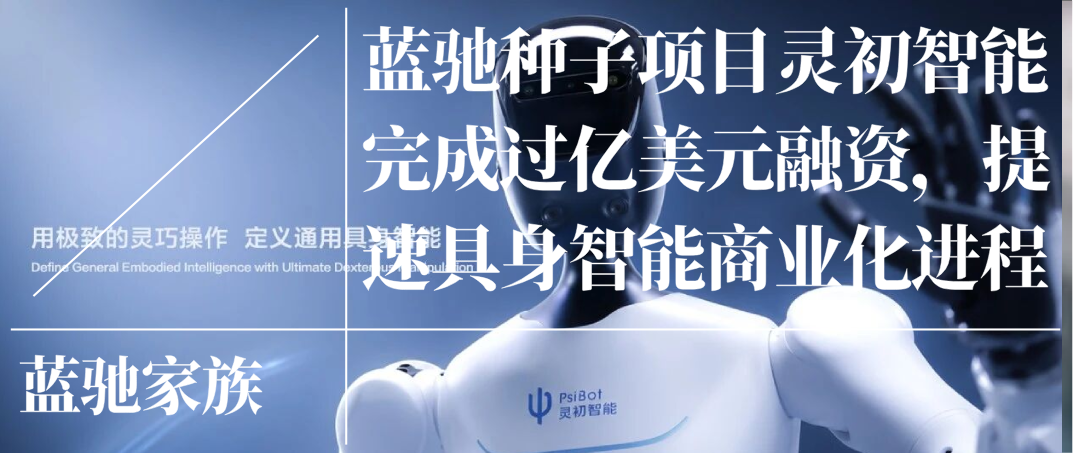 BlueRun seed project Proto-Sentient Intelligence completes over $100 million funding round, accelerating embodied AI commercialization | BlueRun Ventures
 Stepping into reality, robots' new odyssey | BlueRun WRC observations
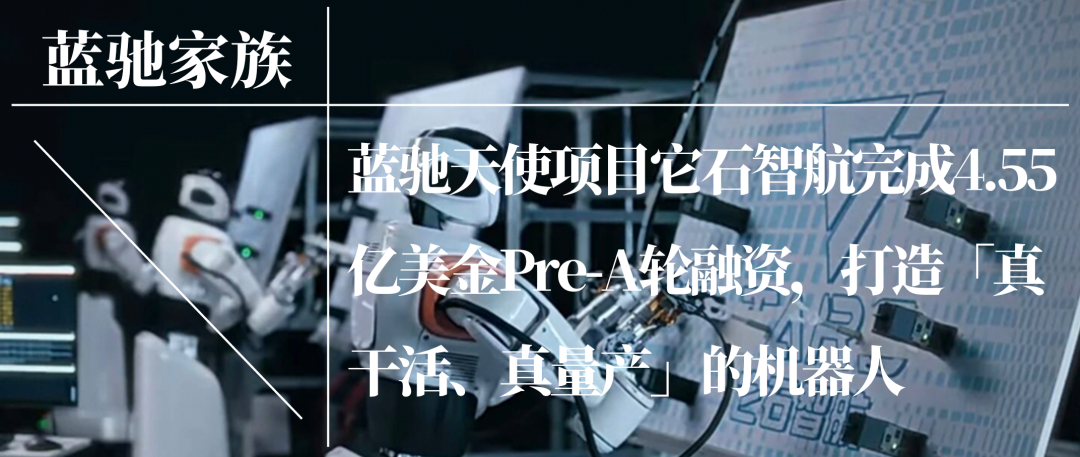 BlueRun angel project Tashi Zhihang completes $455 million Pre-A round, building robots that "truly work, truly scale" | BlueRun Ventures