Former HiSilicon Kunpeng GM and Horizon Robotics Chip President Chen Peng Founds Jiuwanli, Raising Over $100M with BlueRun Ventures Backing | BlueRun Ventures

Edge and On-Device Agentic AI: The Next Blue Ocean
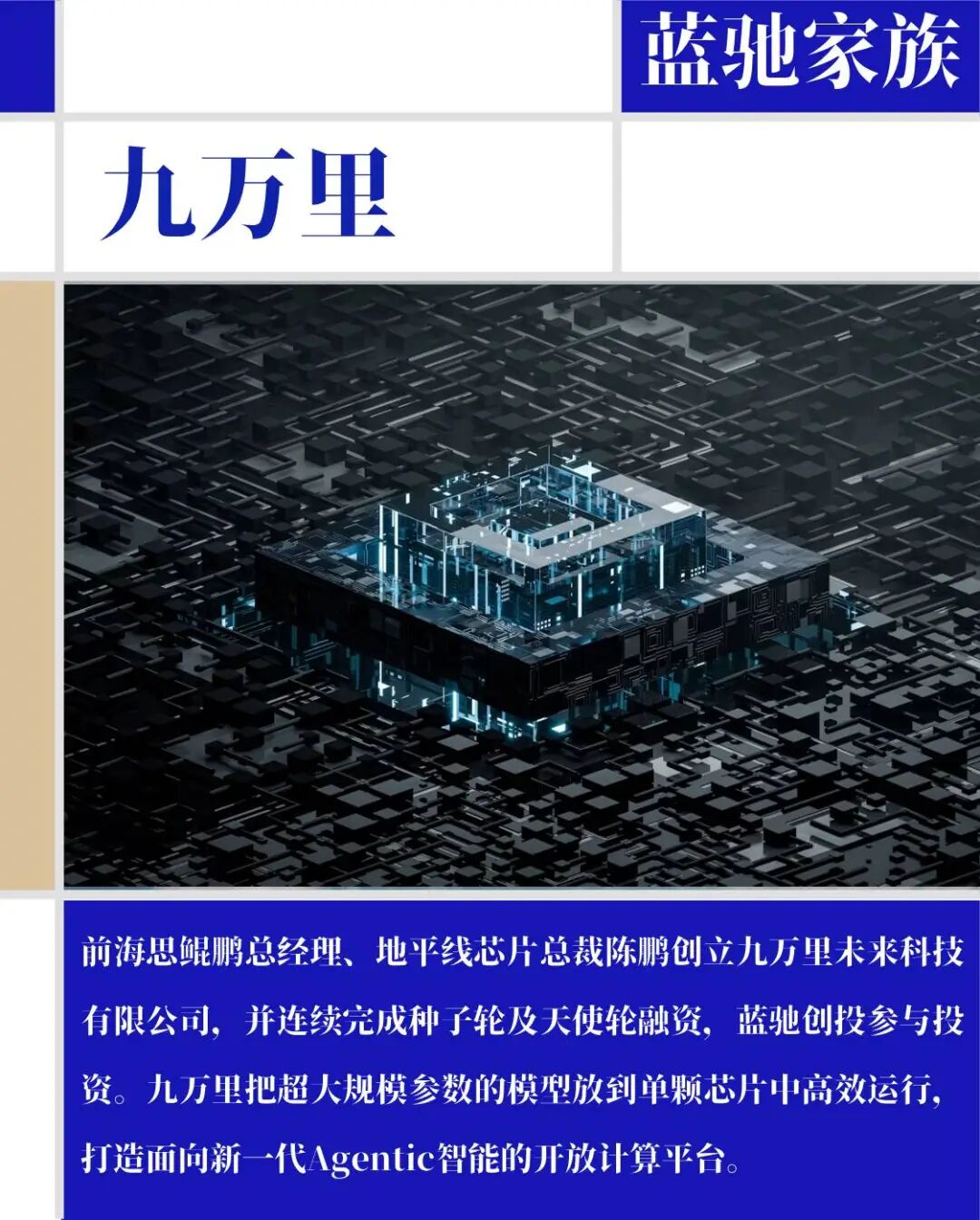
Peng Chen, former general manager of HiSilicon's Kunpeng business and former president of Horizon Robotics' chip division, has founded Jiuwanli Future Technology. The company has consecutively closed seed and angel funding rounds, raising over $100 million in total, with backing from BlueRun Ventures and other top-tier financial and strategic investors.
Peng Chen, founder and CEO of Jiuwanli, said: "I've always hoped that in the critical field of computing chips, there would be teams capable of carrying the mission forward — facing the future, continuously breaking through and advancing, and competing on a global scale. I've worked toward this vision for over twenty years."

AI computing is moving from the cloud to the edge, and high-compute inference chips for edge and endpoint devices will become the infrastructure of next-generation intelligent terminals. Peng Chen is one of the very few industry leaders in China who has walked the complete path from "architecture definition to chip design to volume production." From Kunpeng and Ascend to Journey 6, he has spent over two decades at the forefront of China's homegrown high-compute chips.
The Jiuwanli team combines deep technical expertise with proven productization capabilities, and we believe they can build a high-performance computing platform truly designed for the age of agentic intelligence. BlueRun is honored to have supported the company from its inception, and we look forward to working with the team to drive this transformation of the computing paradigm.


In China's chip industry, people who can design a high-performance chip are not uncommon. What's truly scarce is someone who can master the underlying architecture, define the product, organize a thousand-person R&D team, overcome the engineering challenges of advanced process nodes, and ultimately push a chip to volume production. Peng Chen is one of the few industry leaders who has completed this entire journey.
With more than 24 years in the chip industry, Chen's career spans two pivotal platforms — HiSilicon and Horizon Robotics — where he participated in and led landmark Chinese high-compute chip projects including Kunpeng, the Taishan ARM core, Ascend, and Journey 6. From general-purpose computing to AI computing to automotive-grade intelligent computing, he has remained on the front lines of both the technological evolution and the commercial deployment of domestically developed high-performance chips.
Before joining Horizon Robotics, Chen spent nearly two decades at HiSilicon, growing alongside the company on the world stage of computing. He served as head of R&D for Kunpeng processors, head of chip R&D for Ascend processors, and general manager of the Kunpeng processor business, leading thousand-person teams and long overseeing R&D management and product delivery for high-performance processors. He personally led and contributed to several milestone projects in computing chips: the industry's first TSMC CoWoS advanced-packaging chip; the R&D and mass production of the industry's first ARM64 server chip; the industry's first self-developed ARM CPU core competitive with ARM's native cores, brought to volume production; and building an AI training-and-inference chip series from zero to one — R&D through mass production — in just two years.
That experience covers the most critical and difficult links in the full chain of complex, large-scale chips: from proprietary CPU core architecture and complex SoC design, to foundational software and compiler co-development, to tape-out on advanced process nodes and advanced packaging, mass production, supply chain, and customer delivery. Through this, Chen developed a rare integrated capability spanning "industry, technology, product, engineering, and organization," making him one of China's earliest industry-leading experts in advanced-node, high-compute chip R&D.
In 2023, Chen joined Horizon Robotics as head of chip R&D and president of the chip product line. He built out the chip product line and led the entire Journey 6 series process — from product definition and architecture design to R&D delivery and mass production — bringing his long-accumulated high-performance computing expertise into automotive-grade scenarios with extreme requirements for safety, power consumption, cost, and reliability.
The product and commercial success of the Journey 6 series once again validated Chen's ability to turn cutting-edge technology into mature products: not merely chasing single-point performance leadership, but achieving complex trade-offs across chip, software, system, manufacturing, and customer needs. According to Horizon Robotics' public disclosures, the J6M is the highest-volume, most widely deployed chip in the series.

Looking back at Chen's career, his value lies not simply in having worked on multiple star chip projects, but in having crossed three distinct computing paradigms — from general-purpose CPUs to AI processors to automotive-grade intelligent computing chips — while spanning both mature large platforms and high-growth companies. He understands the long-termism of foundational technology as well as startups' extreme demands on product cadence, resource efficiency, and customer delivery.
In an industry where large-chip development involves long cycles, heavy investment, and complex coordination, he can achieve system-level orchestration across product definition, architecture, SoC, memory and interconnect, compilers, and production engineering — leading thousand-person teams in concert. For a startup building from scratch, this kind of repeatedly proven, end-to-end capability is far scarcer than any single technical credential. Teams that have crossed multiple chip cycles while mastering this full chain are exceedingly rare in China.
In Chen's view, the chip industry is the economics of engineering and manufacturing at the nanometer scale of physics. A truly competitive AI chip is not one that maxes out a single parameter, but a "hexagonal warrior" — finding the system-level optimum across six dimensions: performance, power consumption, cost, data utilization efficiency, software usability, and manufacturability. Imbalance in any one dimension can leave lab-leading metrics unable to translate into a product customers will actually adopt and that can be reliably mass-produced.
Chen believes the core moat that is truly hard to replicate is closing the complete loop of "architecture definition — chip design — volume production": grasping industry and market demand, understanding algorithm and model evolution, while orchestrating the entire flow of SoC, memory and interconnect, compilers, advanced process nodes, packaging and testing, and supply-chain mass production.

Every migration of the computing paradigm in history has gradually moved from the center to the terminal. At an inflection point where AI is accelerating from cloud to edge and intelligent terminals are entering the agent era, the newly founded Jiuwanli Future Technology was born for a new computing architecture revolution. It will focus on high-compute inference chips for edge and endpoint devices, addressing core demands such as high compute power, high energy efficiency, low latency, and long-horizon tasks — running ultra-large-parameter models efficiently on a single chip — to build an open computing platform for the next generation of agentic intelligence.
For Peng Chen and the nascent Jiuwanli team, this is not a leap away from their existing trajectory, but a natural extension of twenty years of technology, product, and industrialization experience — a pursuit of new computing and new intelligence, and above all, a fresh starting point for continued breakthroughs and relentless forward progress.


BlueRun Ventures leads as Violoop closes a nine-figure RMB round to build a personal full-context platform and self-evolving system | BlueRun Ventures

BlueRun Ventures doubles down as MicroNano Core closes over RMB 1 billion in Series B funding, accelerating edge-cloud collaboration for its 3D compute-in-memory LPU chips

SigmaZ AI, a real-time interactive video generation company powered by diffusion language models, raises millions of dollars | BlueRun Ventures