Diffusion language model-powered real-time interactive video generation startup SigmaZ AI raises millions of dollars in funding | BlueRun Ventures

AI Interactions Powered by Pixel-Code Partnership

Recently, SigmaZ AI, a real-time interactive video generation company built on Diffusion Language Models (DLM), raised several million dollars in a funding round led by BlueRun Ventures, with participation from multiple institutions.
SigmaZ AI, an interactive intelligence lab, focuses on the AI visual interaction track. Using Diffusion-LM, it produces "living visuals" that combine Pixel and Code — interactive in real time and modifiable on the spot — fundamentally different from pixel-locked traditional video. Its flagship product, Tap8, is set for official launch, making interactive video the interface between humans and AI.
SigmaZ AI was co-founded by William Yang Bolin, a Cambridge serial entrepreneur born in 2003, and Derek Law, former lead of visual code training for Amazon AGI Lab's (London) flagship models.
BlueRun Ventures stated that the continued evolution of AI technology is pushing information media from "watchable" to "interactive," accelerating the reshaping of content production and consumption. SigmaZ AI is a serial entrepreneurial team with genuine user-demand perspective and model capabilities, with clear judgment on the Pixel-Code convergence path — showing them a new route for real-time interactive content to reach mass audiences. Real-time interactive content is becoming an important new media form in the AI era, and BlueRun will continue to follow and support the technical evolution and product落地 of this direction.
Below is an introduction to the project's technical highlights and progress, edited and compiled from "Crossing." Enjoy:

Imagine you're in a video conference with AI. You'd want to see a face, of course. Expressions, gestures, gaze, emotion — this high-entropy, fuzzy information is best expressed in pixels.
But if the AI is explaining a company's earnings report, you probably don't want it holding up a sheet of paper and reading numbers into the camera. You want screen sharing. Charts should be charts, numbers should be readable numbers, buttons should be clickable, 3D products should be rotatable, processes should be expandable, and when something changes, the system should know exactly which object changed.
These two types of information fundamentally belong to different modalities.
Pixels excel at expressing appearance; Code excels at expressing structure.
The former handles "what the world looks like"; the latter handles "what's in the world, how things relate, and what I can do to them."
Looking back at the past two years, AI's imagination has been constrained by the "chat box." Whether typing or speaking, interaction remains the traditional question-and-answer format.
In reality, much human curiosity resists precise translation into text. When watching headphone reviews, we want to see the internal structure directly, not read a description of it. When following workout videos, we want to know instantly, without delay, whether our form is correct...
Content that should be visual is forced through text by the model. But information already lives in the image — converting it to prompts (text) and back out is itself a detour.
Behind this lies a neglected fundamental issue: the growing gap between humans and AI isn't in intelligence, but in "information bandwidth."
One set of numbers illustrates this bandwidth gap vividly: adults read silently at roughly 5 tokens per second, while frontier models today output at 300 tokens per second.
Every improvement in model throughput significantly widens the gap between humans and AI.
A focused reader is about 60x behind a single model; with ten agents running in parallel, the gap becomes 600x.
In SigmaZ AI's view, to bridge this gap, what truly needs replacing isn't the model — it's the interface between model and human.
As early as May this year, OpenAI founding member Andrej Karpathy wrote on X: roughly one-third of the brain's compute is devoted to vision, making it a ten-lane superhighway for information entering the brain; AI output will evolve from pure text, to markdown, to HTML, ultimately reaching model-generated interactive video.
On this AI visual interaction model track, rather than a pure Pixel-based approach, SigmaZ AI has chosen the "pixel-code hybrid" path: visuals still appear as video, animation, or scenes, but behind them lies not just pixels — there's an underlying content organization that can be understood, modified, and continuously updated.
Currently, explorations in interactive video and world models mostly cluster around "game engines" and "robot simulation training," serving developers and specific industrial enterprises — far from ordinary people's phone screens.
SigmaZ AI's chosen service scenario: bringing interactive video into daily use cases — building a general-purpose platform.
This means SigmaZ AI's threshold has risen from "can we build a demo" to brutally realistic engineering breakthroughs — feedback must be fast enough, generation quality stable enough, inference costs sustainable for high-frequency use.

To achieve this engineering breakthrough, the SigmaZ AI team started from infrastructure, making three core technical bets. These three bets interlock, forming the company's technical moat and its technology flywheel.
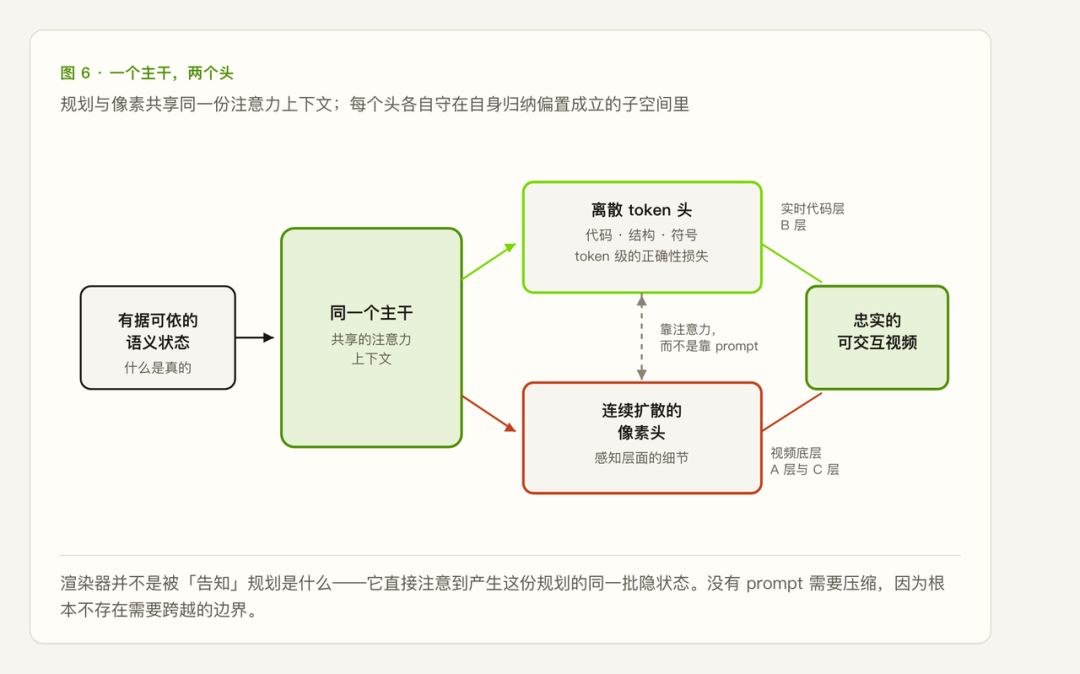
First, shifting the generation medium from "Pixel" to "Code-Pixel Mix" — with clear division of labor. Code handles structure, causality, interaction, and state; Pixel diffusion handles texture, detail, and high-entropy open-world content.
Pure Pixel video models output pixel streams; once generated, the image is locked. SigmaZ AI enables models to output executable frontend code, which renders into visuals. Interaction is itself part of the medium, not an add-on grafted onto video.

Second, from Test-Time Scaling to self-evolution: a vision-guided recursively self-improving multimodal model.
At the model level, SigmaZ AI achieves self-evolution. A long-criticized limitation of Diffusion Language Models is the intelligence ceiling of single-pass generation: faced with complex visual code tasks, models struggle to get structure, logic, and visual effects right simultaneously. SigmaZ AI's approach begins with Test-Time Scaling, allowing the model to think more, try more, and err more on a single task.
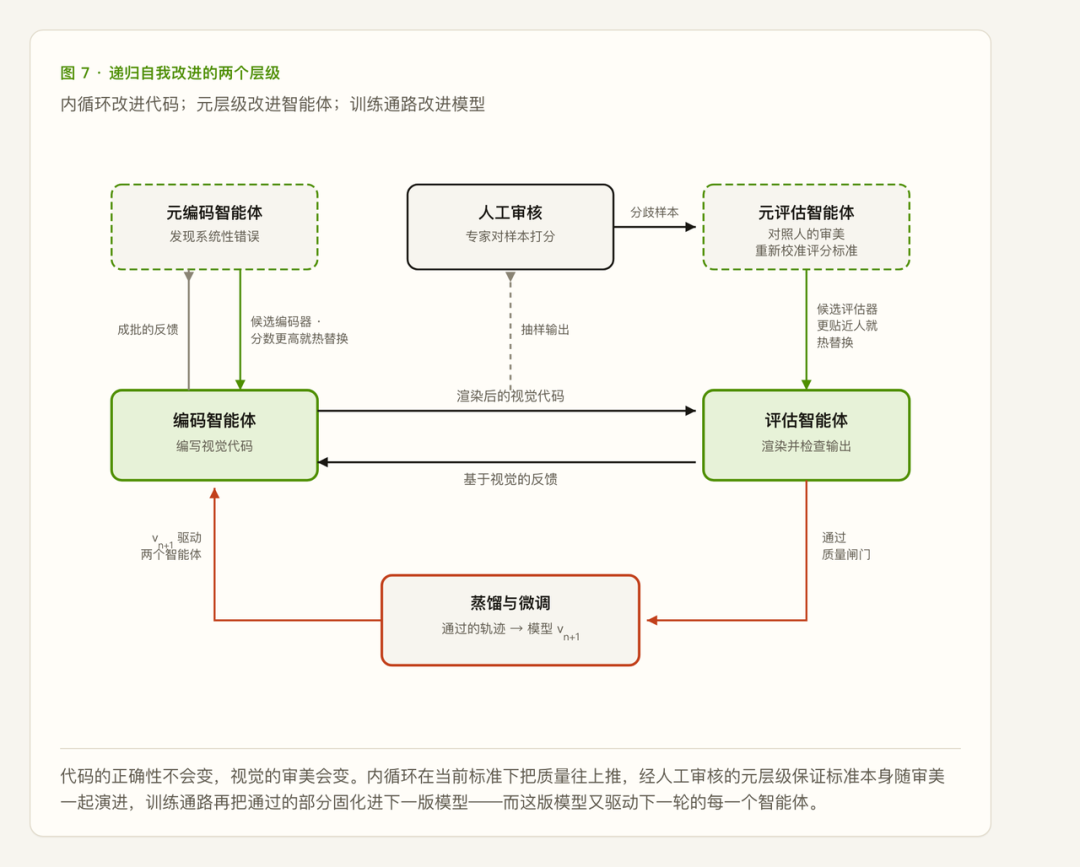
The second step is Training-Time Internalization. SigmaZ AI converts the critiques, revisions, and optimal trajectories from this reasoning process back into training signals, distilling them into model weights — so what took five trial-and-error rounds to learn this time, the next-generation model may get right on the first try.
Finally, SigmaZ AI is also pursuing Evaluator Evolution. From a technical standpoint, evaluation itself needs continuous retraining and evolution. For this, SigmaZ AI designed a "meta-evaluator" layer for ongoing calibration. A "meta-evaluator" agent specifically monitors discrepancies between evaluator agents and human expert scoring, automatically running experiments and recalibrating scoring criteria until it aligns more closely with human judgment; meanwhile, another "meta-coding" agent batch-analyzes evaluator feedback, identifies systematic errors that coding agents repeatedly make, proposes fixes, and allows deployment after passing backtesting.
These three loops (Test-Time Scaling, Training-Time Internalization, Evaluator Evolution) connect to form genuine model self-evolution: reasoning produces experience; experience crystallizes into capability; ever-evolving evaluation standards determine which direction the next-generation model should strengthen toward.
Behind SigmaZ AI's evaluation standards lies an on-demand expert network accumulated over several years, numbering roughly 1,000. These experts all come from QS top-200 universities, covering 9 vertical domains, 75% with master's degrees and 25% with PhDs. Moreover, they don't just score — their more important role is "calibrating automated evaluation models." Currently, SigmaZ AI achieves inter-annotator consistency between 0.67 and 0.91.
This method was developed into a paper by SigmaZ AI CTO Derek Law as core author: Vision-Guided Iterative Refinement for Frontend Code Generation, published at ICLR 2026's RSI Workshop.
Third, rebuilding the model stack for real-time generation: Diffusion-LM with full-stack post-training.
Autoregressive models write excellent code, but their problem is speed — they emit tokens sequentially one by one, at roughly 100 tokens per second. Generating a content-rich scene takes several minutes. This speed suffices for offline rendering but is fatally inadequate for real-time interaction.
The SigmaZ AI team systematically applied DLM to real-time interactive video early on. The base model is a commodity available on the market, but the vertically integrated system built around it is not — this is SigmaZ AI's true moat. "Post-training is just the first step," SigmaZ AI stated. "In the next phase, SigmaZ will enter Pixel-Code joint training. Code and Pixel will no longer be two separate model capabilities, but two decoding paths atop the same world model representation."
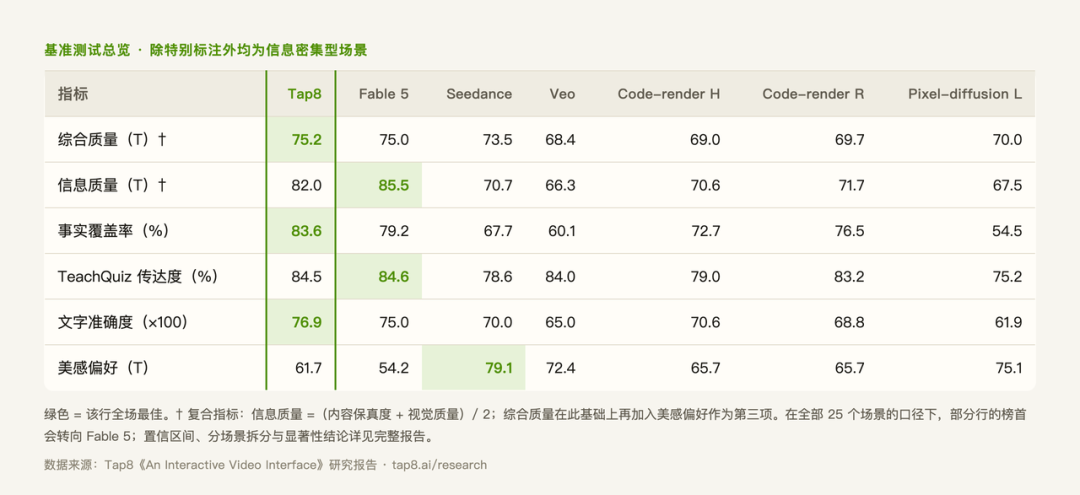
In July this year, SigmaZ AI conducted a horizontal evaluation of its internal generation engine: covering 7 mainstream systems, 5 categories of real-world scenarios, 25 specific scenarios totaling 173 video clips, with independent annotators producing 6,760 blind human annotations. Evaluation data showed that in information-intensive scenarios, SigmaZ AI's engine ranked first in overall quality, factual coverage, and text accuracy, tied for first in content understanding accuracy — outperforming Fable 5, Seedance, and Veo.
Of course, for SigmaZ AI, this benchmark data is merely a starting point. The upcoming product launch is the true test of the company's strength. Therefore, SigmaZ plans to formally launch Tap8 in 2026, its first productization of these model capabilities, positioned as "a practical and fun real-time interactive content platform."

SigmaZ AI's core moat comes from the team's composite know-how spanning model training, visual generation, and consumer-grade products.
In team composition, SigmaZ AI co-founder and CEO Yang Bolin (William Yang) is a serial entrepreneur born in 2003, with academic backgrounds at the University of Warwick and University of Cambridge. He has taken multiple startups from zero to tens of millions in revenue and completed one exit, with first-hand judgment on translating new technologies into daily-use products.
SigmaZ AI co-founder and CTO Derek Law graduated in Computer Science from Imperial College London. With nearly a decade of experience at frontier AI labs, he was the first Chinese algorithm researcher at Amazon Alexa, responsible for technical development from visual code training to launch for Amazon's flagship models.
Beyond the two founders, SigmaZ AI's core team brings together senior researchers and product leads from top-tier labs including Amazon AGI, Alibaba AI Lab, ByteDance AI, and Baidu.
SigmaZ AI's other advantage lies in "data." Interactive video is an entirely new category; the industry has neither existing public datasets nor specialized data annotation services. Over the past year, SigmaZ has accumulated hundreds of thousands of real-world data points with human preference annotations in actual production environments.
Data comes from three channels:
- Consumer-facing products. While the industry generally remained观望 about "generating interactive video with code," SigmaZ AI began布局 last year-end, accumulating initial seed data through its first consumer product.
- B-end pilot partnerships. With clear direction, the team launched pilot collaborations with numerous B-end users. These users generate high-quality data continuously in real-world scenarios and controlled environments.
- Synthetic data. Building on the first two data types, the SigmaZ AI team further scales data volume through synthetic methods.
These three data types complement each other: consumer data provides real user feedback, B-end data covers structured scenarios, and synthetic data achieves scale amplification. Together they constitute the core material for SigmaZ AI's model post-training, and in turn drive the continuous operation of the RSI self-evolution loop.
Co-founder and CEO Yang Bolin stated: "Looking back at every round of media revolution, the essence was always an underlying technology rewriting the information carrier once again. The printing press grew newspapers, radio grew broadcasting, video encoding plus streaming grew today's short-video platforms. Every media revolution starts from the bottom — new media and that era's greatest platform grow from it."
SigmaZ AI believes AI is the foundation of the next emerging medium, and its true product is real-time interactive content. Therefore, with vision as the entry point for next-generation human-computer interaction, taking Diffusion-LM as a new model paradigm for the real-time interactive era, and using Code as its native language connecting to the visual world, it opens a new entry point for user-AI interaction.

 BlueRun early-stage project AI interactive content community Loopit completes $100 million funding | BlueRun Ventures
  BlueRun angel project Tashi Zhihang completes $455 million Pre-A funding, building robots that "really work, really scale" | BlueRun Ventures
  BlueRun early-stage project Pongbot raises nearly 200 million yuan in Series A funding, redefining sports with AI | BlueRun Ventures