Into Reality, a New Odyssey for Robots | BlueRun Ventures' WRC Observations

Chinese robotics entrepreneurs are writing a new narrative for robots.
This year's WRC, robots started doing harder things.
Tracking WRC across recent years, BlueRun Ventures has observed robots moving from large-scale locomotion to fine manipulation, from single-point tasks to long-horizon execution, from exploratory demos to clear scenario deployment. Chinese startup teams are building their own model pre-training and post-training capabilities. Application directions explored over the past few years are beginning to crystallize into more defined scenarios — logistics, industrial, retail — further testing scene understanding, reliability, and delivery capacity.
In 2026, robots moved from labs to real-world scenarios. The real world made everything harder: addressing a series of challenges including greater hardware stability; model deployment, post-training, and self-evolution; robustness and generalization of scenario tasks.
This is the clearer technological and industrial thread BlueRun saw at this year's WRC after years of deep work in embodied AI. On the other side, the entrepreneurs BlueRun has long sought out and supported along these key variables are becoming the most direct participants in this shift.
At this year's WRC, BlueRun portfolio companies continued pushing toward the real world along different technical paths, delivering a series of notable technical advances and achievements:
Galaxy Universal spanned home, retail, and industrial settings, with robots learning new tasks on-site; Moqi Intelligent Technology pushed robot long-horizon tasks toward more stable execution; MUKA tested world-model reasoning and decision-making through real physical interaction; Proto-Sentient Intelligence explored scaling real-world data toward million-hour scale; Sudu Tech placed "over 99% high reliability" ahead of large-scale deployment; RoboCT and Pongbot brought robot capabilities into real scenarios. And on the World Humanoid Robot Games field, AgiBot took two golds in unstructured, high-disturbance, long-process scenario competitions; AGILINK swept all three autonomous team categories with a commanding lead.
Below, BlueRun distills six technological and industrial shifts worth watching at this year's WRC, and documents the technical progress of portfolio companies at the exhibition. Enjoy:

1. From "Static" to "Dynamic": Robot Product Maturity Is Accelerating
This year's WRC showed clear changes in robot product maturity.
If past exhibitions still featured numerous robots relying on rigs and fixed mounts for demonstrations, the most visible change this year was: the vast majority of robots could perform dynamic demonstrations, with more stable motion control and task execution, gradually approaching more mature product forms. This reflects the maturation of body design, motion control, and perception capabilities in the embodied AI field — the advancement of foundational robot capabilities.
The body maturity demonstrated at this year's WRC marks an important foundation for embodied AI's transition from technical validation to task validation. BlueRun's sustained focus on embodied AI includes continuous observation of robots evolving from single-point capabilities toward system-level capabilities.
2. From "Big Movements" to "Fine Manipulation": Robot Operational Capability Improves
Another clear trend at this year's WRC: significantly more dexterous manipulation demonstrations.
In past years, robot demonstrations focused on walking, locomotion, and other large-scale movements. This year, numerous robots showcased fine manipulation capabilities. Whether through dexterous hand solutions or gripper-based operating systems, they began attempting more complex tasks — playing piano being a typical example of dexterous manipulation.
Fine manipulation demands more from robot perception, control, and environmental understanding. Robots need to more accurately recognize object states and execute continuous, precise movements according to task requirements. Robots are gradually gaining the ability to handle more complex tasks, laying groundwork for entering more real-world scenarios.
3. From "Finding Scenarios" to "Understanding Scenarios": Robot Competition Shifts Toward Delivery Capability
A clear change at this year's WRC: compared to the broad exploration of "what can robots do" in earlier stages, the industry is converging on several validated scenarios with shared characteristics. Robots are no longer just demonstrating single-point capabilities but entering specific business processes to face real demand validation.
Logistics induction was one of the more clearly defined deployment directions at this year's exhibition. Logistics induction essentially involves robots completing continuous tasks in logistics chains — parcel identification, grasping, placement, waybill recognition — feeding parcels into conveyor lines and advancing them to subsequent scanning and sorting processes. Compared to single-action demonstrations, such scenarios demand: induction rhythm speed, accuracy, generalization across different parcel types, customer payback speed, and sustained stability over long-term operation.
When robots enter such real-world application scenarios, after technical feasibility is validated, scalable deployment becomes critical. Scene understanding, product delivery capability, and industrial experience become focal points of industry competition.
BlueRun believes embodied AI's path to industrial deployment rests on mature and stable bodies, usable pre-trained models, and mature data collection and infrastructure tooling platforms. On this foundation, companies must genuinely understand scenarios and form complete closed loops from technical capability to product delivery. Robots entering the real world face not standardized simulation and experimental environments, but complex, variable actual conditions. Future robot company competitiveness requires long-accumulated industry know-how. At WRC 2026, we judge that embodied AI has entered a stage of comprehensive competitiveness.
4. Pre-training and Post-training Capabilities Strengthen: Chinese Robot Teams' Training Paths
BlueRun's team has tracked WRC across recent years and found that past exhibitions focused more on validating existing model capabilities. For example, folding clothes — a task with relatively rich data accumulation — was a common demonstration; many robot capabilities also relied on task-specific engineered programming.
This year's WRC showed Chinese robot startup teams moving from "replicating existing capabilities" toward exploring their own model training paths, continuously improving models' understanding of the physical world and task generalization through proprietary data accumulation and real-world scenario feedback.
On one hand, stronger pre-training capabilities are emerging in robotics. On the other, the importance of post-training capabilities is becoming visible. Chinese robot teams are beginning to attempt more general understanding of the physical world through larger-scale, richer data; they're also using real-world scenario data to further optimize foundation models for specific tasks, widening the capability gap between robots.
BlueRun's sustained focus on embodied AI centers on Chinese entrepreneurs who can push robots from "completing tasks" toward "understanding the world" through this paradigm evolution.
5. From General to Vertical: Robots Entering More Niche Scenarios
At this year's WRC, exploration in vertical domains like industrial and heavy-load robotics increased noticeably, with industrial competition deepening into specific vertical scenarios. These robots are more oriented around particular industry demands, requiring adaptation to specific environments, task flows, and operational requirements.
Future robot industry competition won't be just about single robot body capabilities, but will gradually evolve into comprehensive capability competition across different vertical domains. For example, industrial scenarios prioritize stability, precision, and long-term operation capability; heavy-load scenarios focus on payload capacity and reliability; service scenarios require stronger environmental understanding and interaction capabilities. Embodied AI development won't follow just one technical route or robot form, but will form differentiated competition across vertical domains.
BlueRun believes that as the industry enters deeper stages, robot companies with genuine long-term competitiveness need not only technological innovation capability but also understanding and continuous accumulation of specific industrial demands.
6. The Robot Native Generation Forming: BlueRun's Continued Bet on New Creators
Beyond robot technology's own evolution, at the WRC venue we were pleased to notice: younger generations are understanding robots in deeper ways. BlueRun observed that many young visitors' interest in robot technology no longer stops at appearance and movement, but extends to actively asking about components and parts. Robotics is gradually becoming an important technology encountered by younger generations throughout their development — no longer just a specialized field.
On one hand, their acceptance of robot products and applications is higher; embodied AI is becoming a technology form naturally integrated into life, giving robots a broader user base. On the other, earlier exposure to robots means more young people are likely to enter robot R&D, engineering, and entrepreneurship, giving the future robot industry more adequate talent reserves and innovation momentum.
What BlueRun anticipates is the innovation ecosystem that embodied AI as a technical direction will form over the long term: over the next decade, what drives continuous robot evolution will be not only today's entrepreneurs, but also a new generation of creators who grew up in the robot era.

Galaxy Universal
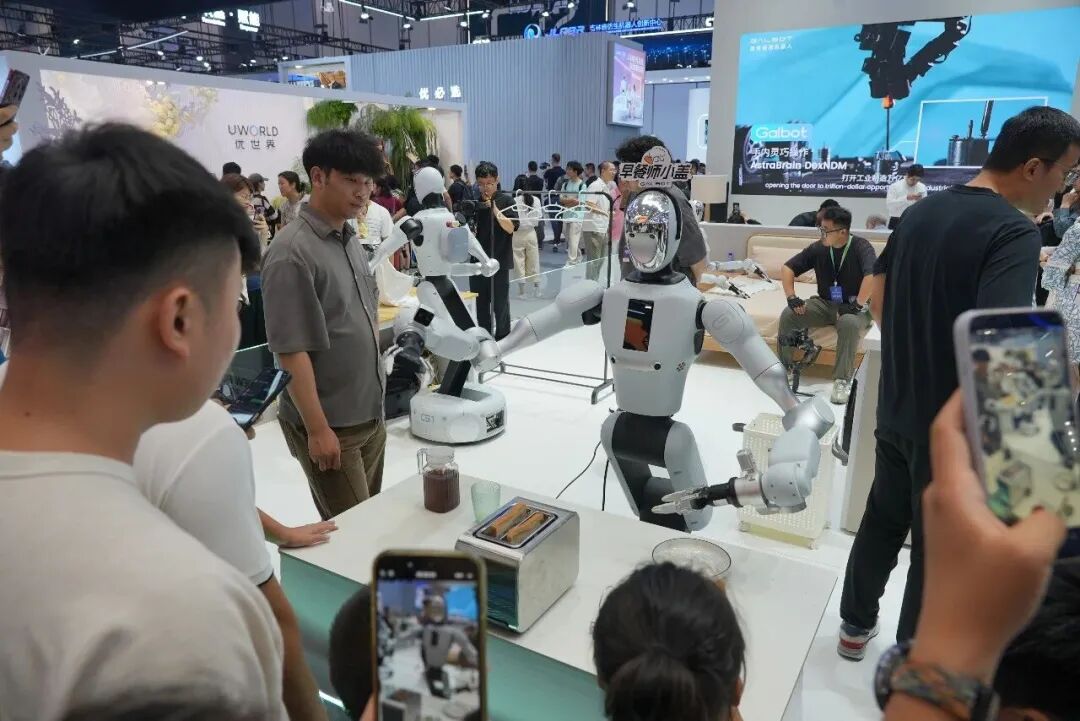
From Multi-scenario Exploration to Embodied General Intelligence At this year's WRC, Galaxy Universal demonstrated across home, heavy industry, retail, and other scenarios: Galbot G1 completed long-horizon tasks in home and retail scenarios; the heavy-load robot Galbot S1 targeted industrial environments, demonstrating material handling and other tasks. Galaxy Universal also unveiled Galbot ET1 "Galaxy Star" — the world's first humanoid robot agent with autonomous learning capability. Unlike robots dependent on preset movements, Galaxy Star can autonomously identify and extract motion trajectories through real-time human interaction, achieving on-site learning and on-site replication.
Galaxy Universal's self-developed embodied large model system, AstraBrain, enables different robot forms to share the same intelligence capabilities, understanding tasks, planning actions, and completing execution across different physical environments.
Galaxy Universal is exploring how to give robots general intelligence that can transfer across scenarios and tasks. This reflects a key judgment in BlueRun's sustained focus on embodied AI: the core of future robot competition lies not only in robot body capabilities, but in the long-term capabilities built from the combination of models, data, and real-world interaction.
AgiBot
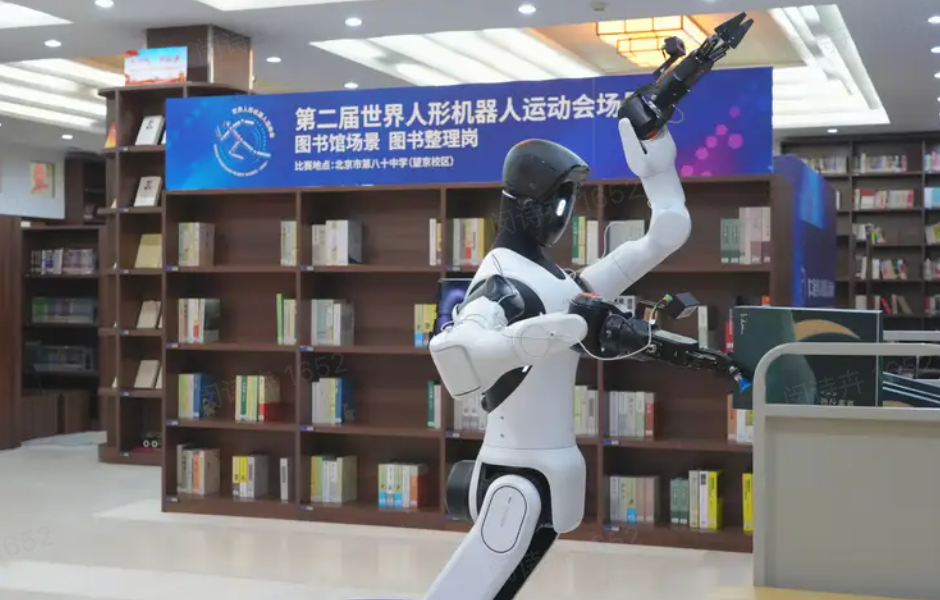
Two Golds Leading the Pack: Embodied AI Enters Scenario Competitions At the 2nd World Humanoid Robot Games, BlueRun portfolio company AgiBot entered with Spirit G2,灵犀 X2, and Expedition A3, with Spirit G2 taking two gold medals in the "scenario competitions" that emphasized real operational capability — fire emergency and library scenarios — accumulating two golds, three silvers, and two bronzes. Scenario competitions tested robots' comprehensive operational capabilities in unstructured, high-disturbance, long-process real-world environments.
These different scenarios did not rely on "one scenario, one system" specialized development. AgiBot used the GO series models for visual understanding, instruction parsing, and task generalization; Genie Studio Agent for scene understanding, task decomposition, and capability orchestration; and reinforcement learning toolchains for policy training and optimization — with the same capability system reusable across different tasks.
AGILINK
Three Autonomous Teams Sweep Championships, Delivering "Cliff-like" Lead AGILINK delivered a highly convincing record at this year's World Humanoid Robot Games: 3 golds, 1 silver, and 2 bronzes on day one of the dexterous hand competition, with all three autonomous teams winning championships.
AGILINK's own team took gold in tweezers bean-picking and block building through fully autonomous operation; the Wuhan University-AgiBot joint team using OmniHand became the only team in the powder weighing event to complete the competition fully autonomously and win.
From AGILINK's self-developed algorithms completing the autonomous closed loop of "see — judge — act," to external teams using OmniHand also achieving fully autonomous victories, AGILINK is transforming dexterous manipulation capability from a single-point technical advantage into replicable, scalable product and system capabilities. This confirms BlueRun's investment thesis for AGILINK: the dexterous hand is the critical interface for embodied AI extending into the physical world, and true moats come from the combined accumulation of product technology, engineering iteration, mass production validation, and real-world scenario closed loops.
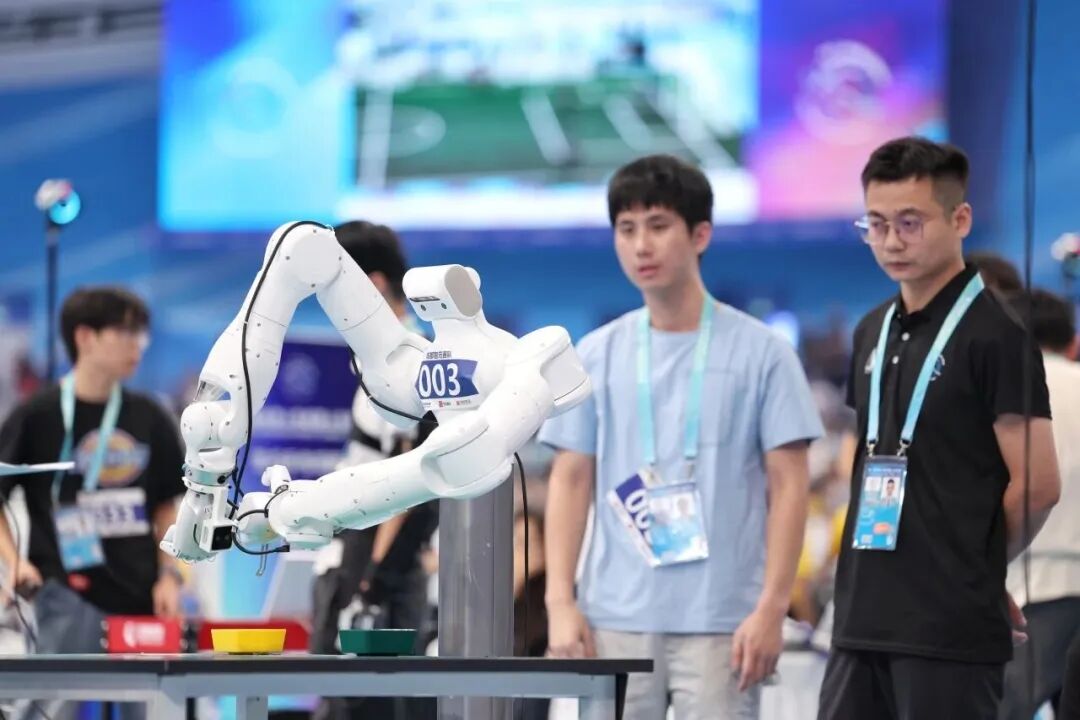
Moqi Intelligent Technology
Anti-interference, Uninterrupted. Robots Begin Completing Long-horizon Tasks Moqi Intelligent Technology demonstrated MORPHI KINO's long-horizon task capability in real home scenarios at this year's WRC. Based on the self-developed embodied model framework MoRA, the robot receives a complete task goal, plans autonomously, and continuously advances the task — even if items are removed mid-process or the environment changes, it can replan based on current state.
In BlueRun's view, embodied AI's move into real physical worlds competes not on single-point model capability alone, but on system capabilities combining software-hardware integration, real-time closed loops, and engineering reliability. Stable execution in long-horizon tasks is the most direct test of this systems engineering capability.
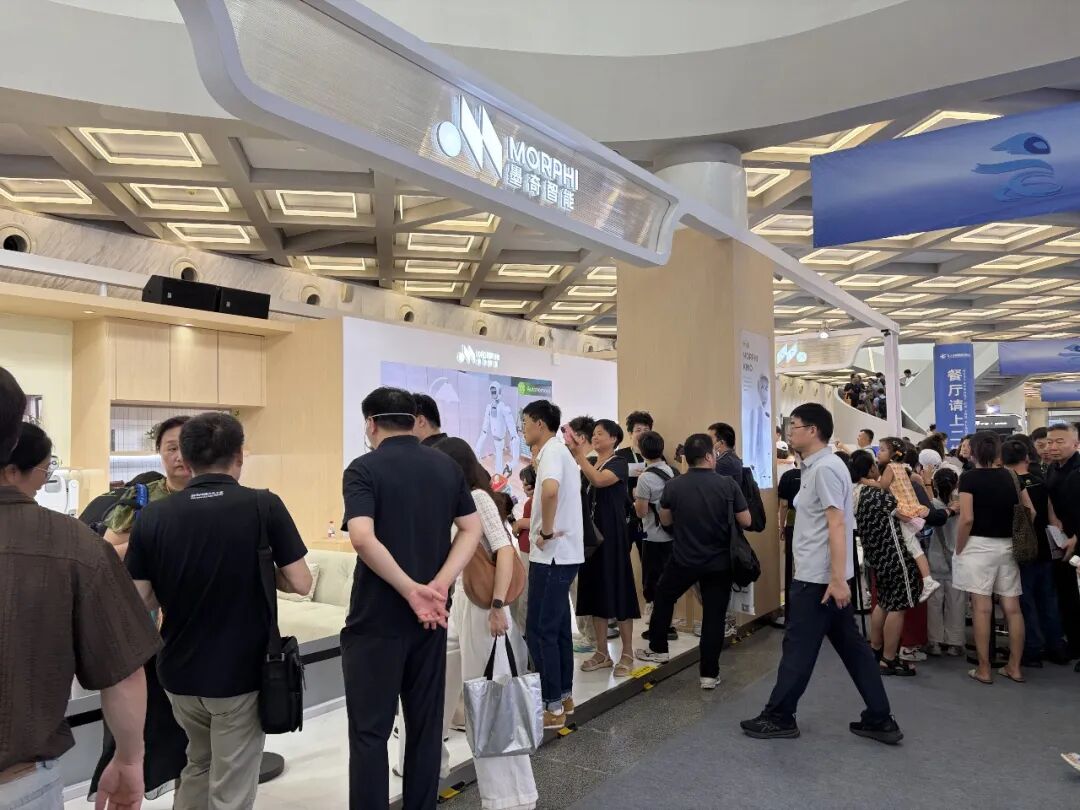
MUKA
Translating World Model Capabilities into Physical World Interaction As a recently founded embodied AI foundation model company, BlueRun portfolio company MUKA chose a fresh demonstration approach at WRC: through extensive game-based interactions — curling, mazes, blocks — audiences directly altered the physical environment, and robots had to perform visual reasoning, prediction, and decision-making based on current state. This reflects MUKA's bottom-up technical thinking: moving robots from "executing actions" to "understanding the world."
These interactions themselves are part of model iteration: each on-site participation generates real interaction data feedback for model fine-tuning and generalization validation. Around WRC, MUKA released and demonstrated multiple world model advances: HDR, a latent-space reasoning model for the physical world; LJM, a joint representation learning and efficient training model. MUKA further demonstrated its foundational model exploration centered on "understanding the physical world."
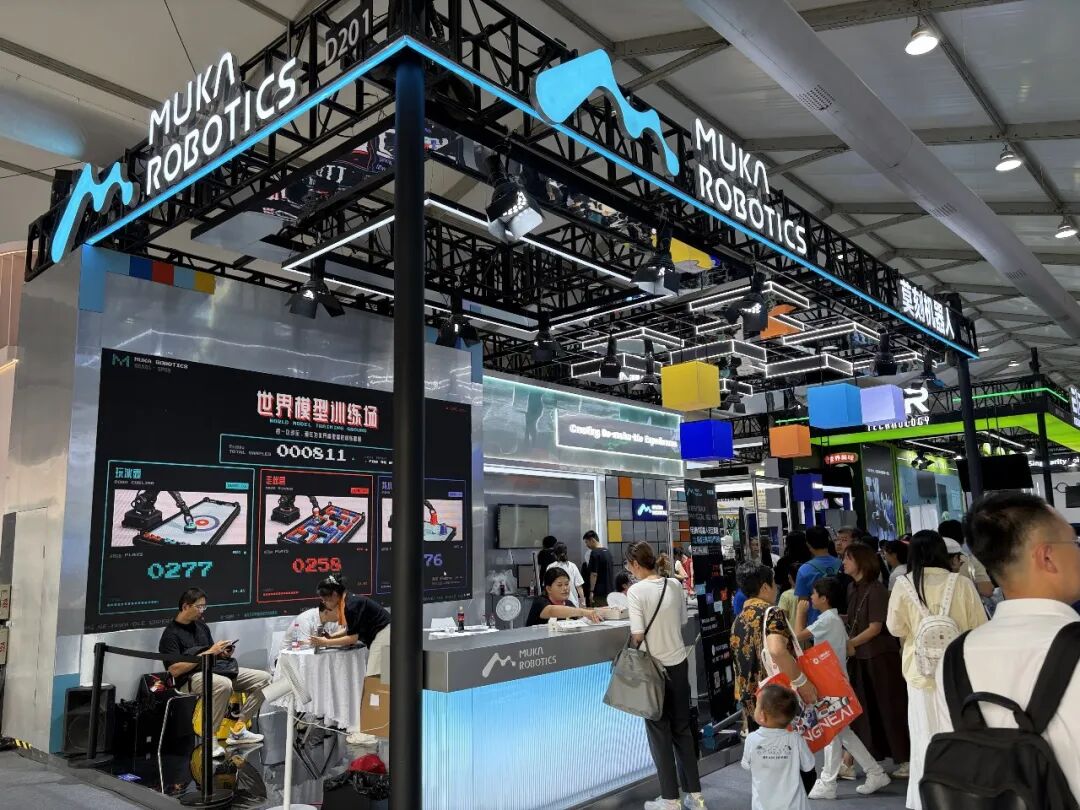
Proto-Sentient Intelligence
Wearable Data Collection Debuts, Exploring Million-hour Real Data at Scale Proto-Sentient Intelligence's highlight at this year's WRC was its wearable embodied data collection solution: through Psi-SynEngine, converting human operations in real scenarios into high-quality robot-learnable data, and further driving end-to-end PSI series model and Ψ-SynRobot training and iteration.
Real-world physical interaction cannot be fully replaced by simulation, and wearable data collection can transform human dexterous operations into robot learning data at low cost and large scale. Proto-Sentient's current glove-based collection costs roughly one-tenth of real-machine teleoperation solutions, with plans to move toward portable, crowdsourced collection — only when real data acquisition costs continue falling does million-hour-scale data accumulation become truly viable.
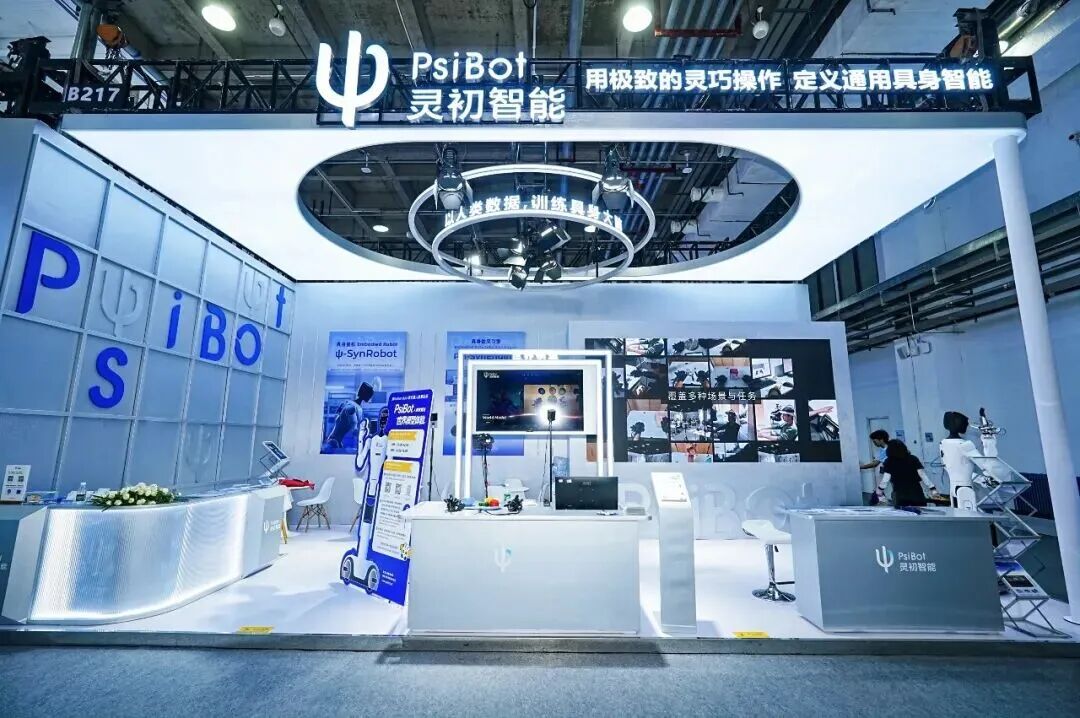
Sudu Tech
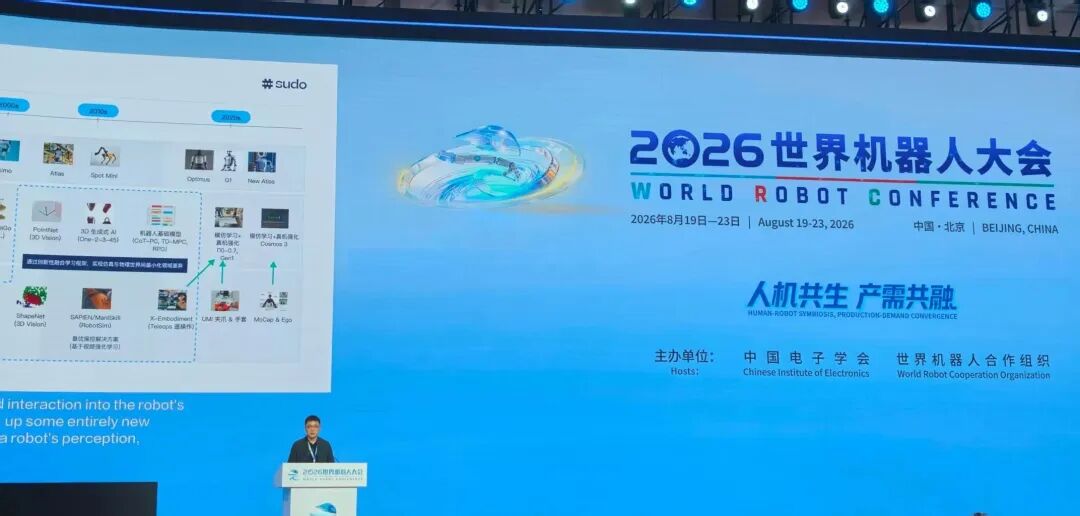
Robot Scale Deployment Requires Moving from Generalization to High Reliability At the WRC main forum, Sudu Tech co-founder and CEO Han Zheng shared "From Embodied Research to Scale Deployment: The Path to Building Highly Reliable Robot Agents." He proposed that while embodied AI still focuses mainly on generalization capability exploration, AI will not lower real-world application standards just because problems get harder — over 99% high reliability is an unavoidable prerequisite for robots to achieve scale deployment.
Sudu chose to first focus on the most complex and critical "object manipulation": achieving high-reliability manipulation without cherry-picking objects or environments, then沉淀ing grasping, placement, assembly and other capabilities into reusable skills, using upper-layer models and agent orchestration to complete complex long-horizon tasks. While ensuring generalization, truly pulling reliability to industrially usable levels.
RoboCT
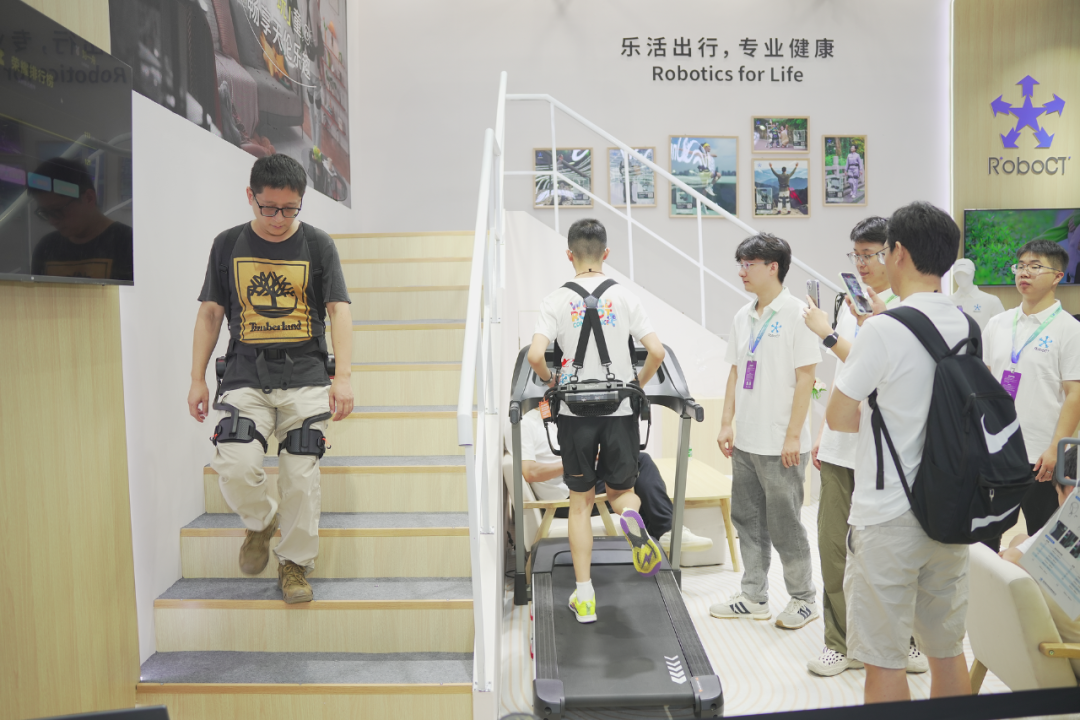
Bringing Exoskeletons Truly into Homes RoboCT formally launched the consumer-grade new product GoGo-H Pro Speed Assist Exoskeleton at this year's WRC, positioned as "the first exoskeleton for your home." Based on clinical validation accumulated across over 1,800 medical institutions and more than 1 million sessions, 1 billion steps of real rehabilitation training data, it features a new-generation AI gait adaptive algorithm that can real-time sense movement intent and adapt to different motion states including flat ground, stair climbing, and outdoor hiking.
On-site, RoboCT turned its booth into a try-on living scenario: ordinary visitors, middle-aged and elderly people, and sports enthusiasts wore the exoskeleton to walk and climb stairs, directly experiencing human-machine coordinated movement.
Pongbot
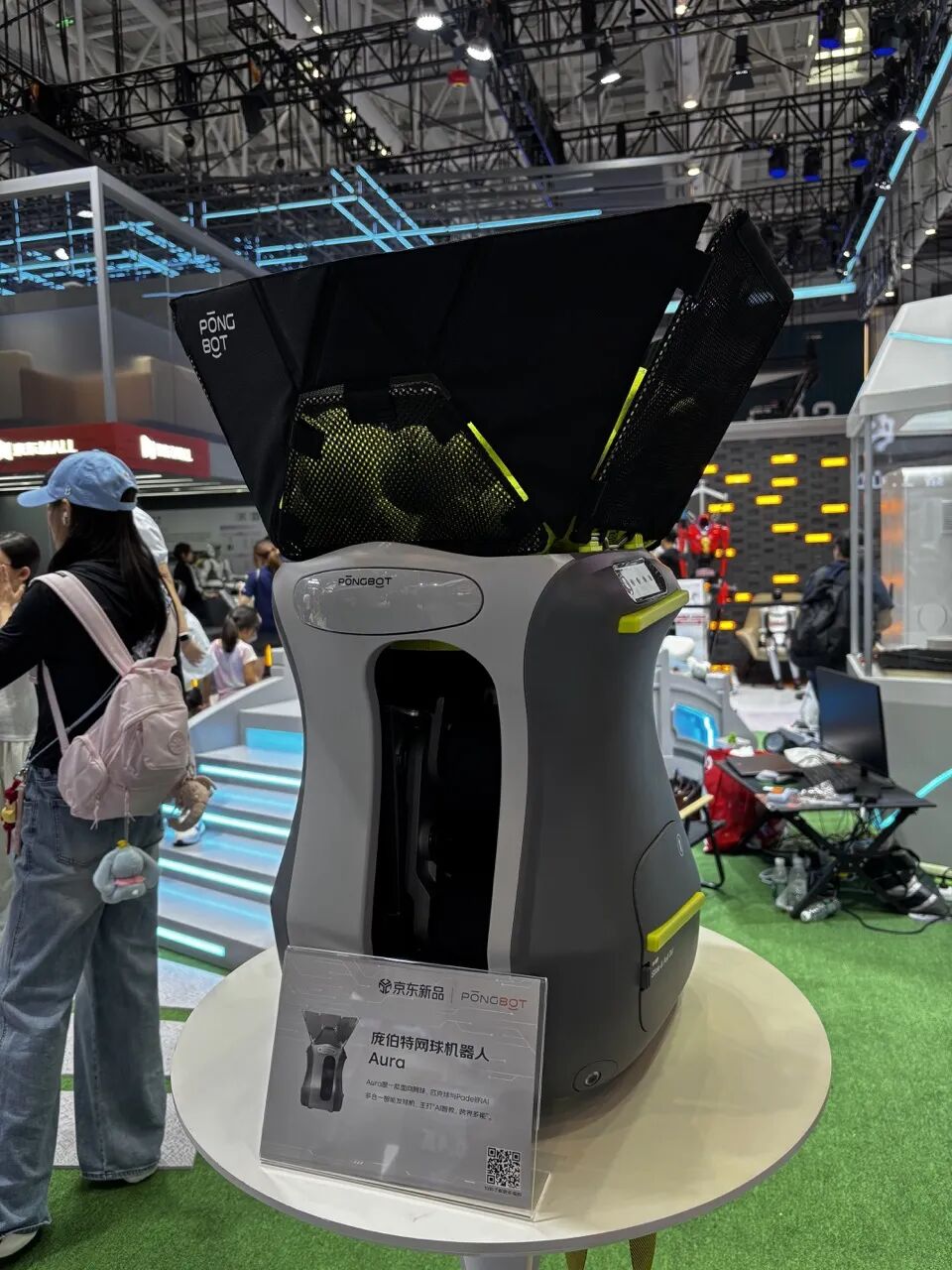
AI Coach Enters Real Sports Venues Pongbot brought Aura — the world's first AI multi-sport coach robot. Powered by Pongbot's sports large model, Aura continuously observes athletes' forehands, backhands, serves, volleys, footwork and other movements, analyzes current training status, and provides real-time targeted voice coaching; while one device covers multiple racket sports including tennis, pickleball, and padel. Robots are beginning to understand a professional scenario and provide services previously requiring professional personnel.

BlueRun's Jui Chan on Data, Value, and Long-term Judgment: What Truly Survives the AI Hype?

Moonshot AI K3 Release: A Sleepless Night, Witnessing Long-termism Pay Off