He Started a Business at 20, and Now He's Selling Mushroom-Grown Leather to the World | Linear Voice
SynBioTech announced the completion of a Series A funding round exceeding 100 million yuan.

Today, SynMetabio announced the completion of a Series A funding round exceeding RMB 100 million. The round was co-led by Ordos Group and Heda Financial Services, with participation from Nest.Bio Ventures.
SynMetabio is a global leader in the sustainable mass production of bio-based leather, and one of the very few companies to achieve continuous, roll-to-roll manufacturing of this material. Its materials have already made their way into ANTA Group stores and well-known hotel chains, and are poised to hit the shelves of multiple high-end European luxury brands.
As the lead investor in its angel round, Linear Capital has stood by SynMetabio since day one. Four years ago, backing a Gen Z founder was still far from common. What drew us in was founder Rui Su's unwavering focus on two things from the very first day: how to mass-produce, and how to go global. And the founding team's resilience in weathering industry cycles. Here's the SynMetabio story from our perspective. Enjoy:
"In biomanufacturing, the hardest part isn't finding a valuable molecule — it's scaling it to industrial production." This is a point Rui Su has returned to repeatedly over the years.
2020 to 2021 marked the peak of synthetic biology hype. Overseas leaders like Ginkgo and Zymergen went public at multi-billion-dollar valuations, sending markets into a frenzy. But as the bubble deflated in 2022 and 2023, most of those top companies fell silent — some acquired, others filing for bankruptcy. Nearly all of them stumbled on the same four words: "industrial scale."
SynMetabio was the exception — not only did it survive, it actually achieved scaled commercial deployment.
Today, it is a global leader in sustainable mass production of bio-based leather, and one of the very few companies to achieve continuous, roll-to-roll manufacturing. Through a joint-venture production line with a publicly listed company, annual capacity has surpassed 16 million square meters. Its products have passed rigorous testing by over ten top international luxury brands and automakers, with carbon emissions reduced by over 80% compared to conventional routes — and production costs for some products now even lower than traditional oil-based PU. SynMetabio's materials have already made their way into ANTA Group stores and well-known hotel chains, and are poised to hit the shelves of multiple high-end European luxury brands.
Today, SynMetabio officially announced its Series A round exceeding RMB 100 million, with multiple strategic investors participating. As the lead investor in its angel round, Linear Capital has stood by SynMetabio since day one.
Four years ago, backing a Gen Z founder was still far from common. What drew us in was Rui Su's unwavering focus on two things from the very first day: how to mass-produce, and how to go global.
When an industry's bubble bursts and rationality returns, why is it this startup that managed to actually scale bio-synthetic materials? The answer isn't complicated. While the future of biomanufacturing was being painted in grand visions again and again, SynMetabio kept returning to a concrete question: how to change the way a material is made, used, and understood.

SynMetabio recently cleared out four thousand trays from its basement.
These were shallow trays from early cultivation attempts — contaminated, nearly scrapped. Before, every time an investor visited, Rui Su would take them down for a look and joke: "This is our legacy." The disposal of those four thousand trays coincided with a milestone — a factory with single tanks exceeding twenty tons had officially come online. SynMetabio had truly entered large-scale production.
What SynMetabio makes is leather that "grows." The "leather" in our sneakers and bags has traditionally come from one of two sources: animals, or petroleum. SynMetabio wants to create a third — using microbial fermentation to produce resin, then turning it into leather: bio-based, low-carbon, and scalable.
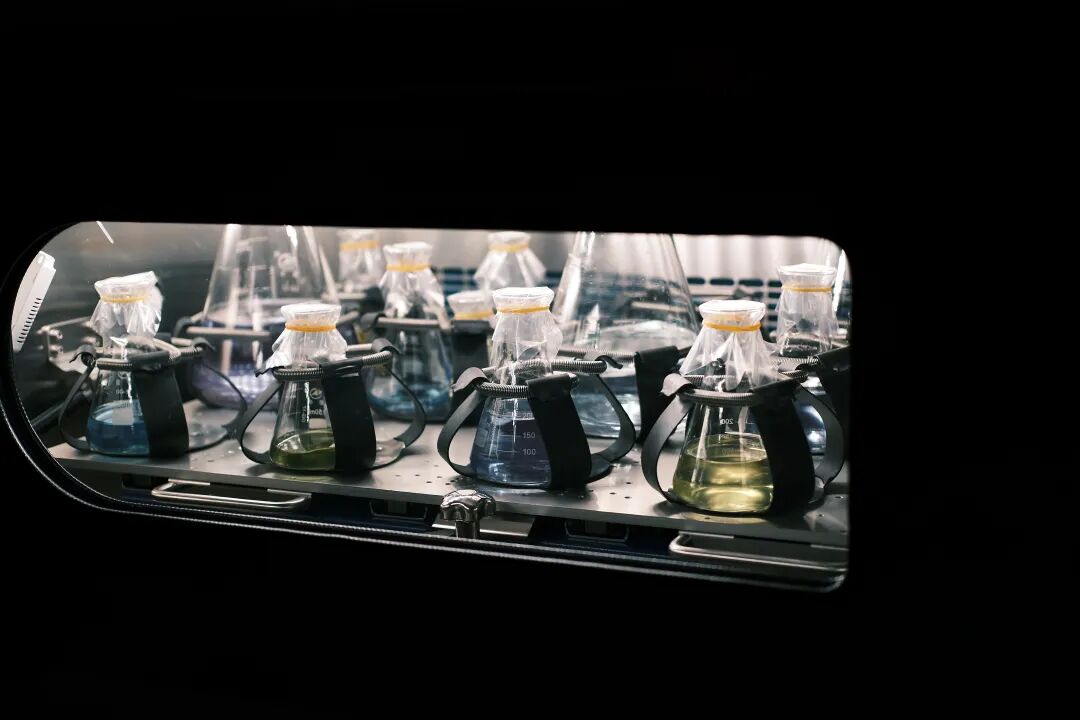
The story began in 2021. Rui Su, then a student at ShanghaiTech University, happened to obtain a membrane in the lab. A few strains of bacteria, some sugar, left for some time — a thin hydrogel layer grew, which shrank into an extremely dense fiber when dried. A membrane less than one millimeter thick, he couldn't tear it no matter how hard he pulled, yet it felt remarkably like leather.
That year, at age 20, he led a team to win an award at the International Genetically Engineered Machine (iGEM) competition. Following the conventional path, he could have easily secured grad school admission, pursued a PhD, and entered academia. Instead, he chose to turn that membrane into a company.
This was the direction Rui Su had settled on since middle school — to become an entrepreneur, and if possible, to drive some change in how society develops. So, never having held a job, he resolutely chose to start a company with classmates upon graduation.
Scaling biomaterials offers two paths — sheet and roll-to-roll. The former uses shallow trays for layer-by-layer cultivation. With few trays, everything works fine. But as numbers rise, so does contamination probability. One infected tray spreads like an epidemic. That's how SynMetabio ended up with four thousand trays in its basement.
Rui Su's post-mortem focused not on contamination itself, but on the fact that this method produced sheets — requiring subsequent cutting, scar removal, uneven thickness, heavy manual traces, and poor integration into production lines. This was the shared predicament of the mainstream approach at the time.
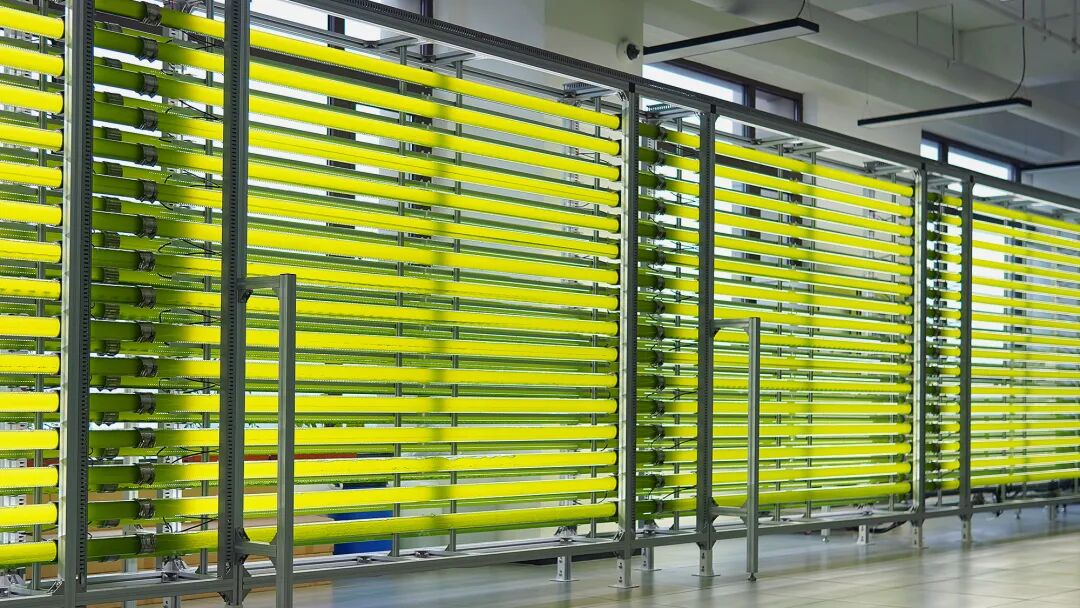
What SynMetabio wanted was roll-to-roll material — using microbial liquid fermentation to produce bio-based resin, then building it into rolls layer by layer like film coating. This choice was thoroughly non-mainstream at the time, yet it pointed to the only path toward industrial scale.
The way to achieve it wasn't to start from scratch, but to reverse-engineer against existing industrial systems. Over 80% of global synthetic leather capacity sits in China, with corresponding machinery and processes already in place. SynMetabio worked backward from these gears — what could satisfy existing production conditions, then what strains could satisfy those conditions, then cost control.
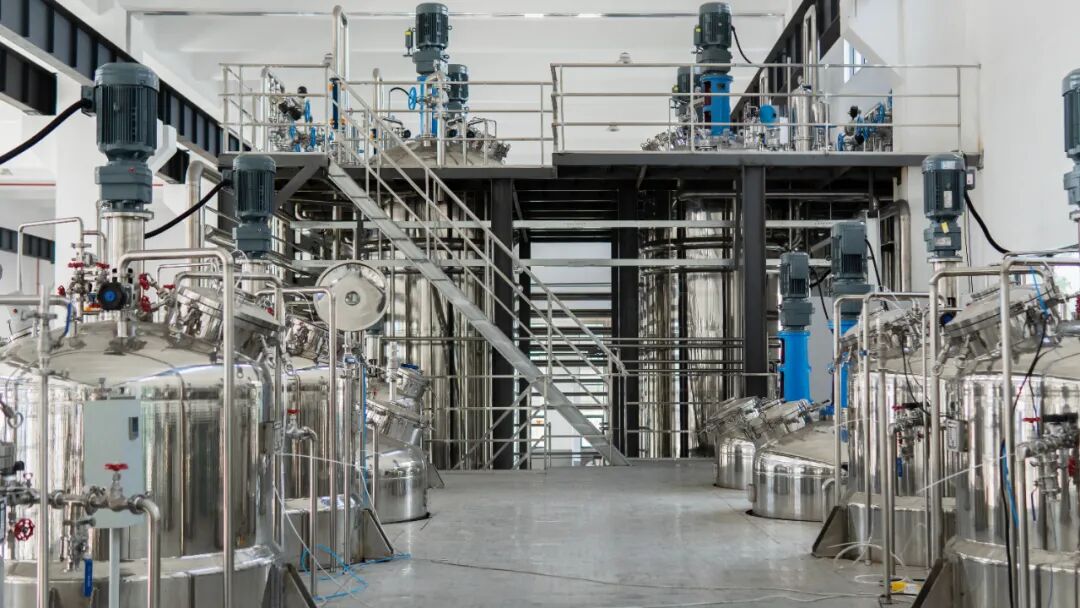
Fermentation scale-up is a widely acknowledged challenge in synthetic biology. In a twenty-ton tank, chain reactions at extremely high cell densities are nearly impossible to predict. Previously, workers sampled every two hours, inferred, and adjusted parameters. But biological variables are too numerous for human oversight. SynMetabio built a system for specific strains that could simulate from five liters to twenty tons. Several AI agents: one inferring cell state from exhaust gas, one tracking fermentation progress, one using fluid dynamics to calculate corrections, then learning from new data. The foam that once caused headaches was captured by vision models and turned into a signal for tank conditions.
A twenty-ton scale-up law that previously required seven or eight costly trial batches can now be simulated at two hundred liters for a few thousand yuan per run. Fermentation cycle compressed from seventy-two hours to thirty-six. Costs cut to one-fourth. Real industrial data from the full process feeds back into the models, systematically reducing uncertainty with each scale-up.
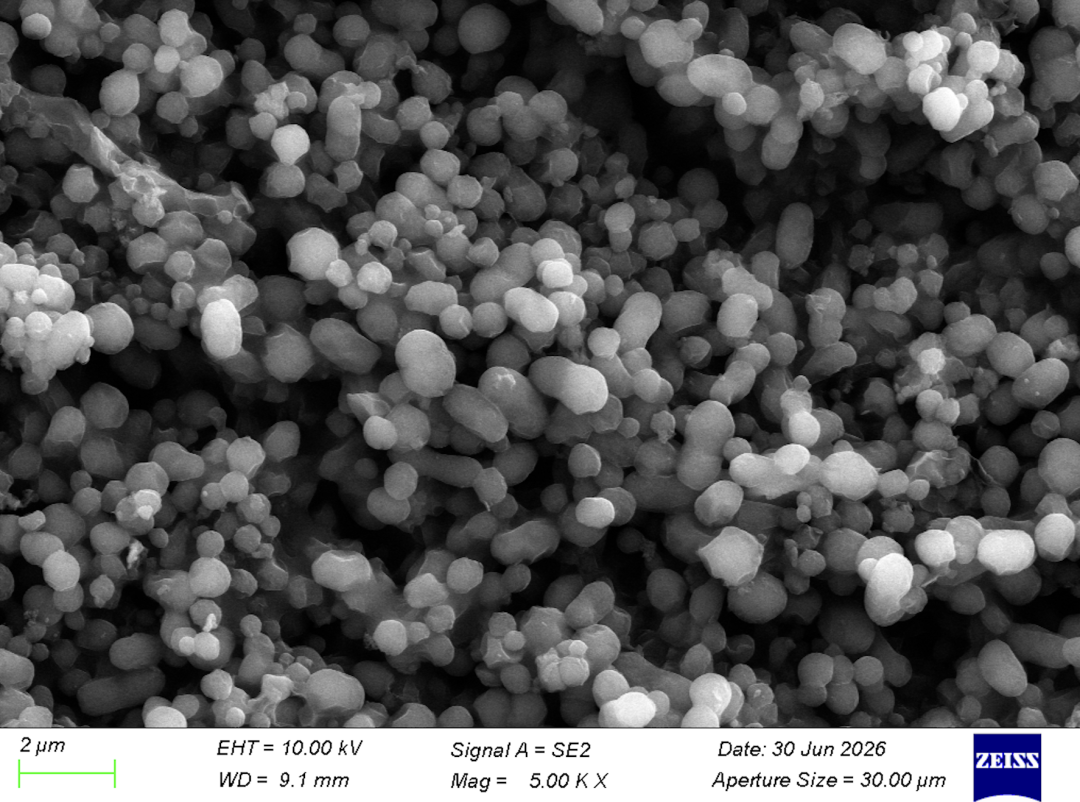
SynMetabio's fermented nano-polyester elastomer
And so, that tear-resistant membrane gained a factory. While overseas pioneers remain trapped in heavy-asset cycles of "raise funds — build factory — raise funds again," SynMetabio chose to form a joint venture with a listed company, owning production lines through an asset-light model and pushing annual capacity beyond 16 million square meters.
This was precisely a key reason for Linear's bet. In 2022, we were searching for domestic teams working on bio-based leather comparable to overseas efforts. A video Rui Su posted caught the attention of Linear investor Tianyi. The two young people talked for two hours straight. Rui Su's persistence, his grasp of technology and business, never once made Tianyi realize the founder across from him was a Gen Zer.
What truly pushed us to invest was that Rui Su "was the only one thinking seriously from day one about how this product could be mass-produced." At the time, many synthetic biology companies hadn't considered scale-up at all — "they had a technology but never thought about how to supply tens of thousands, hundreds of thousands, tens of millions of meters." Yet materials is a business that must ultimately answer to scale. That string of mass-production, Rui Su has kept taut from day one to today.

Apart from initial experiments, nearly all of SynMetabio's major brand partnerships began with the brands knocking on their door.
Rui Su sees this as the best proof that something works: customers coming to you beats a thousand words. Behind it lies a repeatedly validated business logic. Bio-based leather is a new category, and new categories need flagship anchor customers. Once leaders adopt, others follow in droves.
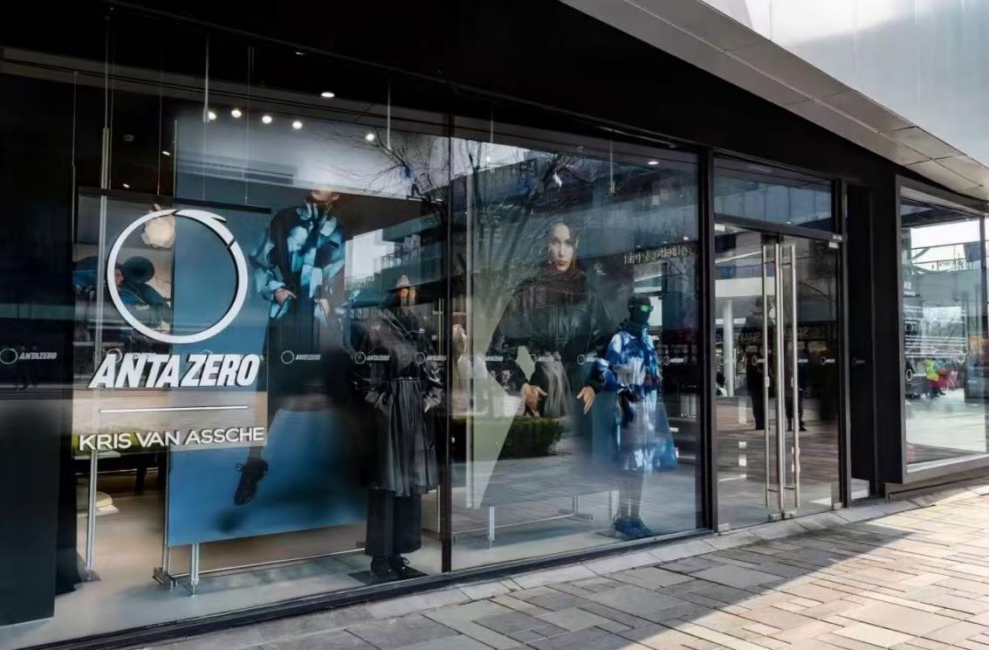
SynMetabio's collaboration with ANTA at the Taikoo Li Sanlitun pop-up (Image: ANTA)
This is the chain reaction that production capacity enables. And it reflects SynMetabio's scarcity. Stable, consistent quality supply. Customizable bio-based content. Controllable pricing. These three conditions, stacked together, are all indispensable — and SynMetabio is virtually the only company that can satisfy them all simultaneously.
From the April 2025 debut of the Aojie sneaker series with ANTA, to the November 2025 launch of ANTA ZERO × KRIS VAN ASSCHE Phase One, to the March 2026 release of Phase Two — three iterations in eleven months. SynMetabio definitively answered whether bio-based materials can be stably replicated in a leading sportswear brand's supply chain.
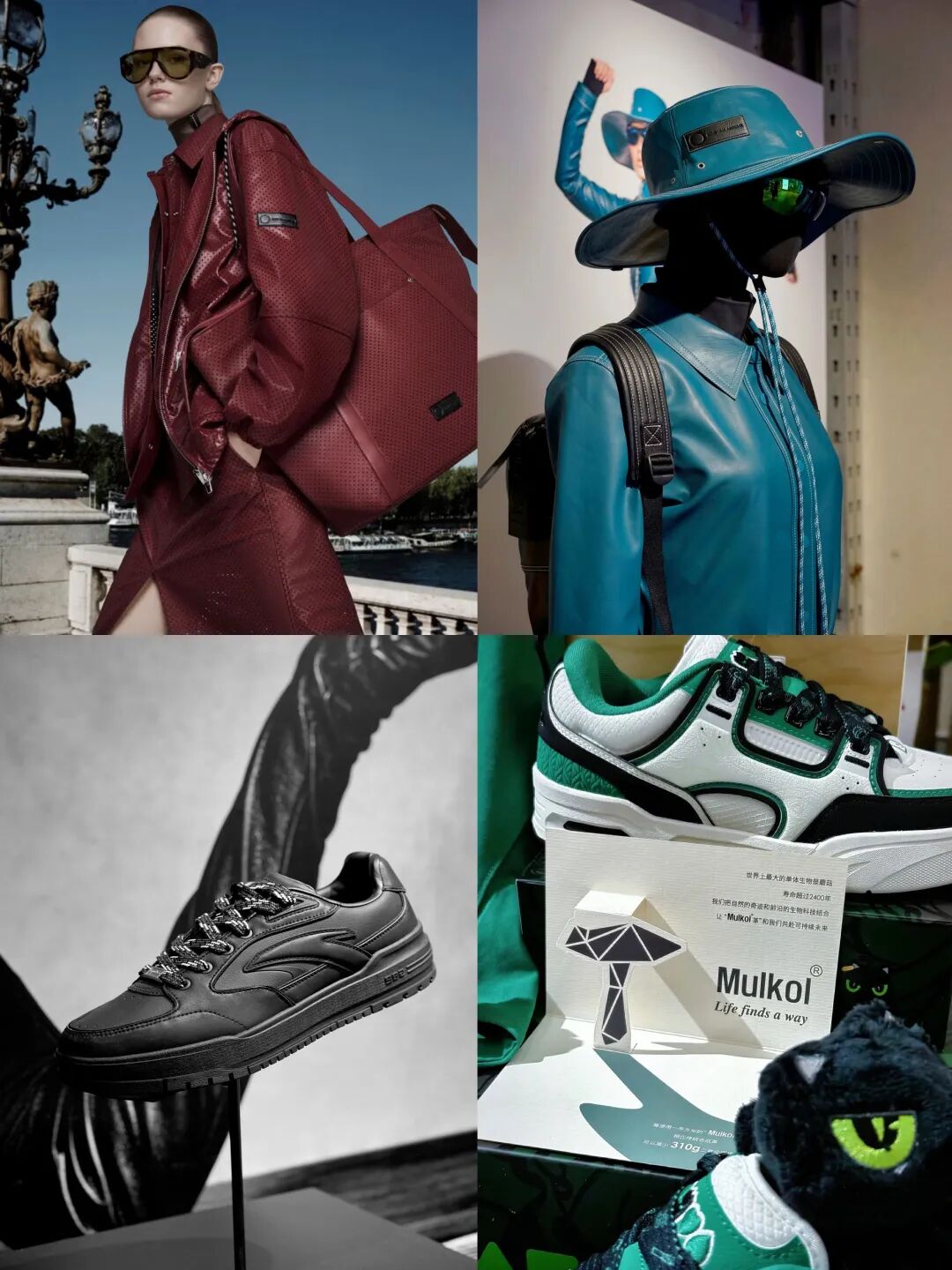
With this as leverage, SynMetabio's materials rapidly penetrated five sectors: footwear, bags and luggage, apparel, home furnishings, and 3C electronics. Atour and Kempinski use it for hotel interiors. Shanghai South Railway Station and Daning Park's public spaces feature it. More European high-end brands are in the pipeline for factory audits and onboarding.
Meanwhile, SynMetabio chooses to make only raw materials, not touching downstream processing. How leather is cut and shaped is left to others. This seemingly concessive choice actually creates space. Core slurry stores at high density and ships easily to any corner of the globe. When geopolitical turbulence drives up prices and disrupts supply of petroleum-based high-grade rubber elastomers, SynMetabio's bio-based materials in raw form naturally cut into a larger market.
Europe has dense concentrations of high-end brands and urgent low-carbon demands. The EU Carbon Border Adjustment Mechanism (CBAM) has begun substantive fee collection, making low-carbon materials a genuine cost advantage. SynMetabio has established a wholly-owned French subsidiary, SYNMETABIO, as its European regional headquarters — leveraging channels in the UK, Germany, Italy, Turkey, and the Nordics to cover Europe's major markets, with cumulative European orders already approaching RMB 100 million.
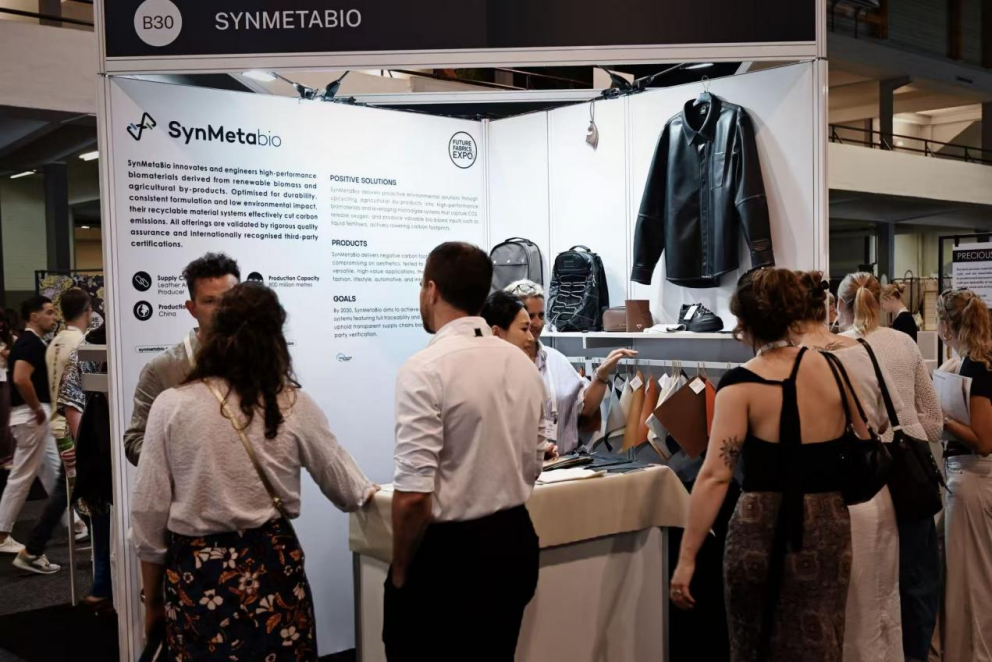
But Rui Su isn't rushing to scale volume. This year's positioning for SynMetabio is boutique: iconic brands, substantial orders. Mass rollout will wait until the moment it needs a billion in revenue — which Rui Su says may still be two years away.
But leather is only SynMetabio's first entry point. Its "chassis" opens up more possibilities and imagination.
SynMetabio was never just about leather. The same strain chassis ferments bio-based polyesters that can extend downward into an entire elastomer family. It's now positioning bio-based composite rubber, targeting the global multi-billion-dollar footwear sole materials market — "low-cost, high-performance, no equipment modification needed," plugging directly into brands' existing production lines. Further ahead lie membrane materials, packaging, industrial films, and broader applications.
Recently, a dexterous hand team came to SynMetabio — embodied intelligence materials need friction, skin-friendliness, texture, and memory, which happen to fall entirely within SynMetabio's sweet spot.
Such customers appear almost regularly. A leather "grown" from mushrooms is evolving along an unplanned path into a platform.

SynMetabio is easily reduced to two stories: a Gen Z campus entrepreneurship tale, a green materials production narrative.
But in Rui Su's view, the meaning of bio-based materials goes beyond being an "eco-friendly alternative." If something can only be sold on being "greener," it hasn't truly established itself.
SynMetabio's logic runs counter: first match genuine leather on performance, match traditional PU on cost — low-carbon is a bonus delivered along the way, not a reason to charge a premium. What makes people pay must be the material itself.
Rui Su calls SynMetabio a "company without a vision" — the direction shifts every year. But this isn't chaos; it's letting go. Hold to fundamental principles, ensure the path is right and the direction good, then leave the rest to a group of interesting people and let it grow naturally. And one of Rui Su's most impressive abilities — beyond his years — is precisely this leadership. From production scale-up, formulation, fermentation, to recruiting a veteran salesperson who cracked the French market, at each stage he consistently finds the right person to get things done.
Of course, the entrepreneurial path is never smooth, and SynMetabio is no exception.
Around Spring Festival 2025, SynMetabio went through its darkest period. A local factory was about to launch, but subsidies failed to materialize due to various factors. Cash on hand was visibly dwindling. Two institutions in funding discussions had reached final stages — financial and legal due diligence complete — only to decide at the last minute to "wait a bit longer."
The pending factory was stuck at the goal line. The company reached a critical juncture. Without a moment's hesitation, Rui Su led the founders in putting in all their personal savings to tide the company over. The team had to urgently shrink to under ten people.
At this critical moment, Linear held internal discussions. Tianyi initially proposed lending SynMetabio $500,000 to bridge the gap, but Harry felt half a million wasn't enough, so we ultimately invested another $2 million. Not long after, SynMetabio's production line was running again, and its partnership with the listed company was back on track.
Rui Su still keeps a photo on his phone from that time, leading the team on a hike. "Looking back, it was bitter and exhausting. The only thing we never considered was giving up."
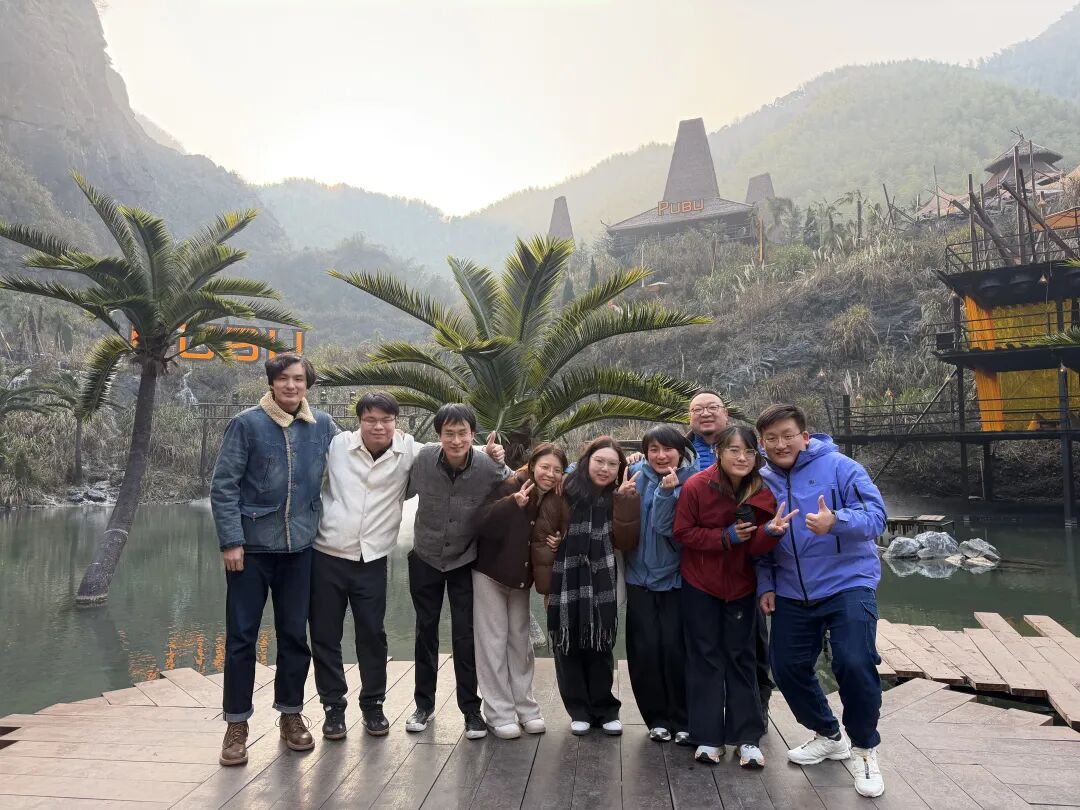
Rui Su (far right) with the SynMetabio team
SynMetabio's slogan is in English: Life finds a way. As long as evolution continues, a path will always be found. The line comes from Jurassic Park. In the film, humans attempt to control dinosaur reproduction by making them all female. The male lead responds: no, that's impossible, because life always finds a way. In the corridor of ShanghaiTech's School of Life Science, a banner hangs from above with this same phrase at its center. Rui Su was struck the first time he saw it.
Its meaning shifts for him each year. Early in the journey it was "just do it, there's always a way"; midway, there were periods of being lost, but being lost was fine — return to the beginning, understand why the company was founded; today, it's learning to let go — believing that a group of vital people gathered together will naturally spark remarkable ideas.
From a tear-resistant membrane to having production lines and orders, SynMetabio has traveled five years. What made it possible was a simple method: don't fight reality, respect it — respect the probability of contamination, respect cost structures, respect existing industrial systems, respect biology's inherent unpredictability.
A group of people committed to something worthwhile, as long as they don't stop, will always find the way. And what we did was choose to believe in the thing itself, and in the people themselves, at its hardest moment.