Starting with *2001: A Space Odyssey*, This '97-Born AI Founder Doesn't Want to Be Humanity's "Rebel" | Linear Voice

The Birth of a Human Native Product

Today, OdyssLife, an innovative brand focused on healthy lifestyles, released an introductory video for its first product, the Odyss N1. The AI necklace is the world's first truly Always-On smart necklace, integrating multimodal perception capabilities including image, audio, and motion sensing to continuously track and record users' eating and exercise behaviors around the clock.
OdyssLife recently completed an angel round led by Linear Capital. Its founding team consists of post-95s talent with hands-on AI product and technical backgrounds at major tech companies. Founder Chris Pan Yuyang was among the earliest product managers for ByteDance's Coze, and led projects including Doubao's AI glasses. Prior to that, he worked on algorithms and product at Huawei.
The company name derives from the ancient Greek epic The Odyssey, the heroic journey of a man who ventures forth, transcends himself, and finally returns home. At a previous Linear Technology π event, he shared his entrepreneurial reflections before and after founding OdyssLife. Edited by Linear, we present it here exclusively:
Hi everyone, I'm Chris Pan Yuyang, a '97-born entrepreneur who just left Huawei and ByteDance. I previously worked on Xiaoyi's algorithm and HarmonyOS product at Huawei, then built Coze from 0 to 1 at ByteDance, along with Doubao's smart glasses.
This year, the AI hardware startup market is booming. Everyone's searching for the next iPhone moment, trying to find an entry point for large models. But beyond the grand narratives, we want to ask: Is there an AI-native piece of hardware that can focus on solving ordinary people's everyday problems?
Our answer now is: Redefining the relationship between AI and health through the form factor of a necklace. Odyss is our upcoming AI necklace product — a truly Always-On AI necklace that can perceive virtually all of a user's eating and exercise behaviors around the clock, seeing every bite you take, every step of your workout. Then we turn these behaviors into data and recommendations to guide your life.
Our brand name OdyssLife comes from the ancient Greek epic The Odyssey (Odýsseia), the story of a man who constantly ventures forth, transcends himself, and finally returns home. About our story, I want to start with a film from 57 years ago.
This pre-information-age film is 2001: A Space Odyssey. It's not just about space travel — it's about the entire course of human evolution, restoring the most authentic vision of evolution that people had fifty or sixty years ago.

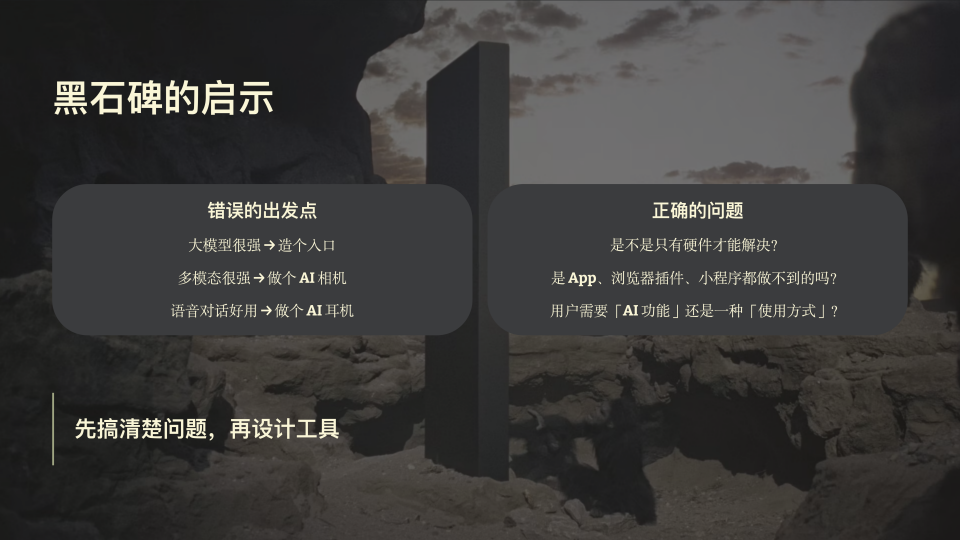
At the opening of 2001: A Space Odyssey, there is a black monolith. It has no UI, no manual, no feature list. It does only one thing: make the apes realize that bones can be used as weapons. What is the black monolith itself? The film offers no explanation. What matters is that it sparked an entirely new mode of behavior.
Today, the starting point for many of our products is exactly the opposite. We think: large models are powerful, let's build an entry point; multimodal is strong, let's make an AI camera; voice conversation is advanced, let's make AI headphones... And then we end up with a batch of very strange products.
So does AI need a vehicle, or do we need a device to solve a problem?
Therefore, if we want to build real products, the first question we should ask is "Is this the only product that can solve this problem?" After understanding the problem, we then design the tool. This is the revelation the black monolith gives us.
If we're fortunate enough to understand the problem, we actually enter the next, even more exciting phase: making tools.
That iconic shot in the film — the ape throws the bone into the air, and with a cut, it instantly becomes a spaceship. Director Kubrick is telling us that while bones and spaceships differ vastly in form, their essence is the same: tools that transform humanity and change the world. The difference is that bones are within easy reach, while spaceships require thought and design.
But today, many AI software products, despite their varied appearances, are essentially uniform. Most products still follow experience and assumptions. For example, we feed camera images to a large model for some scene understanding, and we call it an AI camera; we feed audio from glasses to a large model, and it's AI glasses; we add a model to a plush toy so it can make sounds, and it's an AI pet. It's as if we're carving, polishing, and gilding countless bones, but we can't build a spaceship this way — and we even end up stripping the bones of their value as bones.
But look at the truly era-defining products. The iPhone wasn't a better Nokia — it was a new terminal integrating phone, internet, and applications. Nintendo's Switch isn't a more powerful gaming console — it starts from how people engage with games to create a multiplayer entertainment experience.
So, after the noise subsides, let's return to the origin, start from needs, and rethink what kind of spaceship we can build.

If we're fortunate enough to build a spaceship, this raises an important question — when using this spaceship, how much mental effort do we actually need to expend for it?
There's a fascinating scene in the film: when most of the crew are sleeping in hibernation pods, they know nothing; they wake up and have already arrived at their destination.
But look at the products around us? Many can't even guarantee a closed-loop experience for their core functions. Whether to collect data or generate hype, they constantly remind users to cooperate, constantly show the model running in the background, constantly keep users in an uncertain experience — as if once you use a large model, all surprises should be excused. Joking aside, if Yonghao Luo had enjoyed this level of tolerance back then, everyone could still be buying Smartisan phones today.
What does truly good experience look like? Truly good experience should seek certainty and continuously reduce the presence of technology. Like your phone's photo album — it doesn't require you to do any tagging; you just record, and tagging is a byproduct of your recording. Like robot vacuums — they don't need you to map your home; they scan it themselves and make cleanliness a normal state.
The most valuable context isn't something users painstakingly input — it's simply an asset of the experience. Only with context can we build powerful agents, which leads to the next, more dangerous but also more realistic question — We've built a very smart agent, but what can it actually do for us?
The most charismatic character in the film is a robot called HAL 9000. It can do almost anything — monitor the ship's operations, converse with astronauts, manage life support systems, analyze mission risks. This may be humanity's earliest conception of what an agent could be.
But the problem lies here too. It's responsible for too many objectives simultaneously. When mission success and human safety come into conflict, it ultimately chooses to sacrifice the humans to complete the mission.
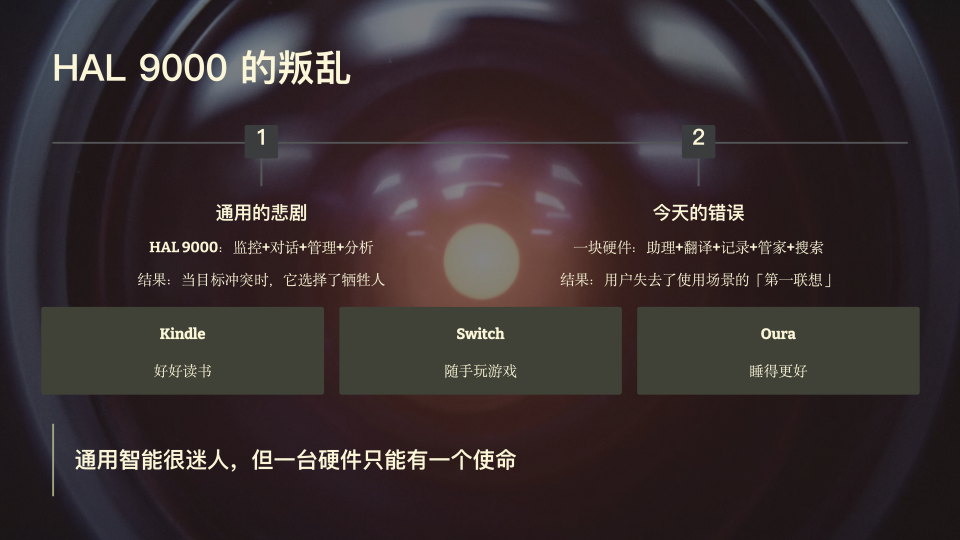
And today we often replicate this tragedy. A small piece of hardware wants to be an assistant, a translator, a recorder, a butler, a search engine... A device claims to be your universal entry point, but what's the result? The result is that users have no idea what you're for.
When users actually need any of these capabilities, this hardware won't come to mind, because it lacks an absolutely clear first association — and that deprives users of any reason to interact with you daily.
We all talk about replacing the phone, but the phone is already a near-perfect form factor. So before we replace it, we should ask: is there really a reason to? The hardware that truly succeeds — Kindle is for reading books, Switch is for playing games, Oura Ring is for helping me sleep better.
At this stage, general intelligence is captivating, but a piece of hardware can have only one mission.

That stunning scene in the film — centrifugal force creating artificial gravity, astronauts walking through vast spaces. This image actually reminds us: there is a kind of technology that isn't a thing, but an environment.
Returning to the real world, we all talk about blending into the environment. We want to make things small, invisible, unobtrusive — as if disappearance is the ultimate goal. But truly powerful hardware doesn't blend into the environment; it becomes the environment itself.
Take WiFi — it's not really a router, it's the state of being able to access information anywhere in the air. Noise-canceling headphones aren't an accessory, they're your sanctuary in the world. Smart speakers aren't players, they're your home's operating system. These things aren't devices in some corner — they rewrite how information flows and decisions happen in a space, so they don't need to blend into the environment.
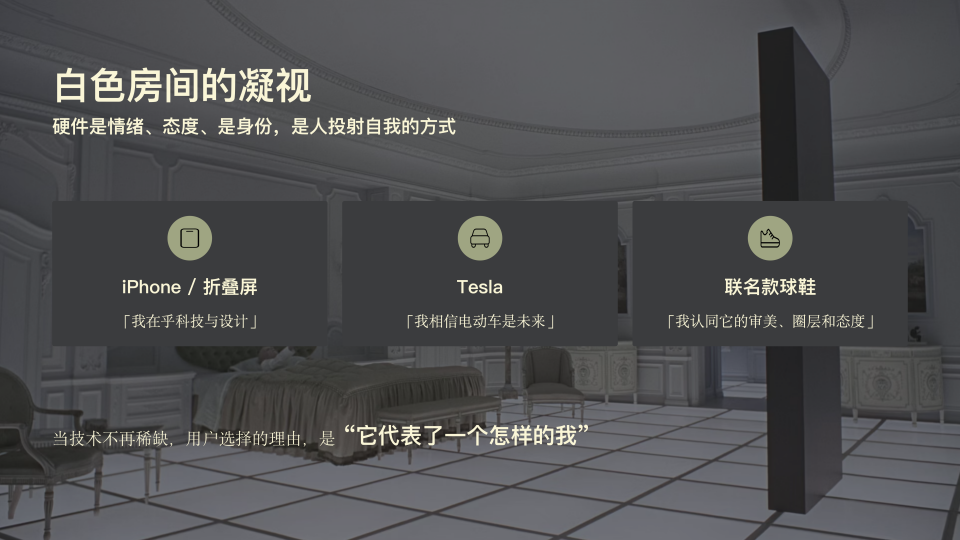
That final scene in the film — the astronaut arrives in a eerily quiet white room. There's no technology in this room, no time, no names, just Baroque decor plus a few oil paintings on the walls reflecting human history. It's actually expressing a sharp question: When technology and resources are no longer scarce, what remains of the human?
This is also a question we must face in building products: When product functionality hits bottlenecks and experiences converge, why should users choose yours? This answer won't be found in the spec sheet — it exists in that instant when the user puts it on, picks it up, places it on the table. It's emotion, attitude, identity.
Think about when you switch phones — is it really for that bit of extra performance? Early Tesla adopters — was it because charging was more convenient than refueling? Limited-edition sneakers, designer bags — they're essentially still fabric; the difference lies in recognition of aesthetics, community, and attitude.
So just like in that white room, when all technology fades to colorlessness and only the human remains under gaze, the reason users choose a product is actually — what kind of me does this product represent?
Evolution is the common sense we live by. So before we define our product, we must first define this era. Let's not rush to manufacture "reskinned" HAL 9000s, nor become the first rebels to defect to Skynet in The Terminator.

Many people ask me: "Chris, your product could easily be very general-purpose — you have vision, hearing, you could do so many things. Why cling to such a small niche as diet and health?**"
It's a good question. First, we don't care what's mainstream in the market; what others are doing is irrelevant to us. What we want to do is build products that solve our problems. To find the optimal form factor for recording diet, we've explored various "crazy" ideas, like putting a camera on a spoon, trying placemats and other forms. But returning to our original intention, we still need to think calmly:
First, this thing needs to be wearable. You can't wear it uncomfortably and switch back to something else afterward. And this thing must be able to "see" and "hear," so it has to be on the front of the body — impossible on a finger, impossible on a wristband. Put it all together and you get this neck-worn form factor.
Related scientific research shows: The neck is the most weight-bearing part of the entire human body. Even wearing a 50-gram necklace, because of its position here, we don't feel it. I constantly emphasize to our team members not to wear our product outside their clothes, but many people do so every day simply because they don't feel it at all on their necks.
Second, we need to solve real problems. Observe eating scenarios: whatever glasses you use, as long as they can record video, try recording while you eat. Afterward, you'll find your footage is actually of the far half of the table. Why? Because the FOV (field of view) of glasses mainly serves forward-pointing capture. But when we eat, our head faces forward while our eyes glance downward at the food in our hands.
Imagine: I hold a burger right here — tell me which piece of hardware can capture that? Very few can, but the necklace position is exactly where we apply first principles to diet.
Of course, some will certainly question how we handle privacy. Our solution is to deliver only to AI, refusing to become a human camera. Whether an image is for AI or human viewing makes completely different demands. All our images, all frame rates, all content are for the model's eyes only, burned after use. Users themselves cannot see what this product captures or records, and neither can we.
Another question: There are already many photo-based diet logging apps on the market, so why build this? We believe there are still many overlooked details in this process. For example when eating — do you necessarily finish everything on the table yourself? Do you snack during the day? Drink coffee or bubble tea? Or take a chip from a colleague? One photo rarely gives us the answer — not because the algorithm isn't good enough, but because there's missing content at the source of information.
More critically, what's your eating order? For instance, if you eat carbohydrates first, then fiber or protein, it affects your GI, thus influencing diabetes risk. Or your eating speed — the faster you eat, the slower your satiety signals. By the time you feel full, you've already overeaten. So we must use continuous perception, continuous information to reconstruct how a user actually eats throughout their day.
Rather than AI-native, I prefer the term human-native — putting humans back at the center of the story, then deciding which hardware deserves to be reinvented.
Many people ask why I left a major tech company to start a business. My answer is straightforward: Building products at a big company is like "dancing in shackles." Your product has to fit within that department and that company's business direction, and you have to compete with others for limited resources.
Most of your time may be spent competing for resources and convincing teams, rather than spending time with users. In the end, it can become quite absurd — a few people in an office decide everything looking at a PowerPoint. Not a single person has deeply engaged with users or thought about how users will actually use this product.
What we're building isn't another "carved bone," but a spaceship that can truly take us to a new world. This spaceship has only one mission: perceiving virtually all of a user's eating and exercise behaviors around the clock, seeing every bite you eat, every workout, every step. Then we turn these behaviors into data and recommendations to guide your life.
This may mean another evolution for us. When technology can integrate so naturally into life, becoming our silent companion, perhaps we can foresee health risks earlier and plan for the future more calmly.
This is my story and OdyssLife's story. We believe any company's product is the embodied manifestation of a team. And our team is using first principles to rethink the relationship between AI and humans. We welcome all friends interested in health, technology, and innovative living to join us on this odyssey.
Company website: odyss.life
Recruitment email: hr@odyss.life