A Business Lens on Data-Driven Strategy: Sensors Data's 2022 Data-Driven Conference Unveils New Closed-Loop Digital Product Suite

On October 26, the Sensors Data 2022 Data-Driven Conference was held at the Beijing Liting Huayuan Hotel. The conference, themed "Reshaping Marketing with Science," featured Alexander Osterwalder, a renowned author in the field of business model innovation; Sang Wenfeng, founder & CEO of Sensors Data; Cao Jiang, co-founder & CTO of Sensors Data; and the deputy general manager of Xiaomi Group's Internet Business Division.


On October 26, Sensors Data's 2022 Data-Driven Conference was held at the Beijing Liting Huayuan Hotel. With the theme "Reshaping Marketing with Science," the event featured keynote speeches from more than 50 renowned experts, including Alexander Osterwalder, a leading author in business model innovation; Wenfeng Sang, founder & CEO of Sensors Data; Jiang Cao, co-founder & CTO of Sensors Data; Dong Wang, Vice General Manager of Xiaomi Group's Internet Business Division & General Manager of TV and Video Business Division; and Jun Yang, DIT VP of Infinitus (China) Company Ltd. They shared and discussed how scientific methods unlock value in enterprise digital marketing scenarios.
The conference opened with Alexander Osterwalder's keynote "Building an Invincible Enterprise." Wenfeng Sang explained "why data-driven approaches work" from a business perspective, reinterpreting the "Business Model Canvas + Data Closed-Loop Methodology." Jiang Cao gave a comprehensive introduction to Sensors Data's new digital closed-loop product solution. The afternoon of the 26th featured a financial services track, while the 27th brought online tracks for retail, internet, and enterprise sectors, where industry guests shared practical case studies.
Back to Basics: Why Data-Driven Approaches Work
Sensors Data's thinking about the nature of business stems from exploring a fundamental question: why do data-driven approaches work?
Sensors Data's mission is to help clients achieve data-driven transformation. As Wenfeng Sang explained, for seven years since its founding, the company has been working to answer one question: why is data-driven effective? "We've explored this from multiple perspectives, which ensures the underlying logic of everything Sensors Data does is sound."
In familiar historical tales like the Chu-Han Contention and the Straw Boat Borrowing Arrows, we see glimpses of data thinking. The scientific method brings us closer — it encompasses observation and statistics, standardization and processization, and hypothesis and testing. This maps neatly onto Sensors Data's data philosophy, including principles like "data sources matter."
But fundamentally, Sensors Data exists to help clients realize commercial value. A deep, thorough understanding of a company's business model is the prerequisite for truly delivering value.
Alexander Osterwalder is the author of Business Model Generation and creator of the Business Model Canvas. Invited by Sensors Data, he gave a comprehensive interpretation of the canvas at this year's conference and discussed business topics with Wenfeng Sang.
Deep Dive into the Business Model Canvas: Three Keys to Being "Invincible"
Alexander Osterwalder believes invincible enterprises share three characteristics. First, they constantly reinvent themselves — their products, services, customer relationships, and business models are always being reshaped. Second, they build business models with exceptional competitive advantage, rather than focusing solely on product refinement. Third, they continually break industry boundaries.
In his speech, he elaborated on how to make enterprises "invincible" through three lenses: exploration and exploitation, business models, and innovation culture.
Exploration and exploitation — or exploring the future while managing the present. Osterwalder argues enterprises must do both simultaneously: entrepreneurship begins with an idea, and once products and services, value propositions, and viable business models are clarified, the company begins scaling for the future. The entire process is messy and highly challenging, and the Business Model Canvas can effectively balance both exploration and exploitation.
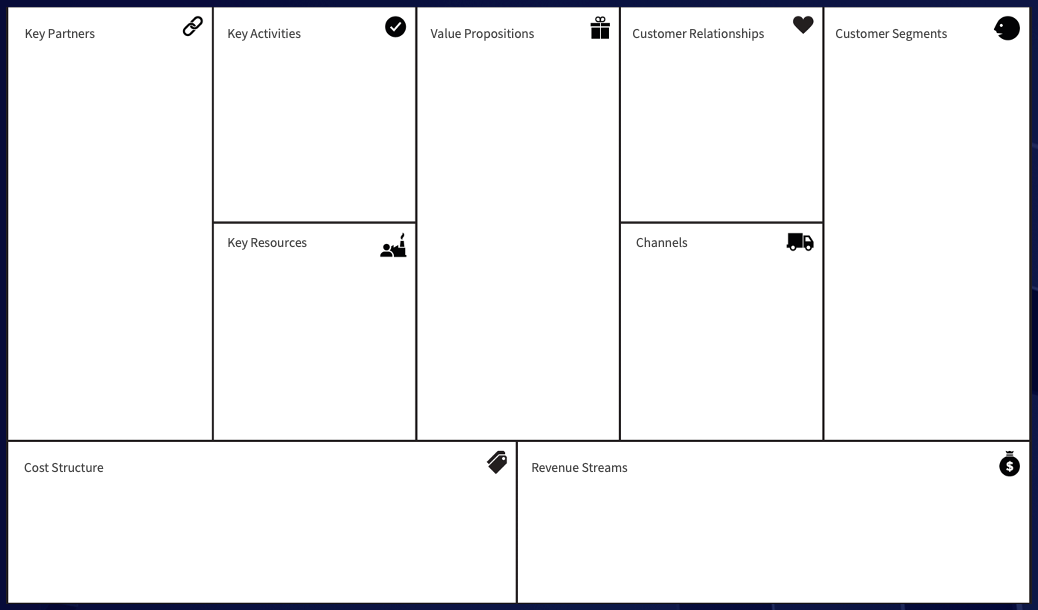
He explained in detail that the canvas helps enterprises evaluate and improve operations, and enables idea validation, launch, or iteration of new businesses. The canvas comprises nine building blocks across three layers: front stage (value propositions, customer relationships, channels, customer segments), middle stage (key partners, key activities, key resources), and foundation (cost structure, revenue streams). Continuous adjustment of these three layers can transform the business model. He illustrated this with numerous domestic and international examples.
Regarding innovation culture, Osterwalder emphasized that new business models always carry certain risks. He advised that when new ideas emerge — whether for business models, products and services, or value propositions — they shouldn't be executed directly. Instead, ideas should undergo low-cost, repeated validation and iteration to achieve optimal results. In this process, "the more data a company has, the greater the odds its ideas are correct and the lower the risks of implementation."
Data Closed-Loop Methodology from a Business Perspective
Business is a technology. As The Nature of Technology points out, new technologies don't emerge from nothing; they are new combinations of existing elements, and technology can infinitely recombine into new configurations. The same applies to business — it combines people, resources, environment, and other elements to create value. When we view "business" as "technology," enterprises gain the possibility of upgrading and improving.
Building on Osterwalder's explanation of the Business Model Canvas, Wenfeng Sang systematically articulated the understanding of "business as technology" through the "Business Model Canvas + Data Closed-Loop Methodology."
Sang believes target customer segments and value propositions are the two critical links in the canvas. Both may be in dynamic flux, and the process of achieving PMF (Product-Market Fit) is one of continuous dynamic matching between value propositions and target segments.
Digital transformation for enterprises centers on transforming "value propositions," "target customer segments," and "value delivery methods" — continuously generating new customer segments, new value propositions, and new delivery methods in the process. It's worth emphasizing that business models require measurement and validation, so both elements need relatively clear definitions.
Sensors Data provides enterprises with big data analytics and marketing technology products and services. In 2020, it officially released the data closed-loop methodology SDAF (Sense-Decision-Action-Feedback). In the digital era, user analysis and user operations are critical components of enterprise management: user analysis helps companies precisely distinguish which segment each customer belongs to, and validates the effectiveness of value propositions through user behavior data. "Digital user operations" enable more precise value delivery.
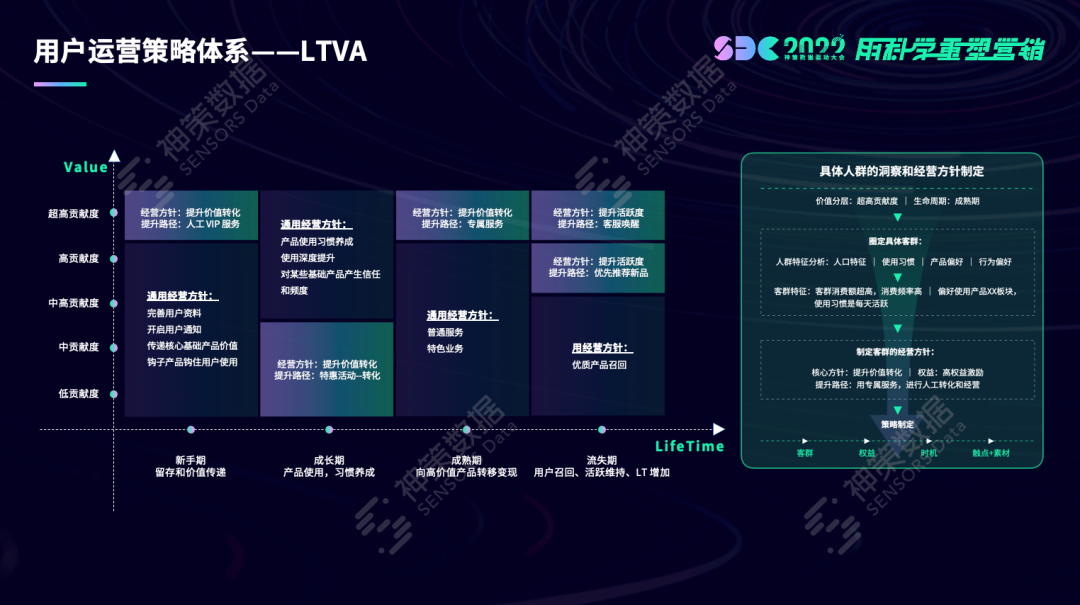
Next, focusing on user analysis and operations, Sang introduced the LTVA user operations strategy system. Combining user lifecycle stages with user value layering, he presented a methodology system for implementing user management strategies. This integrates enterprise business model operating logic with digital operations, unlocking the value of data in enterprise digital management.
Click to enlarge for high-resolution image
Evolution of Sensors Data's Product Portfolio: A New Digital Closed-Loop Product Solution
Beyond user analysis, with sharper focus on user operations.
At the conference, Jiang Cao gave a comprehensive introduction to Sensors Data's new digital closed-loop product solution based on the SDAF methodology. He shared the company's latest product thinking:
- Analysis: from users to operations. To help enterprises achieve closed loops, Sensors Data can't stop at user behavior analysis; more comprehensive operational analysis is needed.
- Marketing: beyond systems. A marketing cloud isn't a single product; customer needs must be addressed through platformization + ecosystem partnerships.
Around the new digital closed-loop product solution, he elaborated from three perspectives: the Sensors Data foundation platform, Sensors Analytics Cloud, and Sensors Marketing Cloud.
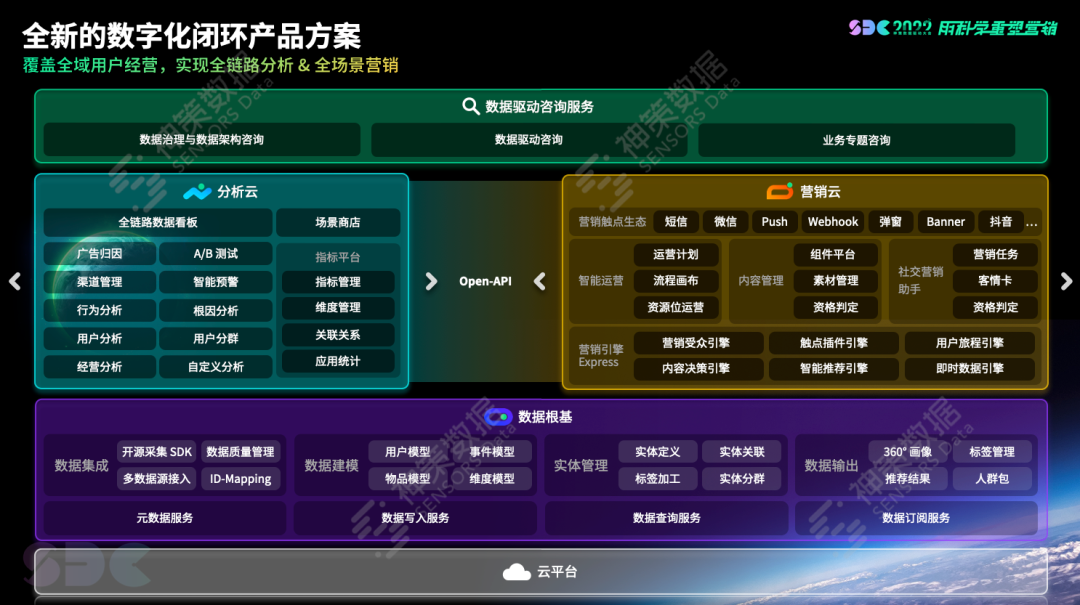
Cao explained that the Sensors Data Universe Platform serves as the underlying data foundation, providing fundamental data capabilities for Sensors Analytics Cloud and Sensors Marketing Cloud. It unifies enterprise-wide data to form complete data assets, solving data silo problems: developing a data ingestion framework to effectively and reliably collect data and centralize data ingestion management; upgrading data models to support detailed models beyond events and multi-entity support, achieving integration of user behavior data with business operations data; building data asset views to manage data assets through multiple business perspectives; enhancing data processing capabilities like tagging and segmentation; and improving platform capabilities with standard Open APIs to help enterprises build digital marketing systems best suited to their own operations, empowering their user management ecosystems.
In applying the SDAF data closed-loop methodology, user behavior analysis alone cannot support enterprises in completing the loop — especially when companies have numerous business systems. The key to closing the loop lies in holistic integration of multiple business systems with users and full-chain connected analysis. Cao noted that based on this understanding, drawing from years of serving thousands of enterprises, Sensors Data has continuously upgraded and refined its full-chain operational analysis closed loop, steadily expanding the capabilities of Sensors Analytics Cloud. This includes not only public-private domain traffic integration, but also enhanced user analysis capabilities, operational analysis, metrics platforms, and scientific experimentation upgrades.
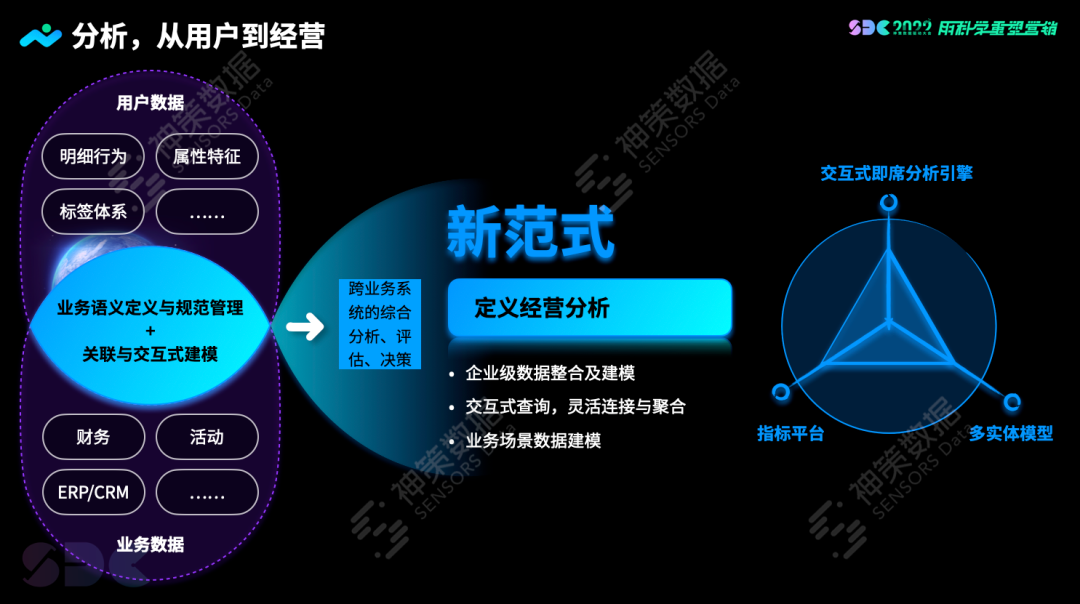
Sensors Data has redefined operational analysis. Cao explained that post-chain operational analysis scenarios are relatively complex. Evolving the data model into a multi-entity model leverages the combined power of a robust query engine + custom business analysis + reusable user behavior analysis models. Based on finest-granularity data, ad-hoc queries can satisfy enterprises' exploratory data needs.
"A marketing cloud is a business system that needs to align with customers' actual business scenarios, using platformization + layered design to unlock scenarios and deliver value propositions," he said. Sensors Marketing Engine Express, after a year of refinement, has completed another upgrade. Based on rich marketing scenarios across industries, it abstracts six core capabilities covering the most fundamental, universal links and elements in marketing scenario construction, and provides Open APIs externally. Relying on strong platformization capabilities and a co-built open ecosystem with third parties, it creates value for customers alongside quality industry partners.
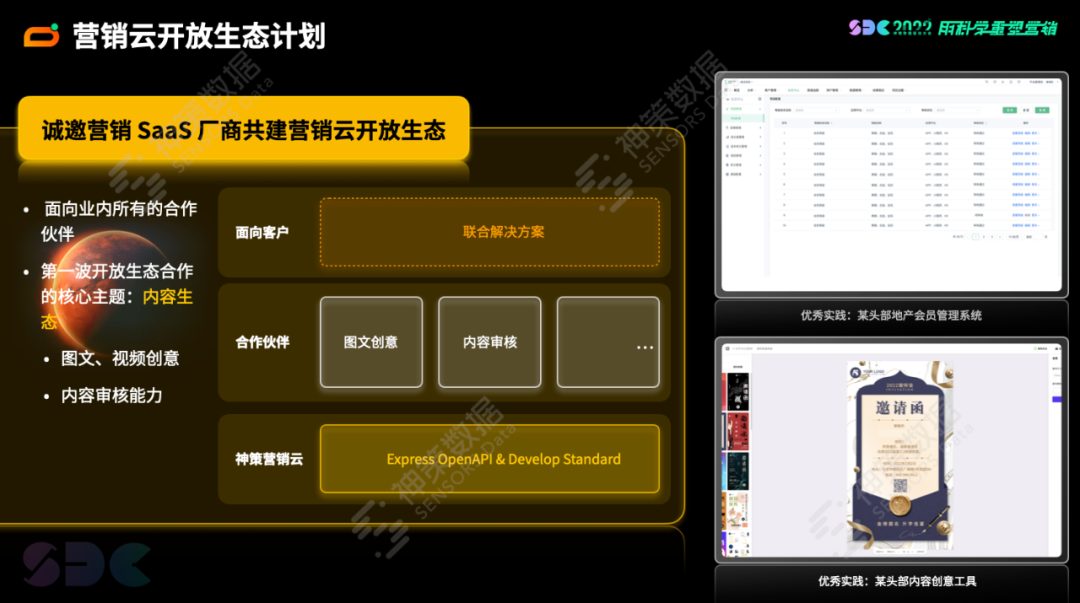
He then discussed excellent practices in Sensors marketing applications across three scenarios — SCMS, SCRM, and SLink — further emphasizing the principle that "marketing goes beyond systems."
Concluding his speech, Cao shared Sensors Data's technology evolution and contributions: honoring its commitment to actively contributing to open source communities; iterating hybrid deployment capabilities to meet three demands — unified operations, platform reuse, and resource conservation; achieving a favorable balance of security and convenience through a five-layer transparent storage and encryption solution, built on top of authentication and permission systems; and responding to national calls for breakthroughs in critical infrastructure technology. Based on full-stack domestic innovation technology industry solutions, it supports multiple domestic operating systems and CPU servers, working with various vendors and open source communities to jointly advance the industry's maturity in domestic innovation.

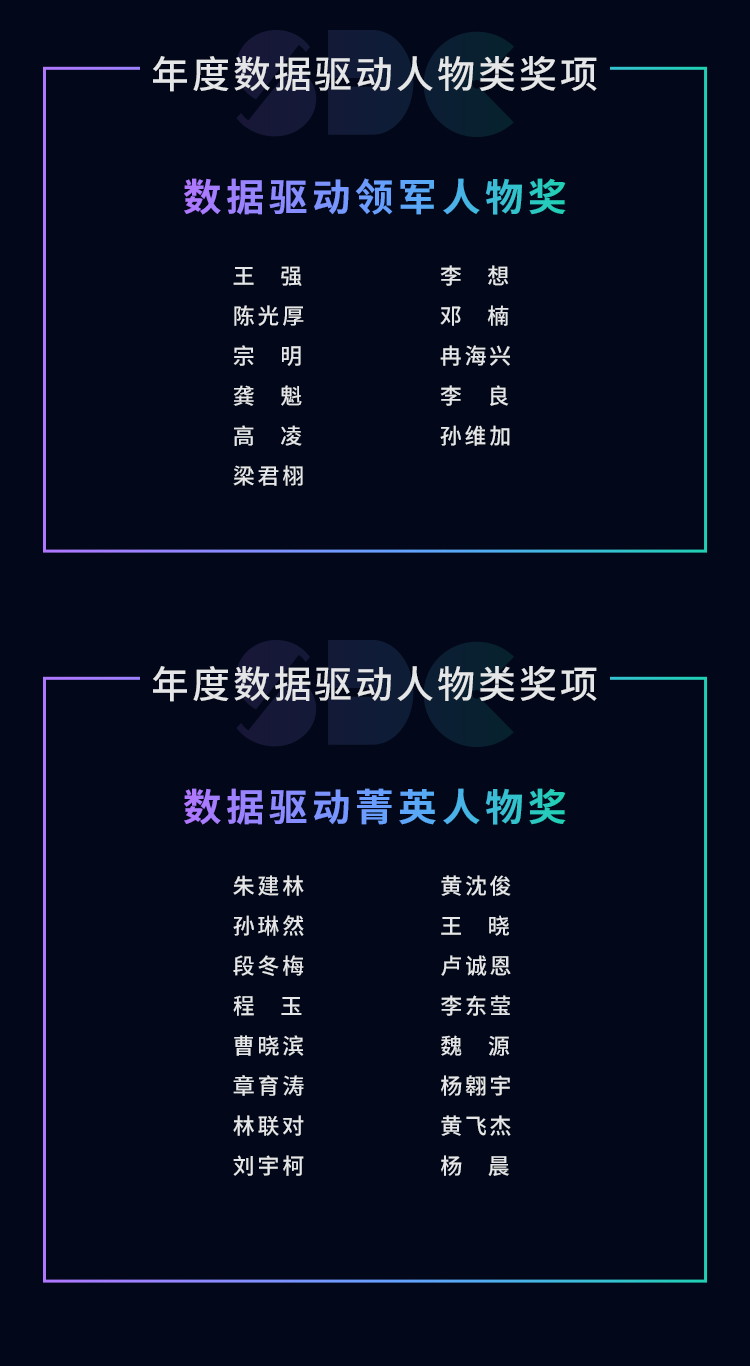
The conference officially announced the winners of the 6th "Xingdou Awards" and held the award ceremony. The detailed list follows:
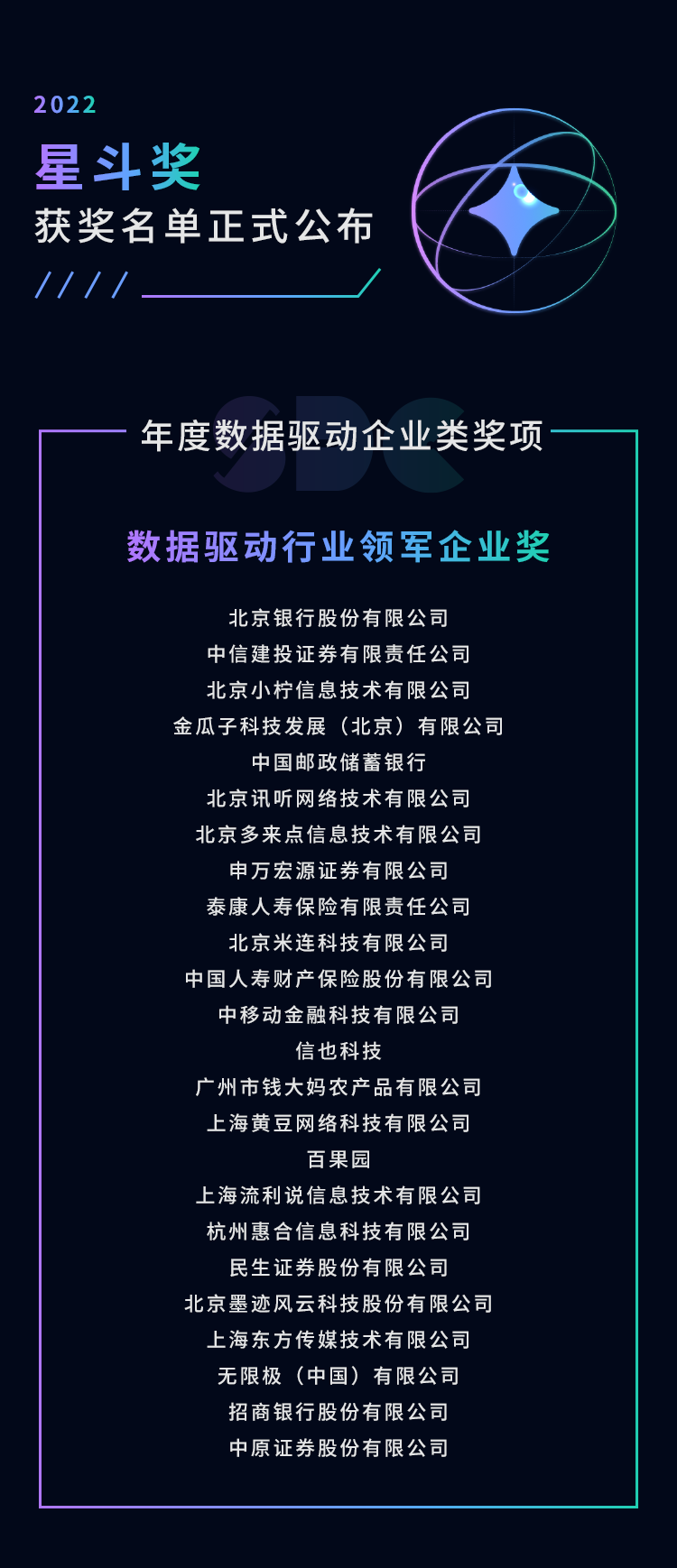
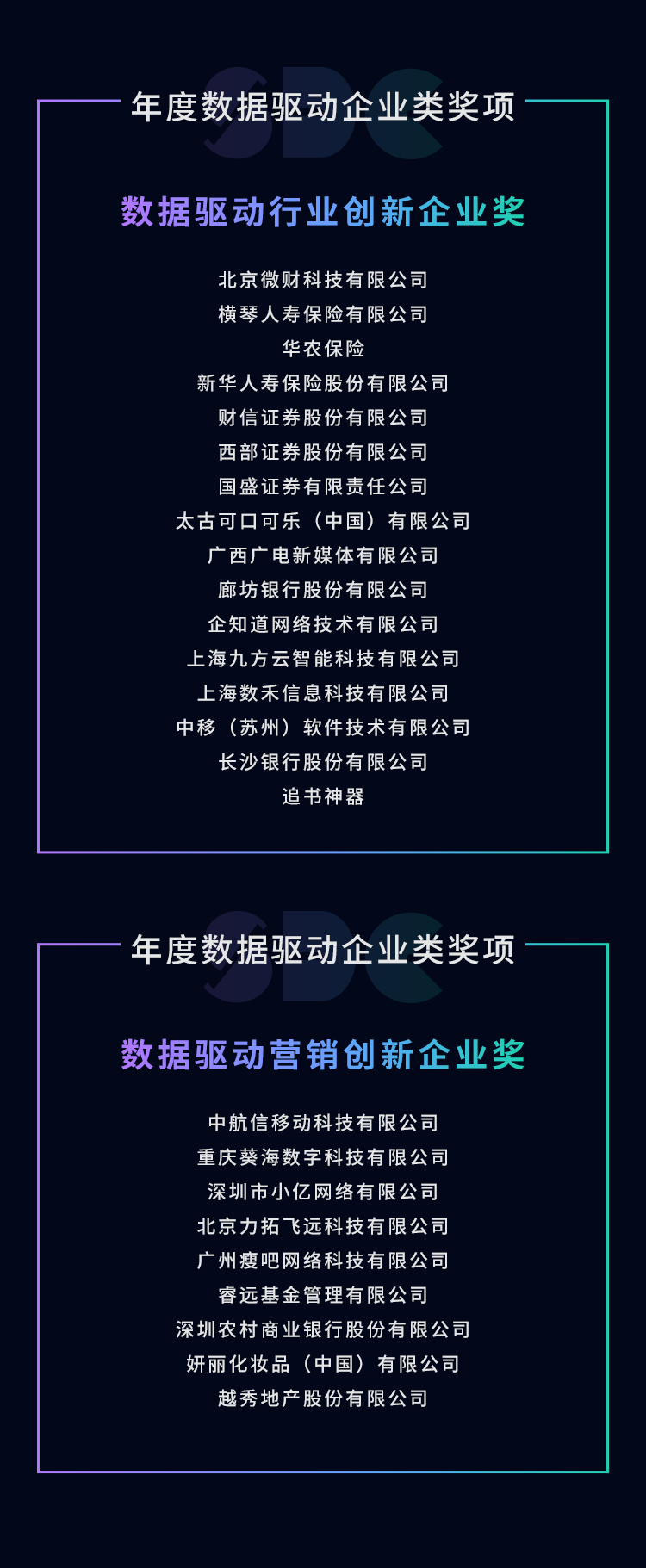
This afternoon, the Sensors Data financial services track will commence. Tomorrow (October 27), online tracks for retail, internet, and enterprise sectors will also stream live — stay tuned!