Destruction Precedes Creation: Rebooting the Era of General Artificial Intelligence

On August 22, Chinese tech think tank *Jazzyear* hosted the "2023 Jazzyear Gravitational Force X Tech Industry Investment Conference" in Beijing. Dozens of industry leaders gathered to discuss cutting-edge topics, using AI and other hard-tech investments as a starting point to analyze emerging trends in the tech industry and explore new directions, opportunities, and futures for the sector. In 2023, generative AI led by ChatGPT has swept across the globe, ushering in a second wave of artificial intelligence.

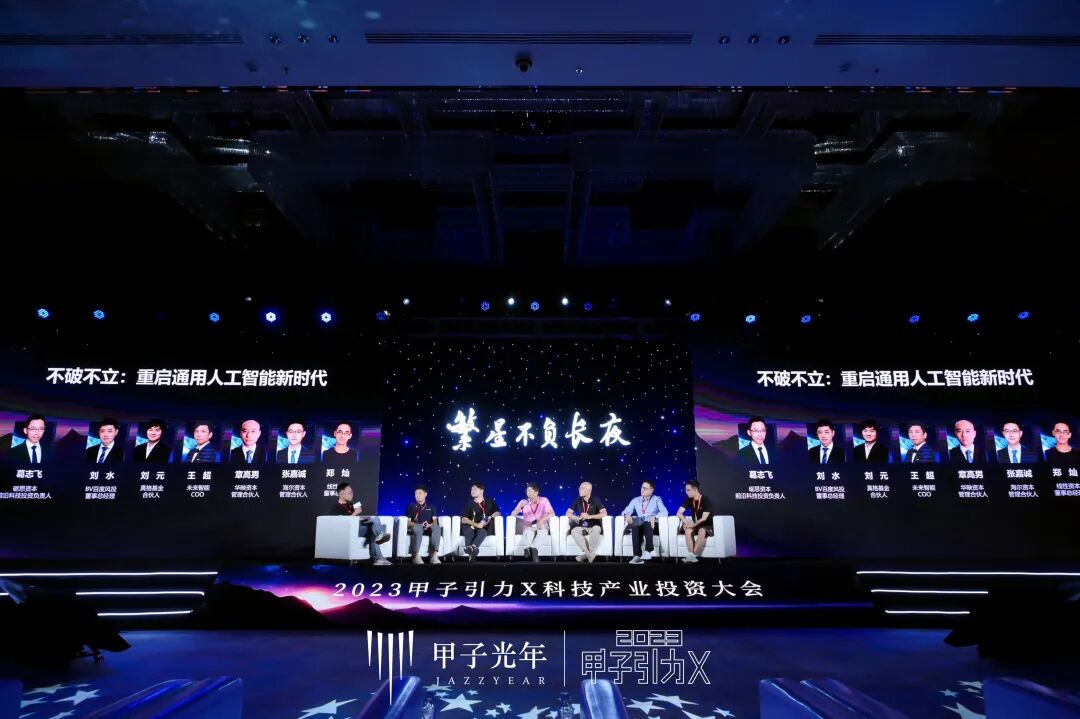
Navigating industry cycles, rebooting a new era of artificial intelligence.
On August 22, Chinese tech think tank "Jazzyear" hosted the "2023 Jazzyear Gravity X Tech Industry Investment Conference" in Beijing. Dozens of industry leaders gathered to explore frontier topics, using AI and other hard-tech investments as a starting point to dissect new trends in the tech industry and collectively chart the course for its future. In 2023, generative AI led by ChatGPT swept the globe, ushering in the second wave of the AI revolution. From AI 1.0 to AI 2.0, as the industry navigates its cycles, discussions around model computing power, product deployment, application scenarios, and investment logic continue. Invest in models or applications? When will the AGI era arrive? How can AI commercialization break through?
During the afternoon panel session, Ge Zhifei, head of frontier tech investment at Monolith, joined Liu Shui, Managing Director at Baidu Venture; Yuan Liu, Partner at ZhenFund; Wang Chao, COO of iFLYTEK Future; Zhang Gaonan, Managing Partner at Huaying Capital; Zhang Jiacheng, Managing Partner at Haier Capital; and Zheng Can, Managing Director at Linear Capital, for a discussion titled "Break to Build: Rebooting the Era of General Artificial Intelligence," exploring how investment logic has evolved in the AI 2.0 era and what trends lie ahead.
The following is a transcript of the panel discussion, edited by Jazzyear:
1. Rebooting AI: What Has Changed in AI Investment?

Ge Zhifei: Good afternoon, everyone! I'm Ge Zhifei, head of frontier tech investment at Monolith. Monolith has been around for two years now, with both VC and hedge fund strategies, focusing primarily on next-generation digital industries and intelligent manufacturing. Let's start with brief introductions from each of you. Since this panel centers on AI, please share how your investment sentiment around AI has shifted over the past six months, and highlight some projects you've invested in.
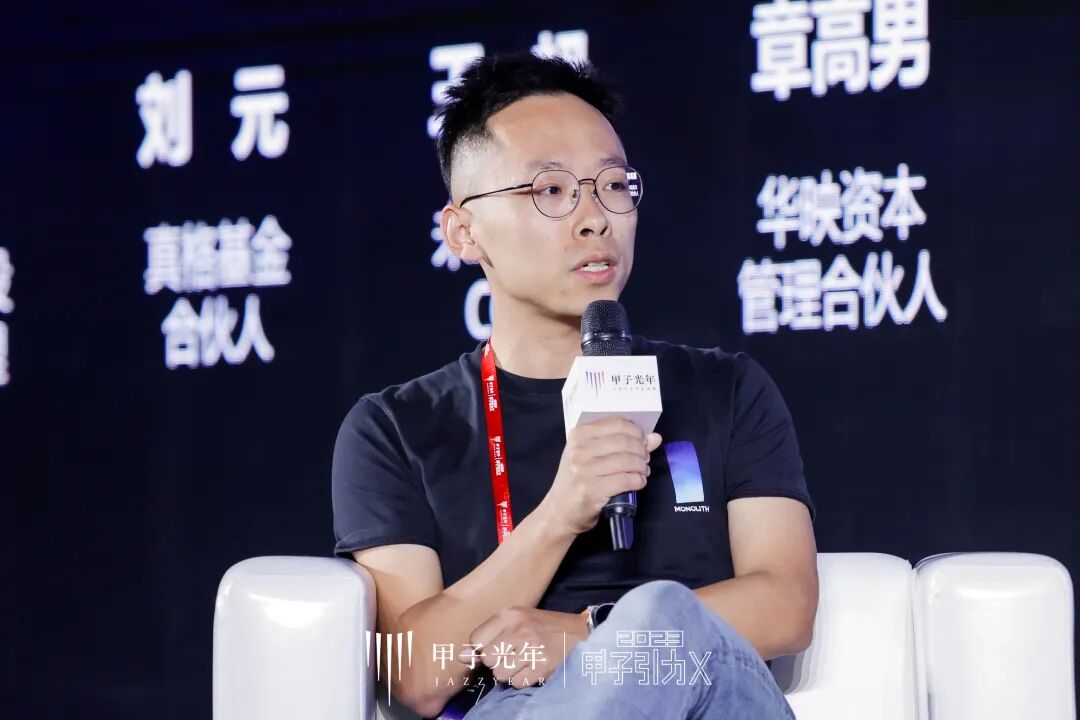
Ge Zhifei, head of frontier tech investment at Monolith
Liu Shui: Good afternoon! I'm Liu Shui from Baidu Venture. Baidu Venture was founded in 2017 as a market-driven VC initiated by Baidu Group. From day one, we've focused on AI sector deployment and exploration — we've essentially experienced the full arc from AI 1.0 and witnessed the arrival of 2.0. To date, we've deployed capital across over 200 projects globally, spanning AI underlying technologies, B2B and B2C applications, and AI-extended hard tech. Now, amid the global large model frenzy, we remain committed to our AI-centric investment philosophy. I'm delighted to discuss and share with everyone here today. Thank you!
Yuan Liu: Hello everyone, I'm Yuan Liu from ZhenFund. Founded in 2011, ZhenFund is one of China's earliest angel investment institutions. We focus on early-stage projects and have always adhered to a "invest in people" philosophy. Over the past 12 years, we've actively sought out the best entrepreneurs in AI, autonomous driving, chips, and other fields. For instance, in chips we've invested in companies like VastaiTech and Enflame Technology, and in autonomous driving we've backed Momenta and Nuro as their first investor. So ZhenFund has consistently invested in technology. Ten years ago, half of our portfolio were technology-driven startups, while the other half leaned toward business model or consumer companies. In the last two to three years, we've essentially invested exclusively in technology-driven companies.
People keep asking if we're "all in" on AI. While that phrase has become somewhat overused, we are indeed seeing a massive influx of AI-adjacent projects. As technology advances and markets evolve, numerous projects are distributed across AI's application layer, middleware, and infrastructure. So our strategy isn't simply chasing AI for its own sake, but pursuing technology innovation combined with market potential. For example, in the first half of this year alone we invested in over 20 projects, many of which intersected with AI technology to varying degrees. Overall, we're quite active and engaged.
Wang Chao: Hello everyone, I'm Wang Chao from iFLYTEK Future. Our team was established in November 2021, working primarily on AIGC-related products. Our main offering is a voice recording and transcription tool delivered through TWS earbuds — a hardware-plus-service product. We've released two to three generations now, with strong reviews on JD.com and Tmall. I suspect many investors here are already our users. That's about it, thank you all.
Zhang Gaonan: Hello everyone, I'm Zhang Gaonan from Huaying Capital. Huaying Capital focuses on two major directions: technology and consumer. On the tech side, we've historically concentrated on enterprise services and intelligent manufacturing, investing in dozens of companies, with some new energy deployments in recent years. We've maintained consistent attention to AI — AI itself is a technology, not an industry category. We've previously invested in AI-related projects including AI PaaS platforms, AI inspection, and AI data annotation.
Zhang Jiacheng: Hello everyone, I'm Zhang Jiacheng from Haier Capital. Thank you to the organizers for this opportunity. Haier Capital is the investment platform under Haier Financial Holdings. Haier needs no introduction — it's a global leader in smart living and digital transformation solutions. As a differentiated industry-focused investor, Haier Capital aligns its investments with the group's strategic priorities. Over the past decade, we've managed over 29 funds with AUM exceeding 30 billion RMB, investing in nearly 300 projects.
Regarding our investment style, Haier Capital aims to build industrial ecosystems along the value chain, empowering portfolio companies through our comprehensive industrial investment model. Our two main directions are: first, intelligent technology, including technology applications and informatization; and second, healthcare, where we're very focused on medical devices, related services, and healthcare IT. In both areas, we've remained active this year. Our headquarters are in Shanghai, with offices in Beijing, Qingdao, and elsewhere — a nationally deployed CVC. I look forward to more exchanges and collaboration this afternoon. Thank you.
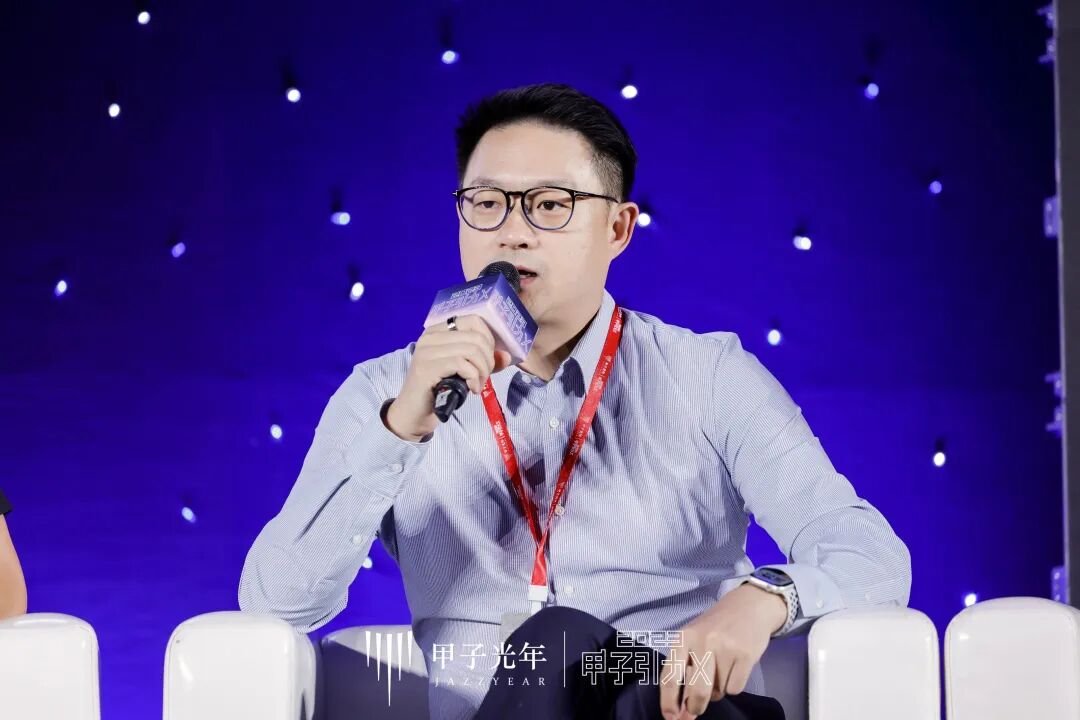
Zhang Jiacheng, Managing Partner at Haier Capital
Zheng Can: Hello everyone, I'm Zheng Can from Linear Capital. Linear Capital primarily invests in data intelligence and frontier technology, which aligns well with today's topic. Since our founding in 2014, we've completed five fund raises with total AUM of approximately $2 billion, investing in around 120 companies. We focus on early stage — our earliest investments in companies like Horizon Robotics and Sensors Data are fairly well-known. Data intelligence is our core赛道, so when AI underwent major leaps over the past year, many of our portfolio companies benefited. That's been very exciting for us, so I'm looking forward to more discussion.
Ge Zhifei: From a technology development perspective, if AlexNet in 2012 kicked off the first wave of AI, then OpenAI's large models may be launching the second wave — that's the supply-side view. But as investors, we want to see real industrial deployment. I'd like to hear from each of you: from the last AI wave to today's second wave, what areas are you paying particular attention to? Feel free to focus on one favorite area.
Liu Shui: Baidu Venture has done extensive exploration in AI + industry applications, so we have strong feelings about AI's evolution. We view large model development as a paradigm shift in underlying technology. We've previously invested in many CV-based AI industry solutions — industrial, medical, financial, marketing, and so on. Recently, we're particularly focused on AI + traditional industries. Take industrial applications: industrial internet and industrial vision have developed for years, but what changes can AI or large models bring? We see two main opportunities: first, using language model capabilities to build knowledge bases from specialized industrial expertise; and second, in areas like industrial visual inspection, where traditional CV couldn't cover multiple scenarios with a single model, multimodal capabilities today offer genuine potential to unlock more scenarios and achieve deeper integration with industrial software, hardware, and solutions.
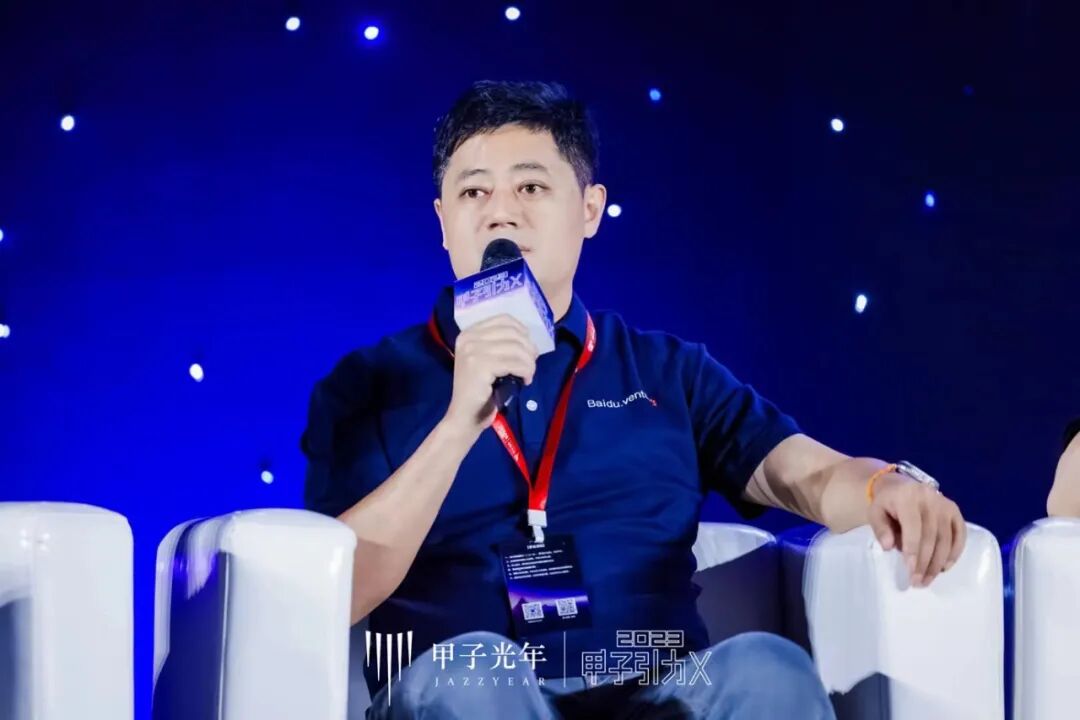
Yuan Liu: What we're seeing is that domestic startups tend to focus on B2B, while those going overseas mostly target consumer markets. The regulatory environment for consumer businesses in China remains uncertain, and many founders worry about policy risks. Meanwhile, Chinese entrepreneurs' ability to build consumer products abroad has improved dramatically compared to five or six years ago. Take our portfolio companies Monica.im and HeyGen — both gained significant user traction in overseas consumer markets in a remarkably short time. Several model-building companies we've backed also have serious ambitions for global expansion with their end-to-end models, a notably different posture from the previous generation of AI founders.
We invest primarily in people, and we care deeply about the founder. Looking at the two AI waves from this angle, we've clearly seen domestic investors placing greater emphasis on scientists and university professors. Investing in technology isn't like investing in consumer brands — AI is fundamentally more academic. Everyone comes from prestigious research lineages, top-tier labs and universities. Investors are essentially migrating toward schools, toward where the frontier of technology concentrates. Additionally, because Silicon Valley has accumulated substantial large model expertise, VCs are also exploring whether technically strong Chinese talent abroad might have opportunities. Chinese teams can build mainstream applications overseas and also drive genuinely transformative technical advances.
Chao Wang: Our team has been working on intelligent voice interaction all along, operating in the AIGC space with a focus on meeting transcription for office professionals — solving pain points in vertical, niche scenarios. Back in 2018, we partnered with China Mobile to build the world's first smart translation earphones, and we've been iterating in this space ever since. Earphones are the smart hardware or wearable device closest to your mouth, making them a natural entry point for many voice interaction scenarios. But before ChatGPT, we were largely building on NLP technology, producing relatively inefficient AI. It was painful work. Starting this year, with the emergence of various large models, we've found that many features with previously unsatisfactory performance can now be optimized. We launched the world's first AIGC-powered earphones, which have received excellent feedback — a 98% positive rating on JD.com and Tmall. Using AI to generate, follow up on, and organize text has significantly improved office productivity. That's why we have so many users from investment circles, journalism, academia, and universities.
Gaonan Zhang: Speaking of old versus new AI — mathematically and theoretically, so-called large models represent no fundamental breakthrough. But OpenAI developed some excellent engineering optimization methods that achieved major advances in natural language semantic understanding, where large models now perform exceptionally well.
Looking at future investment opportunities, I'd roughly identify several directions. First, breakthroughs in algorithms — a strategy of betting on algorithms themselves. The "T" in GPT (Transformer) may not be optimal; this architecture's inherent technical limitations prevent genuine reasoning capabilities. There may be frameworks and algorithms that better approximate artificial general intelligence. Betting on algorithms is challenging in China's environment and demands extremely high sophistication from investors. The second direction involves building applications on top of general-purpose large models. I previously compared general large models to wheels — you can build cars, motorcycles, tanks on top of them. There are substantial opportunities here. The third direction takes inspiration from large models' success in language and generalizes similar deep learning techniques to non-language applications — expanding from language models to other domains. Since I primarily invest in B2B areas like intelligent manufacturing and materials, these fields require extensive simulation and computation. Though not language-focused, they can similarly borrow from deep learning and large model frameworks. This is one insight large models offer, and a key focus of my personal investment strategy.
Jiacheng Zhang: Artificial intelligence is a very old topic. Ten years ago, it felt close at hand — machine conversations, facial recognition, many problems that once required human effort now solvable with a single sentence. Looking back, including today's panel theme "Break to Rebuild, Restarting a New Era" — why restart? Everyone here understands that the past decade of AI development contained countless pitfalls. Many companies were initially excited, only to later discover whether they possessed genuine intelligence, learning capabilities, foundational technical originality. In fact, they didn't. Moreover, many AI companies had excellent valuations and teams but couldn't actually land in markets. The STAR Market has been relatively friendly to such companies. But before it launched, many people including founders fell into considerable difficulty. That's why we talk about "break to rebuild" and "restarting a new era."
As investors who've crossed this cycle, we now view investments more objectively and rationally, including in the new era of general AI. Industrial capital is deeply pragmatic — no matter how good your algorithm or whether your team includes academicians or "Thousand Talents" scholars, if your product doesn't work for my industry or costs too much, I won't invest. Beyond underlying algorithms and technical innovation, we focus more on AI applications in actual industries. Of course, in the previous cycle we invested in many companies including upstream chip and algorithm firms, including CloudWalk Technology. During that wave, CloudWalk's market cap reached over 30 billion, nearly 40 billion yuan, and we captured some of that upside. But consider how many companies it takes to produce one CloudWalk, how many to produce one genuinely original AI company?
Looking at our next investment opportunities, we must rely more on industrial capital's sharpness in niche verticals, truly helping specific industries solve problems. Yet this isn't absolute — with our larger fund size, we do less early-stage investing, concentrating instead on growth and mature stages. Here we've found that technology may not be a company's sole competitive advantage, though it remains important. More often, it's about using technology to solve industry problems, even establishing position and tangible results within an industry — our most common scenario. For example, we invested in a logistics AI company that simply uses software-hardware integrated modules to address efficiency and safety issues in existing logistics operations. Its technology isn't the most cutting-edge, but the top five logistics companies are all its customers, purchasing annually. This validates our direction. As industrial investors, we're more practical, more grounded, moving in step with our fund's overall rhythm.
We also closely track early-stage algorithms. Most people don't realize that in what appears to be a completely traditional industry — home appliances, especially white goods — domestic substitution seems high. In reality, high-end home appliances have only about 20% domestic market share; roughly 70% still depends on imports. Whether software or hardware, we have a long road ahead, so we pay close attention to early-stage core technologies. In AI, we remain quite cautious about cycle-crossing.
Can Zheng: From our perspective, when we defined our focus as data intelligence and frontier technology rather than AI and frontier technology, part of the reason was that narrowly understood AI — CV and NLP — is extremely constrained. These technologies solve specific problems well in tightly controlled, highly standardized scenarios, but generalize poorly. Change the data, change the scenario, introduce any ambiguity, and they fail. So when we invested in data intelligence previously, we emphasized combining AI, CV, and NLP with mechanistic models — that was a major pillar of our investment thesis.
A huge shift today isn't that current models can do everything, but that they've gained the ability to leverage diverse knowledge. Now I can use the model itself to solve certain problems, or combine the model with my knowledge to build a domain-specific model — we see extraordinarily high potential and ceiling here, with capability gaps becoming starkly apparent. Speaking of domains, much current AIGC discussion focuses on content creation, where content-heavy fields will directly benefit. Beyond gaming and marketing that others mentioned — setting aside business models for a moment, just talking value — education is also an extremely content-intensive domain. Beyond content generation, large models possess strong capabilities for understanding and organizing knowledge, similar to structuring. Previously, moving from data generation to usable form required massive human effort and IT systems for structuring. Going forward, AI can handle this normalization process, transforming highly informal inputs into fully usable knowledge. This has strong relevance to business processes and commercial activities, so over the longer term, people will gradually uncover more practically meaningful value here — a direction we're particularly interested in.
2. Bet on Models or Bet on Applications?
Ge Zhifei: This year, both domestically and internationally, most AI investment capital has ultimately flowed to model companies. Within the industry, there's ongoing debate about whether one should invest in model companies or application companies. Because this wave differs from the last — the previous AI wave was more like scenario-specific artificial intelligence, whereas this wave's potential lies in stronger generalization capabilities. So investing in specialized domains always carries a risk: a large model company could disrupt you overnight. Therefore, from a portfolio construction standpoint, our fund wants to place bets on both the models themselves and the application layer, to hedge against the uncertainties of technological development. In the large model space, we've invested in Moonshot AI, founded by Tsinghua's Zhilin Yang, and we also have positions in vertical segments. I'd like to invite the two investors who've backed large models to share their views — how do you assess the moats of large models themselves?
Liu Shui: First, the emergence of large models has been incredibly exciting for us. Our investments span both large models and the application layer, reflecting BV's long-standing commitment to systematic AI investing. On the model side, our team at Baidu Venture determined that next-generation multimodality was the inevitable direction, so we invested in Shengshu Technology, which uses a Transformer architecture to achieve arbitrary cross-modal generation between text and images. The team is also independently developing higher-parameter, industry-grade large models that incorporate additional modalities like 3D and video on top of text and images. Beyond that, we made an early bet on Westlake Xinchen, one of the first domestic large model companies to launch a series of ToC products — AI writing, AI drawing, AI psychological counseling — and has since accumulated over two million C-end users. Meanwhile, Westlake Xinchen is also exploring B-end applications, partnering deeply with many well-known companies such as Talking Tom, Zhiyi, Starbucks, Alipay, Zhihu, and Kujiale.
AI Infra is another critical component of our overall strategy. We recently invested in CAS Jiahe, which focuses on compiler technology. We believe China's computing platforms and underlying chip infrastructure will not be monopolized by any single player, but will instead feature diverse ecosystems of CPUs, DPUs, and NPUs. CAS Jiahe can help chip vendors build unified compiler platforms and enable developers to build more effectively. Looking back, BV has consistently maintained AI as our investment theme. We've been deeply engaged in this space for years. AI development happens bottom-up, not through isolated breakthroughs, so our portfolio companies span the infrastructure, middleware, and application layers.
Yuan Liu: At the beginning of this year, everyone got excited about ChatGPT, and I was somewhat surprised. Because when GPT-3 came out three years ago, we talked with friends at many major tech companies, and they didn't think large models were that important back then. The reason people got excited this year is that we haven't seen something with such strong scale effects and network effects in a very long time. Building large models requires massive scale, and with so many players, not everyone will succeed. Our investment logic is simple: bet on people. For example, as legacy shareholders of Recurrent AI, we'd heard that Zhilin Yang was their absolute standout talent — a "god among gods." When someone that capable was building a large model, we decided to invest immediately.
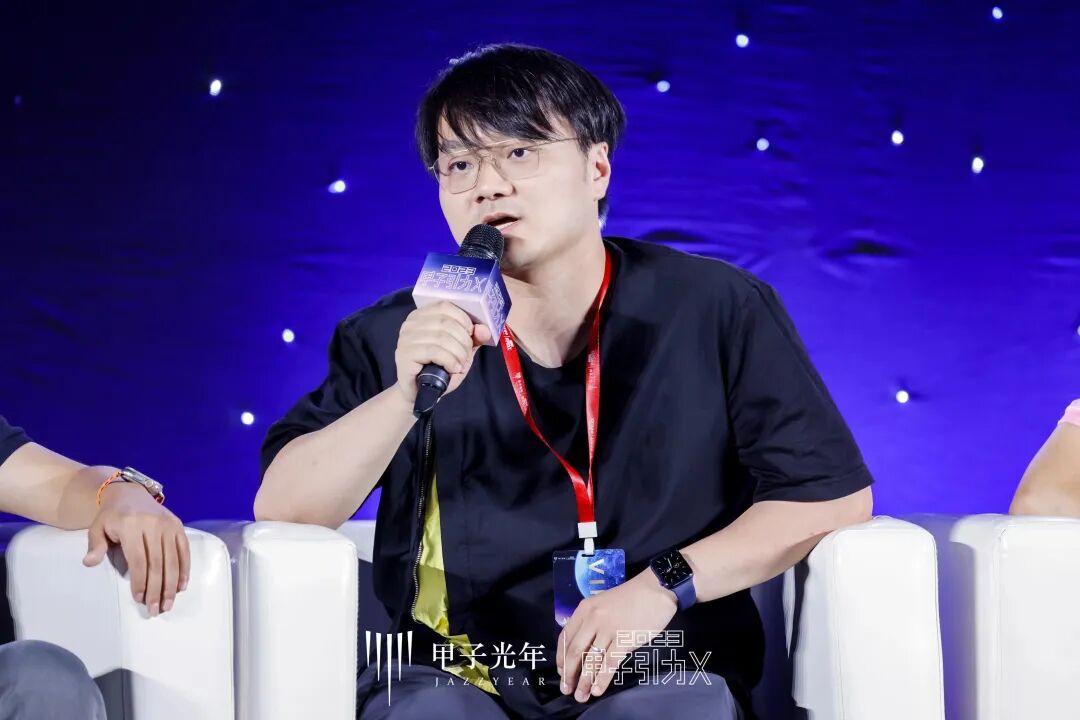
Yuan Liu, Partner at ZhenFund
Ge Zhifei: Mr. Wang Chao, since your company spun out from iFlytek, you have some inherent advantages in AI scenario implementation. I'd like to ask you to share — from a technology and product perspective, where do your company and products have advantages?
Wang Chao: For us, the core is returning to scenarios and user problems themselves — can we solve the user's problem? For an AIGC startup team to succeed, four elements are indispensable: computing power, algorithms, scenarios, and data. As mentioned earlier, Meta's open-source large models are no longer a barrier; instead, data and scenarios have become the barriers. Our team has always focused on the business office domain, committed to solving problems that white-collar workers face in meetings. Our investors hold seven or eight meetings a day — how do you organize so many meetings? You need AIGC to generate meeting summaries and such, to solve user problems in the meeting scenario.
Looking ahead, as models become smaller and capable of running offline, AIGC can better integrate with intelligent hardware — collecting data through various terminals like glasses, watches, and earphones, then creating stickiness through well-designed products that generate more data, which in turn feeds back into model training. As I mentioned, future models can run offline; as intelligent hardware computing power increases, some models may run directly on phones. The direction that AIGC startups or companies should aim for is how AIGC combines with intelligent hardware to solve various problems in user scenarios. So ultimately, it comes back to scenarios and data. Our company has been around for less than two years and has already generated a large volume of focused data. This data is a significant asset for both us and our users because it's costly to acquire. Our users hold meetings daily — even just one hour per day generates thousands of hours of meeting content. That's why our product has high renewal rates: users find our product works well, generate substantial data, and continue using our hardware. And hardware has a lifespan — the service value behind it is the greatest. That's the core of our team.
Ge Zhifei: Thank you, Mr. Wang. The two previous speakers shared perspectives on AI applications at the pure software level, while Mr. Wang discussed AI applications in intelligent hardware. Now I'd like to invite Mr. Zhang and Mr. Zhang to share from a manufacturing perspective — how do you view AI implementation or potential applications in the next three to five years? Including the robotics field.
Zhang Gaonan: Personally, I'm relatively conservative about investing in robotics. Everyone has their own investment methodology and logic, and mine isn't well-suited to sectors like robotics where every niche has many players. Robotics is unlikely to see a single dominant winner, and scarcity is the factor I emphasize most in my investments. But this doesn't mean there are no investment opportunities in robotics — on the contrary, it's an enormous incremental market opportunity. There are many excellent companies in robotics, and I do look at projects with particularly distinctive technical characteristics in the ToB space.
My personal understanding is that regardless of hardware or form factor, as long as there's data, there's machine learning, and therefore there's AI — that's the underlying logic. Industry contains massive amounts of data, though not necessarily language data; it's machine data, including IT data, sensor data, and so on. This data includes both structured data and much unstructured data like video and images. What AI can teach us in manufacturing is that as digitalization in manufacturing becomes more widespread and deep, more and more production management and business operations can be fully integrated with AI. Especially at production operation sites, many processes have high real-time requirements, creating substantial application scenarios for fusion technologies that combine edge computing with AI. We can borrow deep learning algorithms and combine them with scenarios, even applying large models to scientific computing. In the past, simulation meant building mathematical models and solving multidimensional nonlinear equations — anyone with a computer science background knows this is a massive computational challenge and difficult problem, because greater precision demands more data and computing power, and convergence becomes harder. Could we approach this differently, without strict mathematical reasoning through nonlinear solution methods? Perhaps we could use neural networks to solve these problems. I think there are considerable opportunities here. I'll personally spend a lot of time looking for such opportunities — borrowing the underlying algorithmic mechanisms of so-called large models in industry, particularly self-attention mechanisms. This is an area worth exploring.
Zhang Jiacheng: Regarding robotics applications in intelligent manufacturing and the manufacturing industry, we've indeed done fairly deep thinking. Haier was among the earlier implementers of Industry 4.0, a benchmark for lights-out factories, and also one of the earliest companies to pursue industrial internet. In this context, we've seen many projects related to machine automation, efficient manufacturing operations, and the integration of AI with manufacturing. However, from another angle, equipment manufacturers or startups capable of taking on projects at Haier's scale aren't necessarily good investment targets. Although we're a CVC, Haier's ownership stake in our LP structure has dropped below 50%; we also have external LPs. As direct investors, we still pursue overall project development and value for money. In this situation, we found that simply being a large, innovative AI company in intelligent manufacturing isn't a good investment target. We'd rather move upstream — investing in core components, algorithm and computing power companies, or further upstream in scenario solution companies. Returning to investment itself, we still need to look at a project's position in the industry chain. But from an entrepreneurship perspective, we believe China still has massive room for development — whether in core components, equipment, software, or even integrated comprehensive solutions — there are substantial application spaces in manufacturing. Our group also attaches great importance to this area. As investors, we focus on mid-to-late stage projects. We also look at very early-stage original technology, but we actually deploy capital there relatively infrequently. Much of the time, we look for more mature opportunities in the space.
Zheng Can: We have seriously considered investing in models and reserved some capital for large model investments. In fact, we invested in an AGI company called Mindverse two years ago — those interested can look it up. From our perspective, we wanted to find a model that was different in either modality or learning mechanism — a new paradigm. We haven't found that yet. Of course, another reason is that large model companies are simply too expensive today.
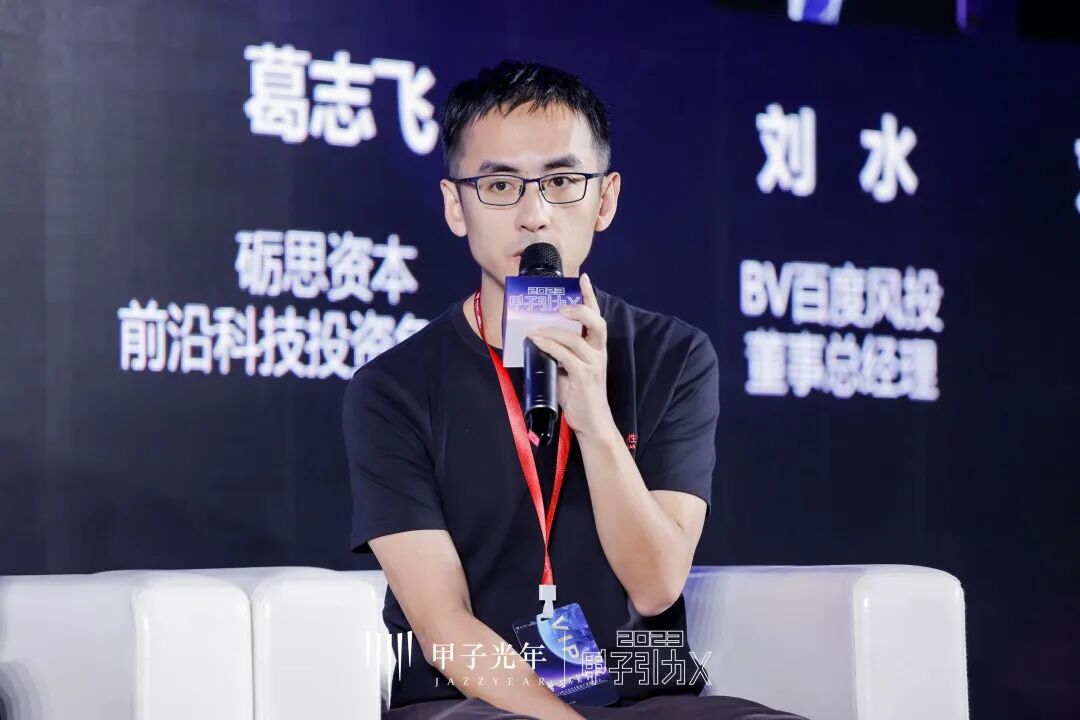
Zheng Can, Managing Director at Linear Capital
3. Have Large Models Ushered in the AGI Era?
Zhifei Ge: I have a question for Zheng. If applications become heavily dependent on open-source large models in the future, could you map out what the landscape might look like for open versus closed-source models over the next three to five years?
Zheng Can: Honestly, projecting three to five years out is pretty tough. Google has done some modeling, and their view is that nobody really has a moat. My take is that from a methodology standpoint, there's no moat—everyone's thinking and approach are relatively similar. But when you look at data, capital, and chips, moats do exist. Large enterprises and well-funded startups have advantages. How far the open-source ecosystem can go depends, in some sense, not just on what remains outside, but also on how much large enterprises are willing to give back, for whatever reasons. Right now, the best-performing models aren't open-source—this is the first time the industry's best can't be obtained through open-source channels. But soon we got LLaMA 2, as a slightly weaker alternative. For most tasks or needs, current open-source models can already hit 80%, and anyone can use them. My sense is that open-source large models will likely remain slightly behind the best closed-source ones in performance, but for most problems people need to solve, they'll probably be sufficient. That's my understanding.
Zhifei Ge: Following up on Zheng's point, one last question. What are everyone's expectations for the future of large models? If we're at GPT-4 now, and GPT-5, GPT-6, GPT-7 get trained in the coming years, will capability growth be linear or exponential? If it keeps growing and we gradually approach AGI, do you believe this path can lead to artificial general intelligence, or do you think it's not possible?
Shui Liu: The BV team believes AGI will arrive. We support the next step of large models moving toward open source, gradually leveling out some technologies, and integrating into various industries—going deeper and more genuinely into industrial applications to achieve sector-specific intelligence. That's the meaning of AI universalization. For example, recently our portfolio company AgiBot, founded by Huawei's "genius youth" Zhihuijun, released its first-generation general-purpose humanoid robot Expedition A1—a combination of large models and humanoid robotics that has many industry insiders saying they see the dawn of AGI again. We maintain an attitude of anticipation, giving emerging technology some patience and time. After all, any industry or technology goes through peaks and troughs.
Yuan Liu: From the steam age to the electrical age, the information age, and now today, we've witnessed time and again how technology has upended people's lives. The reason ChatGPT became so huge is that it far exceeded expectations. We believe technology will only get better, cheaper, and more broadly applicable, so we're relatively optimistic.
Chao Wang: We're in smart hardware, so we're focused on how AIGC can combine with smart hardware. Right now we're still building our own customized models based on large models, and later we'll develop our own vertical scenario service models. Because general-purpose large models draw much of their training data from public web sources, they don't perform particularly well in many focused or niche scenarios. We're currently concentrated on the office domain, targeting very specific verticals—investors, lawyers—where we might do highly mechanized AIGC content, including private small models. Those are directions we'll push toward. As we discussed, model miniaturization and offline operation are trends, and privacy protection requirements will rise too. Moving in this direction, AI undoubtedly needs to integrate with hardware. That hardware could be phones, earbuds, watches, glasses, and so on, but we'll definitely stick to what we're good at. Our team has always worked on voice interaction, so we'll leverage our strengths to make products closer to the human mouth—earbuds, glasses, and the like. That's our thinking, thank you.
Gaonan Zhang: There are many large models now, and as technology develops, the barrier to using them will keep dropping—anyone will be able to use them. But large models are still far from AGI; they count as a starting point at most. Existing large models cannot generate thought. In the future there should be more algorithms and models that approach AGI, but that's still very distant.
Jiacheng Zhang: Hard to say. Many new technologies in the past quickly fell into involution, rapidly forming very crowded tracks. For us, we need to hold the bottom line of industrial investing and be friends with time.
Zheng Can: From a model perspective, everyone is certainly pushing toward bigger and more capable, but they'll soon hit bottlenecks too. Because the scale of these models today is unimaginable compared to the past, these bottlenecks may not just be software or hardware—they'll emerge at more fundamental levels like energy and materials. Some of the largest enterprises today are already running into power supply problems with their large model infrastructure. So pushing much further will require enormous efficiency and capability gains, and will face challenges on many levels. There needs to be a methodological breakthrough or shift—that's what we're hoping for. AGI is more distant; no telling when it will be achieved, but it will come eventually.
Zhifei Ge: Thank you all. END.