Tech Unicorn Fireside Chat Transcript | Tezign: A Business Adventure in Technology-Enabled Creativity
"Tech Unicorn Fireside Chat" is Linear Capital's [Linear Fellow program](https://mp.weixin.qq.com/s?__biz=MzAwNTAyMDAyNQ==&mid=2652302409&idx=1&sn=4f470812e7565650196e8665129fb996&chksm=8
"Tech Unicorn Fireside Chat" is a startup experience sharing event launched by Linear Capital's Linear Fellow program and entrepreneurship knowledge sharing platform Linear Academy. Each session invites a tech "unicorn" to share their journey from zero to one and from one to one hundred, fostering exchange among founders. At the end of 2022, we held our first offline event, also connecting live online with Linear Fellows, inviting Linear Capital founder Harry Wang and Tezign founder Ling Fan to share Tezign's early founding story, along with Linear Capital's observations and reflections on Tezign over the past seven-plus years as its angel investor (investing in 2015).
Due to space constraints, we share here selected portions of the conversation between Ling Fan and Harry. For more tech unicorn stories, follow Linear Capital's upcoming events and articles.
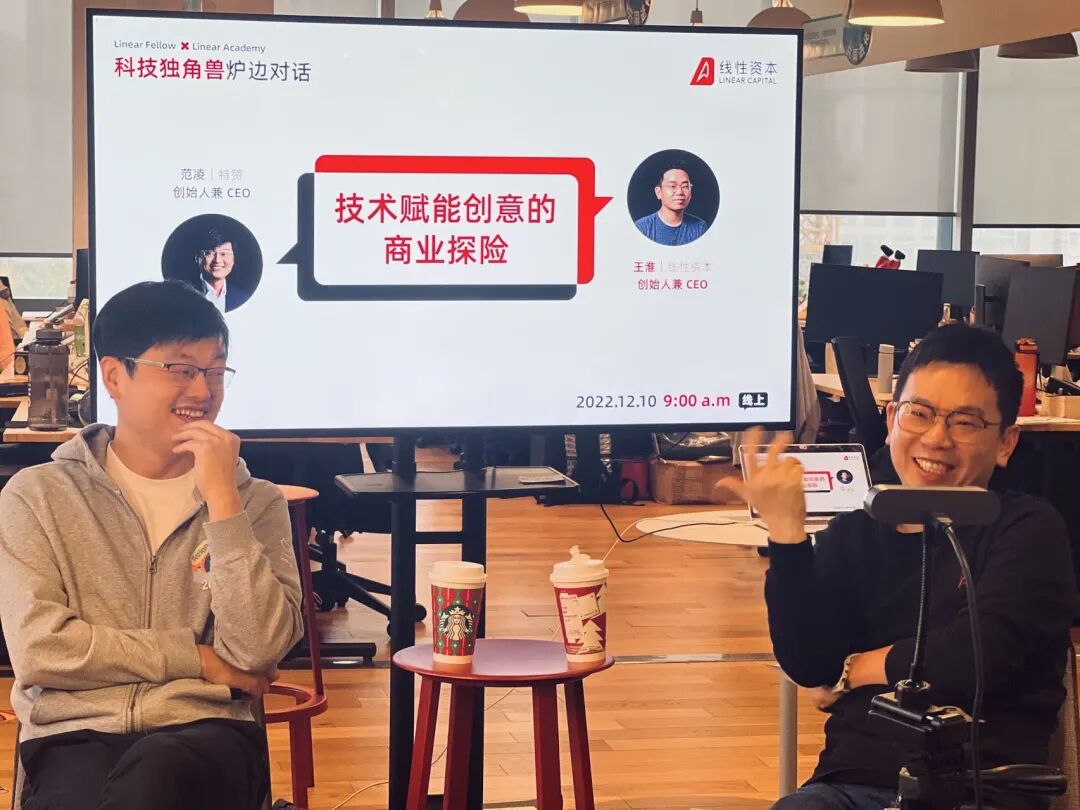
Guest Introductions
Ling Fan, founder and CEO of Tezign. He earned his bachelor's degree from Tongji University, master's in architecture from Princeton University, and PhD in design from Harvard University. In 2017, he was selected as a Young Global Leader by the World Economic Forum.
Founded in 2015, Tezign is dedicated to building the digital infrastructure for creative content, providing global brands with solutions for content experience production, management, distribution, and analysis, empowering brands' digital content transformation and helping them drive growth through content.
Harry Wang, founder and CEO of Linear Capital. Established in 2014, Linear Capital focuses on "frontier technology + industry" investments — frontier technologies represented by data intelligence, digital new infrastructure, next-generation robotics, and new technological transformations in traditional sectors (such as biomedicine, materials, energy, etc.), applied across vertical industries to substantially improve industrial efficiency, empower solutions to pain points, and complete industrial upgrading — achieving excess commercial returns through significant increases in industrial value. Linear insists on entering at early stages and providing continuous support throughout the project lifecycle. Currently, Linear Capital manages ten funds with total AUM of approximately $2 billion. It has made early-stage investments in over 120 startup teams including Horizon Robotics, Kujiale, Sensors Data, Tezign, Agile Robots, Shushu Technology, Rokid, Guandata, and Douxiang Technology, with a combined portfolio valuation of approximately $20 billion.**
Conversation
Harry: Professor Fan previously taught at renowned universities including UCB, CAFA, and Tongji both domestically and abroad. What prompted you to choose entrepreneurship?
Ling Fan: I already had the idea of entering the internet industry and starting a business when I was in high school. In my senior year, 1999, there was a bookstore near my home that had started carrying the English edition of BusinessWeek. One story left a deep impression on me — a "snake swallowing an elephant" tale about AOL's acquisition of Time Warner. It sparked my fascination with the internet industry. Later, I also read about Bo Shao in the Chinese edition of BusinessWeek, which further deepened my longing for the industry and my hope to achieve something there. Unfortunately, my college entrance exam year coincided with the dot-com bubble burst in 2000, and I ultimately didn't study computer science. But the seed of entrepreneurship had already been planted in my heart.
During my undergraduate and graduate years, I realized that school is a place where process can be treated as result — especially in research, where both successful and failed experiments hold value. This conflicts with the strong results-orientation of entrepreneurship. It wasn't until 2013, when the US economy began recovering, that I noticed top American universities like Stanford University, MIT, and CMU were doing exceptionally well in entrepreneurship, and Harvard also wanted to introduce courses and incentive policies to encourage student founders. I was pursuing my PhD at Harvard at the time, and inspired by this, I began studying fascinating companies like Airbnb. I found entrepreneurship exhilarating because it could solve problems I had wanted to address during my doctoral studies. So I took my first step into entrepreneurship. Looking back, choosing to start a company was a very emotional decision — I had only a general direction in mind, with no consideration of product planning, business model, or team planning whatsoever. But I was always filled with passion and enthusiasm. The seed planted in my senior year quietly sprouted at that moment.
Harry: In Tezign's journey from zero to now, what has changed and what has stayed the same?
Ling Fan: What has changed is our product form, which has always evolved with the times. What hasn't changed is our original aspiration for design innovation. Unlike most startups, Tezign didn't begin by identifying a specific problem but rather by spotting a systemic directional opportunity. This choice meant that Tezign and its investors had to bear greater risk during the startup phase, with lower probability of success. I'm very grateful for Harry's recognition back then. I often revisit our original pitch deck, and looking back, it was quite naive.
Harry: Linear's decision to invest in Tezign was largely based on recognition of founder Ling Fan. Years of practice have proven that Linear's judgment was accurate. At the time, Linear was also in its startup phase, still early in accumulating investment methodology. We relied more on gut feeling when judging people. Over the years, we've gained substantial experience and developed our own set of rules for evaluating founder teams. But now we worry that these very rules might screen out quality talent and projects like Professor Fan and Tezign in the future. In short, Linear and Tezign met at the right time and right place, creating the success story we have today. At the angel round, Professor Fan received offers from many investment institutions, including well-known major funds. Why did you ultimately choose Linear Capital, which was also a startup?
Ling Fan: What I value most in choosing investors is their ability to accompany Tezign's growth. In that environment, most investors on the market were financial investors without product or technical backgrounds themselves, nor had they truly participated in a tech company's journey from zero to one. Meanwhile, most investors had rather stringent requirements for Tezign's product, business model, and operations — many of which didn't match Tezign's development stage at the time.
Harry was different from most investors I met then. He had an entrepreneurial drive and deep product and technical background. When I first met Harry, his attire was like that of a North American startup founder — an entrepreneurial temperament that attracted me. Understanding his background, I believed an investor who had deeply participated in Facebook's journey from 0.1 to 1 would be more helpful for Tezign's future development. It proved to be the right choice. Harry once said that whenever Tezign needs anything, Linear will show up immediately.
Finally, compared to large institutions, Tezign preferred to grow together with a startup fund, achieving mutual success. Tezign also hoped to become a well-known portfolio company of Linear, telling the Tezign story together with Linear.
Harry: In Tezign's entrepreneurial journey from zero to now, could you share the decision you're most proud of and the one you most regret?
Ling Fan: The decision I'm most proud of is consistently adhering to a technology + creativity product strategy and a major client service strategy. During Tezign's startup phase, most B2B companies believed valuable customers were SMB clients. The market believed only by serving small customers could companies rapidly improve their product and technology, and market education for major clients was still immature. Tezign consistently served major clients like Alibaba, improving product capabilities through that service. At the same time, Tezign clearly understood what should be done, what we wanted to do, and what we could do — finding the intersection of these three circles, and that intersection is what we actually pursued. In serving clients, we encountered many customized demands, but we neither extended infinitely along client value nor always followed market hot topics. Instead, we went deep in the content management system direction, striving to build our product into a China-leading, world-class product.
The most regrettable decision was being strategically overeager, mainly manifested in expansion and personnel management. After receiving new funding, Tezign very much hoped to move toward systematic development, with more optimistic expectations for expansion. This led us to almost lease office space far exceeding our business development stage. In this process, we also tried to recruit more professional commercial talent, but without suitable soil, we couldn't retain them, while simultaneously hurting some partners who had been with us since the founding days.
Harry: In the entrepreneurial process, which mistakes were worthy ones, and which could have been avoided?
Ling Fan: I categorize mistakes in entrepreneurship into two types: those wrong at the level of original intention and motivation, and those where the intention wasn't wrong but the specific implementation methods were. Tezign's mistakes were mostly the second type. Optimizing talent structure itself wasn't wrong — what was wrong was our team management planning and specific execution strategy at each stage.
Harry: What changes has Tezign experienced in team recruitment, and have your principles and standards for hiring changed?
Ling Fan: Tezign currently has 300+ employees total, and has gone through three stages in employee recruitment.
Stage one: Selecting high-potential talent willing to join Tezign, relying on them to complete Tezign's transformation from zero to one.
Stage two: Introducing professional managers. The benefit was substantial contribution to company development, helping the team make many commercialization attempts, open new business lines, and bring in more revenue. The downside was high cost.
Stage three: Recruiting both high-potential talent and experienced industry veterans simultaneously. For high-potential talent, providing complete training systems; for industry veterans, retaining and motivating them through market-based methods to contribute to the company, while always being mindful in interactions with them to first do things together, then become friends.
Harry: In product innovation, does Tezign prefer to give customers a faster horse or a car that disrupts customer needs? How do you view the application of these two types of innovation in the B2B market?
Ling Fan: I've always believed entrepreneurs and inventors are two different roles. Entrepreneurs more so play the role of business leaders. A business leader must first think about how to lead the company to survive in the market, rather than pursuing sufficiently innovative inventions.
Of course, this doesn't mean enterprises don't need product innovation. Taking B2B scenarios as an example, great B2B companies attach extreme importance to customer value, driving product innovation through customer value. What Tezign currently cares about is how to achieve better PMF. At present, Chinese SaaS companies can't avoid customization largely because their products and services aren't good enough — the customers and scenarios they serve aren't very clearly defined. If the product provided exceeds customer expectations by 5 to 10 times, perhaps customers won't raise customization demands. Take cloud computing as an example — cloud computing technology's birth and commercial application occurred mainly in B2B scenarios, not B2C scenarios. This was similarly technology and product innovation driven by customer value, though it also included entrepreneurs' imagination of future technology.
Harry: How does Tezign understand the relationship between product, technology, and business?
Ling Fan: Tezign always believes marketing is merely the externalization of results — product and technology are what determine whether business is good or bad. The best marketing is sufficiently excellent product and technology, so that when customers have needs in relevant domains, they think of you first. Tezign hopes customers think of us when they have needs for digital content transformation or design intelligence. If customers have relevant needs but don't come to us, this isn't a marketing reach problem — it's that our product's best practices haven't been perfected to their best state.
Tezign is very clear about what to do and what not to do. For example, we don't do products involving user data storage, but we will definitely do anything related to content assets. Some needs may not be what customers immediately need right now — such as AIGC-related functions — but Tezign will also push these forward through technology-driven approaches.
Harry: How do you view future entrepreneurial opportunities, and what are the benefits of becoming an entrepreneur?
Ling Fan: I believe China's digital transformation over the next decade will create many opportunities, and Tezign hopes to become a great digital enterprise in China. Tezign believes the core criterion for a great enterprise is: whether it can cover half of the core target population. Tezign is willing to work toward the goal of making excellent products and becoming an excellent enterprise.
For me personally, entrepreneurship allows me to live every day in a way I enjoy, obtaining happiness from within. At the same time, entrepreneurship keeps me iterating cognitively at high speed — every year when communicating with investors and reporting on the full year's situation, I can perceive my own progress at the cognitive level.
Harry: What has been the biggest change in Professor Fan's cognition over the past three months?
Ling Fan: What I've been thinking about recently is the life and death of companies and individuals. I think the market of the past two years was like the Cretaceous period — Tezign was a small dinosaur in the Cretaceous, fortunate to survive. This year feels like the Cretaceous extinction period — if Tezign doesn't actively evolve, it will easily be eliminated by the market.
About Linear Capital
We are currently hiring for our investment team, with multiple positions open. For details, please click here.
Linear Capital is an early-stage investment institution focused on "frontier technology + industry" investments — frontier technologies represented by data intelligence, digital new infrastructure, next-generation robotics, and new technological transformations in traditional sectors (such as biomedicine, materials, energy, etc.), applied across vertical industries to substantially improve industrial efficiency, empower solutions to pain points, and complete industrial upgrading — achieving excess commercial returns through significant increases in industrial value. Currently, it manages ten funds with total AUM of approximately $2 billion.
Our investment stage focuses on angel to Series A lead investments, with typical investment amounts of $3 to 8 million or RMB equivalent per project.
We have made early-stage investments in Horizon Robotics ($3B), Kujiale (>$1B), Sensors Data, Tezign, Rokid, Guandata, Agile Robots, and over 120 other startup teams. Linear's invested projects have a combined valuation of approximately $20 billion.
In the near term, Linear Capital is working to become the best "Data Intelligence Technology Fund," and in the long term, gradually build itself into the most influential "Frontier Technology Application Fund." **