Wire | Yunnan Rubik's Cube Releases Intelligent Document Recognition Platform, Accelerating Logistics Document Automation

Recognition accuracy exceeding 95%, zero-code self-service AI model customization, and seamless integration with internal and external enterprise systems to automate business workflows.

"Documents" are holding back enterprise digital transformation. In logistics and transportation, every link — customs clearance, shipping, warehousing — generates business documents that need processing. Customs declarations, dispatch orders, delivery receipts, warehouse in/out slips, and a sea of ocean booking requests: these "unstructured documents" carry the vast majority of a company's operational data — yet businesses typically struggle to process them with speed and precision.
-
Relying on manual labor to convert massive volumes of unstructured data is time-consuming and error-prone;
-
Generic OCR struggles to accurately recognize these specialized documents with their wildly varying layouts and mixed languages;
-
Custom models, meanwhile, come with prohibitive development costs and timelines that can't keep pace with constantly shifting requirements.
These manual bottlenecks block end-to-end process automation and severely limit how efficiently and nimbly a business can operate — ultimately impacting customer experience, margins, and growth potential. Yunna Cube makes its official debut: an "intelligent document recognition workbench" purpose-built for logistics, offering three core advantages: recognition accuracy exceeding 95%, zero-code self-service AI model customization, and seamless integration with internal and external enterprise systems to automate business workflows.

Industry Focus + Advanced Algorithms
Pushing Accuracy Past 95%
OCR technology has achieved breakthroughs across multiple domains and is widely deployed for recognizing relatively fixed-format documents like ID cards, bank cards, and invoices — powering automated government approvals and expense reimbursements. But its generalized, rule-based approach proves rigid and impractical when confronted with the complexity and variability of logistics documents. What's needed is a more flexible, intelligent technology capable of tackling the challenges of diverse document types, ever-changing layouts, and complex content.
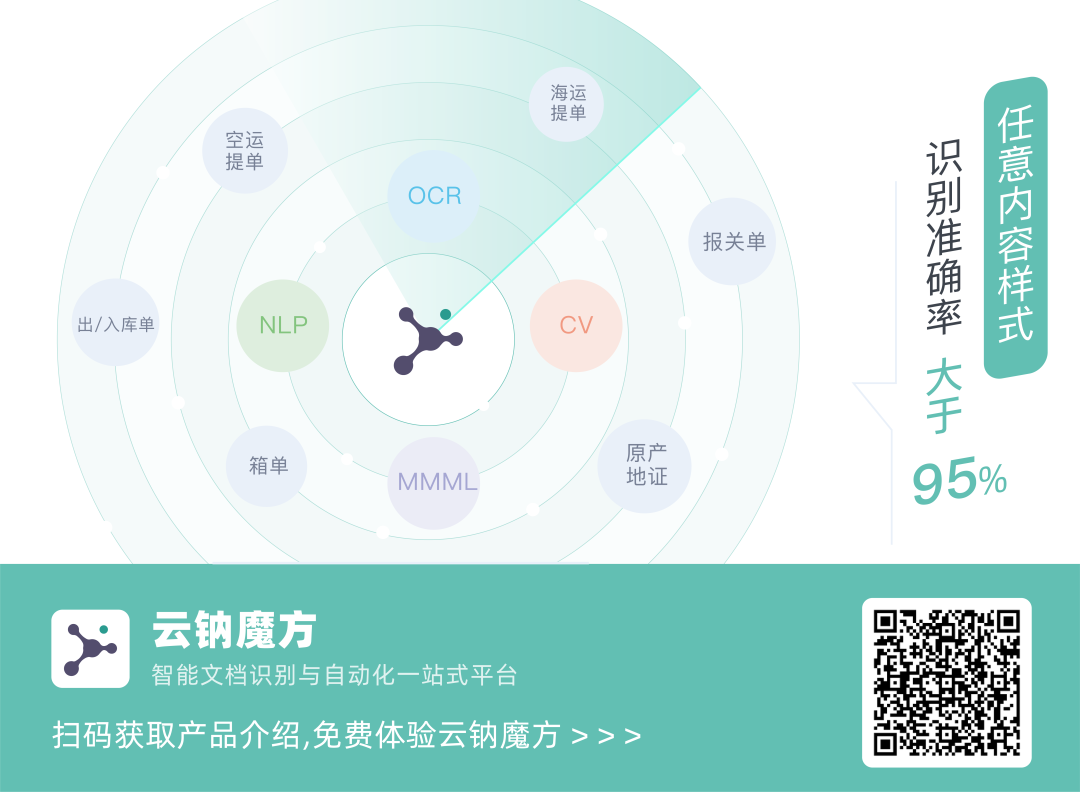
Yunna Cube extends OCR's boundaries through NLP, computer vision, and multimodal machine learning, making it smarter at handling variation and capable of tackling more complex scenarios. It also features self-learning capabilities, continuously improving performance through use to approach near-perfect accuracy. Furthermore, as an enterprise service provider with deep, ongoing supply chain expertise, Yunna Technology has accumulated tens of millions of industry-specific training samples spanning cross-border trade, freight forwarding, road logistics, and other circulation-related sectors. It can accurately recognize ocean booking requests, customs documentation, and various other document types while supporting arbitrary content formats — all with over 95% recognition accuracy.

Zero-Barrier AI Model Customization
Keeping Costs Under Control!
While achieving higher accuracy, Yunna Technology also confronts another challenge plaguing logistics documents: change, and the customization costs that come with it. On one hand, logistics and transportation involve massive volumes of long-tail needs; on the other, volatile market conditions generate constantly shifting demands. These fragmented, dynamic requirements, if addressed through custom development, mean high costs, long cycles, and complete rebuilds whenever needs change — costs spiral out of control, and business demands go unmet. Put differently, enterprises need a platform that not only solves the accuracy problem, but also empowers them to customize AI models independently. Moving from giving fish to teaching fishing, Yunna Cube introduces "zero-code AI model customization" — making AI accessible to everyone:
- Built-in large-scale pretrained models, using high-precision, few-shot balanced algorithms to meet accuracy requirements for zero-code modeling across diverse scenarios;
- Fully automated, standardized workflows — no AI talent required, no massive data labeling needed, business users can create AI models on their own.

Just three simple steps: define your required fields — upload sample data — review and annotate manually, and the system automatically builds the model. Even never-before-seen document formats can be configured quickly and put into production immediately. With exceptional product performance and a simple development model, AI model building becomes "within everyone's reach" — freeing you from exorbitant customization costs and endless waiting periods, with costs fully controllable!

Seamless Integration of AI Recognition
Enabling Full-Process Automation!
Beyond "intelligent document recognition," Yunna Cube also supports embedding recognition capabilities directly into your workflows for end-to-end automation.
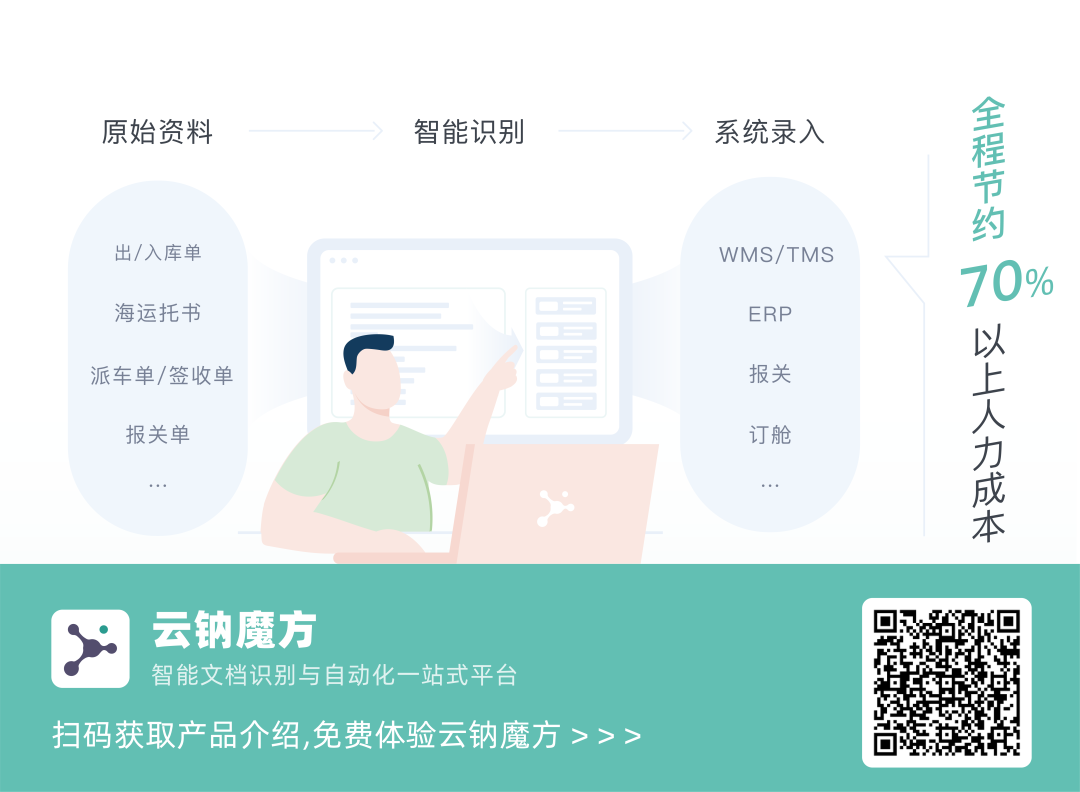
Leveraging RPA + API capabilities, it can automatically retrieve these unstructured documents from web portals, email, enterprise systems, and other channels. Meanwhile, the structured data produced through intelligent recognition supports preset rules and automatic execution of business operations — such as batch ERP entry, automatic booking, and one-click customs declaration generation.
**
"Intelligent Warehouse In/Out Slip Recognition"
**
**
Recording warehouse in/out slips is a foundational operation for logistics companies. Information including consignee, shipper, product name, quantity, and time must all be entered into WMS/TMS systems, where slot allocation, route planning, and carrier assignment are then completed.
**
The manual review, processing, and entry of this document information consumes significant labor, involves high volumes and complex steps, and introduces hand-entry errors — creating process discontinuities.
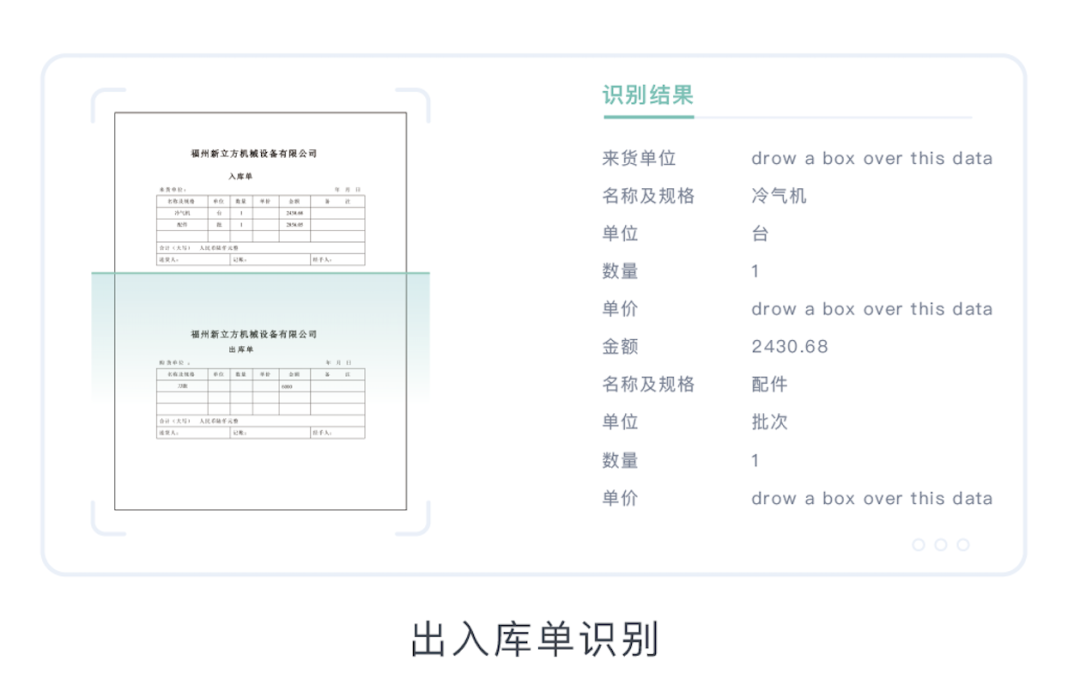
Through Yunna Cube, document information is automatically recognized and intelligently extracted with 100% accuracy. The resulting structured fields, governed by rules, can be handed to RPA bots to automatically complete data entry and subsequent business operations — effectively enabling automated information and data flow, eliminating the problem of stale, lagging information, removing repetitive manual work and reducing wasted effort.
"Intelligent Booking Request Recognition"
**
Ocean booking requests come in diverse types with complex content and wildly varying formats. Different companies each have their own proprietary booking request formats, often involving merged tables, misaligned tables, and other special cases that dramatically increase the difficulty of content recognition and extraction.
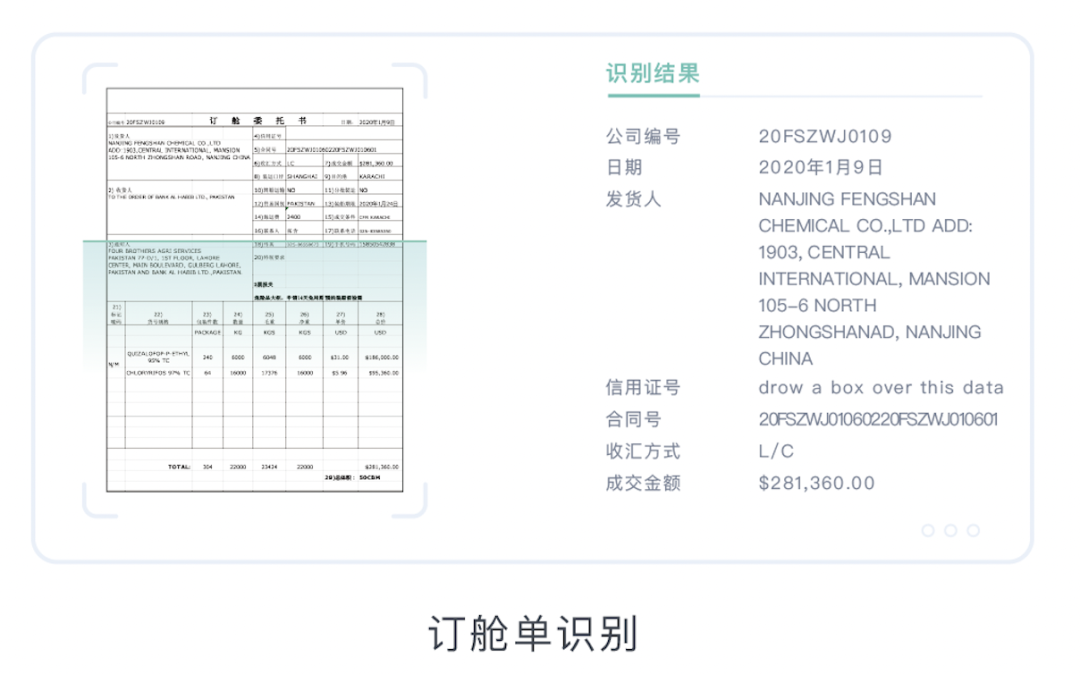
Yunna Cube's precise, powerful recognition capabilities accurately identify all booking request formats and automatically complete information conversion and entry:
- Supports images, scans, PDF, Word, and any document format, handling Chinese-English mixed layouts, data tables, and special formats with ease; also supports zero-code AI model building for flexible adaptation to unique booking request formats.
- Extracted structured information supports automatic entry into internal company systems, or based on preset booking rules, RPA bots can automatically complete the entire booking operation, saving over 70% in labor costs.
**
"Automated Customs Declaration Generation"
**
In import/export customs operations, the involved documentation is complex and varied. Producing a customs declaration that meets customs and inspection requirements requires manual collection, verification, and entry based on various source materials. Manual input is error-prone and inefficient, failing to meet the timeliness and accuracy demands of customs operations.
**
Yunna Cube supports automatic, batch recognition and extraction of content from bills of lading, packing lists, invoices, contracts, and verification documents, with recognition accuracy exceeding 95%. After extracting required fields, it generates structured data; then through business logic, populates standard declaration templates to generate customs declarations with one click.
**
The entire process takes under three minutes, dramatically improving declaration preparation efficiency, preventing human error, effectively helping enterprises reduce labor costs, and boosting operational efficiency.
**
Conclusion In an era where supply chain disruptions have become the norm, change is now common knowledge across the industry — and increasingly frequent crises are transforming how an entire sector operates.
Among these changes, enterprises that first achieve intelligent, automated, and streamlined logistics document processing can seize opportunities for accelerated growth amid crisis. Converting "unstructured" text data into "structured" data with efficiency and precision; empowering businesses to easily handle complex, ever-changing document types through zero-code model customization; and finally, grounding technology in real scenarios to connect end-to-end business processes — Yunna Cube is accelerating the intelligent transformation of supply chains! Scan to inquire, and begin your supply chain intelligence upgrade journey 👇
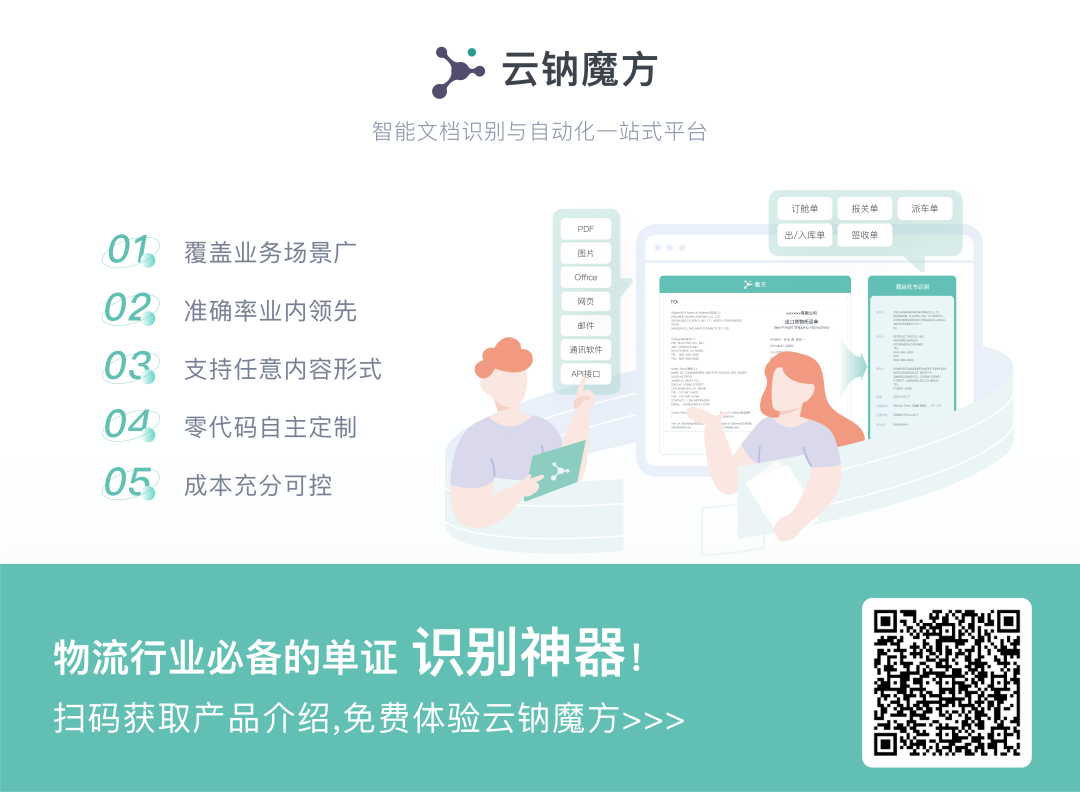

Yunna Technology
Shanghai Yunna Information Technology Co., Ltd. ("Yunna Technology") is an enterprise service provider focused on delivering cloud-native, SaaS-deployed RPA cloud platforms for the broad circulation sector, effectively addressing enterprises' fragmented, long-tail pain points around manual entry and data movement, helping businesses reduce costs and improve efficiency.
Yunna's loosely coupled Magic Image product line emphasizes ease of use and technology democratization, enabling out-of-the-box deployment for enterprise and individual users alike.
Founded in November 2020 and headquartered in Shanghai, Yunna Technology maintains offices in Shenzhen, Guangzhou, Hangzhou, Ningbo, and Shenyang, and has earned recognition from top-tier international investors including Sequoia Capital and Linear Capital.