Linear Capital Portfolio Spotlight | Xinkong Intelligent: How to Achieve Production Line Simulation for Automotive Welding?

The automobile has been hailed as "the machine that changed the world." With tens of thousands of components, yet bound by the demands of a consumer product — easy maintenance, high reliability, low cost — calling it a miracle of industry is no exaggeration. But miracles are rare by nature. That the auto industry has endured a century of trials through sun and storm, through epochs of transformation, speaks to the extraordinary scale of the challenges it has faced.
The automobile has been called "the machine that changed the world." With tens of thousands of parts, yet required to be easy to maintain, highly reliable, and low-cost as a consumer product, calling it a miracle of industry is no exaggeration. But miracles are rare. That the auto industry has endured a century of sun and storm, through massive transformations, speaks to the enormity of the challenges it has faced.
Understanding automotive manufacturing processes is the foundation for understanding those challenges.
Vehicle production mainly consists of four processes: stamping, body welding (焊装), painting, and final assembly. Among these, body welding bears the critical mission of forming the vehicle body and providing its structural support. It must not only ensure exterior quality but also guarantee the precise installation of all components during final assembly.
Welding is vastly more complex than the other processes.
Welding lines have numerous stations, tedious design procedures, demanding multi-machine coordination requirements, and strict precision requirements for installation points. As one of the four major assemblies of a vehicle, the body-in-white (BIW) directly impacts safety performance and market competitiveness. The importance of body welding in vehicle manufacturing is self-evident.
How to efficiently and reliably design a body welding production line? How to manufacture BIW that meets quality requirements within strict cycle-time constraints? An Overview of Automotive Welding Production Planning
Selecting the Main Line Conveyor Method The main line conveyor method determines conveying efficiency and effective working time at each station, serving as the basis for process division and station count determination.
Process Division and Station Count Determination
During the production line design phase, engineers must comprehensively calculate welding operation times, centrally arrange arc welding equipment that generates smoke and dust pollution, and ensure that unit station effective working time and effective operation time do not exceed station operation time.
Side Panel Assembly Method The side panel assembly has high surface quality requirements. Its conveying method must comprehensively consider conveying efficiency, determine whether inventory is needed, and factor in side panel line layout area.
Main Framing Station Structure The main framing station structure must be considered together with the side panel conveying method. It is mainly constrained by floor space and vehicle model variety. Common types include the tilting slide table, switchable flexible slide table, and back-clamp types.
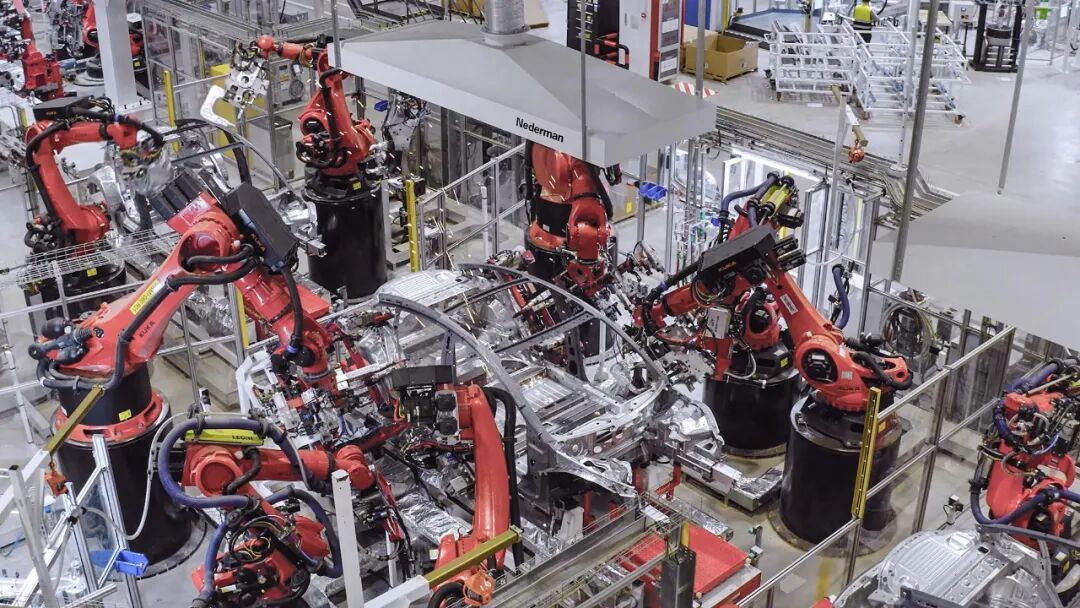
(Tesla welding shop)
Capacity Calculation and Cycle Time Determination
Based on annual capacity requirements from corporate strategic planning, production cycle time and single-station operation time are calculated as primary data for process division and station count determination. The calculation methods are as follows:
Production Cycle Time (JPH) — Jobs Per Hour, the number of units produced per hour. Production Days — 365 calendar days, minus national holidays and weekends, approximately 251 production days per year. Daily Production Time — 8 hours for single shift, 16 hours for double shift, 22.5 hours for triple shift. Equipment Utilization Rate — The ratio of effective equipment operation time. Welding shop equipment utilization is generally planned at 90%.
Process Simulation
Based on station count, side panel conveying method, main framing station 3D dimensional data, and other parameters, production line layout and simulation are performed to verify the feasibility of process planning.
Xinkong Intelligent's Automotive Industry Solution Verification
(Xinkong Intelligent — Automotive Welding Station Case)
Under the "Made in China 2025" strategic framework, digital technologies and industrial software continue to evolve. Drawing on years of industry experience and technical expertise, Xinkong Intelligent has developed production line planning software — Xinkong Smart Factory, a powerful tool for improving production line design quality.
Xinkong Smart Factory enables process planners to conveniently and rapidly perform production line planning design, optimization, and simulation, ensuring information exchange and sharing. It can also shorten manufacturing preparation time and accelerate process planning and design speed.
The software includes a massive built-in model library and parametric models, helping users quickly find required BIW CAD models, fixtures, robots, welding guns, and related equipment within the library.
Model editor functions support users in importing proprietary models and performing lightweight editing, ensuring users can simulate larger scenes without upgrading computer configurations.
After completing the construction and layout of body welding production lines in Xinkong Smart Factory, users can perform joint-space or Cartesian-space teaching for robots, record corresponding points for parts and weld spots, set welding paths, generate programs, and complete production line programming — simulating a 1:1 virtual production line matching real line cycle times and motion trajectories.
(Xinkong Smart Factory — Automotive Engine Deburring Case)
Xinkong Smart Factory also provides "Intelligent Programming Process Packages." Each process package can rapidly generate programs for a single operation object, saving users the time of point-by-point teaching programming. Users simply need to interactively configure scheduling relationships between robots, then call algorithms to simulate the entire production line. This saves the repeated alignment and debugging work required for manual teaching, reducing teaching programming difficulty and improving efficiency.
(Xinkong Smart Factory — Dispensing Intelligent Programming Process Package)
Xinkong Intelligent — Digital Twin Platform
Beyond meeting production line design and solution simulation needs, automotive manufacturers are increasingly troubled by tight process iteration schedules, growing product variety, increasingly complex production equipment, and pressure for uninterrupted equipment operation. The information chain transmission and coordination of process data is urgently needed. A 1:1 virtual factory is critically needed to standardize and manage basic process data uniformly, enabling rapid reuse of production line processes, quality and efficiency improvements, and shortened product launch cycles.
To address these needs, Xinkong Intelligent performs 1:1 modeling of welding shops, achieving virtual-real synchronized motion for robots, welding equipment, grippers, tooling, seventh-axis slides, and rotary tables. The main interface displays real-time production parameters such as planned variables, inspection cycles, reminder times, and other visualization parameters, as well as equipment status parameters.
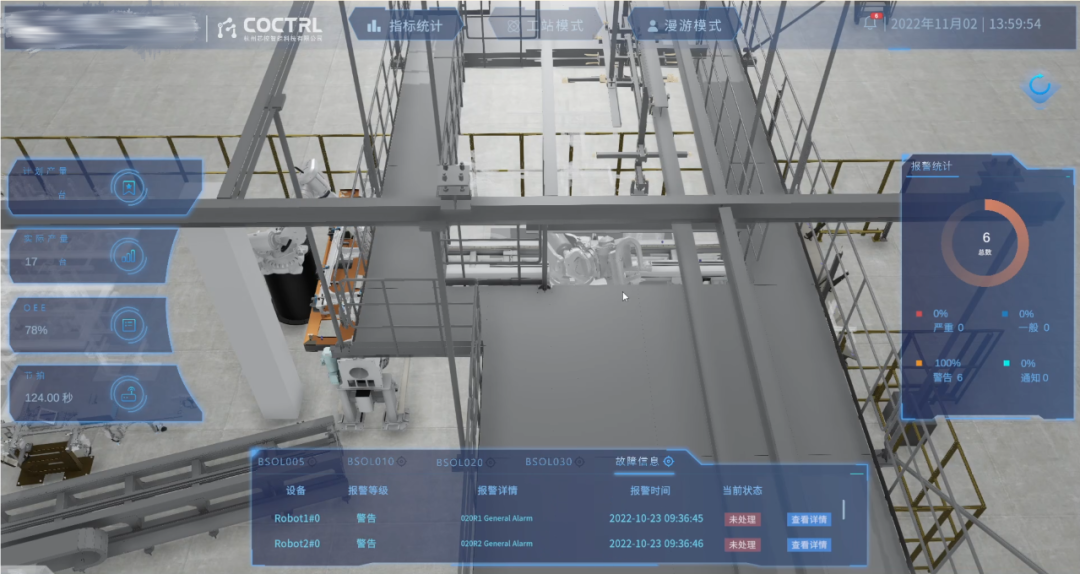
(Xinkong Intelligent — Digital Twin Platform)
In operations management, the digital twin platform provides real-time feedback and statistics on equipment alarms and maintenance information, displaying faulty equipment in 3D visualized form, with 3D traceability of historical alarm information. Xinkong Intelligent also enables digital factory walkthroughs in virtual scenes, with free switching between multiple viewing angles for single stations, workstations, or entire lines.
Xinkong Intelligent's self-developed digital twin platform can establish intelligent predictive maintenance platforms for automotive OEMs, achieving high linkage between physical and virtual spaces, virtual-real synchronization of production scenarios, real-time visualized cycle time calculation, and remote equipment monitoring, viewing, analysis, and maintenance.
The digital twin platform built by Xinkong Intelligent is committed to solving the consistency challenges from product prototype design through production to operations in the automotive industry, helping discrete manufacturing achieve digital transformation, and providing an effective practical model for realizing Made in China 2025.
Xinkong Intelligent is a software company serving the intelligent manufacturing industry, providing "rapid solution design" and "agile implementation" full-stack development tools for equipment suppliers and solution engineers in the intelligent manufacturing sector.
The company's products include Assembly Line Design Automation (ALDA) software, Edge Computing centers, and Industrial Lego Robots. Through AI algorithms, it rapidly generates production line layout solutions; provides modular robots for rapid production line construction and implementation; and uses Edge Computing centers as the hub to achieve true digital twins. Current end products cover automotive, lithium battery, photovoltaic, 3C, new energy, and other industries.