Microfluidic production chip company **Haoli Technology** has closed a multi-million RMB angel funding round led by **Linear Capital**.

Focused on developing production-scale microfluidic technology.
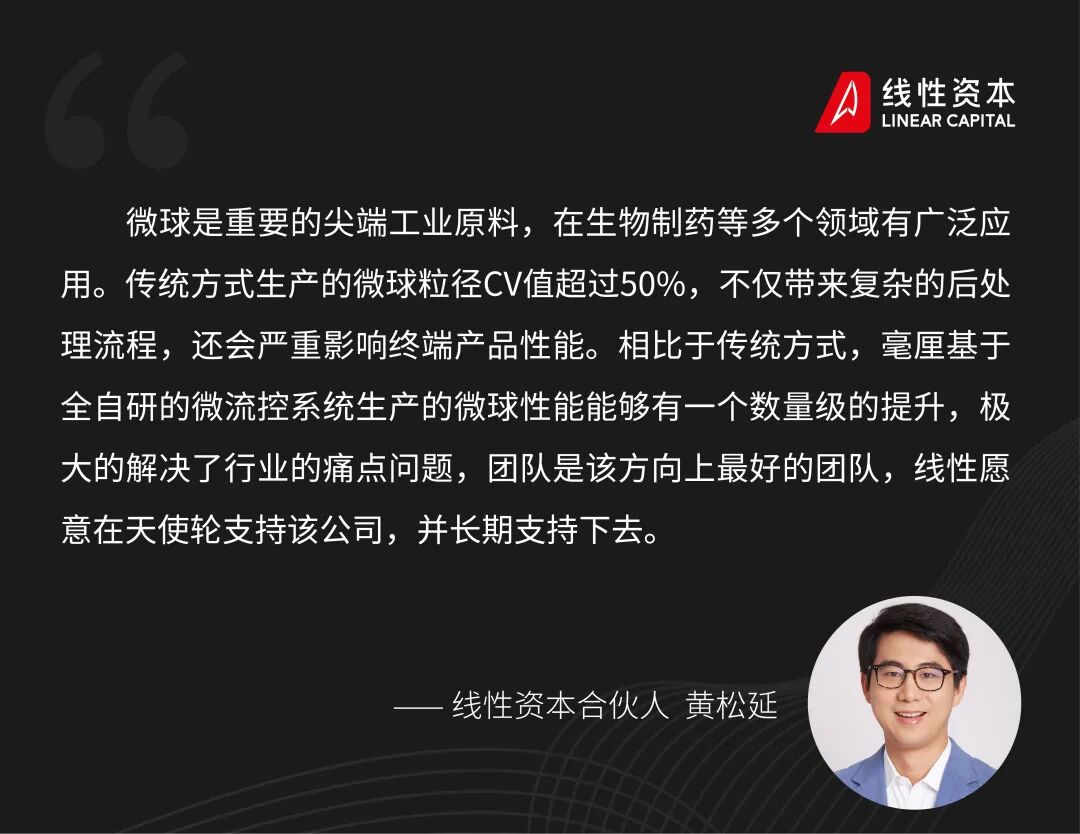
Hangzhou Heli Technology Co., Ltd. (hereinafter referred to as "Heli Technology"), a microfluidic production chip company, recently announced the completion of a multimillion-yuan angel funding round led by Linear Capital. The proceeds will be used primarily for continued R&D of high-throughput microfluidic production systems and expanding applications of microsphere products in life sciences. Heli Technology is a microfluidic production chip company that has extended this technology into a universal production platform for microsphere materials in life sciences. Its pipeline under development can be widely applied to biopharmaceutical purification, drug encapsulation and delivery, Car-T cell screening, in vitro diagnostics (IVD), and medical aesthetics materials, providing solutions for improving microsphere product performance and enabling functional innovation. In life sciences, the largest application market for microsphere materials is biopharmaceutical downstream purification chromatography media, with a global market size of $3-5 billion and a domestic market of approximately RMB 5 billion, growing at around 8% annually in recent years. Purification chromatography media is a critical high-value consumable that affects product quality in biopharmaceutical processes, with over 80% of the domestic market currently held by imported brands. In the purification of monoclonal antibodies (mAbs), for example, affinity chromatography media accounts for over 60% of production costs. As upstream process technology continues to improve and antibody expression levels increase, downstream purification faces ever-higher demands for efficiency and cost-effectiveness. Heli Technology has developed a new generation of high-throughput production microfluidic chips using advanced semiconductor manufacturing processes such as photolithography. These chips are specifically designed for agarose microsphere production, integrating 32-512 production channels on a 6-inch wafer, with operating temperatures up to 250°C and working pressures up to 3.0 MPa — fully meeting the requirements for large-scale, stable production of high-viscosity, high-temperature agarose framework microspheres, and making possible further cost optimization, reduced batch-to-batch variation, production efficiency gains, and supply security for biopharmaceutical downstream chromatography media. Before the emergence of microfluidic production technology, agarose microspheres were primarily produced using emulsion-stirring methods in reaction vessels. This method often required sieving to obtain the desired particle size, resulting in not only low yields but also particle size variance typically exceeding 20%. Linchun Han, founder and CEO of Heli Technology, told 36Kr that Heli Technology's production microfluidic technology possesses liquid microprocessing capabilities and enables digital production on-chip. It can directly generate microspheres with highly uniform particle sizes in microfluidic channels, with particle size variance stably controlled within 5% and yields approaching 100%. In terms of technical applicability, the microfluidic production platform can achieve microspheres of different materials, sizes, and size distributions through computer modeling of microsphere structures, and this micron-scale processing technology can produce more complex double-layer or multi-layer material-encapsulated microspheres. Heli Technology has completed the development of multiple types of high-throughput microfluidic production prototype machines, compatible with various raw materials including agarose, inorganic materials, and plastic polymers, enabling rapid scaled production of microspheres with different sizes and functions. Currently, Heli Technology's production pipeline includes multiple product lines such as Protein A affinity chromatography, Ni affinity chromatography, and ion exchange, covering purification microspheres for antibodies, recombinant proteins, and nucleic acid drugs; its R&D pipeline also includes IVD and cell screening microspheres to achieve coverage in cell therapy and IVD fields. In terms of product advantages, taking the Protein A product commonly used for mAb purification as an example, Heli Technology's affinity chromatography microspheres not only exhibit high particle size uniformity but also achieve performance comparable to domestic first-tier microspheres in dynamic binding capacity and residence time. Regarding ligands, Heli Technology has also developed novel protein A protein sequences with alkali resistance exceeding that of comparable proteins, and with continued product optimization, aims to surpass the current technological ceiling within approximately one year. In terms of cost, traditional methods require long-chain, complex production processes with extremely low yields to achieve particle size control, sieving, modification, and encapsulation of microspheres. The emergence of microfluidic technology is expected to reduce expensive microsphere material costs by 1-2 orders of magnitude, while drastically reducing production time and system costs. In production efficiency, microfluidic chip production capacity can achieve exponential capacity expansion or cost reduction with each technology iteration. Currently, the 32-channel prototype machine is already in stable production, the 128-channel equipment is about to be deployed, and there are plans to expand channel count to the thousands within 1-2 years. Linchun Han told 36Kr that in 2023, the company will focus primarily on technology validation, pushing forward validation of R&D products for industrial-grade purification applications in biopharmaceuticals to deliver products meeting production customers' expectations; additionally, the company will strengthen its market focus and increase communication with potential customers, enabling more industry professionals to understand the value and advantages of this technology. Heli Technology's R&D team comprises materials scientists, mechanical manufacturing experts, and biochemistry experts, among others, with core founders possessing R&D backgrounds from top global institutions and years of manufacturing experience. Currently, the company has nearly 20 full-time employees.
About Linear Capital
We are hiring for our investment team. Multiple positions are currently open; please click here for details.
Linear Capital is an early-stage investment firm focused on "frontier technology + industry" — that is, frontier technologies represented by data intelligence, digital new infrastructure, next-generation robotics technology, and new technology transformations in traditional fields (such as biomedicine, materials, energy, etc.), applied across vertical industries to substantially improve industrial efficiency, empower solutions to pain points, and complete industrial upgrading, thereby achieving excess commercial returns through substantial increases in industrial value. It currently manages ten funds with total assets under management of approximately $2 billion.
Our investment stage focuses primarily on leading angel to Series A rounds, with typical investment amounts of $3-8 million or equivalent RMB per project.
To date, we have invested in over 120 early-stage teams including Horizon Robotics, Kujiale, Sensors Data, Tezign, Rokid, Guandata, and Agile Robots. The combined valuation of Linear Capital's portfolio companies is approximately $20 billion.
In the near term, Linear Capital is working to become the best "Data Intelligence Technology Fund," and in the long term, gradually build itself into the most influential "Frontier Technology Application Fund."