Using AI to Accelerate Discovery of Efficient Catalytic Materials, "Deep Principle Technology" Raises Nearly $10 Million in Seed Funding Led by Linear Capital

By Chen Sida | Edited by Deng Yongyi Source: Intelligent Emergence From household daily chemical products to high-efficiency catalysis for energy use, nearly every aspect of life and production depends on emerging materials. The old "needle in a haystack" trial-and-error approach can no longer meet today's materials R&D demands. But the AI boom sparked by the large model wave is bringing "AI alchemy" closer to reality.
By Sida Chen | Edited by Yongyi Deng | Originally published by Intelligent Emergence
From household chemicals to efficient energy catalysis, nearly every aspect of daily life and production depends on advanced materials. The old "needle in a haystack" approach of trial and error can no longer keep pace with modern materials R&D demands. But the AI wave unleashed by large language models is bringing the dream of "AI alchemy" closer to reality.
36Kr has learned that Deep Principle recently announced a nearly $10 million seed round led by Linear Capital, with participation from Zhenzhi VC and Taihill Venture. XtalPi and DP Technology also joined as strategic industry investors.
Founded in 2024, Deep Principle focuses on AI-driven scientific research in chemistry. The company aims to apply artificial intelligence, quantum chemistry, and high-throughput experimentation (HTE) to the chemical materials sector, streamlining innovation workflows and accelerating R&D efficiency.
The founding team are all MIT graduates with extensive experience building large-scale platforms and conducting industrial R&D. CEO and co-founder Haojun Jia earned his PhD in physical chemistry from MIT and previously worked in core R&D at Dow Chemical, where he focused on using AI to develop catalyst formulations and predict chemical reaction pathways. He also served as president of the MIT Chinese Students and Scholars Association (MIT CSSA) for 2022-2023. CTO and co-founder Chenru Duan, also an MIT physical chemistry PhD, worked as a research scientist at Microsoft, where he deployed computational chemistry and AI solutions for multiple chemical materials companies.
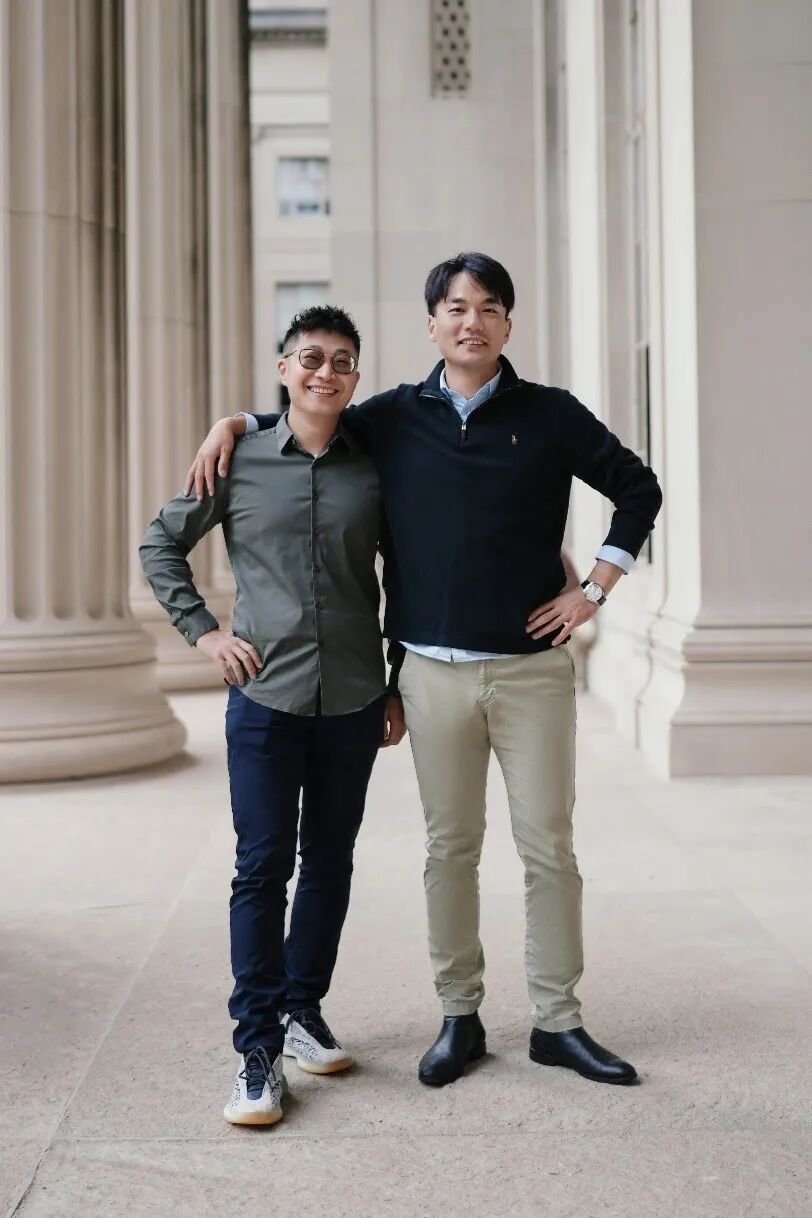
Chenru Duan (left) and Haojun Jia (right)
Whether it's tech giants like Microsoft, Google, and ByteDance, or traditional chemical manufacturing leaders like BASF and Dow, all are making major investments in AI for Science (AI4S). Broadly speaking, the tech giants are leveraging computing power and cloud services to platformize and productize the more mature AI4S methods, while the chemical conglomerates are also pouring resources into R&D, using AI to optimize industrial production techniques.
Drawing on their experience at American industrial and tech giants, the team observed that "the world's best materials chemistry production bases are in Southeast Asia and China." Jia notes that against the backdrop of deindustrialization in the US, Chinese materials chemistry companies are actively shifting from manufacturing to R&D, creating richer opportunities for AI4S to take root in China.
Meanwhile, Duan's experience building and maintaining AI4S scientific communities revealed that due to traditional lab inertia and the complex, varied nature of chemical materials problems, platform products face stubborn adoption barriers, and their maintenance and optimization incur significant engineering costs.
This is why Deep Principle aims to collaborate with clients on developing end-to-end vertical applications that accelerate innovation in chemistry and materials research. "Compared to platform products, this approach makes it easier to spread the efficient research methods that AI enables, cultivating a larger market for the future," Jia explains.
On the technical front, Deep Principle focuses on four core algorithmic modules. First, generative models that actively produce target chemical materials and reactions at scale. Second, a recommendation algorithm module that delivers high-precision computational results at low cost. Third, control models that directly reduce costs and improve efficiency in chemical computation and reaction experiments. Fourth, an active learning and Bayesian workflow that pinpoints target catalytic materials.
The team's chosen technical path is inseparable from its founders' extensive original research output. The two co-founders have co-authored over 60 papers in top-tier journals including Nature sub-journals and leading conferences such as NeurIPS, pioneering multiple AI for Chemistry models. Several patents are currently pending.
One of the team's key achievements is OA-ReactDiff, a diffusion model based on generative AI technology.
A chemical reaction is like a magic trick — reactants transform into products in the blink of an eye. But to uncover how the trick works, you must fix your gaze on the "transition state" during that blink: comparing the 3D spatial positions of atoms before and after the reaction. The transition state is critical to understanding chemical reactions. It encodes reaction mechanisms, can be used to estimate reaction rates and energies, and even guide the design of new materials like efficient catalysts.
Traditionally, discovering transition states using density functional theory (DFT) took hours or even days. Not only was it expensive, but it frequently failed or produced incorrect results.
Compared to DFT, the diffusion generative model OA-ReactDiff accelerates computation by 1,000x, generating transition state structures in mere seconds. The results preserve all physical symmetries required by chemical reactions, with accuracy surpassing previous AI models.
This work was published in the Nature sub-journal Nature Computational Science and selected as a cover paper.
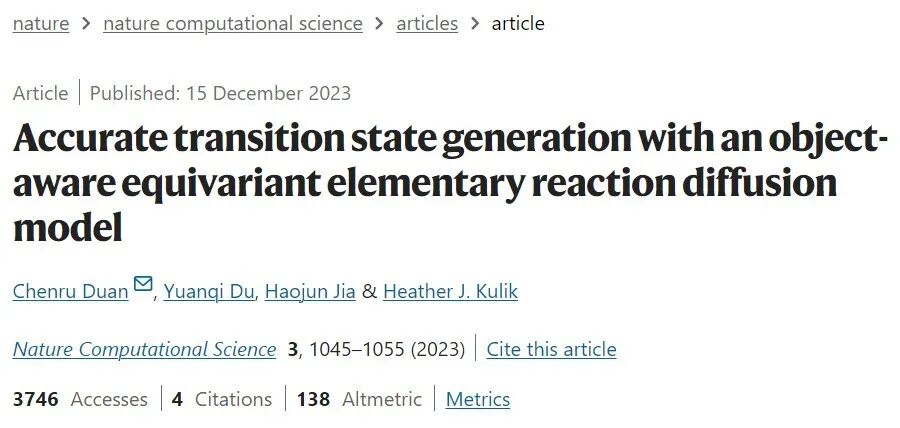
Image source: Company provided
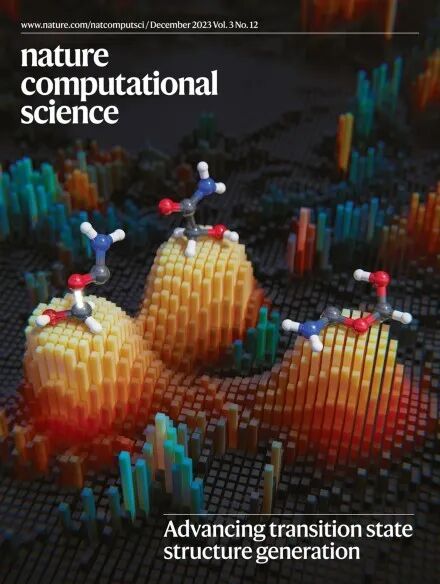
Image source: Company provided
Compared to direct experimentation, computationally screening promising materials and molecules can dramatically save researchers' effort and costs.
But calculating material properties is only one piece of the puzzle. Sometimes multiple computational methods are involved — how do you find the most suitable one? And when you get many approximate results, how do you identify the most accurate? The introduction of AI decision-making algorithms aims to solve these problems.
Scientists previously developed density functional theory (DFT), which reduced the decade-long work of solving Schrödinger's equation to a few hours with 99% accuracy. Yet without addressing the final 1% or even 0.1% of computational error, developing new catalysts remains impossible. Only by choosing the approximation method closest to the material itself — selecting the optimal density functional — can error be minimized.
But if you don't even know the molecule's intrinsic properties, how can you know which density functional it "prefers"?
Duan thought of how Douyin always seems to know what users want to watch. The matching algorithm behind this recommendation feature could help molecules find their optimal density functional. Inspired by this, the team integrated an AI decision model into the computational workflow, building a "density functional recommender" that matches "chemical material — computational method." For the first time, they achieved high-throughput computational accuracy for metal-organic complexes that approaches experimental measurement precision.
While different density functionals typically produce errors around 15 kcal/mol, the new method reduced this to 2.1 kcal/mol — within the 3 kcal/mol experimental measurement variance. In other words, the computational and experimental results became indistinguishable.
From a broader perspective, if AI4S can achieve scale and industrialization in chemical materials, it will not only drive efficient, low-cost development of high-performance catalytic materials but also significantly improve energy efficiency, accelerate greenhouse gas conversion, and align with current carbon neutrality trends.
"Over 90% of industrial products require catalytic materials, and 35% of global GDP is tied to catalytic reactions," Jia notes.
Jia points out that improving energy efficiency is key to achieving carbon neutrality under China's "dual carbon" goals. For example, ammonia synthesis alone consumes 1-2% of global energy annually while contributing 3% of carbon emissions. "Through catalyst improvements, even a 1% increase in conversion efficiency for ammonia synthesis would generate billions of dollars in economic value, reducing costs and emissions simultaneously."
"Using AI4S methods to improve ammonia synthesis efficiency by 5% would be the ChatGPT moment unique to the chemical materials field," Duan believes. Through AI4S methods, he is confident that more chemical materials will reach commercialization in the future.
Currently, the Deep Principle team remains in the early product R&D stage. They plan to enter the market first through chemical materials, adopting an AI+CRO (contract research organization) model for early partnerships, primarily delivering initial experimental and computational results to clients. Going forward, the team may build internal pipelines — the full process from materials design and testing to final commercialization.
Following this funding round, proceeds will be directed toward R&D investment, team recruitment, and market expansion. The data, computing power, and other AI infrastructure provided by XtalPi and DP Technology will effectively support Deep Principle's R&D efforts.
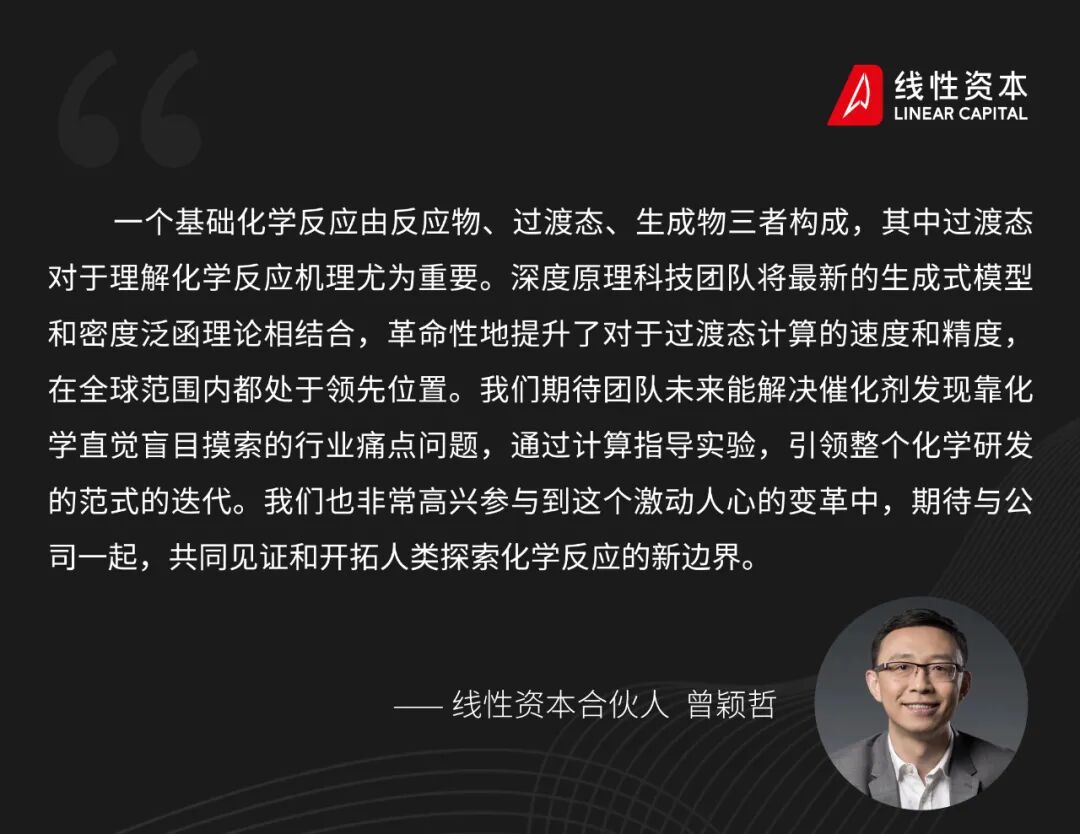
Yingzhe Zeng, partner at Linear Capital, commented: "A fundamental chemical reaction consists of reactants, transition state, and products — with the transition state being particularly important for understanding reaction mechanisms. The Deep Principle team has combined cutting-edge generative models with density functional theory to revolutionize the speed and accuracy of transition state calculations, placing them at the global forefront. We look forward to the team solving the industry pain point of catalyst discovery through blind chemical intuition, guiding experiments through computation, and leading the paradigm shift in chemical R&D. We are thrilled to participate in this exciting transformation and look forward to working with the company to witness and expand new frontiers in humanity's exploration of chemical reactions."
To contact Deep Principle, follow their WeChat official account: